Popular Courses
MCAT
General Course
PHYSICS 1202A/B
Western University
PHYSICS 1E03
McMaster University
PHYS*1300
University of Guelph
PHYS 223
University of Calgary
APSC 112
Queen's University
PHYSICS 1402A/B
Western University
PHYS 205
Concordia University
PCS 120
Toronto Metropolitan University
PHY 1122
University of Ottawa
PHYS 142
McGill University
ENGG 212
University of Calgary
PHY132H1
University of Toronto
PHY132H1
University of Toronto
PHYS-1300
University of Windsor
PHY 1121
University of Ottawa
PHYS 121
University of Waterloo
PHYSICS 1102A/B
Western University
PHYS 227
University of Calgary
SC/PHYS 2020 3.00
York University

0:00 / 0:00
Electric Potential
Disclaimer: Within the attached video, the formula for electric potential should read "ΔU=qΔV" and not "∆V = q∆U".
While electric potential energy is useful, it depends on position and needs to be recalculated constantly if a charge is moving through an electric field. In this section, we introduce electric potential, which describes an entire region of space.
- Electric potential is the electric potential energy of a test charge at some point near a charge distribution.
- With electric potential, we are always comparing two points, and often encounter the term electric potential difference. Usually, the "reference" point is infinity, and the electric potential at infinity is usually taken to be zero.
Wize Tip
When we mention "being at infinity", we just mean really far away, so that the electric potential is zero.
- Electric potential uses the symbol V and is measured in units of Volts (V).
- The electric potential of a point charge is given by the following formula:
- If there are two or more point charges, we can find the total electric potential by adding together the electric potential contributions from each point charge.
Wize Concept
When you learned about electric field, it was explained as the electric force that a positive test charge would experience if it was placed in some location.
Electric potential and electric potential energy can be thought of similarly. Electric potential is the electric potential energy that a positive test charge would experience if it was placed in some location.
The electric field and electric potential describe all of space, regardless of whether there is actually a charge present to "feel" the force or the potential energy.
0:00 / 0:00
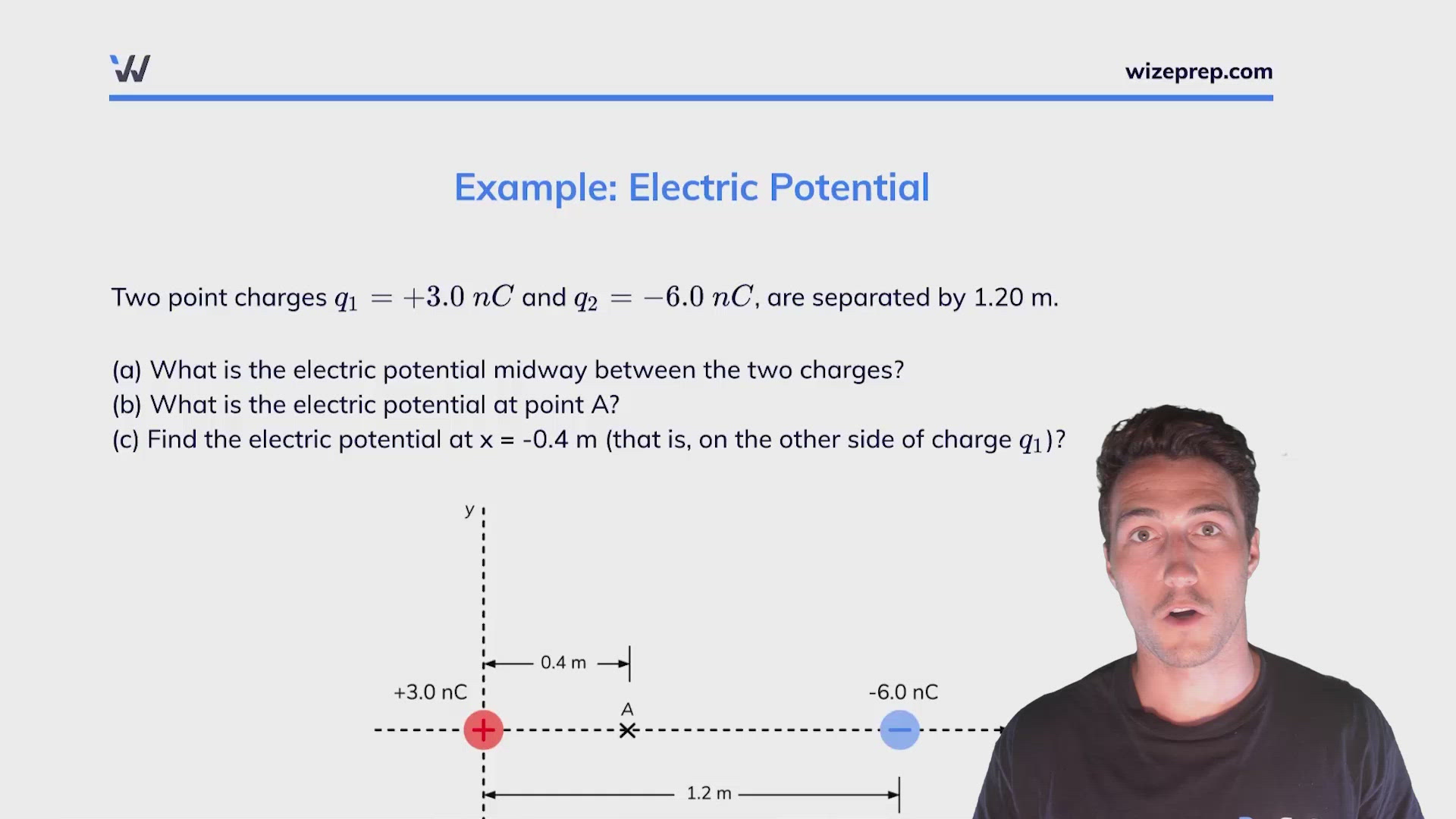
Example: Electric Potential
Two point charges and , are separated by 1.20 m.
(a) What is the electric potential midway between the two charges?
(b) What is the electric potential at point A?
(c) Find the electric potential at x = -0.4 m (that is, on the other side of charge )?
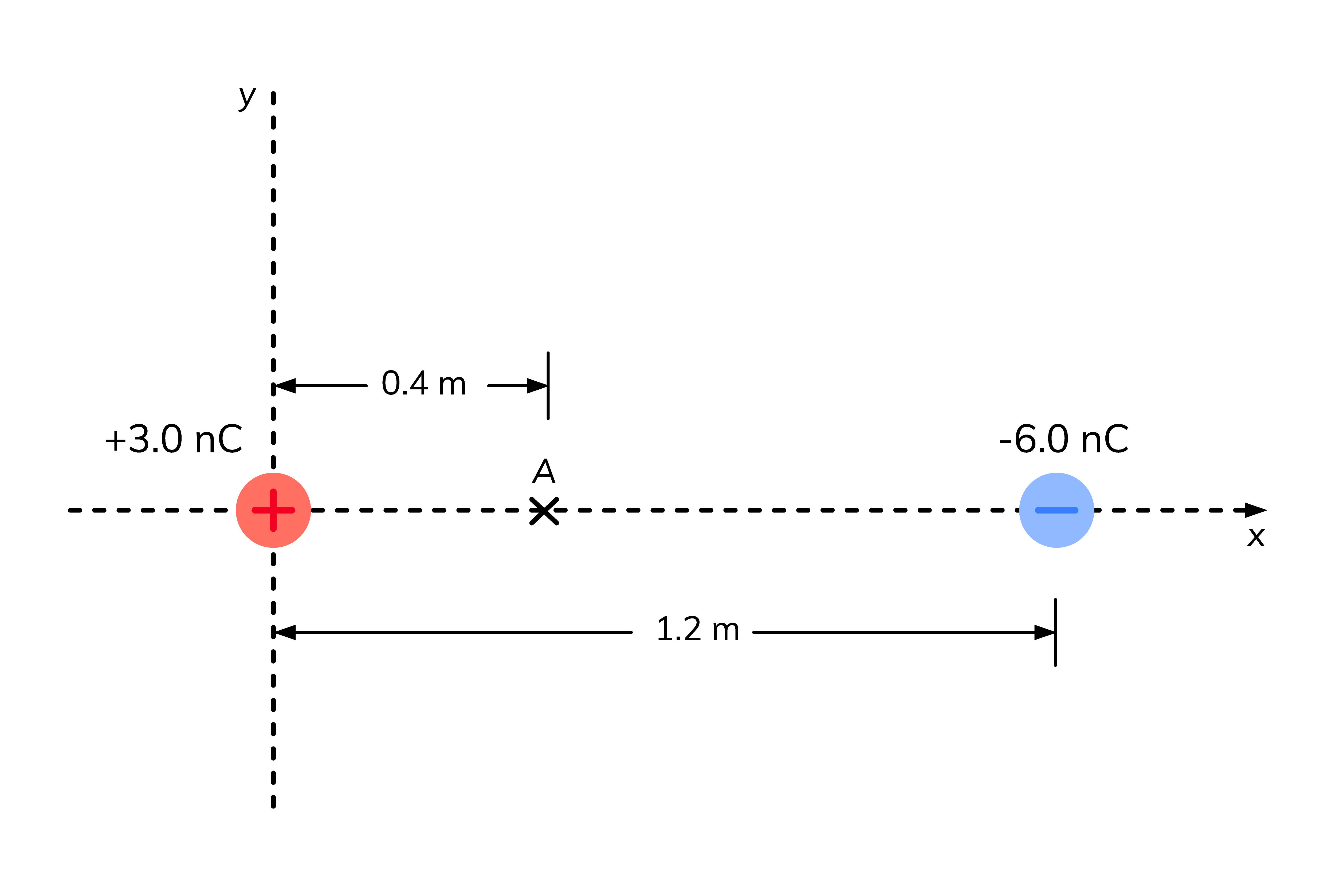
In each of these problems, we simply add together the contributions from each point charge.
a)
b)
c)
One take-away from this example could be that in part (b), the fact that the potential is zero does not mean there is "nothing" there. Potential is always a relative term - to the right of point A is a lower potential, and to the left of point A is higher potential, so a positive test charge placed at point A would move towards the lower potential (to the right).
0:00 / 0:00
Electron Volts
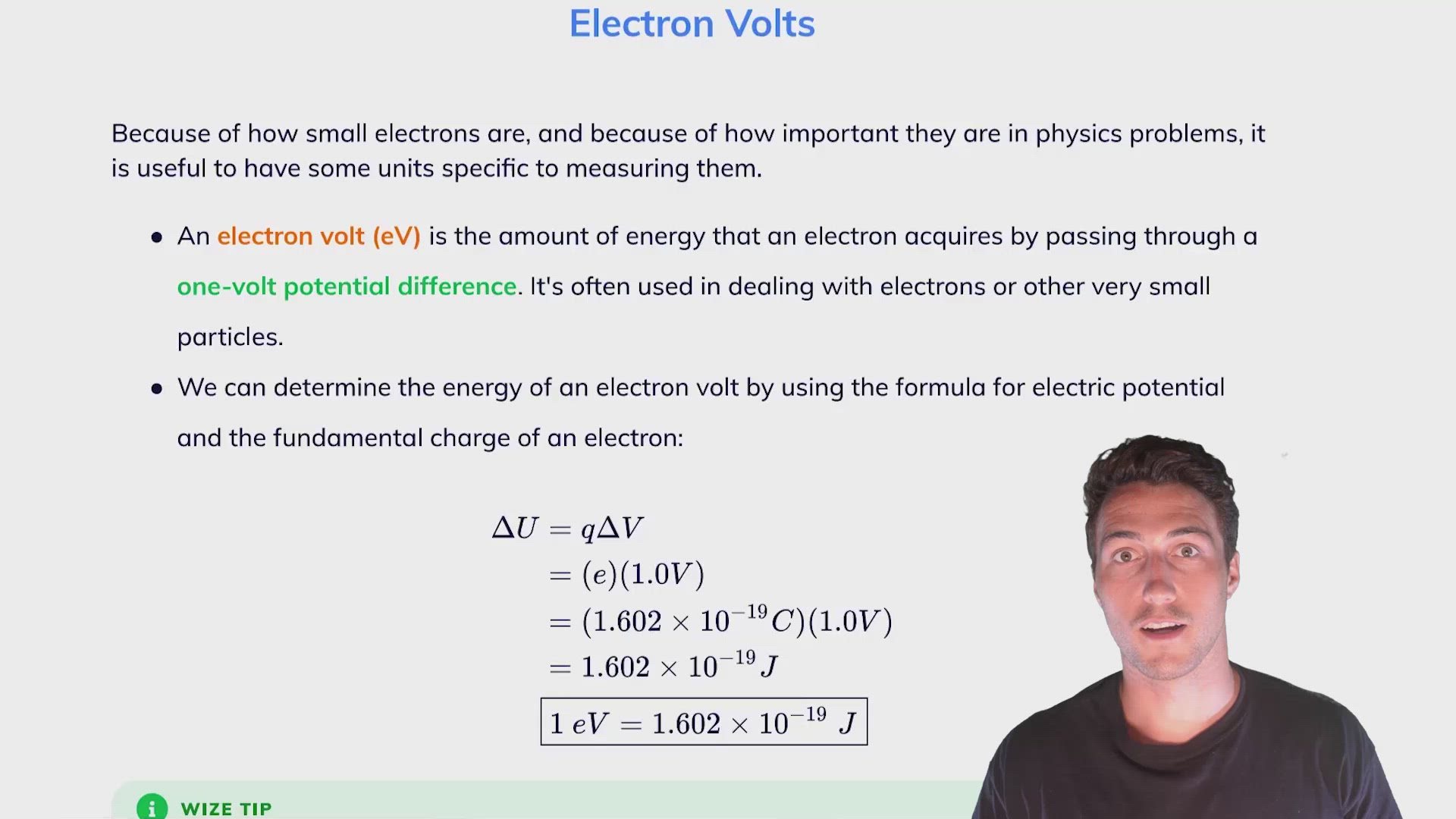
Because of how small electrons are, and because of how important they are in physics problems, it is useful to have some units specific to measuring them.
- An electron volt (eV) is the amount of energy that an electron acquires by passing through a one-volt potential difference. It's often used in dealing with electrons or other very small particles.
- We can determine the energy of an electron volt by using the formula for electric potential and the fundamental charge of an electron:
Wize Tip
Since the amount of charge on a proton is equal to the amount of charge on an electron, this is also the amount of energy acquired by accelerating a proton through a one-volt potential difference.
Watch Out!
The electron volt is a measure of energy and can be written in terms of Joules, NOT Volts!