Wize University Physics Textbook (Master) > Electric Potential and Potential Energy
Electric Potential of Continuous Charge Distributions
Electric Potential of Continuous Charge Distributions
Example: Electric Potential of a Rod (on-axis)
Practice: Electric Potential of a Rod (off-axis)
Practice: Rod with Positive and Negative Charge
Practice: Electric Potential at the Center of a Half-Ring
Practice: Electric Potential of a Ring
Practice: Electric Potential of a Disk
Popular Courses
PHYSICS 1202A/B
Western University
PHYSICS 1E03
McMaster University
PHYS*1300
University of Guelph
APSC 112
Queen's University
PHYSICS 1402A/B
Western University
PHYS 205
Concordia University
PHY 1122
University of Ottawa
PHYS 142
McGill University
ENGG 212
University of Calgary
PHY132H1
University of Toronto
PHY132H1
University of Toronto
PHYS-1300
University of Windsor
PHY 1121
University of Ottawa
PHYS 121
University of Waterloo
PHYSICS 1102A/B
Western University
PHYS 227
University of Calgary
SC/PHYS 2020 3.00
York University
PHYSICS 1AA3
McMaster University
PHYS 116
Queen's University
PHY 9B
University of California - Davis
0:00 / 0:00
Electric Potential of Continuous Charge Distributions
Similarly to electric field, we sometimes need to find the electric potential of a continuous charge distribution rather than a set of discrete point charges. This requires the use of integrals.
Wize Concept
The steps to find electric potential in this way are very similar to those for finding electric field, with the notable difference that electric potential is a scalar, therefore we don't need to worry about splitting any vectors into components.
Steps to finding the electric potential of continuous distributions:
- Draw a diagram if one is not already drawn in the question
- Define one small charge element, , on the diagram
- Write down the electric potential, , at the point of interest based on your charge element. Re-write all variables in terms of your integration variable.
- Integrate your expression for the total electric potential: . The bounds of the integrals are defined by the shape of the continuous charge distribution.
Exam Tip
Similarly to continuous electric field problems, some exam problems actually ask you to write the integral, but not solve them. For example, in some multiple choice problems, you will have to pick an integral that is set up properly, rather than having to determine the electric potential itself.
0:00 / 0:00
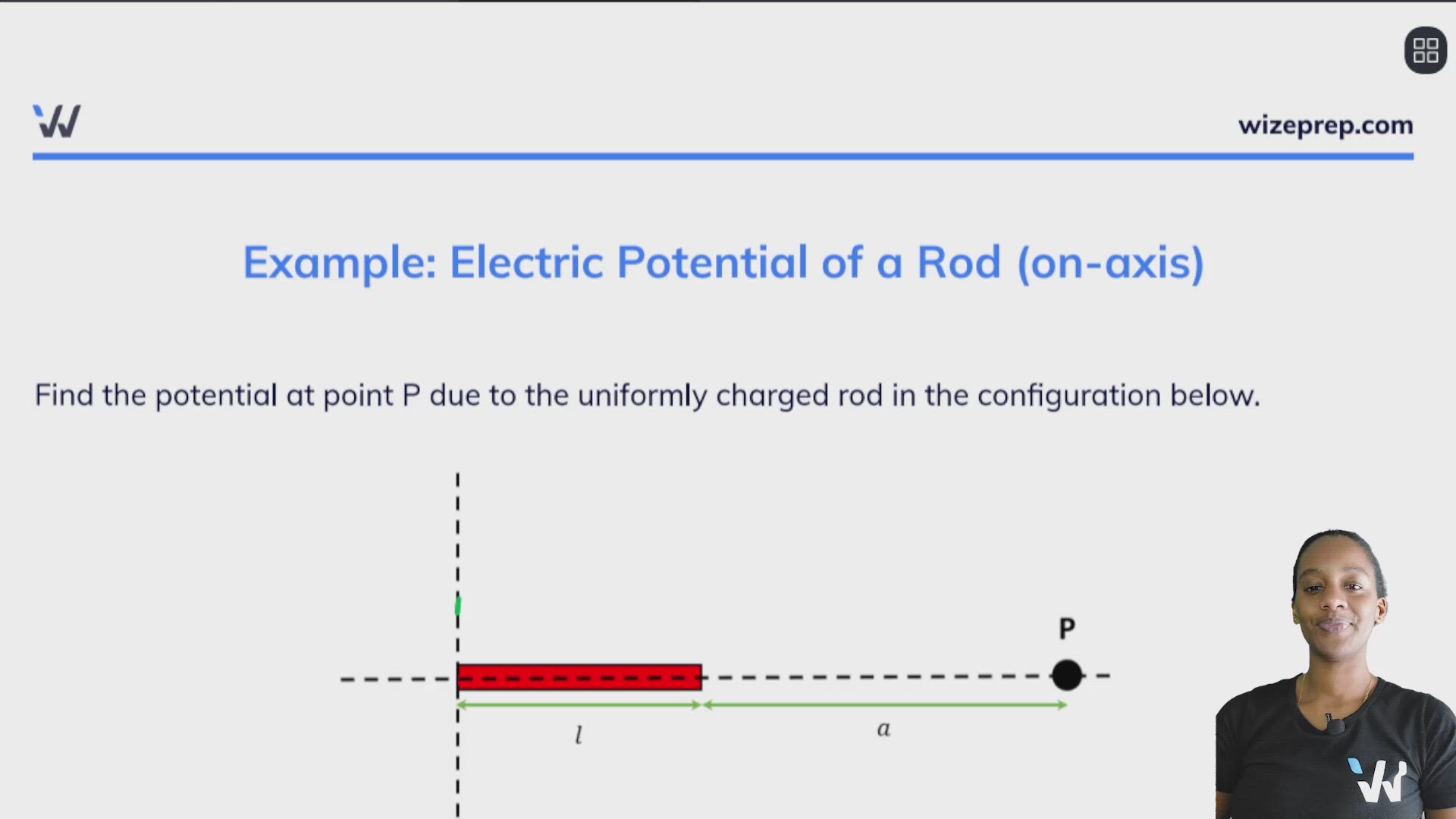
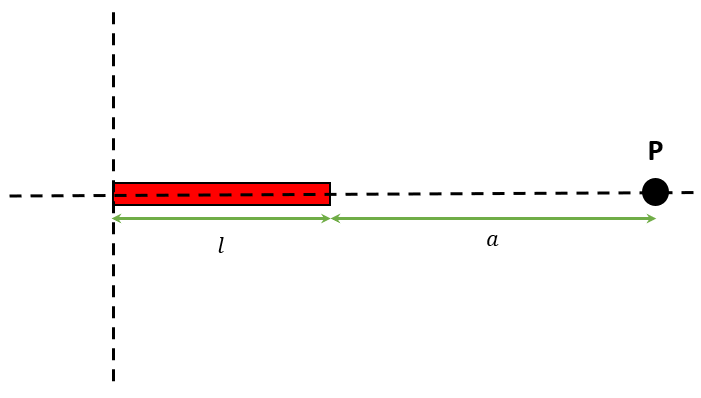
Example: Electric Potential of a Rod (on-axis)
Find the potential at point P due to the uniformly charged rod in the configuration below.
Let's add our charge element to the diagram and re-write some expressions in terms of our integration variable, :
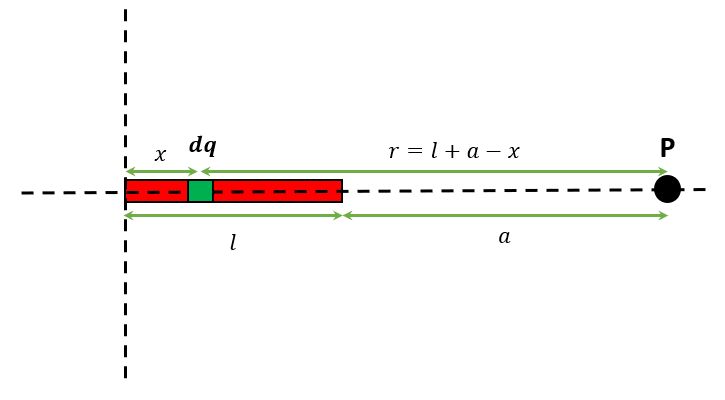
We start by determining the potential contribution from an infinitesimal piece of the rod, which has thickness , is away from the origin, and contributes to the total potential.
We integrate by substitution, using (), which changes our limits of integration to (upper) and (lower):

Mark Yourself Question
- Grab a piece of paper and try this problem yourself.
- When you're done, check the "I have answered this question" box below.
- View the solution and report whether you got it right or wrong.
Practice: Electric Potential of a Rod (off-axis)
Find an expression for the electric potential at point P in the figure below. The rod is uniformly charged.
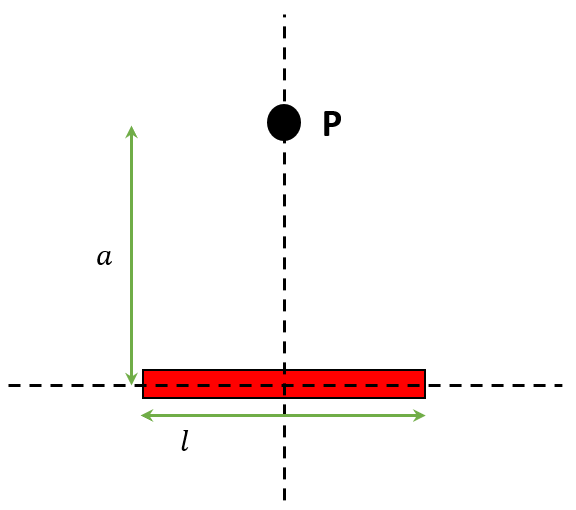
You might find this integral useful:
Practice: Rod with Positive and Negative Charge
A rod of length has a uniform charge distribution, except the left-hand side is positively charged and the right-hand side is negatively charged. Find the electric potential at point P which is at a distancefrom the origin.
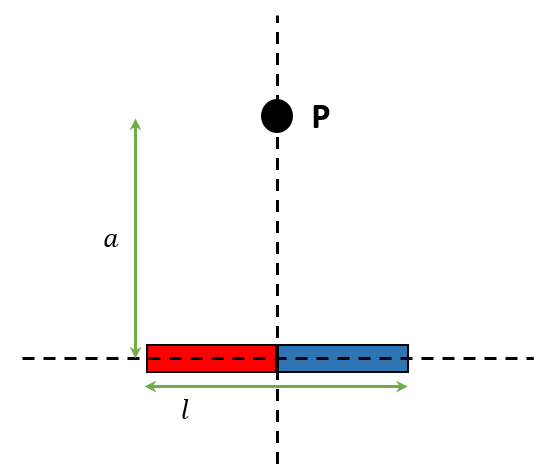
Practice: Electric Potential at the Center of a Half-Ring
What is the field at point P in the figure below? The total charge on the charge distribution is Q and it has a uniform positive charge distribution. Comment on your result.
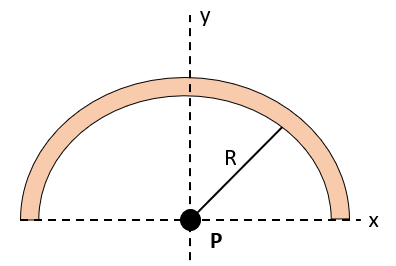
Practice: Electric Potential of a Ring
What is the electric potential at point P in the figure below? The total charge on the ring is Q and it has a uniform positive charge distribution.
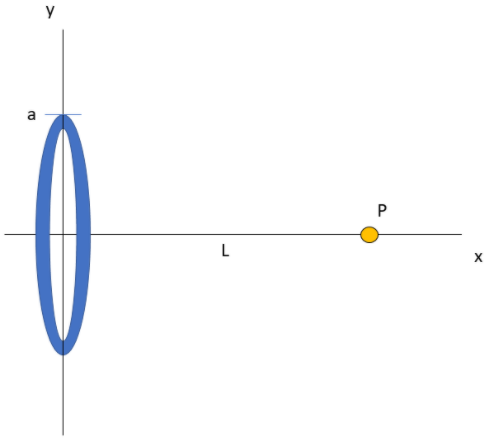
Mark Yourself Question
- Grab a piece of paper and try this problem yourself.
- When you're done, check the "I have answered this question" box below.
- View the solution and report whether you got it right or wrong.
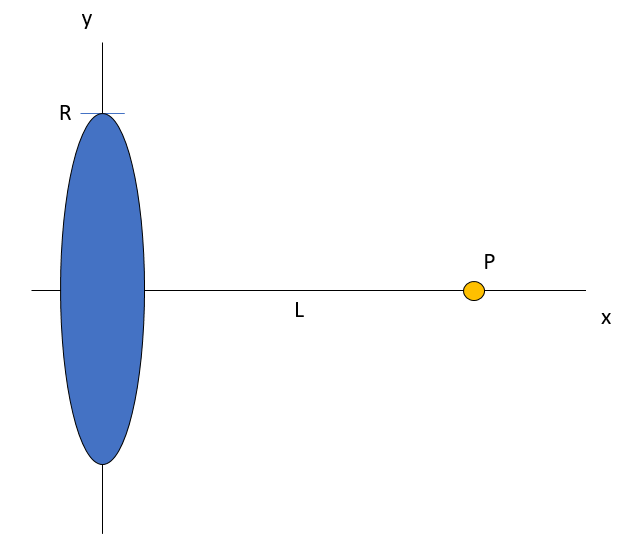
Practice: Electric Potential of a Disk
a) What is the electric potential at point P in the figure below, at some distance L away from a uniformly charged disc of surface charge density ?
b) What is the potential at point P if the distance L is much greater than the radius of the ring R?
Remember that for a ring of radius a and total charge Q (uniformly distributed), the potential contribution to the point P was:
Hint: You will find the following Taylor approximation useful (valid only for very small ):