Wize University Physics Textbook (Master) > Electric Potential and Potential Energy
Conservation of Energy in Electricity
Popular Courses
MCAT
General Course
PHYSICS 1202A/B
Western University
PHYSICS 1E03
McMaster University
PHYS*1300
University of Guelph
PHYS 223
University of Calgary
APSC 112
Queen's University
PHYSICS 1402A/B
Western University
PHYS 205
Concordia University
PHY 1122
University of Ottawa
PHYS 142
McGill University
ENGG 212
University of Calgary
PHY132H1
University of Toronto
PHY132H1
University of Toronto
PHYS-1300
University of Windsor
PHY 1121
University of Ottawa
PHYS 121
University of Waterloo
PHYSICS 1102A/B
Western University
PHYS 227
University of Calgary
SC/PHYS 2020 3.00
York University
PHYSICS 1AA3
McMaster University

0:00 / 0:00
Conservation of Energy
It should not be surprising that we can apply conservation of energy to problems in electrostatics. This will allows us to further link concepts in electricity with concepts from mechanics.
- Just like in mechanics, the total mechanical energy of a moving charge in an external electric field is conserved when moving between two points. If potential energy increases, then kinetic energy decreases by the same amount, and vice-versa.
- We have already seen that work is defined as the change in potential energy: .
- Since mechanical energy is conserved, this means that work must also equal the change in kinetic energy, (assuming there are no non-conservative forces present, such as friction or air resistance).
0:00 / 0:00
Example: Releasing Two Repulsive Charges
Two point charges are held 20 cm apart and each carries 3.0 µc of positive charge. At the same time, they are released from rest, and they begin to move straight apart from each other. What is the velocity of the charges when they are 60 cm apart? Consider the mass of the charges to be 0.3 grams. Give your answer in m/s.
We can use conservation of energy to compare the initial configuration to the final configuration.
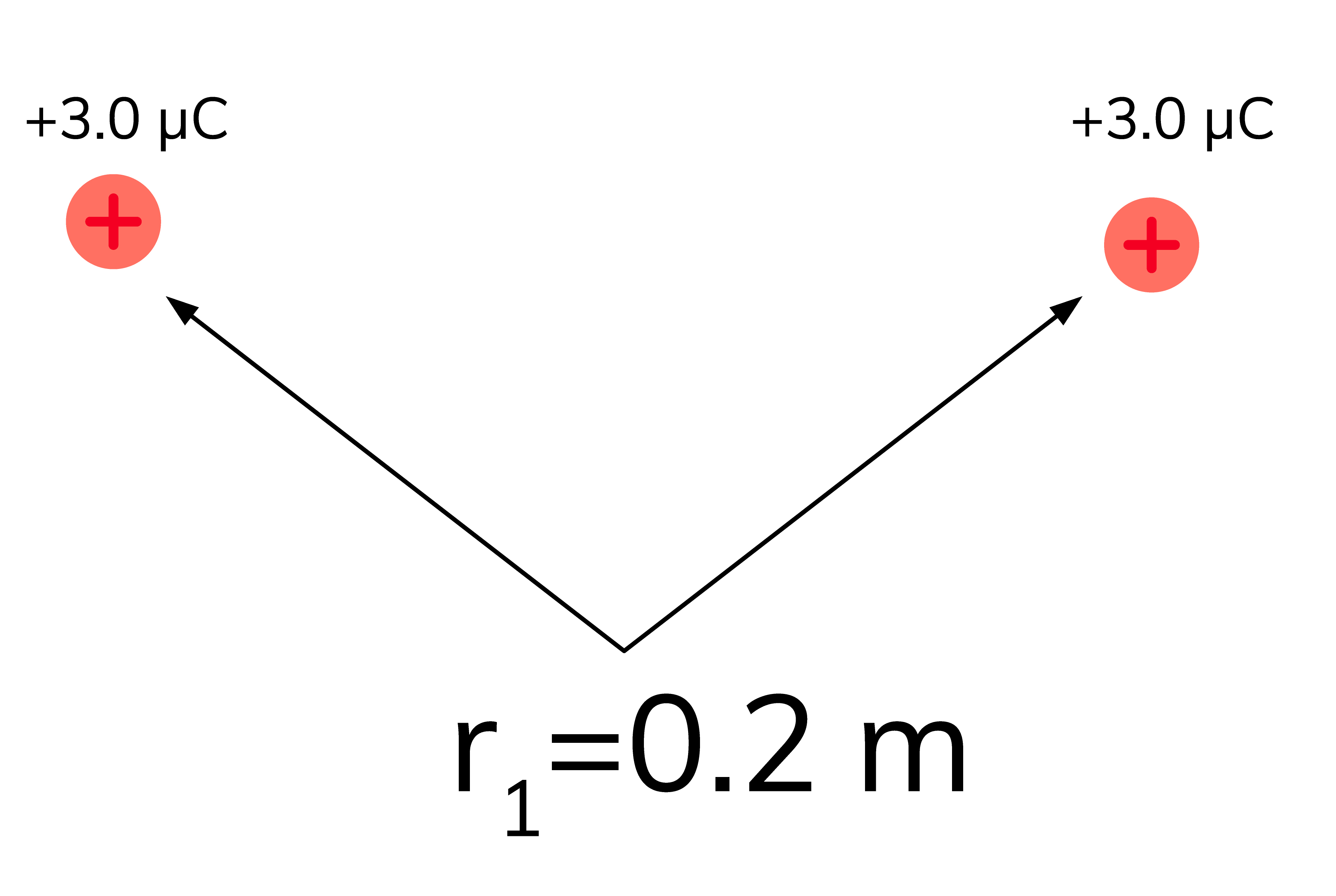
Initial configuration: Charges are static and not moving. There is electric potential energy in the system, but no kinetic energy.
Final configuration (f): The charges are moving (they each have kinetic energy), and there is also still some electric potential energy in the system. By symmetry, the velocity of the two charges must be equal.
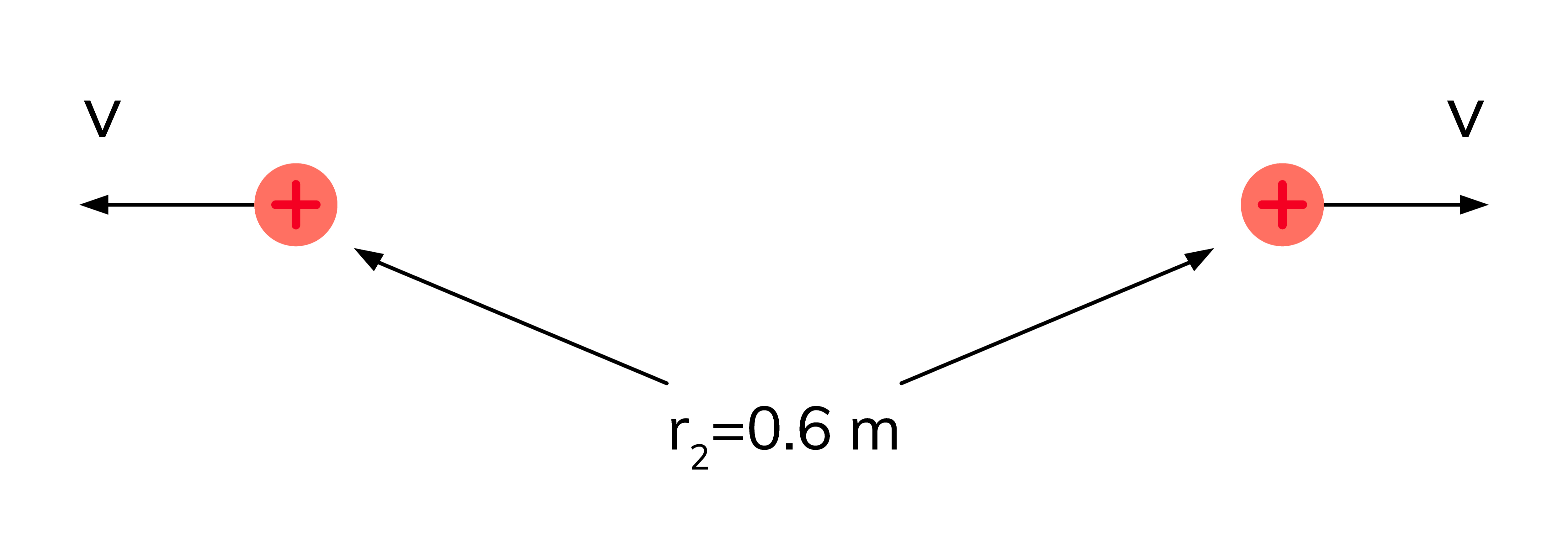
Applying conservation of energy, remember that there are two objects that each have kinetic energy, but only one potential energy term to represent the potential energy between the two charges.
Practice: Conservation of Electric Potential Energy
Three point charges are fixed at corners of an isosceles triangle, as shown below. If q=3.0 μC and d=1.0 cm,
a) What is the electric potential energy of the system?
b) If the top charge is released, what would be its velocity when is very far from the other two charges? Consider the mass of each charge to be 1.0 gram.