Wize University Physics Textbook (Master) > Electric Potential and Potential Energy
Equipotential Lines and Surfaces
Popular Courses
MCAT
General Course
PHYSICS 1202A/B
Western University
PHYSICS 1E03
McMaster University
PHYS*1300
University of Guelph
PHYS 223
University of Calgary
APSC 112
Queen's University
PHYSICS 1402A/B
Western University
PHYS 205
Concordia University
PCS 120
Toronto Metropolitan University
PHY 1122
University of Ottawa
PHYS 142
McGill University
ENGG 212
University of Calgary
PHY132H1
University of Toronto
PHY132H1
University of Toronto
PHYS 102B
University of Victoria
PHYS-1300
University of Windsor
PHY 1121
University of Ottawa
PHYS 121
University of Waterloo
PHYSICS 1102A/B
Western University
PHYS 227
University of Calgary
0:00 / 0:00
Equipotential Lines and Surfaces
For electric potential, it is useful to define equipotential lines to visualize how the potential of some charge distribution changes with position.
- An equipotential line connects all points where the electric potential is equal. Each line represents a different amount of electric potential.
- If we need to consider the motion of charges in three dimensions, then we use equipotential surfaces which serve the same purpose as equipotential lines.
- Equipotential lines can never cross.
Wize Tip
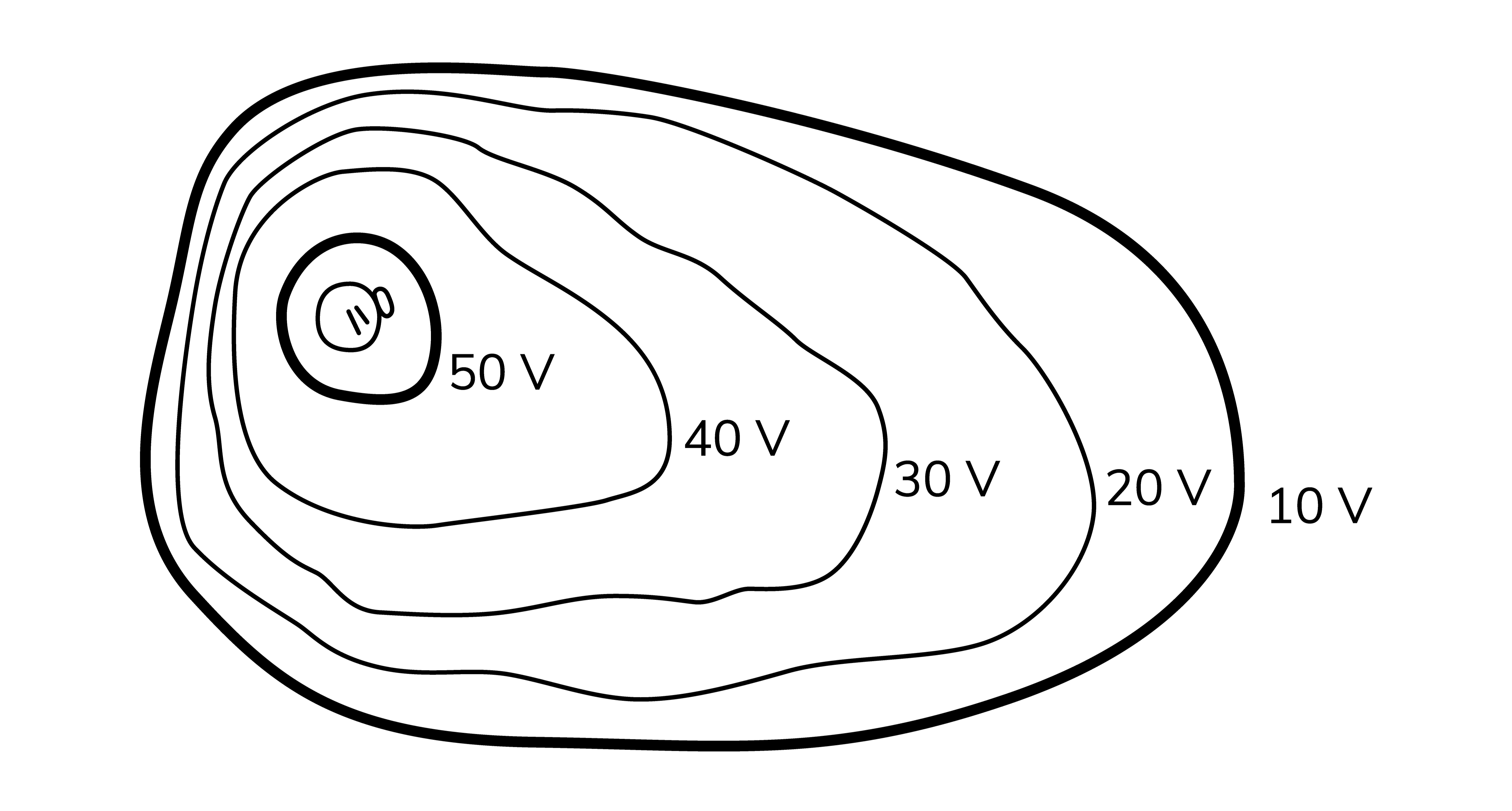
Equipotential lines and surfaces are identical in concept to altitude lines on a hiking map. If there are many altitude lines close together on your map, then you might be near a cliff!
Problem Solving with Equipotential Lines and Surfaces
- Two equipotential lines cannot cross.
- Electric field lines are always perpendicular to equipotential lines.
Exam Tip
If you have to draw electric potential lines on an exam, you could start by drawing the electric field lines, and then draw equipotentials that are perpendicular to your field lines.
- If equipotential lines are very close together, this represents a rapidly changing electric potential.
- If equipotential lines are more spread out, then the electric potential is not changing as quickly.
- Because the potential is equal at all points along an equipotential line/surface, no work is required to move a charge along an equipotential.
Wize Tip
Positive charges travel from high potential to low potential. Negative charges travel from low potential to high potential.
- If equipotentials are provided, they give an easy way to compute the potential difference between two points - we just need to subtract the two electric potential values.
0:00 / 0:00
Example: Drawing Equipotential Lines (basic)
Draw equipotential line patterns for each charge distribution below:
a) A positive point charge
b) Between two plates of a parallel-plate capacitor (i.e. a constant and uniform electric field)
Part a)
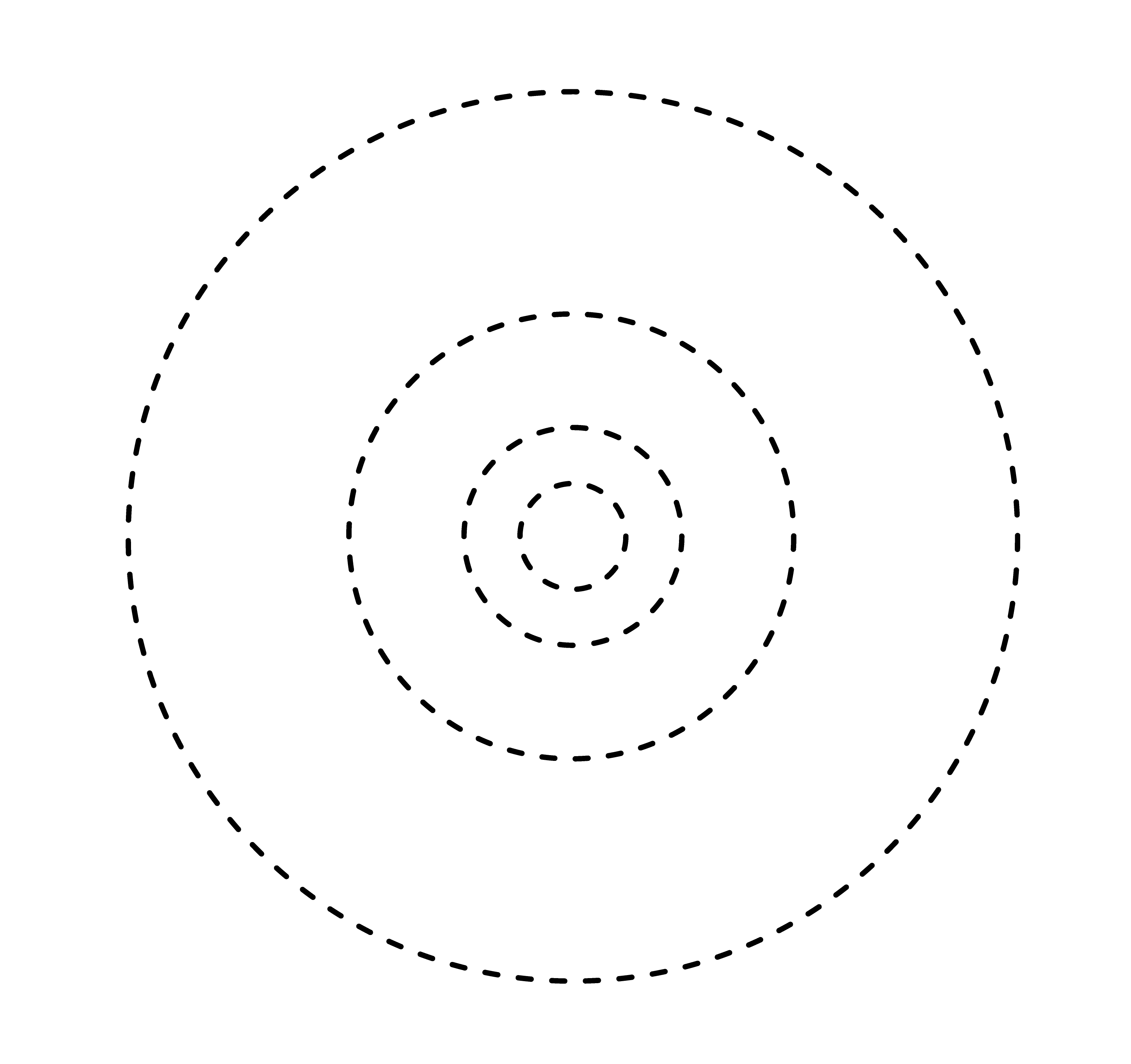
Note - the pattern is the same if the charge was negative! The potential would be decreasing towards the center instead of increasing (but we are just drawing the patterns in this exercise).
Part b)
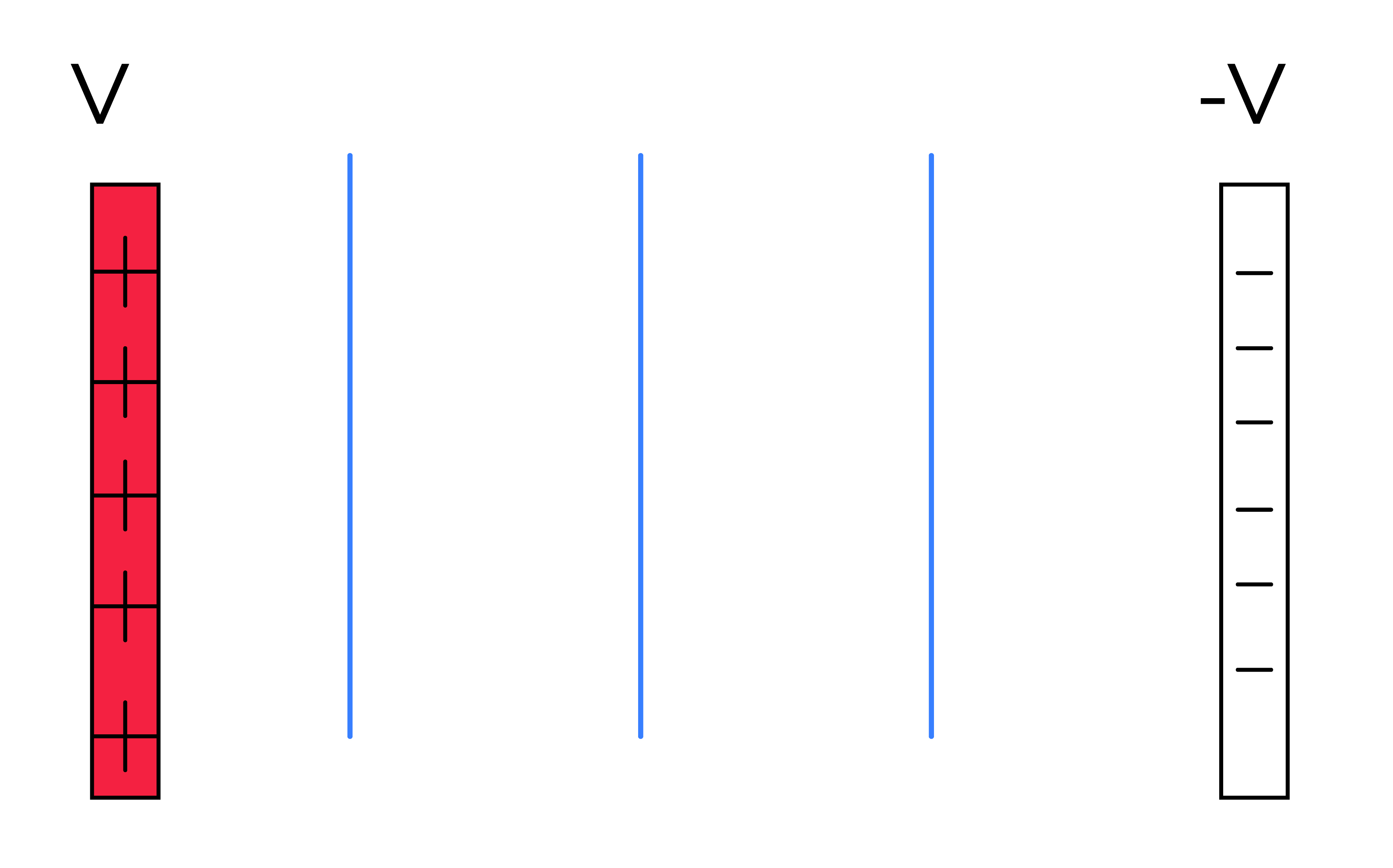

Mark Yourself Question
- Grab a piece of paper and try this problem yourself.
- When you're done, check the "I have answered this question" box below.
- View the solution and report whether you got it right or wrong.
Practice: Drawing Equipotential Lines
a) Draw equipotential lines for an electric dipole (a positive and negative point charge of equal and opposite charge).
b) Draw equipotential lines for two negative charges of equal magnitude.
Practice: Equipotential Lines - Movement of Charge
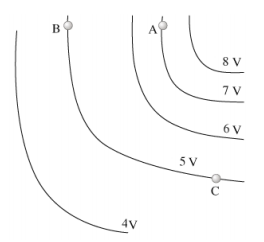
The graph below shows the equipotential lines due to some charge distribution. A charge q=20 µC once moves from point A to B and a second time from point B to C. Work done on the charge (against the field) during each displacement respectively are
Practice: Electric Potential and Equipotentials
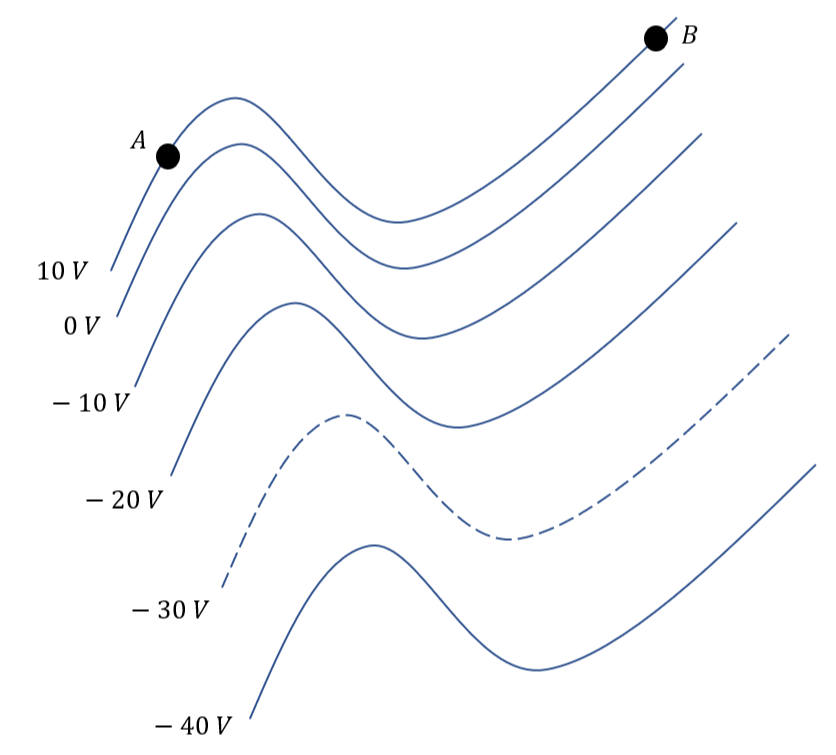
A charge of and a mass of is released from rest from position A below.
a) How fast will it be travelling once it passes the dashed equipotential line below?
b) How does your answer to (a) change if the same charge was released from point B?
Part a)
Practice: Conductors, Charge, and Electric Potential
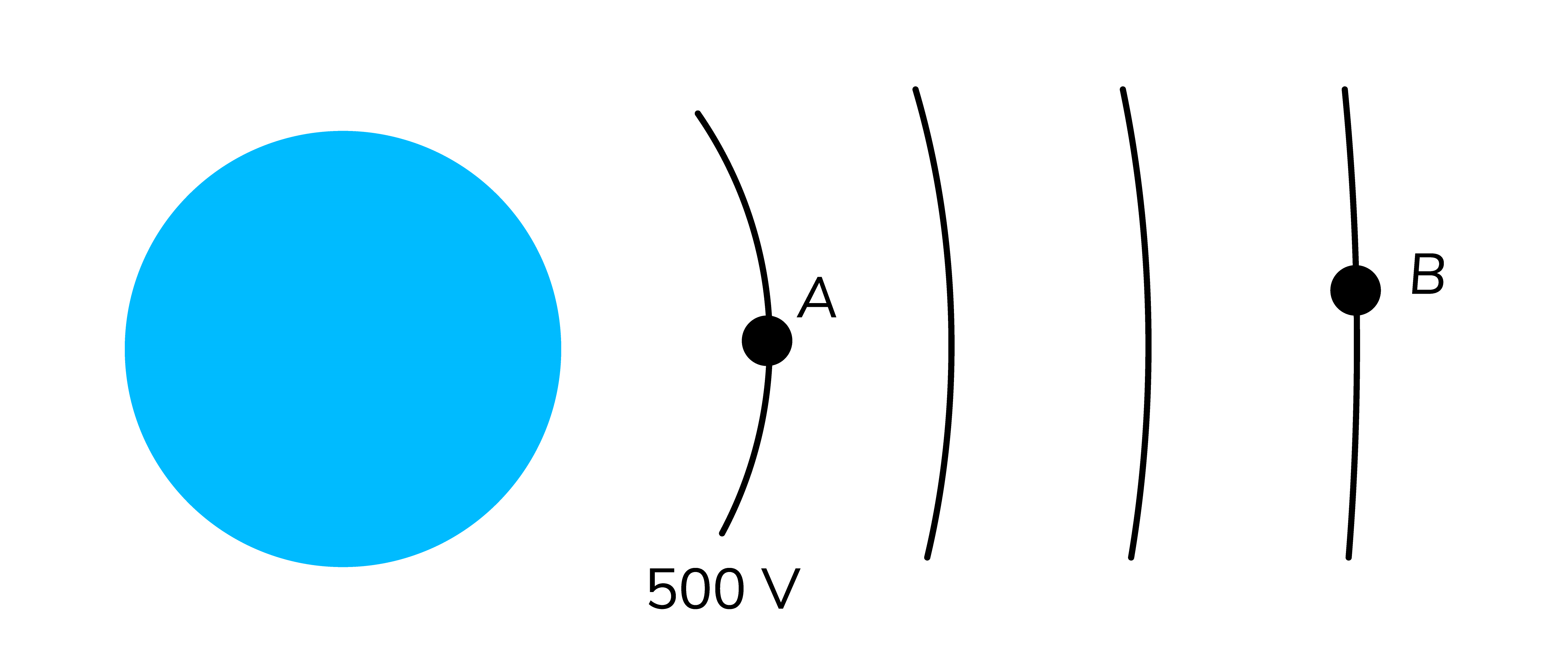
The diagram below shows a charged, spherical conductor of radius 1.0 cm. The equipotential lines below are spaced 1.0 cm from each other. The closest line (labelled 500 V below) is 3.0 cm away from the center of the sphere. Throughout this problem, we assume that V=0 at infinity.
a) What is the total charge on the conducting sphere?
b) What is the electric potential at the surface of the conductor?
c) How much work is required to move a positive 20.0 µC charge to move it from point A to B?