Wize University Physics Textbook (Master) > Electric Potential and Potential Energy
Properties of Conductors
Popular Courses
MCAT
General Course
PHYSICS 1202A/B
Western University
PHYSICS 1E03
McMaster University
PHYS*1300
University of Guelph
PHYS 223
University of Calgary
PHYSICS 1402A/B
Western University
PHYS 205
Concordia University
PCS 120
Toronto Metropolitan University
PHY 1122
University of Ottawa
PHYS 142
McGill University
ENGG 212
University of Calgary
PHY132H1
University of Toronto
PHY132H1
University of Toronto
PHYS-1300
University of Windsor
PHY 1121
University of Ottawa
PHYS 121
University of Waterloo
PHYSICS 1102A/B
Western University
PHYS 227
University of Calgary
SC/PHYS 2020 3.00
York University
PHYSICS 1AA3
McMaster University
0:00 / 0:00
Conductors and Electric Potential
In this section, we turn our attention to conductors, which have special properties in electrostatics that allow us to take shortcuts in some exam problems.
- Electrons inside conductors are free to move around within the material, and that the electric field inside a conductor is always zero.
Wize Concept
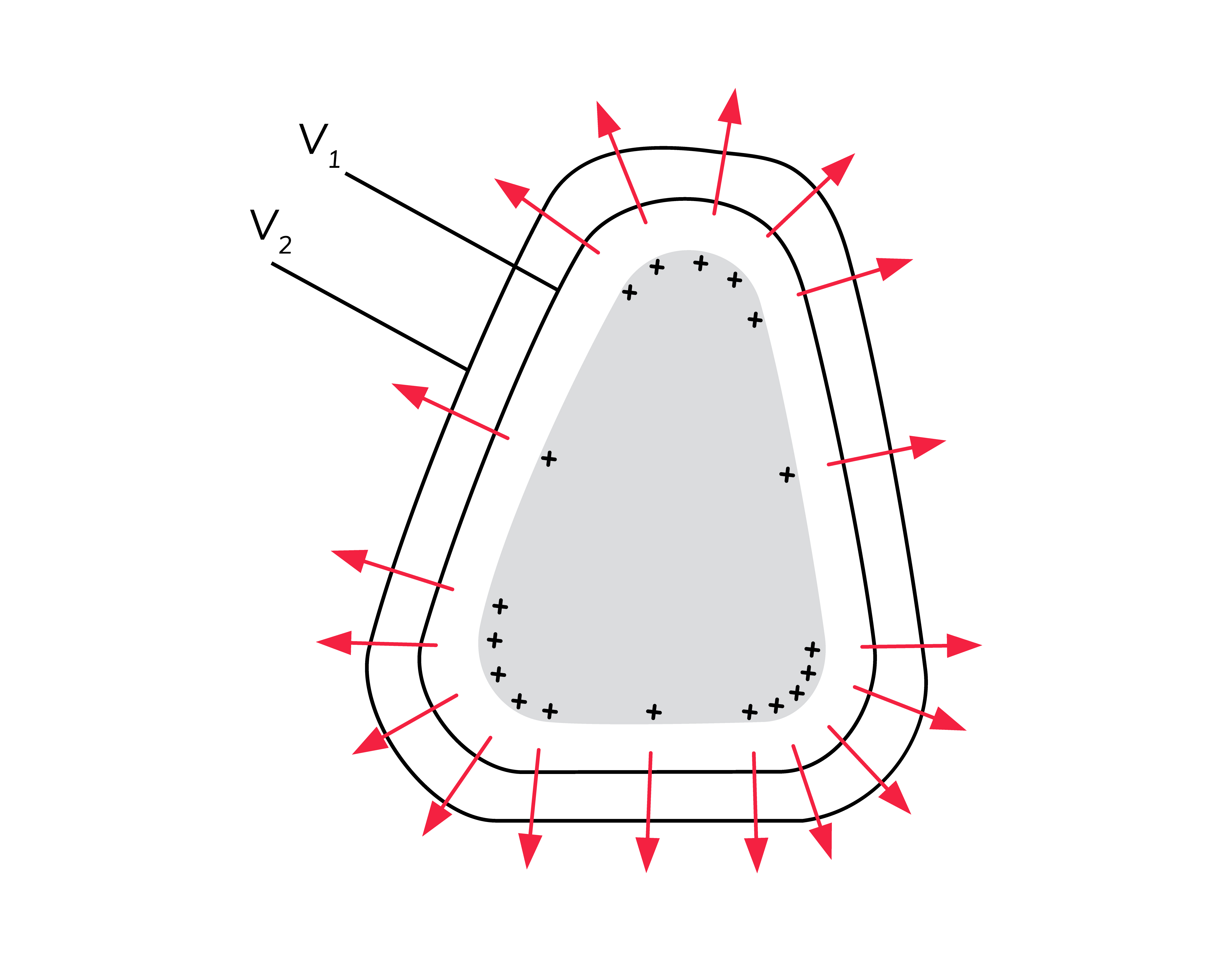
All points inside a conductor have equal electric potential, and the surface of a conductor is always an equipotential surface.
- Since electric field lines are always perpendicular to equipotentials, this also tells us that electric field lines are always perpendicular to the surface of a conductor, regardless of its shape.
Wize Concept
Excess charge only sits on the surface of conductors. If conductors are flat or have constant curvature, then charge is uniformly distributed across the surface.
- However, if a conductor has sharp corners or otherwise changes curvature, the charge density will be greater on these parts of the conductor with higher curvature.
- Since there is more charge in these locations, the surrounding electric field strength becomes greater than that of the rest of the conductor.
0:00 / 0:00
Example: Graphing Electric Potential of a Conductor
Plot the electric potential of a solid conducting sphere of radius R as a function of increasing distance from the center of the sphere.
We know the electric potential outside of the sphere behaves the same as it would for a point charge:
At the surface of the sphere, the potential is:
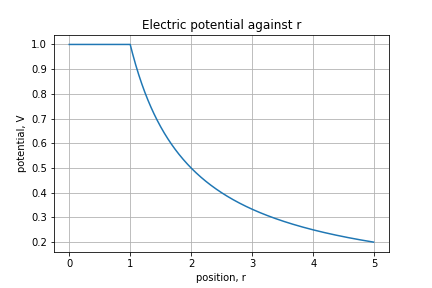
We know that the potential over the entire sphere must be equal. Therefore, the electric potential is constant until we reach the radius R, and then it decreases (inversely proportional to the distance from the center of the sphere). To make plotting easier, we have set k, Q, and R equal to 1:
0:00 / 0:00
Example: Two Conducting Spheres
Consider two solid conducting spheres connected by some conducting wire. The two spheres have radii and .
a) What is the relationship between the total charge on the two spheres?
b) What is the relationship between the surface charge density of the two spheres?
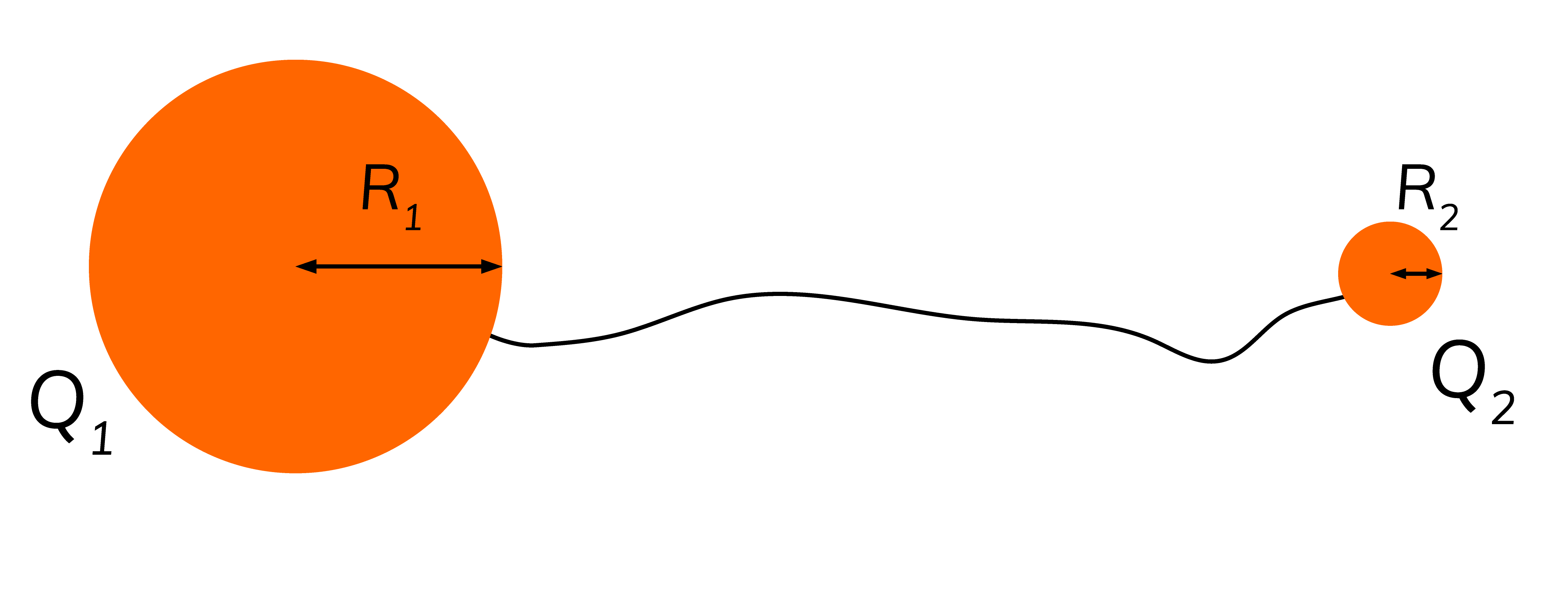
We will tackle both parts of this problem at the same time.
Because the two spheres are conductors, they are both equipotential surfaces with all of their charge sitting on their surface. Since there is a conducting wire between them, both spheres must be at the same potential:
The surface charge density is defined as charge per unit surface area. For spheres, this gives . Substituting:
The two expressions above are very useful! They can also be re-written as follows:
This tells us that if the radius of one sphere is larger than the other, then it will have more charge, but a lower surface charge density.
Our conductor in this example (two spheres with a conducting wire) may not be a "realistic" conductor, but the important take-away message from this example is that by changing the shape of our conductor, we change the charge distribution across its surface.
0:00 / 0:00
Dielectric Breakdown
The fact that the charge density on the surface of a conductor accumulates on sharp corners leads to some important engineering and safety applications.
- The increased charge density can lead to very strong electric fields being produced by sharp tips of a conductor. If the electric field strength in air reaches approximately , sometimes called the dielectric strength of air, air molecules can become ionized.
- This process is sometimes called dielectric breakdown.
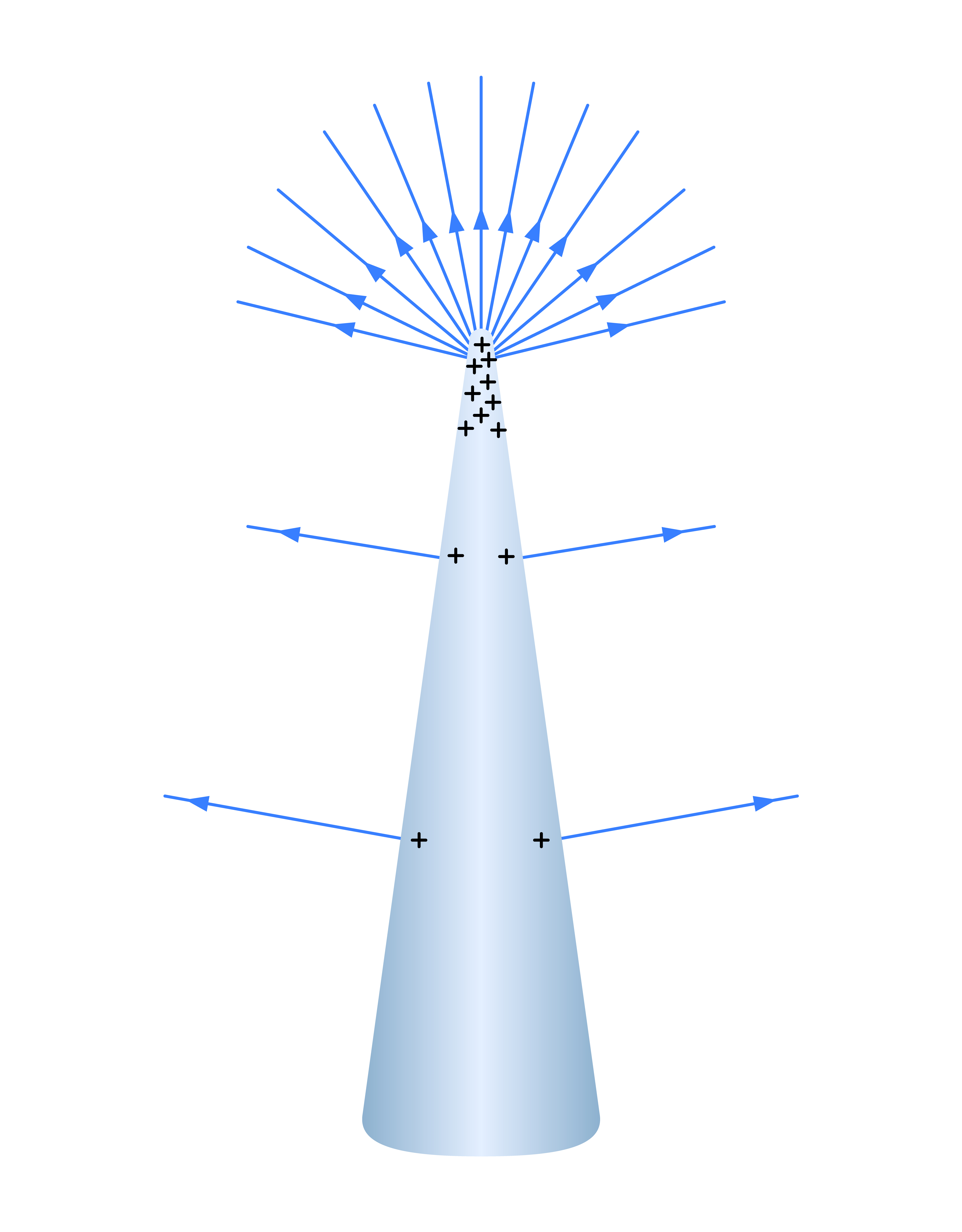
- This is useful in some applications, such as lightning rods which are used to reduce the likelihood of lightning strikes. But given the applications of high-voltage conductors in other areas such as energy transmission (e.g. power lines) and medicine (e.g. pacemakers in the heart), it is often important to design conductors without sharp edges to reduce the likelihood of dangerous outcomes.

Mark Yourself Question
- Grab a piece of paper and try this problem yourself.
- When you're done, check the "I have answered this question" box below.
- View the solution and report whether you got it right or wrong.
Practice: Three Conducting Spheres
Consider a charged conducting sphere of radius and a charge of . It is attached by a conducting wires to two other conducting spheres which both have radius and are both initially uncharged. The radius of the two new spheres are one-quarter of the radius of the first sphere.
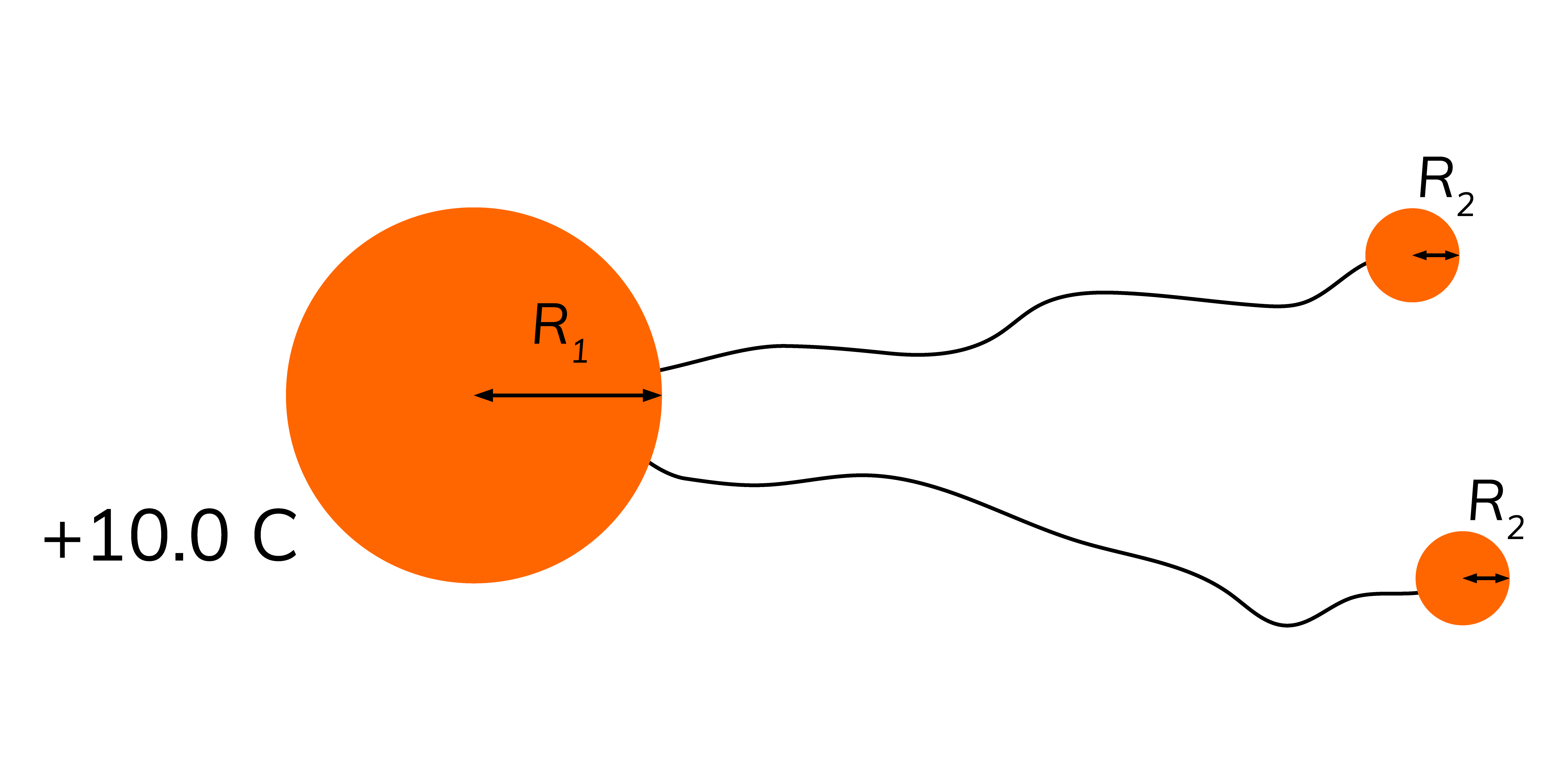
a) What is the final amount of charge on the three spheres after they are connected?
b) What is the ratio between the electric field strength at the surface of the larger sphere, compared to one of the smaller spheres? That is, find the ratio .