Popular Courses
PHYSICS 1E03
McMaster University
PHYSICS 1402A/B
Western University
PHYS 205
Concordia University
PHYS 142
McGill University
ENGG 212
University of Calgary
PHY132H1
University of Toronto
PHY132H1
University of Toronto
PHYS-1300
University of Windsor
PHY 1121
University of Ottawa
PHYS 121
University of Waterloo
PHYSICS 1102A/B
Western University
PHYS 227
University of Calgary
SC/PHYS 2020 3.00
York University
PHYS 116
Queen's University
PHY 9B
University of California - Davis
PHY 131
Arizona State University - Tempe
MCG 1101
University of Ottawa
PHYS 1010
York University
PHYS 1020
University of Manitoba
PHYS 1007
Carleton University

0:00 / 0:00
Power Dissipation in RLC Circuits
In circuit design scenarios, the power for the source and circuit elements is an important consideration.
- For AC circuits, the instantaneous power changes constantly. We usually use average power instead.
- The average power dissipated by a resistor is as follows:
Wize Concept
For inductors and capacitors in AC circuits, the voltage and current are out of phase by 90 degrees, so the average power dissipated is zero.
- The average power generated by the source is as follows:
- In this equation, is the phase angle, and the term is called the power factor.
- At resonance, , so the average power generated by the source is a maximum.
0:00 / 0:00
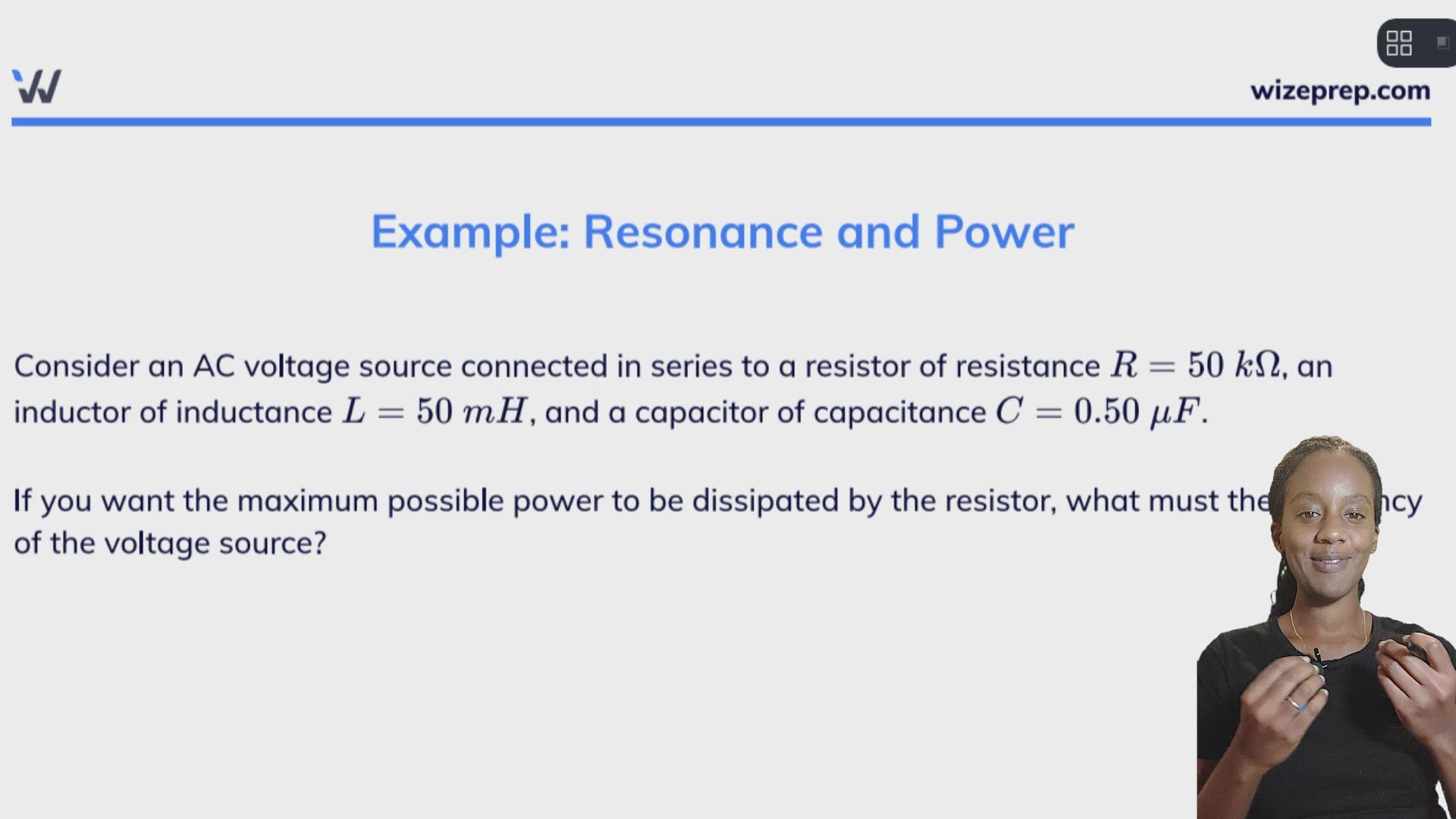
Example: Resonance and Power
Consider an AC voltage source connected in series to a resistor of resistance , an inductor of inductance , and a capacitor of capacitance .
If you want the maximum possible power to be dissipated by the resistor, what must the frequency of the voltage source?
The maximum amount of power is dissipated in the resistor when the RLC circuit is at resonance. This is when the current is the strongest, so the power dissipated in the resistor is the highest.) At resonance, , so the power factor is .
Let's find the frequency (not the angular frequency!) that corresponds to the resonance condition for this circuit.
Note - our answer does not depend on resistance!
Practice: Power Dissipated in a Series RLC Circuit (AC)
Consider an AC voltage source with a frequency of connected in series to a resistor of resistance, an inductor of inductance , and a capacitor of capacitance . The RMS current is .
a) What is the average power delivered by the source?
b) What is the average power dissipated by the resistor?
c) How much energy is consumed by the resistor in 30 seconds?
Part a)
Practice: Adjusting the Power Factor
Consider an RLC series circuit with impedance 50 Ohms, power factor 0.600, and a frequency of 75 Hz. The current is lagging behind the source voltage.
a) If you wanted to raise the power factor to 1.0, what circuit element would you need to add to the circuit?
b) What is the necessary inductance/capacitance/resistance of this new circuit element?
Part a)