Wize University Physics Textbook (Master) > Geometric Optics
Lensmaker's Equation
Popular Courses
MCAT
General Course
PHYSICS 1201A/B
Western University
PHY 1122
University of Ottawa
PHYS 142
McGill University
ENGG 212
University of Calgary
PHY132H1
University of Toronto
PHY132H1
University of Toronto
PHYS 102B
University of Victoria
PHYS 111
University of Victoria
PHYS-1300
University of Windsor
PHY 1121
University of Ottawa
PHYS 121
University of Waterloo
PHYSICS 1102A/B
Western University
PHYS 227
University of Calgary
SC/PHYS 2020 3.00
York University
PHYS 116
Queen's University
PHY 9B
University of California - Davis
PHY 131
Arizona State University - Tempe
MCG 1101
University of Ottawa
PHYS 1010
York University

0:00 / 0:00
Lensmaker's Equation
If each curved surface of the lens has a different radius of curvature, then the focal length can be found using the lensmaker's equation:
- is the focal length of the lens
- is the index of refraction of the material
- is the radius of curvature of the side next to the object
- is the radius of curvature of the side opposite to the object
The focal length is positive for converging lenses and negative for diverging lenses.
Each radius of curvature is positive if the surface is convex towards the object, and negative if the surface is concave towards the object.
Wize Concept
The radius of curvature is infinite for a plane mirror, which means that .
0:00 / 0:00
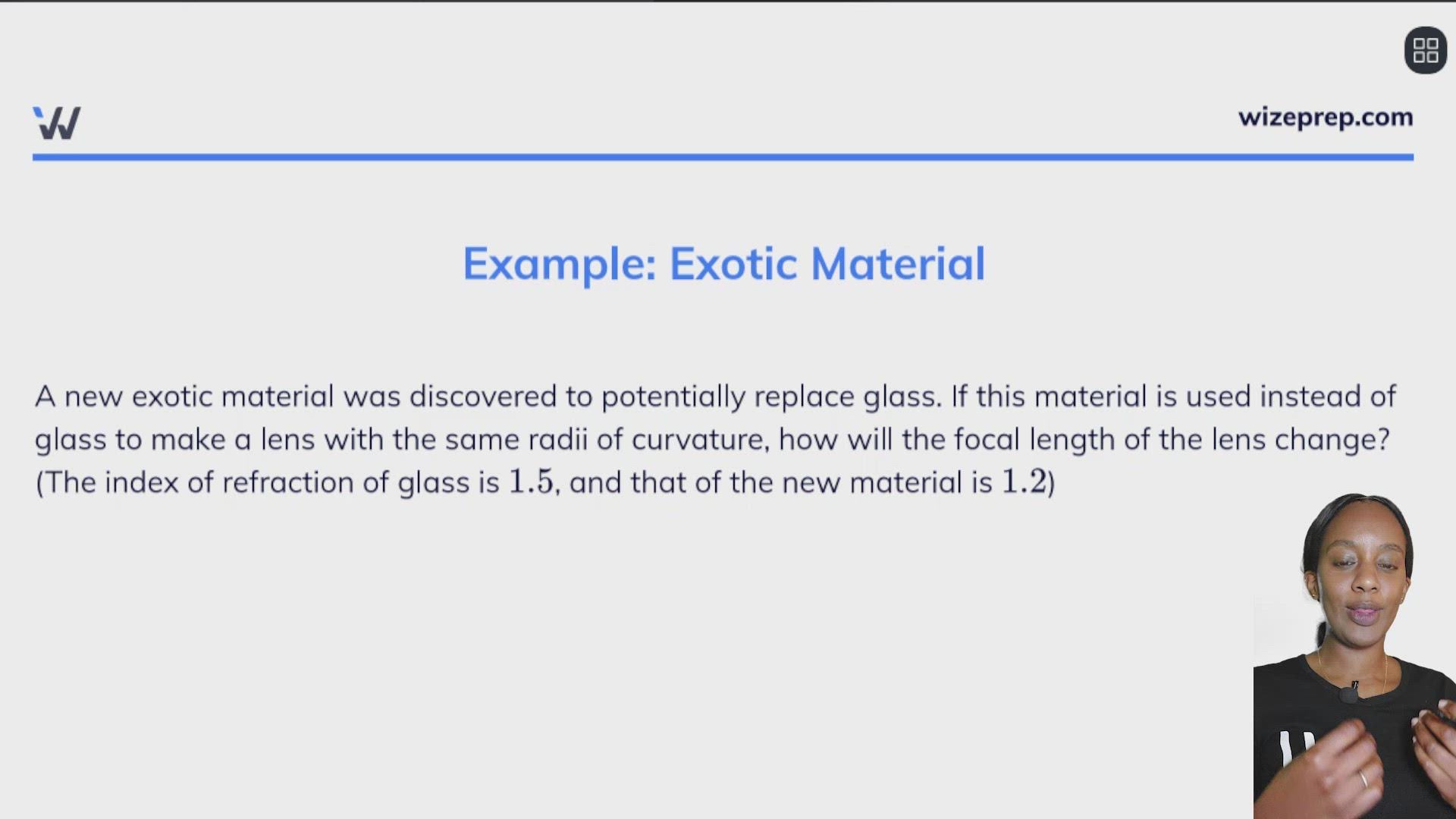
Example: Exotic Material
A new exotic material was discovered to potentially replace glass. If this material is used instead of glass to make a lens with the same radii of curvature, how will the focal length of the lens change? (The index of refraction of glass is , and that of the new material is )
Let's write the lensmaker equation for each situation.
For glass we have:
For the new material we have:
Divide the two equations to get:
(the R part cancels, since the R's are the same)
Rearrange:
Therefore the focal length with the new material will be times larger than when glass is used.
Practice: One Side Flat
You want to make a divergent lens with a focal length of m using glass (). If one side of the lens is completely flat, what should the radius of curvature be for the other side?