Wize University Physiology Textbook > Sensory Physiology
Somatosensory Modality
Popular Courses
MCAT
General Course
DAT
General Course
Intro to Physiology
University Study Guides
PHYSIOL 1021
Western University
PHYSIOL 2130
Western University
Intro to Physiology
University Study Guides
PSL300H1
University of Toronto
PHYSL 210
University of Alberta
PHGY 210
McGill University
PHGY 215
Queen's University
KNES 259
University of Calgary
PHGY 216
Queen's University
BIOL 273
University of Waterloo
BIOL 260
University of British Columbia
PHYSIOL 3120
Western University
KNES 260
University of Calgary
BIOL 116
Case Western Reserve University
PPT 301
University of North Dakota
ANAT 212
McGill University
KNES 323
University of Calgary

0:00 / 0:00
Introduction to Sensory Modalities
- A stimulus is felt as activity of afferent neurons
- The intensity is translated as an increase in frequency of neuronal firing
- Sensory inputs can be modulated by descending neurons
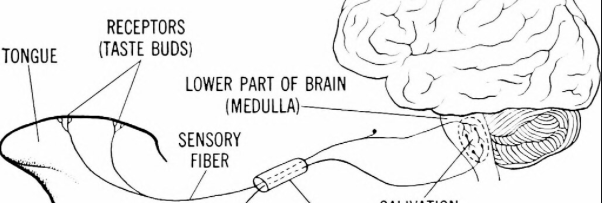
- Sensory neurons are stimulated by the external environment
- ex. taste buds are sensory cells stimulated by food molecules, which result in the sensation of taste
- ex. our ears have hair cells (sensory cell) that are stimulated by vibration, resulting in sensation of hearing.
- The external environment will react with proteins in the cells membrane, resulting in protein channels opening and depolarization of the sensory cell.
Exam Tip
The law of specific nerve energies says that we perceive different types of sensory information (vision, versus hearing, versus touch...) because different types of nervous structures are stimulated in each case.
0:00 / 0:00
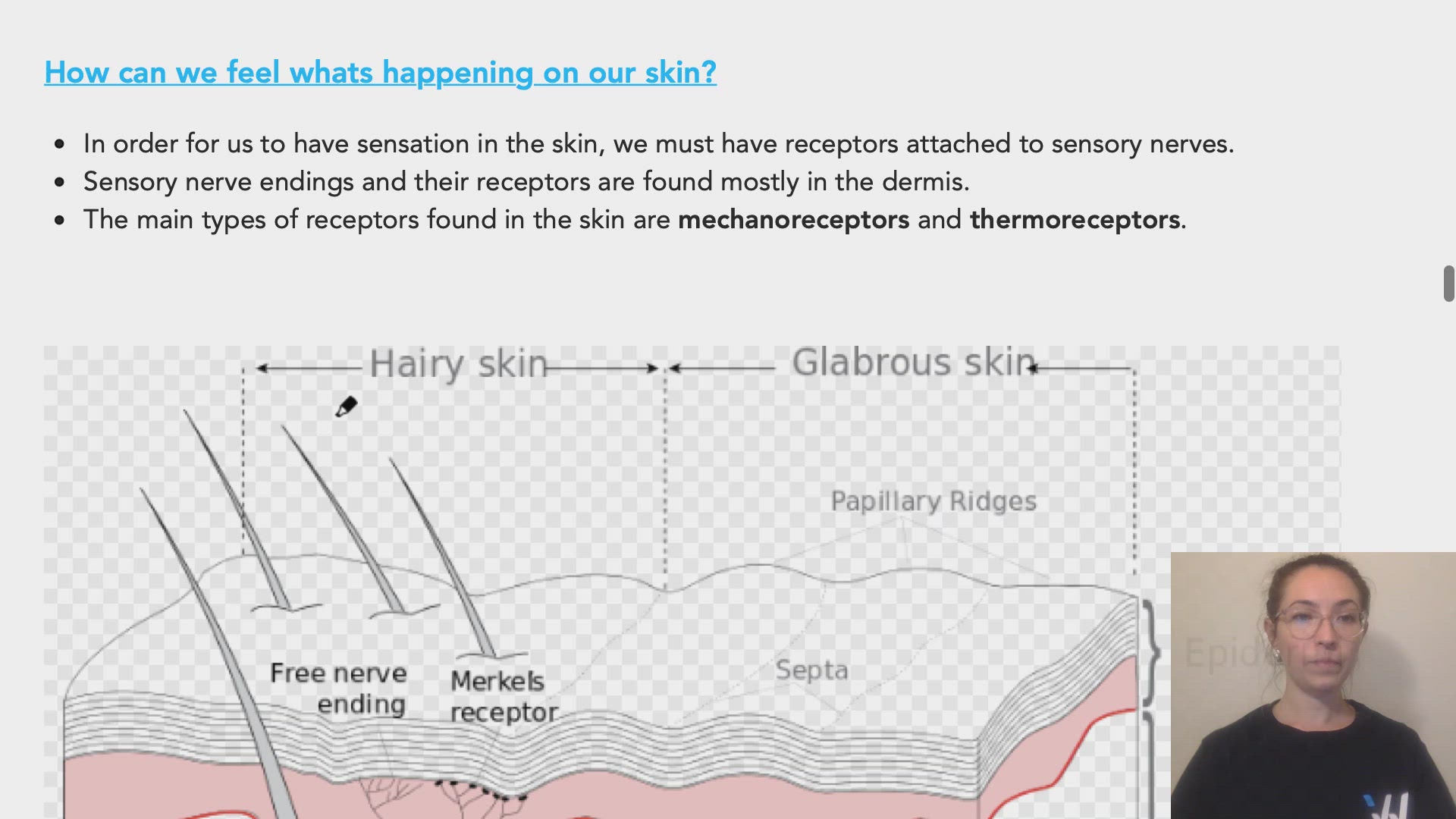
How can we feel whats happening on our skin?
- In order for us to have sensation in the skin, we must have receptors attached to sensory nerves.
- Sensory nerve endings and their receptors are found mostly in the dermis.
- The main types of receptors found in the skin are mechanoreceptors and thermoreceptors.

commons.wikimedia.org
Mechanoreceptors
- Respond to stretching or bending in the skin
- Work with a nerve to provide sensory information
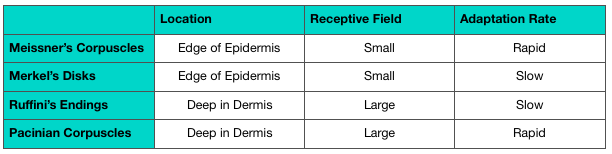
- Four types of mechanoreceptors:
- Meissner's Corpuscles
- Merkel Disks
- Ruffini Endings
- Pacinian Corpuscles
- The receptive field (RF) is the region in space that can activate a particular sensory receptor or neuron
- Large RF = low acuity
- Small RF = high acuity
Tactile Acuity
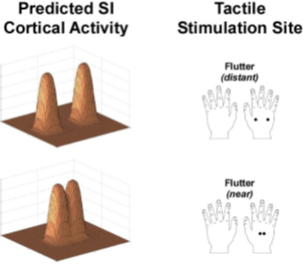
- The ability to discriminate between two points of sensation.
- Different areas of the body have different tactile acuity.
- This happens because in some areas of the body, we have many nerves with small receptive fields, while other areas have few nerves with large receptive fields.
- Other descending neurons can influence this
commons.wikimedia.org
0:00 / 0:00
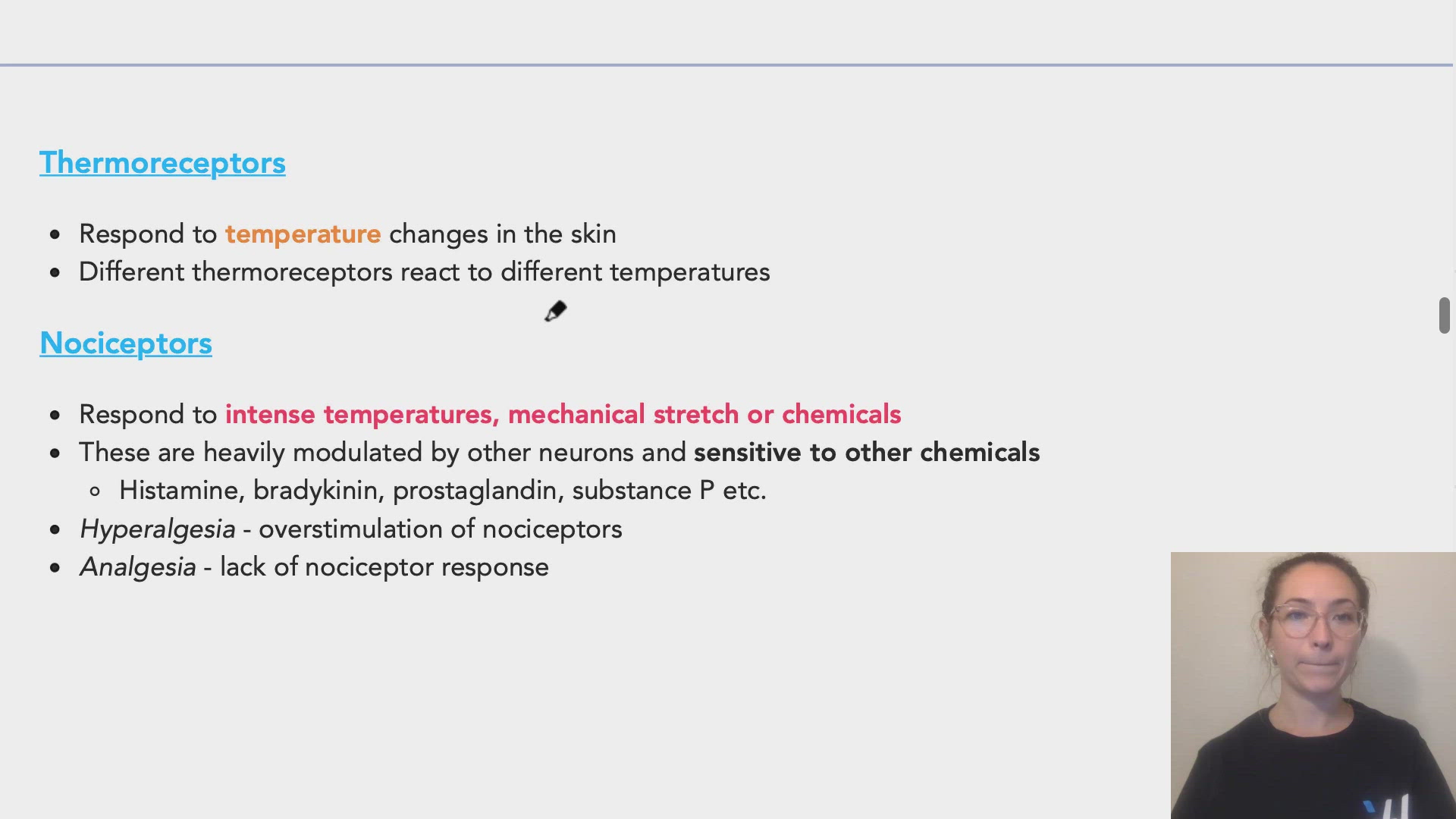
Thermoreceptors
- Respond to temperature changes in the skin
- Different thermoreceptors react to different temperatures
Nociceptors
- Respond to intense temperatures, mechanical stretch or chemicals
- These are heavily modulated by other neurons and sensitive to other chemicals
- Histamine, bradykinin, prostaglandin, substance P etc.
- Hyperalgesia - overstimulation of nociceptors
- Analgesia - lack of nociceptor response
0:00 / 0:00
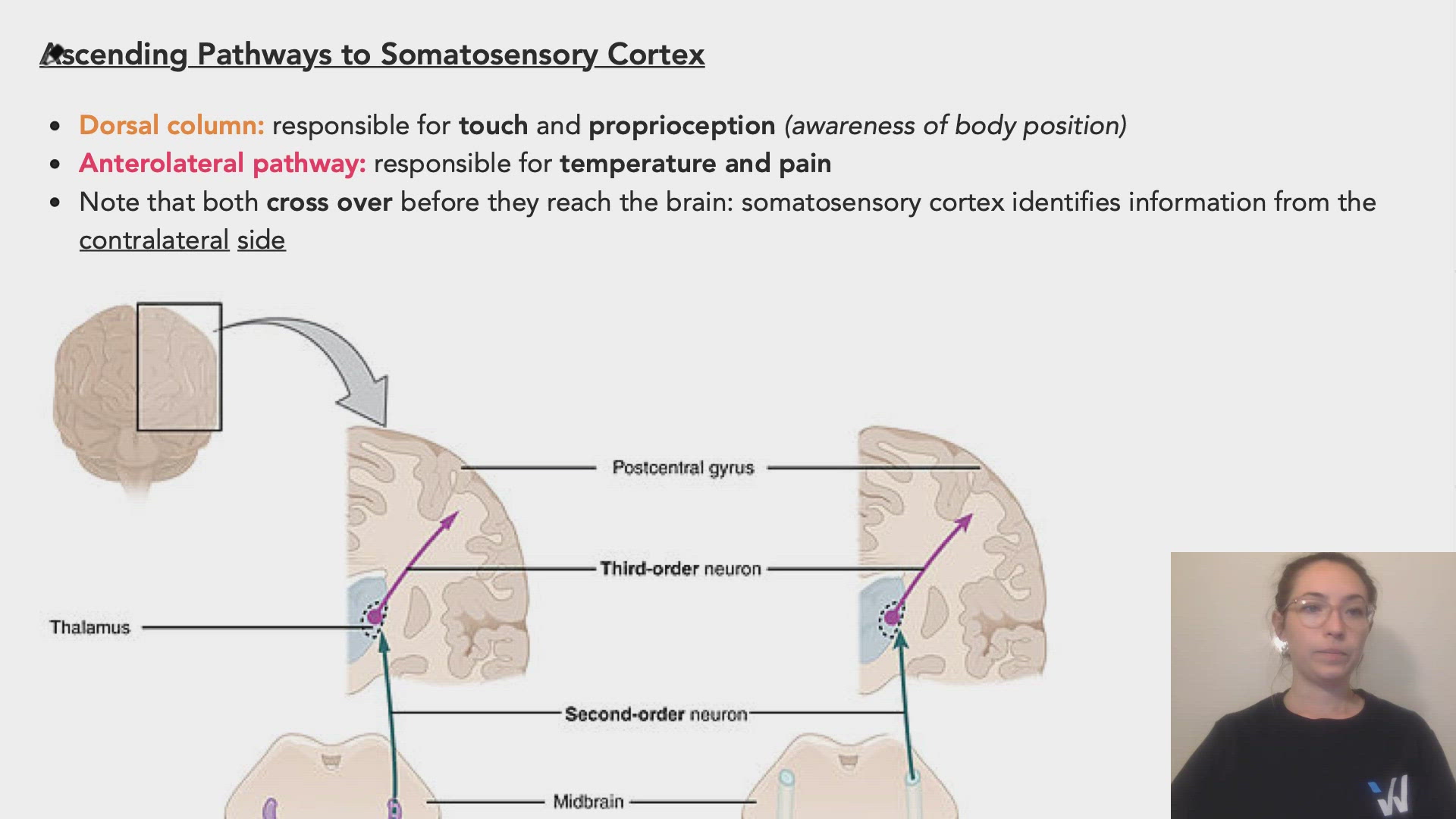
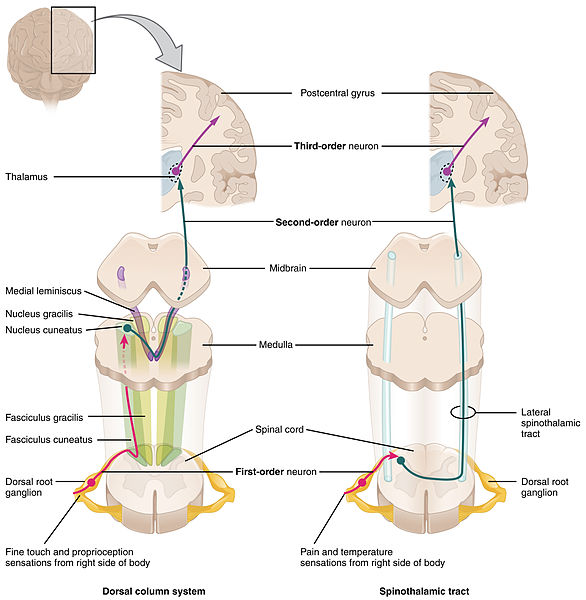
Ascending Pathways to Somatosensory Cortex
- Dorsal column: responsible for touch and proprioception (awareness of body position)
- Anterolateral pathway: responsible for temperature and pain
- Note that both cross over before they reach the brain: somatosensory cortex identifies information from the contralateral side
commons.wikipedia.org
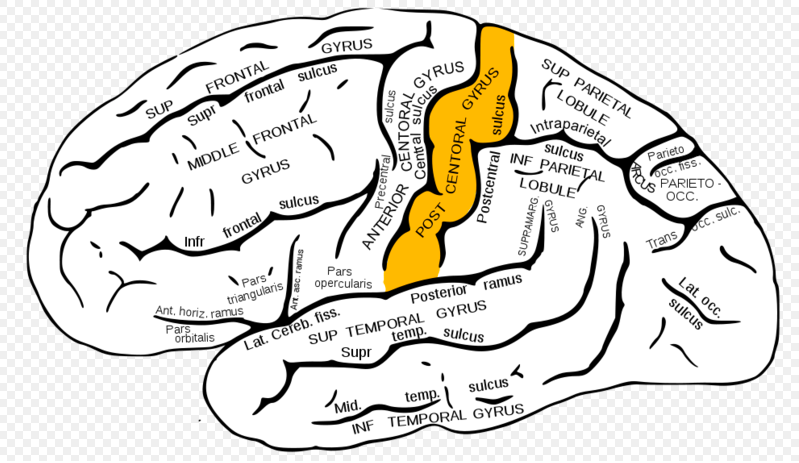
Somatosensory cortex
- Region of the brain responsible for somatosensation
- Specific location is called the post-central gyrus.
commons.wikimedia.org
- On this post central gyrus, the body is “mapped out” in what we call a somatotopy.
- Notice how the hand and face take up a larger area: the body parts that are larger have higher tactile acuity.


0:00 / 0:00
Why do you think the skin on the tips of our fingers is more sensitive than that on our backs? Hint: this has to do with their receptive fields.
Definitions:
A) Receptive field of an individual sensory neuron is the particular region of sensory space (e.g. a piece of skin or a part of your visual field) in which a stimulus will trigger that neuron to fire.
B) Tactile acuity is the ability to differentiate between two points. You can also think of it as the minimum distance between two points that is required for you to differentiate between them.
How does A relate to B?
If only one neuron with a large receptive field is sensing a large area, two pin pricks near one another in that area might be sensed as a single one.
Alternatively, if many different neurons were providing sensory information for that (that is, many neurons with small receptive fields), that same pin prick would probably be felt as separate stimuli.
In general:
- Small receptive field --> high acuity (e.g. fingertips)
- Large receptive field --> low acuity (e.g. back)
In summary, our fingerprints have many neurons with small receptive fields, whereas our backs have fewer neurons with large receptive fields.
A patient complains of loss of touch sensation and proprioception on the right side of his body from hip to feet. A lesion at which of the following would best explain this?
Which of the following are true about the skin?