Wize University Physiology Textbook > Somatic Nervous System (SNS)
Motor Behavior and Reflexes [more detailed]
Popular Courses
MCAT
General Course
DAT
General Course
Intro to Physiology
University Study Guides
PHYSIOL 1021
Western University
PHYSIOL 2130
Western University
Intro to Physiology
University Study Guides
PSL300H1
University of Toronto
PHYSL 210
University of Alberta
PHGY 210
McGill University
PHGY 215
Queen's University
KNES 259
University of Calgary
PHGY 216
Queen's University
BIOL 273
University of Waterloo
BIOL 260
University of British Columbia
PHYSIOL 3120
Western University
KNES 260
University of Calgary
BIOL 116
Case Western Reserve University
PPT 301
University of North Dakota
ANAT 212
McGill University
KNES 323
University of Calgary

0:00 / 0:00
Voluntary Motor Control
- Extension vs Flexion
- Movement is a coordinated balance between both
- Neurotransmitter: acetylcholine (ACh) - excitatory
Generation of Movement
Requires two major components:
- One motor neuron
- A bundle of muscle fibers
- In order for us to have movement, the brain "tells" the motor neuron that there needs to be muscle contraction
- Descending motor commands will synapse with interneurons in the spinal cord
- Interneurons synapse with the motor neurons
- Can be modulated by other types of neurons
- The motor neuron stimulates the muscle fibers --> contraction

0:00 / 0:00
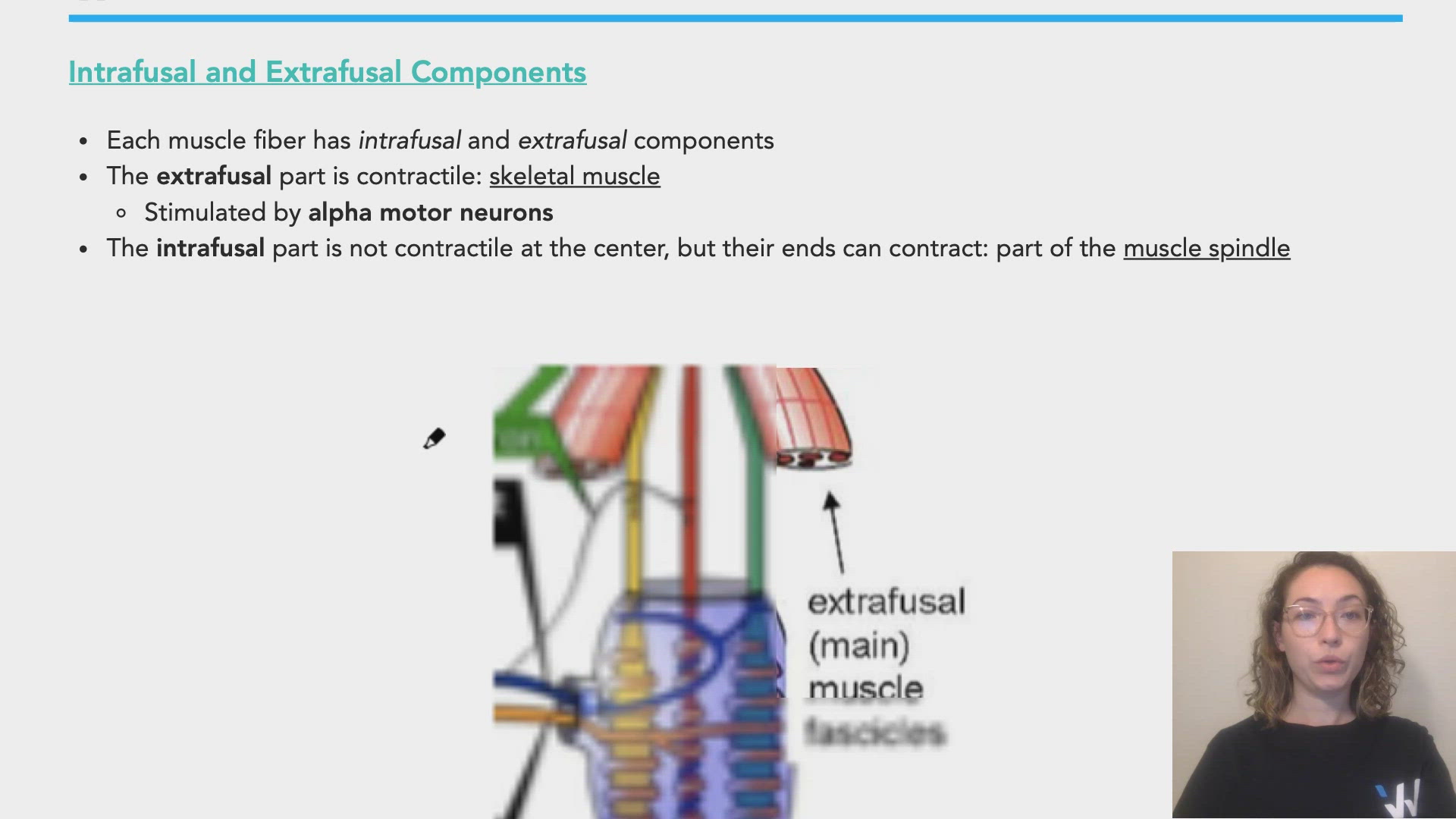
Intrafusal and Extrafusal Components
- Each muscle fiber has intrafusal and extrafusal components
- The extrafusal part is contractile: skeletal muscle
- Stimulated by alpha motor neurons
- The intrafusal part is not contractile at the center, but their ends can contract: part of the muscle spindle

Muscle spindles
- Composed of (intrafusal) muscle fibers with sensory fibers wrapped around
- Located within the "belly" of the muscle, within the extrafusal fibers (parallel)
- Primarily detects and reports changes in muscle length
- Do not contribute to force of muscle contraction
- Innervation of the spindle:
- 1. Alpha motor neuron
- 2. Gamma motor neuron
- 3. 1a afferent neuron
- When the muscle stretches, 1a afferent neurons wrapped around the center sense it
- Gamma motor neurons stimulate the intrafusal fibers to contract

Image:
- First the extrafusal fibers contract
- This causes the muscle spindle to be "loose" - can't effectively sense length now!
- Gamma motor neuron to cause muscle spindle contraction - the tight muscle spindle can sense stretch appropriately again
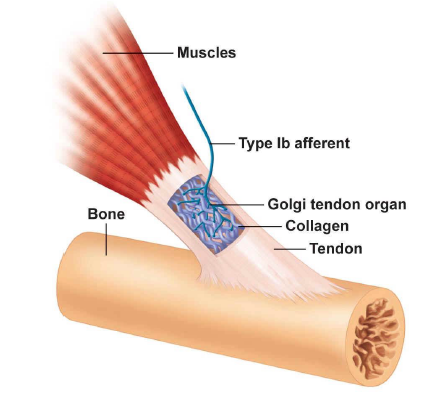
Golgi Tendon Organ
- Detects tension during contraction (in understandable terms, it detects the heaviness of something)
- Located in the tendon (connection of muscle to bone) in series with the muscle
- Protects us against lifting things that are too heavy for our muscles and causing injury
- Relays its information to the 1b afferent sensory nerve which passes on info to the CNS
- 1b sensory information has the ability to inhibit the alpha motor neuron, thus inhibiting muscle contraction and protecting us from harm
Wize Concept
The golgi tendon organ is activated when there is enough tension. It must pass the tension threshold before it can inhibit motor neurons. If the golgi tendon organ wasn't present and we could lift whatever we wanted, the end result could be ripping muscles off of bones (ouch!)
0:00 / 0:00
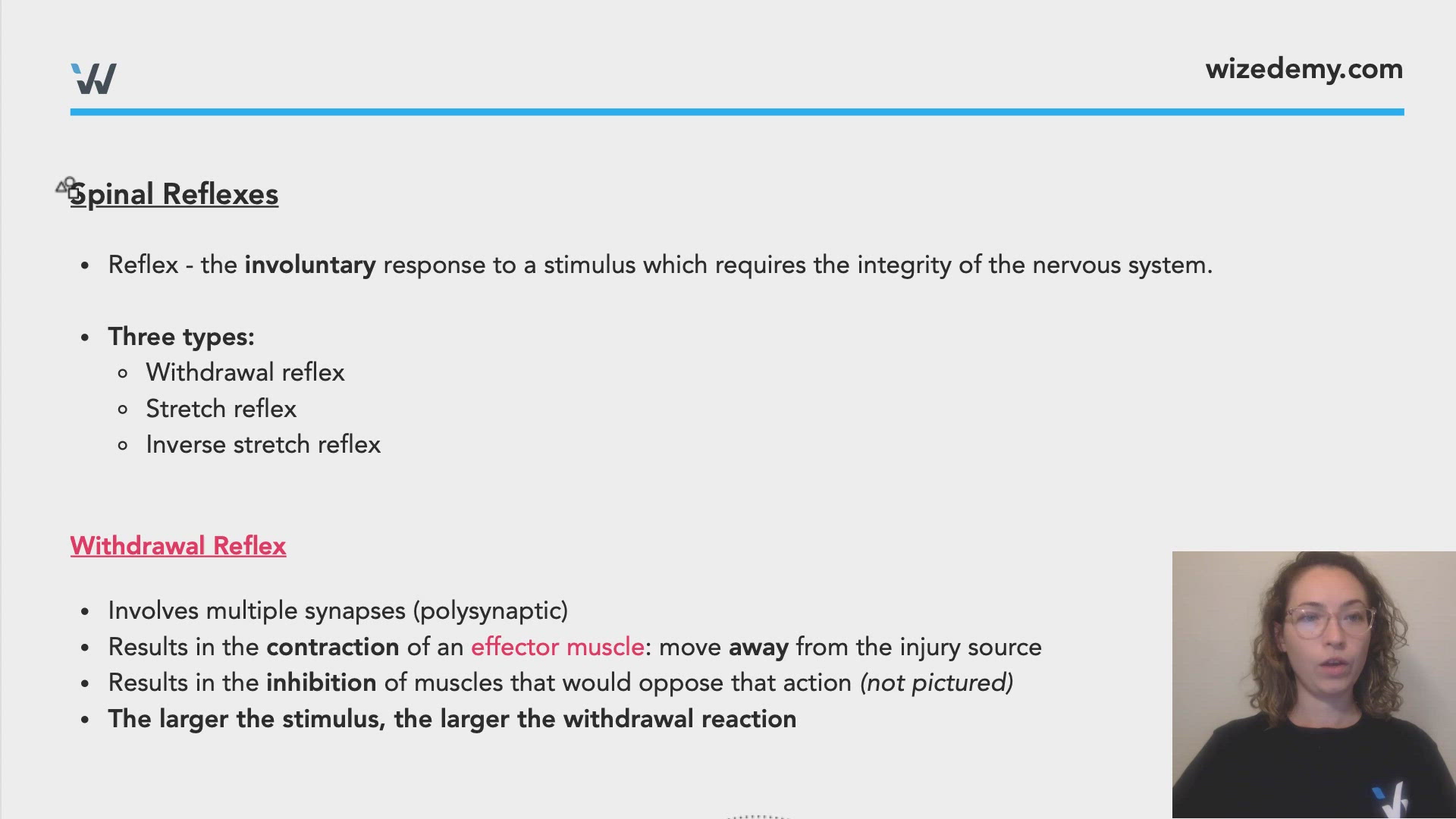
Spinal Reflexes
- Reflex - the involuntary response to a stimulus which requires the integrity of the nervous system.
- Three types:
- Withdrawal reflex
- Stretch reflex
- Inverse stretch reflex
Withdrawal Reflex
- Involves multiple synapses (polysynaptic)
- Results in the contraction of an effector muscle: move away from the injury source
- Results in the inhibition of muscles that would oppose that action (not pictured)
- The larger the stimulus, the larger the withdrawal reaction

commons.wikipedia.org

0:00 / 0:00
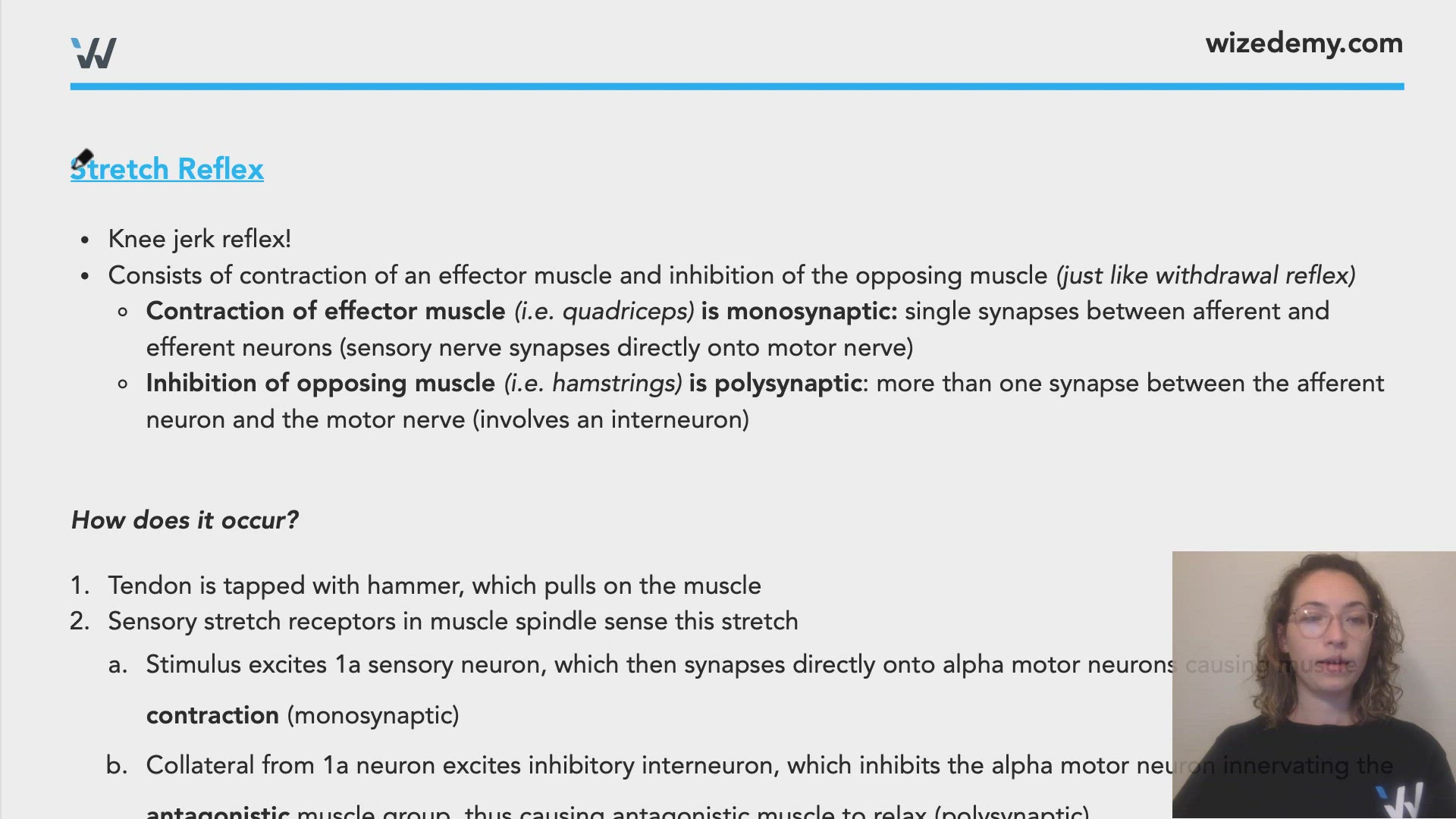
Stretch Reflex
- Knee jerk reflex!
- Consists of contraction of an effector muscle and inhibition of the opposing muscle (just like withdrawal reflex)
- Contraction of effector muscle (i.e. quadriceps) is monosynaptic: single synapses between afferent and efferent neurons (sensory nerve synapses directly onto motor nerve)
- Inhibition of opposing muscle (i.e. hamstrings) is polysynaptic: more than one synapse between the afferent neuron and the motor nerve (involves an interneuron)
How does it occur?
- Tendon is tapped with hammer, which pulls on the muscle
- Sensory stretch receptors in muscle spindle sense this stretch
- Stimulus excites 1a sensory neuron, which then synapses directly onto alpha motor neurons causing muscle contraction (monosynaptic)
- Collateral from 1a neuron excites inhibitory interneuron, which inhibits the alpha motor neuron innervating the antagonistic muscle group, thus causing antagonistic muscle to relax (polysynaptic)

Inverse Stretch Reflex (aka the Golgi Tendon Reflex)
- Triggered by increased tension in the extensor muscle
- Afferent fibers from Golgi tendon organ (Ib afferent) sense increased tension
- Polysynaptic:
- Ib afferent on interneurons --> inhibits extensor muscle (i.e. quadriceps)
- Ib afferent on other interneurons --> excites flexor muscle (i.e. hamstrings)
0:00 / 0:00
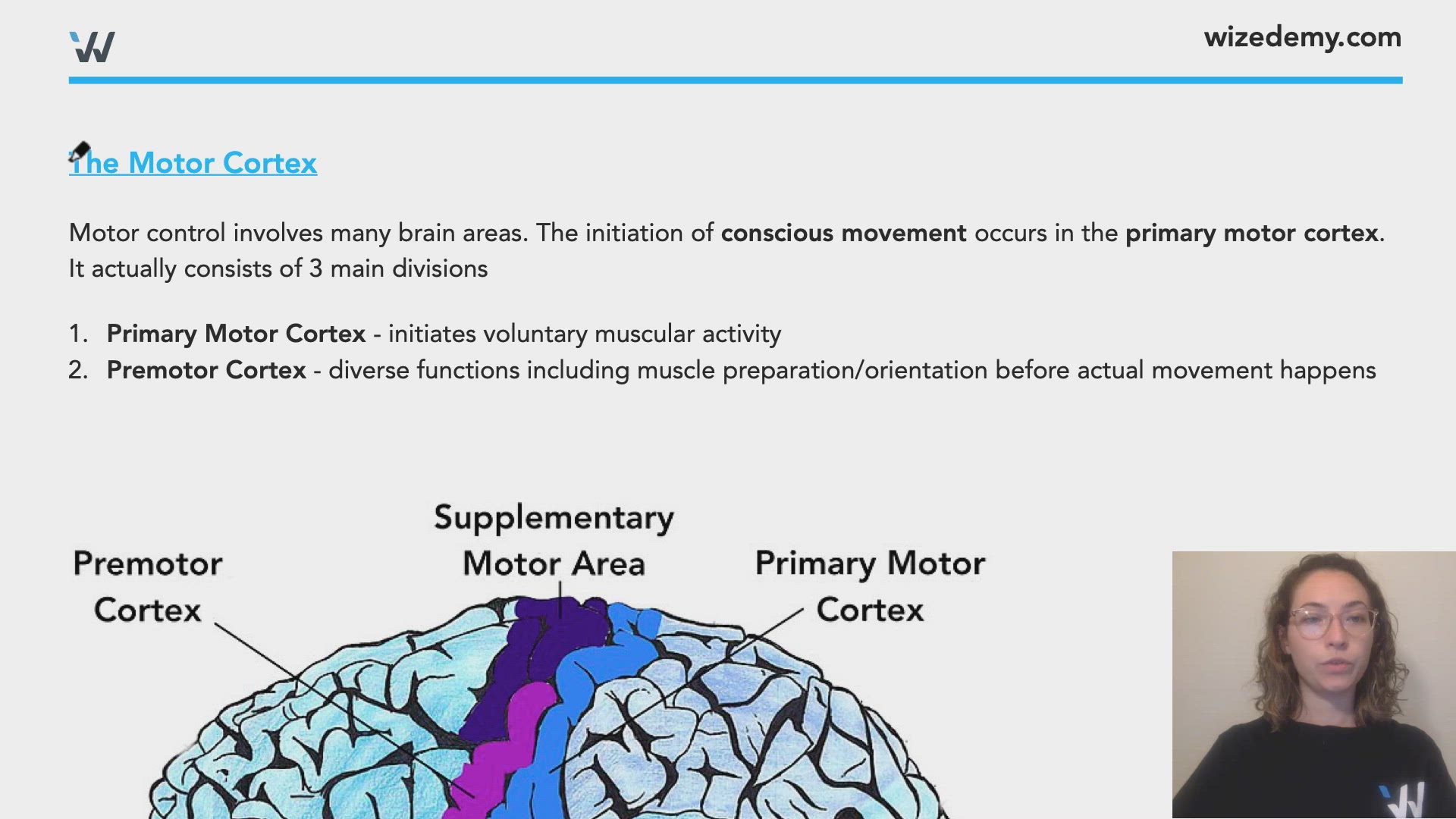
The Motor Cortex
Motor control involves many brain areas. The initiation of conscious movement occurs in the primary motor cortex. It actually consists of 3 main divisions
- Primary Motor Cortex - initiates voluntary muscular activity
- Premotor Cortex - diverse functions including muscle preparation/orientation before actual movement happens

Watch Out!
This concept is the same as we see in the primary somatosensory cortex, but its not the same structure! This one is not for sensory signals, but rather for MOTOR signals.
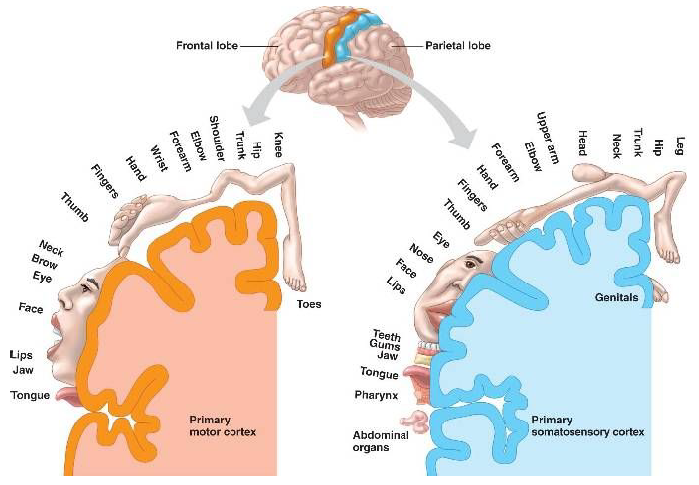
- As in the somatosensory cortex, some areas of the body may show different levels of representation.
- This is because the density of motor units in that area of the body is larger.
- Proportional to number of neurons dedicated to and the degree of skill required in that area
Corticospinal Tract
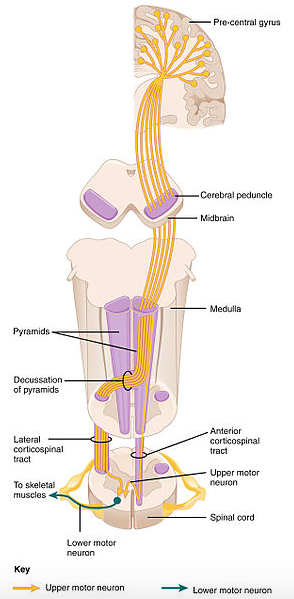
- Neuronal tract which leaves the motor cortex and travels to the spinal cord (descending pathway)
- The neurons cross over at the level of the medulla (left brain affects right side of body) and controls skilled voluntary movement
- Controls movements of the extremities (i.e. hands, feet)
- There is also the extrapyramidal tract that initiates in the brainstem and control trunk and postural muscles: these do not cross over
commons.wikipedia.org
0:00 / 0:00
What is muscle flexion? How do agonist and antagonist muscles come into play?
Muscle flexion occurs when there's muscle contraction that decreases the angle between limbs at the joint. For example, training your biceps at the gym, involves flexing it.
There's always an agonist and an antagonist muscle working.
-- The agonist muscle is the one that facilitates the movement.
-- The antagonist muscle is the one that opposes the movement.
In the example of the biceps, the agonist muscle is the biceps itself, and the antagonist muscle would be the triceps, which would extend your arm. Note that extension is the opposite of flexion.
Which of the following are true?
Which of the following is incorrect?