Wize University Physiology Textbook > Respiratory Physiology
Gas Exchange and Control
Popular Courses
MCAT
General Course
DAT
General Course
Grade 11 Biology
Ontario High School
Grade 11 Biology
Canada High School
Intro to Physiology
University Study Guides
PHYSIOL 1021
Western University
Biology 20
Alberta High School
PHYSIOL 2130
Western University
Intro to Physiology
University Study Guides
PSL300H1
University of Toronto
PHYSL 210
University of Alberta
Life Sciences 11
British Columbia High School
PHGY 210
McGill University
PHGY 215
Queen's University
KNES 259
University of Calgary
PHGY 216
Queen's University
BIOL 273
University of Waterloo
BIOL 260
University of British Columbia
PHYSIOL 3120
Western University
KNES 260
University of Calgary

0:00 / 0:00
Gas Exchange
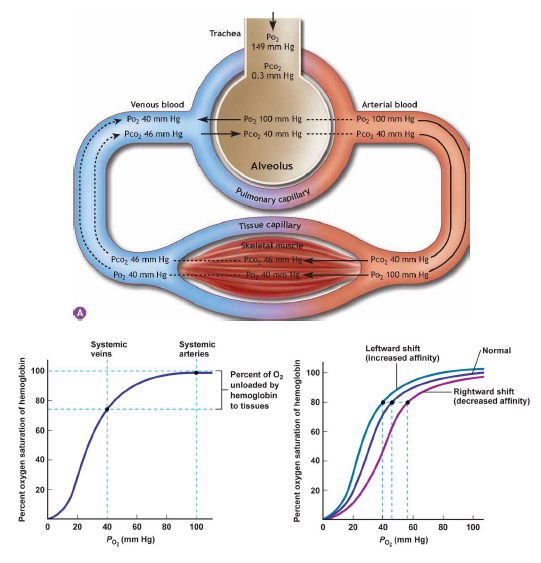
- Partial pressure is a measurement of the amount of force exerted by one particular substance in a mixture.
- Blood contains a mixture of gases, each of which exert pressure on the sides of the blood vessels
- Measured in mmHg
- The partial pressures of Oxygen and CO2 are important for understanding gas exchange in the circulatory system
2. Diffusion and partial pressure
- The higher the concentration of a gas, the higher the pressure it will exert.
- When there is a difference in partial pressure (or gas concentration) across a membrane, the gas will naturally diffuse from the area of high pressure (or high concentration) to an area of low pressure (or low concentration)
3. Pulmonary and systemic circulation
- Pulmonary circulation is the movement of blood between the heart and the lungs to become oxygenated
- Systemic circulation is the movement of blood between the heart and the rest of the body
- Gas exchange occurs in both of these pathways
- When blood reaches the tissues, it delivers oxygen and picks up CO2
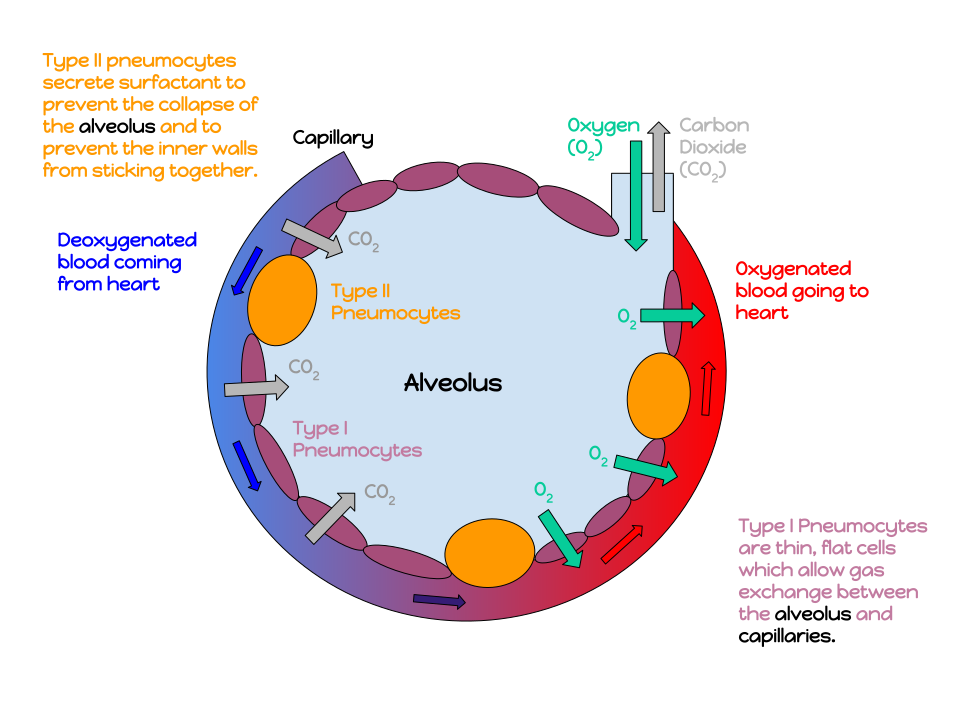
- When blood reaches the lungs, it gets rid of the CO2 and picks up oxygen. In the lungs, the partial pressure of oxygen in the blood is very low (~40 mmHg). This allows oxygen in the alveoli to diffuse into the capillaries. Once the blood leaves the lungs, the partial pressure of oxygen is ~100 mmHg.
4. Oxygen saturation
- The partial pressure of oxygen is a measure of the blood’s oxygen saturation.
- A constant level of saturation above 90% is ideal (arterial partial pressure of 100 mmHg)
0:00 / 0:00
Carbon Dioxide Gas Exchange
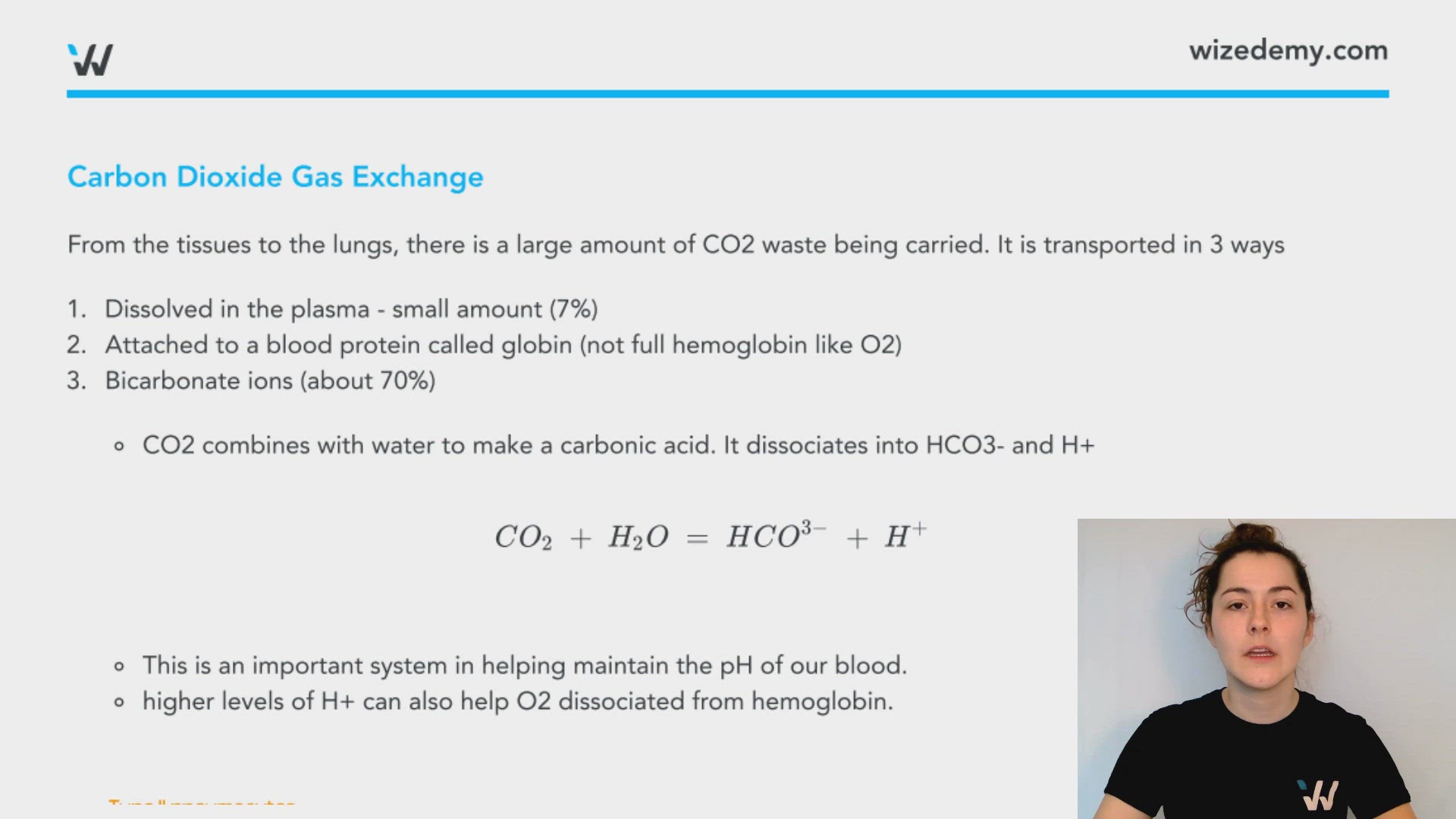
From the tissues to the lungs, there is a large amount of CO2 waste being carried. It is transported in 3 ways
- Dissolved in the plasma - small amount (7%)
- Attached to a blood protein called globin (not full hemoglobin like O2)
- Bicarbonate ions (about 70%)
- CO2 combines with water to make a carbonic acid. It dissociates into HCO3- and H+
- This is an important system in helping maintain the pH of our blood.
- higher levels of H+ can also help O2 dissociated from hemoglobin.
Which of the following statements is true regarding gas exchange?