Wize University Physiology Textbook > Blood
Capillary Wall Transport
Popular Courses
MCAT
General Course
DAT
General Course
Intro to Physiology
University Study Guides
PHYSIOL 1021
Western University
PHYSIOL 2130
Western University
Intro to Physiology
University Study Guides
PSL300H1
University of Toronto
PHYSL 210
University of Alberta
PHGY 210
McGill University
PHGY 215
Queen's University
KNES 259
University of Calgary
PHGY 216
Queen's University
BIOL 273
University of Waterloo
BIOL 260
University of British Columbia
PHYSIOL 3120
Western University
KNES 260
University of Calgary
BIOL 116
Case Western Reserve University
PPT 301
University of North Dakota
ANAT 212
McGill University
HTHSCI 2FF3
McMaster University
0:00 / 0:00
Capillary Wall Transport
If capillaries allow for water and small molecules to leak through, what controls how much plasma stays in your blood vessels vs what goes to the interstitial fluid?
There are two main forces that control capillary fluid dynamics: (1) Colloidal Osmotic Pressure and (2) Hydrostatic pressure ("filtration")
1) Colloidal Osmotic (Oncotic) Pressure
- The capillary wall is permeable to ions and water but not the proteins found in plasma
- The osmolarities of interstitial fluid (ISF) and plasma are very similar (~300 mOsm)
- The osmotic effect exerted by blood proteins has a special name: colloidal osmotic pressure (c.o.p.) or oncotic pressure
- The proteins are what determine the fluid distribution between these two subcompartments of ECF
Wize Concept
Colloidal Osmotic Pressure a.k.a. Oncotic Pressure: it is the osmotic pressure exerted by plasma proteins
In other words: proteins affect the fluid distribution between the ISF and plasma compartments because they exert an osmotic effect since they cannot the capillary walls. This osmotic effect has a special name of oncotic pressure.
2) Hydrostatic Pressure
What happens if you have a water hose with running water and poke a hole through the side? What if you step on the water hose?
- The driving force for flow is a pressure difference (e.g. house vacuum and hose)
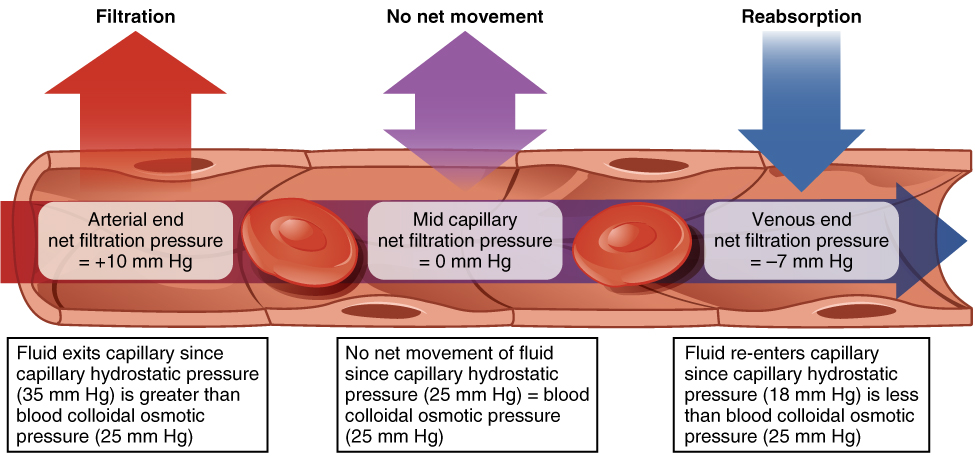
- Protein-free plasma moves from the capillaries to the ISF by bulk flow
- Hydrostatic pressure drives water out of the capillaries, which is where exchange occurs

Colloidal Osmotic Pressure and Hydrostatic pressure oppose one another. The balance between the two controls the fluid distribution between ISF and plasma and net movement of fluid between the two.
These two together are called STARLING FORCES.
0:00 / 0:00
Plasma Proteins
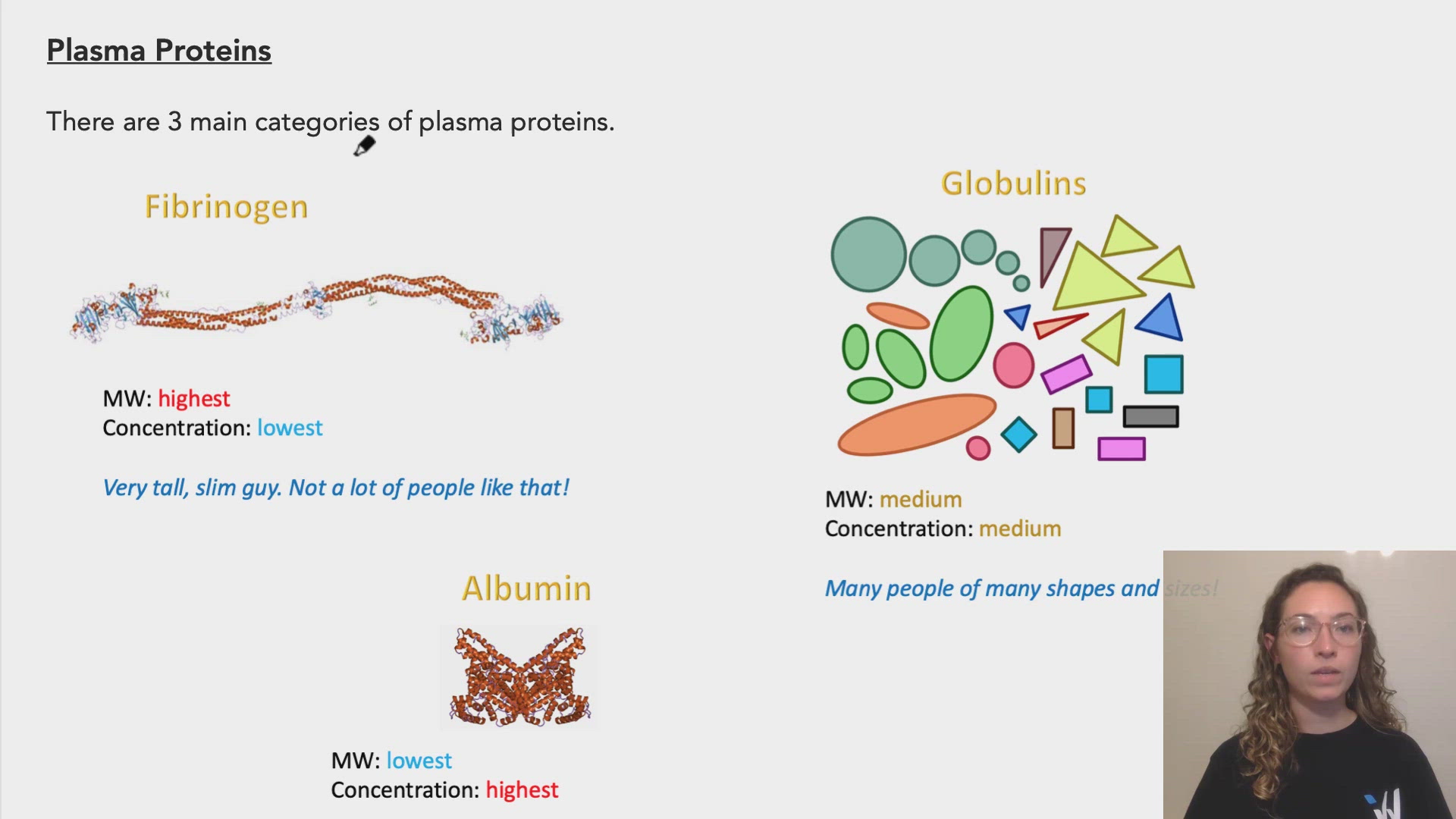
There are 3 main categories of plasma proteins.
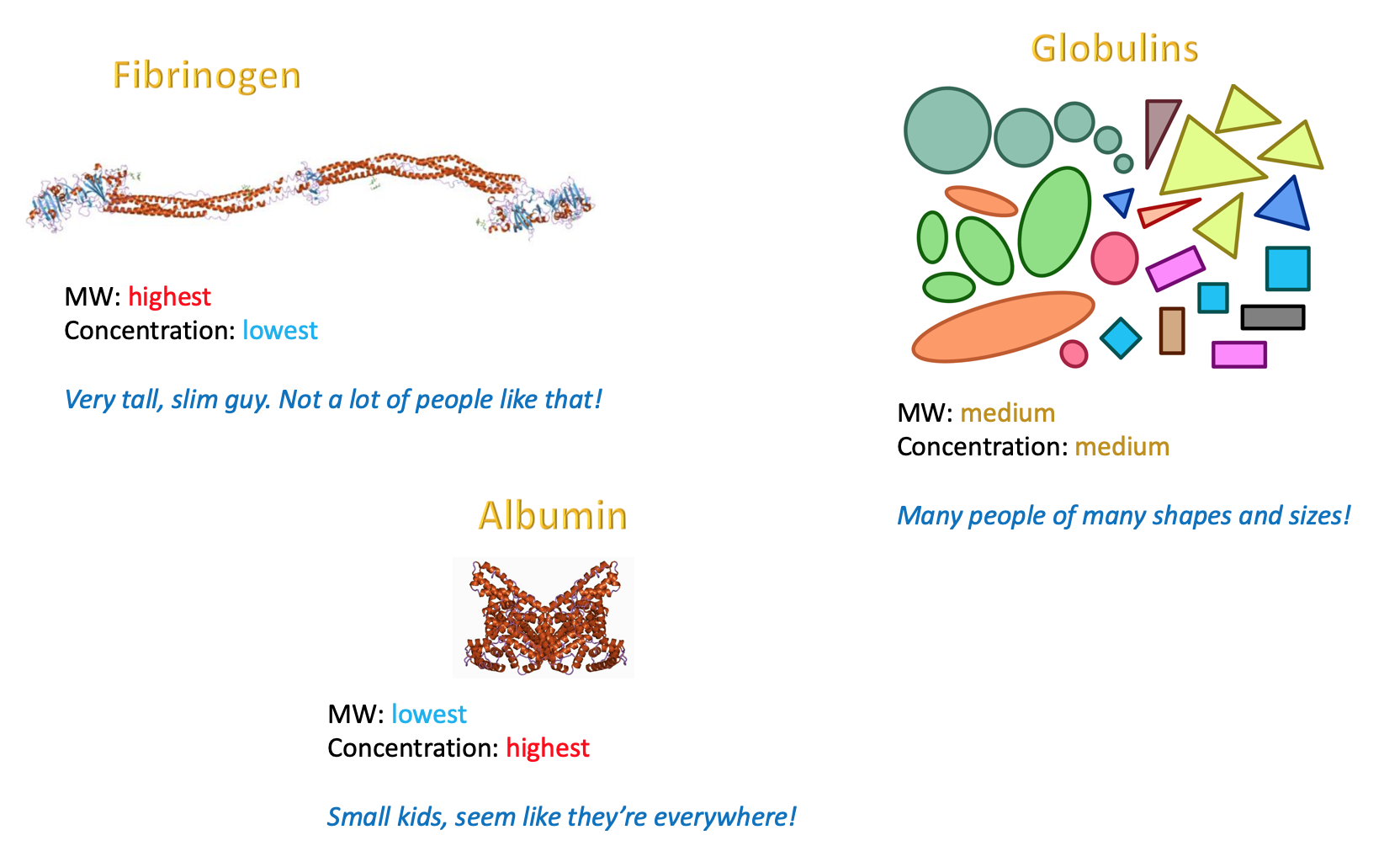
- Albumin is the most important contributor to the colloidal osmotic pressure
- Fibrinogen makes the smallest contribution to the total c.o.p.
0:00 / 0:00
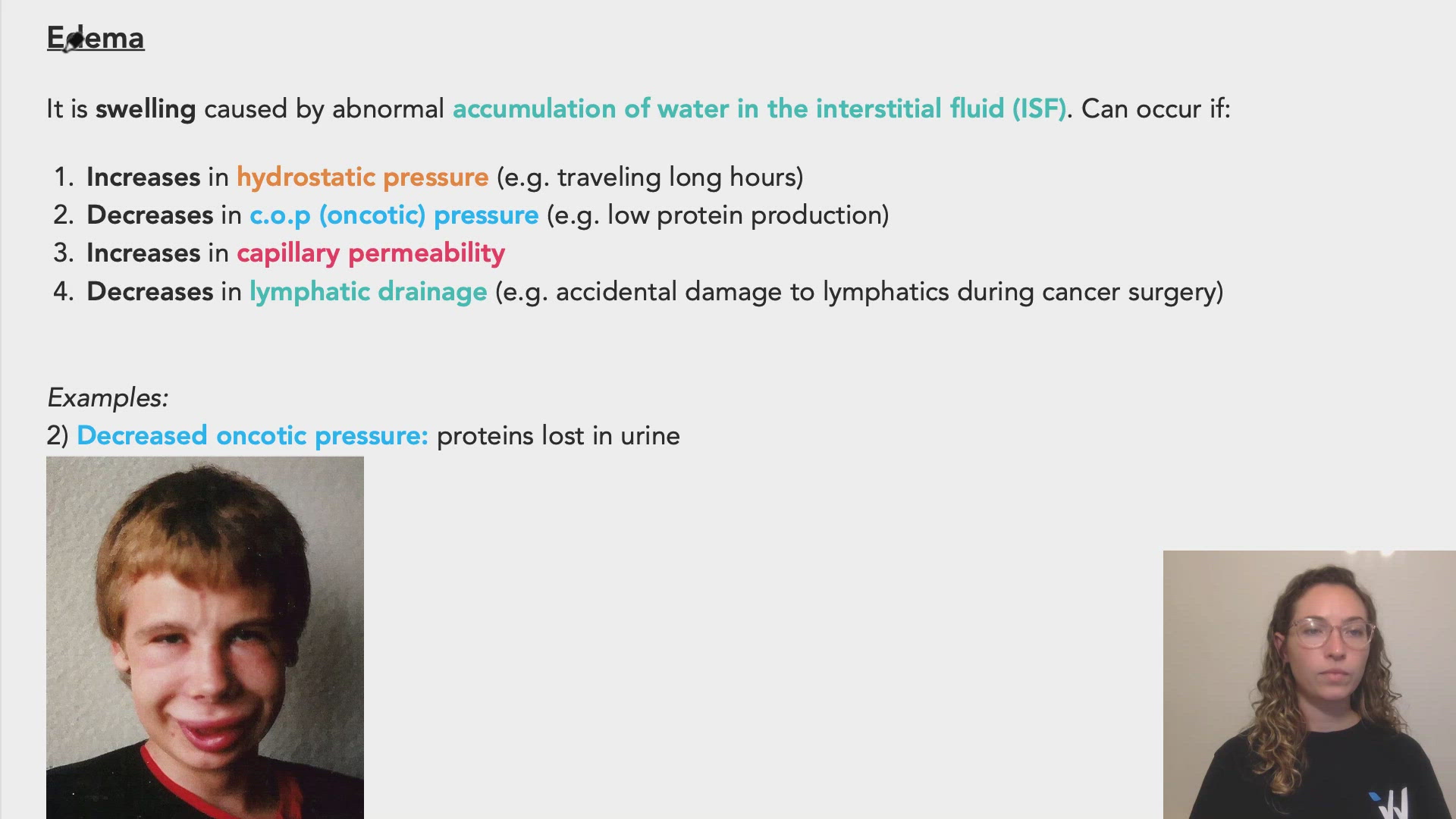
Edema
It is swelling caused by abnormal accumulation of water in the interstitial fluid (ISF). Can occur if:
- Increases in hydrostatic pressure (e.g. traveling long hours)
- Decreases in c.o.p (oncotic) pressure (e.g. low protein production)
- Increases in capillary permeability
- Decreases in lymphatic drainage (e.g. accidental damage to lymphatics during cancer surgery)
Examples:
2) Decreased oncotic pressure: proteins lost in urine

Other example: liver problems
3) Decreased lymphatic drainage: breast cancer surgery

Other example: cancer itself blocking drainage, parasitic infections
Wize Tip
Instead of just memorizing all the causes of edema, think through a particular situation and you will be able to figure out the outcomes!
0:00 / 0:00
An individual with liver disease is given an infusion of albumin. What is the effect of this infusion on their transcapillary dynamics (i.e. what will happen to the balance of oncotic vs hydrostatic pressure)?
Albumin the plasma protein that contributes most to the colloidal osmotic (oncotic) pressure. It is the protein in highest concentration in the blood and has this osmotic effect because it cannot cross the capillary wall. In liver disease, albumin production might be decreased, warranting albumin replacement.

An increase in albumin in blood will draw water into the capillaries, while a decrease in albumin would to the opposite.
All of the following are false, except:
Which of the following could be causes of edema:
Regarding transcapillary dynamics, which of the following are true?