Wize University Physiology Textbook > Neurophysiology
Resting Membrane Potential
Popular Courses
MCAT
General Course
DAT
General Course
Intro to Physiology
University Study Guides
PHYSIOL 1021
Western University
PHYSIOL 2130
Western University
Intro to Physiology
University Study Guides
PSL300H1
University of Toronto
PHYSL 210
University of Alberta
PHGY 210
McGill University
PHGY 215
Queen's University
KNES 259
University of Calgary
PHGY 216
Queen's University
BIOL 273
University of Waterloo
BIOL 260
University of British Columbia
PHYSIOL 3120
Western University
KNES 260
University of Calgary
BIOL 116
Case Western Reserve University
PPT 301
University of North Dakota
ANAT 212
McGill University
HTHSCI 2FF3
McMaster University
0:00 / 0:00
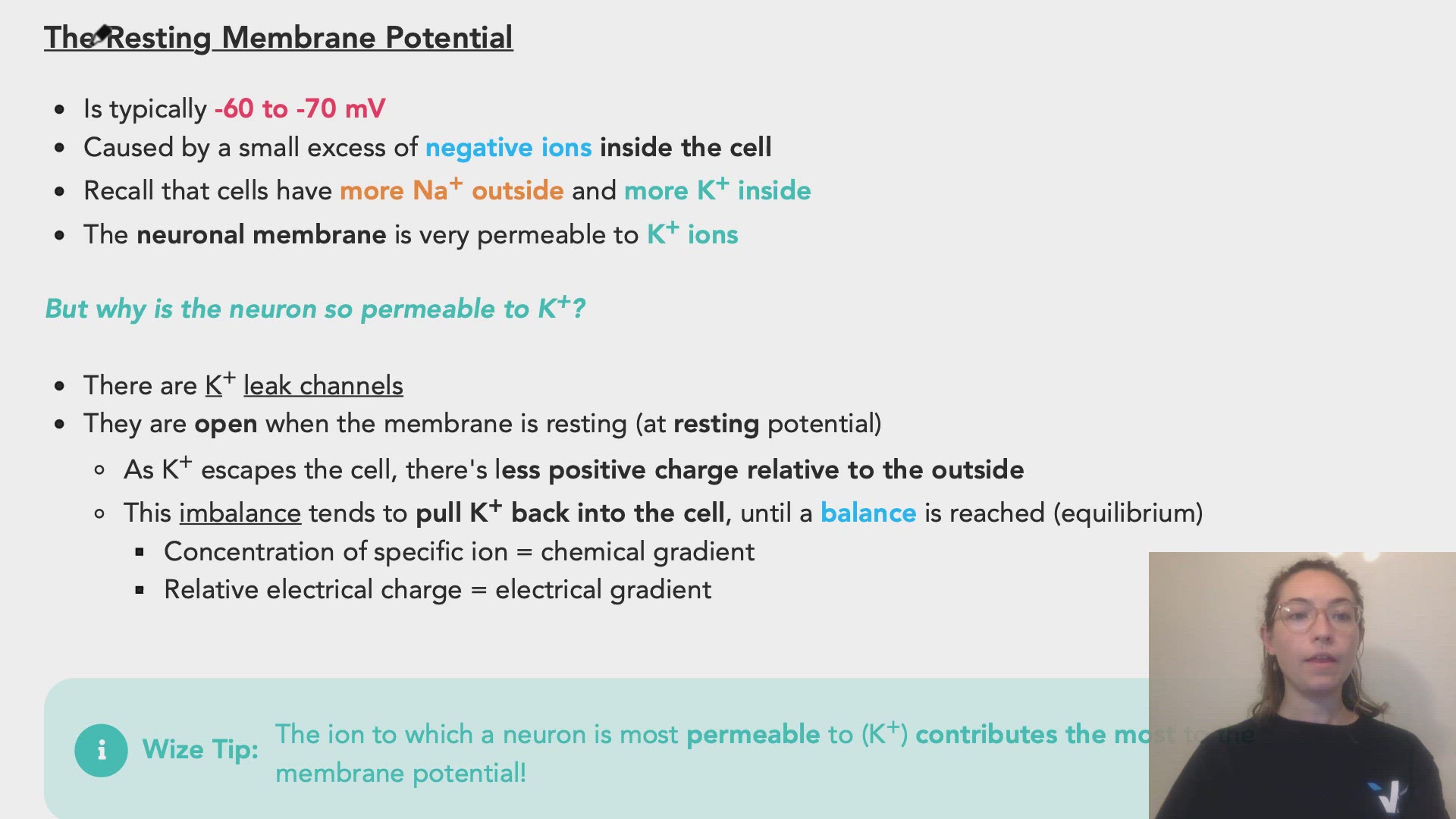
The Resting Membrane Potential
- Is typically -60 to -70 mV
- Caused by a small excess of negative ions inside the cell
- Recall that cells have more Na+ outside and more K+ inside
- The neuronal membrane is very permeable to K+ ions
But why is the neuron so permeable to K+?
- There are K+ leak channels
- They are open when the membrane is resting (at resting potential)
- As K+ escapes the cell, there's less positive charge relative to the outside
- This imbalance tends to pull K+ back into the cell, until a balance is reached (equilibrium)
- Concentration of specific ion = chemical gradient
- Relative electrical charge = electrical gradient
Wize Tip
The ion to which a neuron is most permeable to (K+) contributes the most to the membrane potential!

The Sodium-Potassium Pump
- Remember: PumpKin
- Responsible for maintaining the Na+/K+ gradients
- It is an ATPase
0:00 / 0:00
What would be the resting membrane potential if the membrane was exclusively permeable to Cl-? (a qualitative answer is ok)
To begin this question you must recall that there is more Cl- outside of the cell than inside --> this means that Cl- would tend to move inward into the cell.
If no other ions were entering or leaving the cell at rest, the resting membrane potential would be equal to the Cl- equilibrium potential.
To calculate the actual number, you could use the Nernst equation. However, memorizing and using this equation is not important for your exam, but you might want to keep in mind that this equation takes into consideration the charge of the ion in question and the intracellular versus extracellular concentrations of that ion. Given that you know that for positively charged ions, the equilibrium potential is positive if there's more ion outside rather than inside the cell (for instance, ENa = +70mV), you may conclude that this will be the opposite for a negatively charged ion such as Cl-. Therefore, ECl is likely close to -70mV (the actual answer is -80mV).
What would occur to the resting membrane potential if the permeability of the cell membrane to Na+ was increased?