Wize University Physiology Textbook > Neurophysiology
Action Potentials
Popular Courses
MCAT
General Course
DAT
General Course
Intro to Physiology
University Study Guides
PHYSIOL 1021
Western University
PHYSIOL 2130
Western University
Intro to Physiology
University Study Guides
PSL300H1
University of Toronto
PHYSL 210
University of Alberta
PHGY 210
McGill University
PHGY 215
Queen's University
KNES 259
University of Calgary
PHGY 216
Queen's University
BIOL 273
University of Waterloo
BIOL 260
University of British Columbia
PHYSIOL 3120
Western University
KNES 260
University of Calgary
BIOL 116
Case Western Reserve University
PPT 301
University of North Dakota
ANAT 212
McGill University
KNES 323
University of Calgary

0:00 / 0:00
Voltage-Gated Sodium Channel
- It has three states:
- Closed - at resting membrane potential
- Open - when the membrane depolarizes
- Inactive - quickly stops flow of Na+ after depolarization
- There are many more voltage-gated Na+ channels in the axon than leaky K+ channels
- The equilibrium potential for Na+ (ENa+) is +70 mV
- This means that the more Na+ that can enter the cell, the more positive the membrane potential will become

commons.wikimedia.org
- These Na+ channels are targets for many naturally-occurring neurotoxins, local anesthetics and anti-epileptic medications
Voltage-Gated Potassium Channel
- Only open or closed
- Slow - doesn't open right away which allows Na+ to have a head-start. Without this slowness, there would be no AP at all!
- Helps with repolarization - K+ moves down its electrochemical gradient.
0:00 / 0:00
The Action Potential
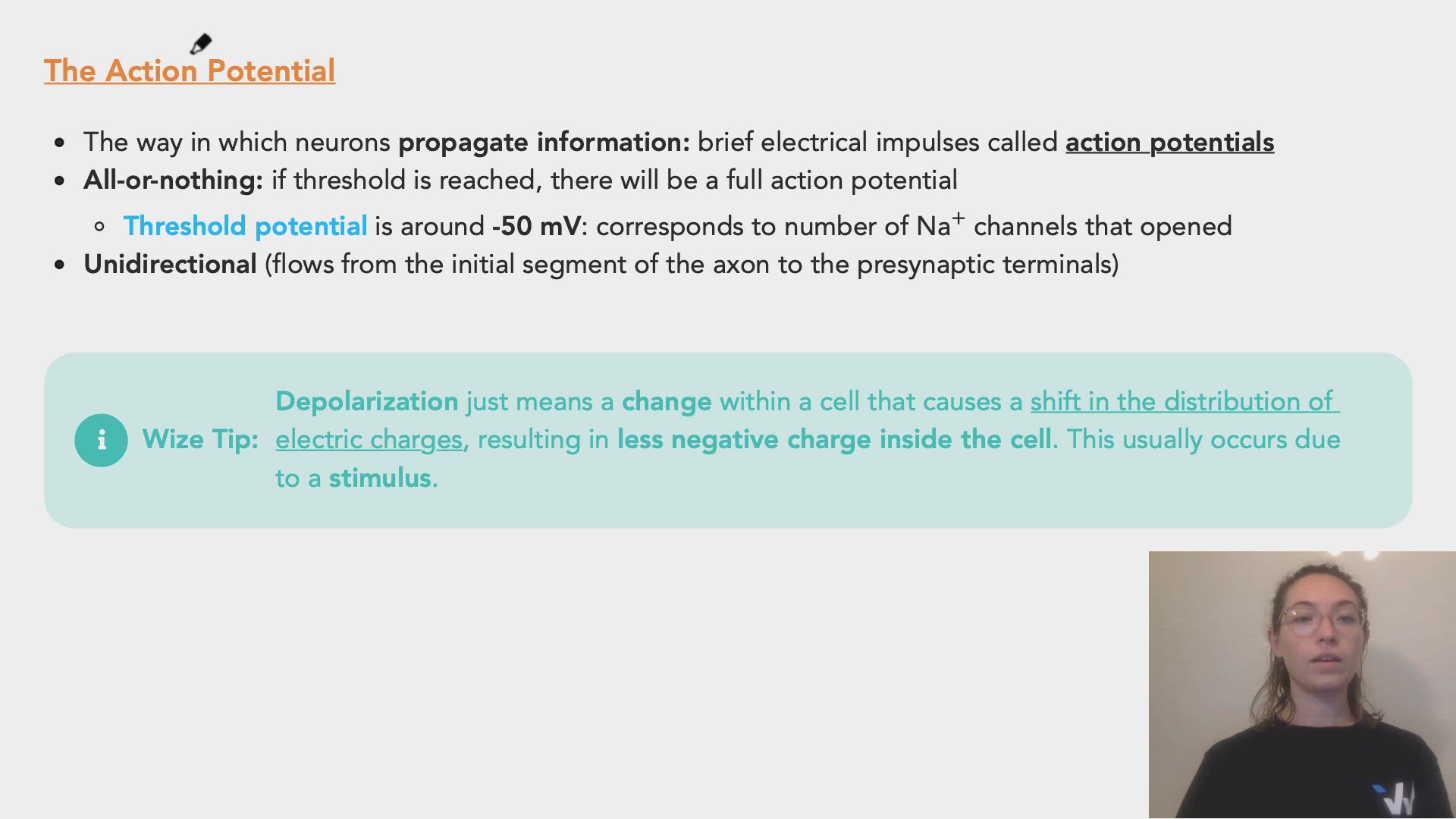
- The way in which neurons propagate information: brief electrical impulses called action potentials
- All-or-nothing: if threshold is reached, there will be a full action potential
- Threshold potential is around -50 mV: corresponds to number of Na+ channels that opened
- Unidirectional (flows from the initial segment of the axon to the presynaptic terminals)
Wize Tip
Depolarization just means a change within a cell that causes a shift in the distribution of electric charges, resulting in less negative charge inside the cell. This usually occurs due to a stimulus.
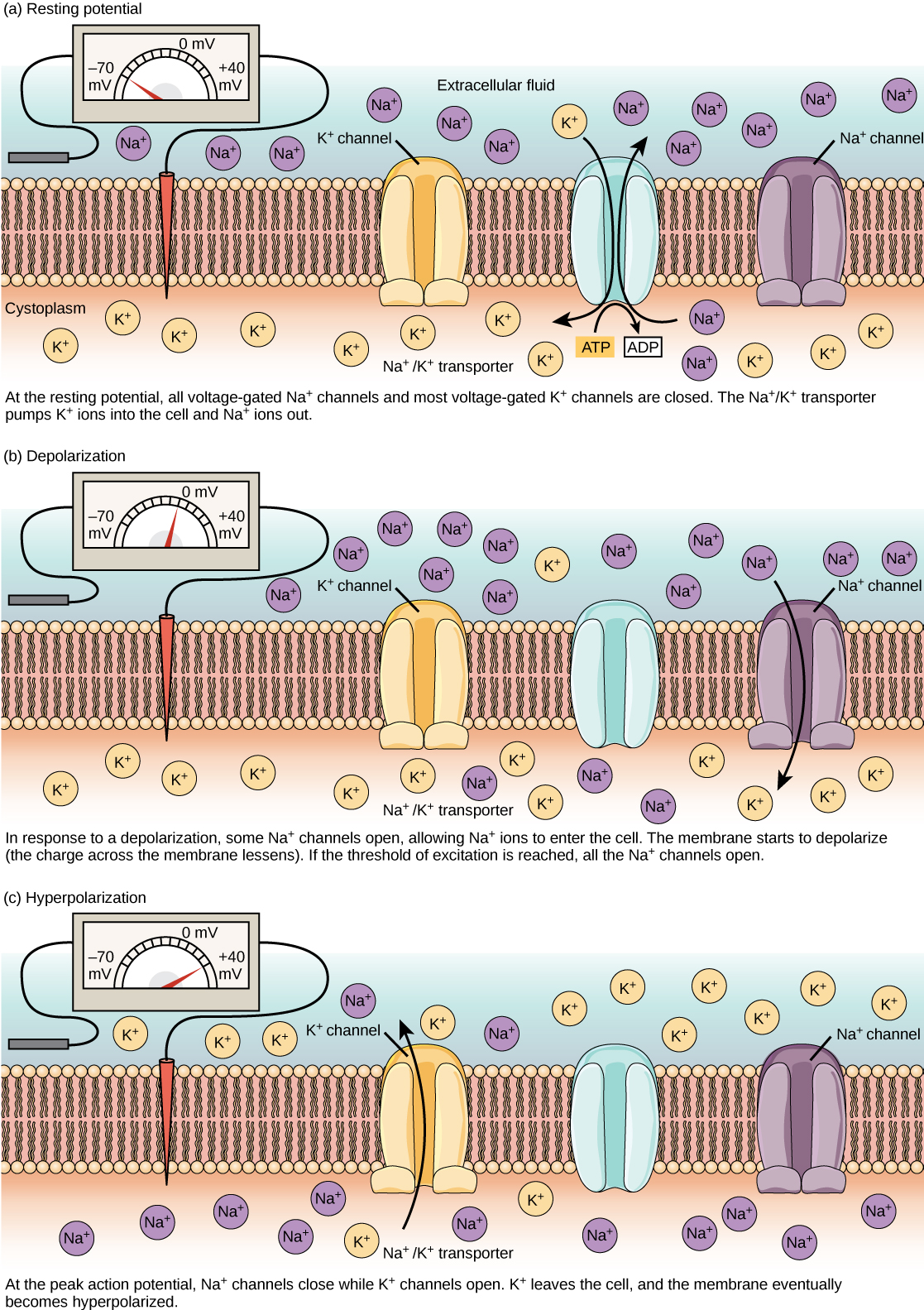
Steps of the Action Potential
commons.wikipedia.org
This can also be observed in this format:

- Voltage-gated sodium channels open at threshold
- At the peak, voltage-gated sodium channels become inactivated , and voltage-gated potassium channels open. The cell now repolarizes.
- While sodium channels are inactivated, the neuron is in the absolute refractory period (can’t fire another AP)
- The cell becomes hyperpolarized because voltage-gated potassium channels stay open
- At this point, voltage-gated sodium channels are ready to open again (absolute refractory ends)
- While hyperpolarized, the neuron is in the relative refractory period (harder to fire another AP)
- Cell is returned to RMP by resting machinery (i.e. Na + /K + ATPase pump)

0:00 / 0:00
Action Potential Propagation
Maintained by sodium diffusion in the neuron.
- The diffusion of Na+ in one area causes the voltage gated Na+ channels further down the axon to open.
- This continues all the way down the axon like a game of telephone until the signal reaches the axon terminal.

commons.wikimedia.org
- Action potential propagation is unidirectional due to the absolute refractory period (Na+ channels are inactivated)
Factors Affecting Speed of Propagation
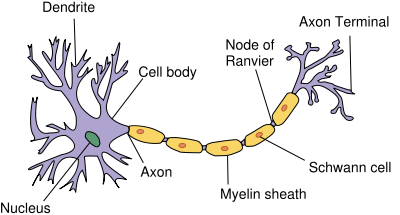
- Diameter of the axon - larger axons propagate faster.
- Myelination - more insulation means less ion leakage, increases conduction velocity
- Saltatory conduction - the term used when AP can skip places on the axon that are myelinated.
- Myelin is formed by Schwann cells in the PNS and oligodendrocytes in the CNS
commons.wikipedia.org
Exam Tip
White matter corresponds to regions of the brain/spinal cord that contain axons with myelin. The way I remember this is that fat tends to look white.
0:00 / 0:00
You are bored in class and start drawing on your hand with a pen. You notice that the more pressure you apply to your arm, the more intense the sensation of the pen against your skin becomes. How do neurons communicate to your brain the differences in intensity of sensation, in terms of action potential patterns?
- Action potentials are all-or-none events. As long as the threshold potential is reached, the AP will fire.
- That means that when you press the pen against your skin, this does not increase the magnitude (size) of the action potential. What increases is the frequency of firing of action potentials.
- In this situation: more pressure ==> more frequent firing.
You are plotting to take over the world and decide to develop a neurotoxin to attack the population. You want to make your neurotoxin similar to naturally-occurring ones, such as those in puffer fish (tetrodotoxin) and frogs (batrachotoxin). What channel will your neurotoxin target?
A patient has been experiencing tingling and numbness on his arms and legs, occasional vision problems and dizziness. Upon seeing his physician and obtaining brain imaging, he is told that he has a disease that results in loss of myelin. What would be expected to be seen?