Popular Courses
MCAT
General Course
DAT
General Course
Intro to Physiology
University Study Guides
PHYSIOL 1021
Western University
PHYSIOL 2130
Western University
Intro to Physiology
University Study Guides
PSL300H1
University of Toronto
PHYSL 210
University of Alberta
PHGY 210
McGill University
PHGY 215
Queen's University
KNES 259
University of Calgary
PHGY 216
Queen's University
BIOL 273
University of Waterloo
BIOL 260
University of British Columbia
PHYSIOL 3120
Western University
KNES 260
University of Calgary
BIOL 116
Case Western Reserve University
PPT 301
University of North Dakota
ANAT 212
McGill University
KNES 323
University of Calgary

0:00 / 0:00
Chemical Synapse
- A synapse is the connection between two nerves.
- Once the AP reaches the end of the axon, it must transmit its information to the next neuron or target cell. It does this via a chemical synapse.
Steps of Synaptic Transmission
- AP reaches the axon terminal, causing voltage gated Ca2+ channels to open.
- Ca2+ rushes into the terminal.
- This Ca2+ influx causes pre-prepared vesicles full of neurotransmitters to be released from the terminal into the synaptic cleft between the two cells.
- The neurotransmitters bind to receptors on the post-synaptic cell.
- Response in post-synaptic cell (in this case, AP propagation)

commons.wikimedia.org
ANALOGY: I like to think of the neurotransmitters like a small navy of soldiers. They are set up in groups. Each group is on a boat and they are waiting for the signal to charge. Once the Ca2+ channels open, its like a flag waving or a trumpet sounding - now it's time to attack! The vesicles (boats) reach the synaptic cleft (land) and the neurotransmitters (soldiers) get off the boat to find something to attack
Post Synaptic Effects
- Things that happen after the synaptic transfer of information
- Could be excitatory or inhibitory
- Excitatory: called an excitatory postsynaptic potential (EPSP)
- Chemically gated Na+ channel allows Na+ into the cell causing an AP (depolarization)
- Inhibitory: called inhibitory postsynaptic potential (IPSP)
- Chemically gated K+ or Cl- channels allow those ions out of the cell, causing it to become even more negative inside (hyperpolarization)
- Whether or not an EPSP or IPSP will occur depends on the neurotransmitter that binds to post-synaptic neuron
0:00 / 0:00
Excitatory Synapses
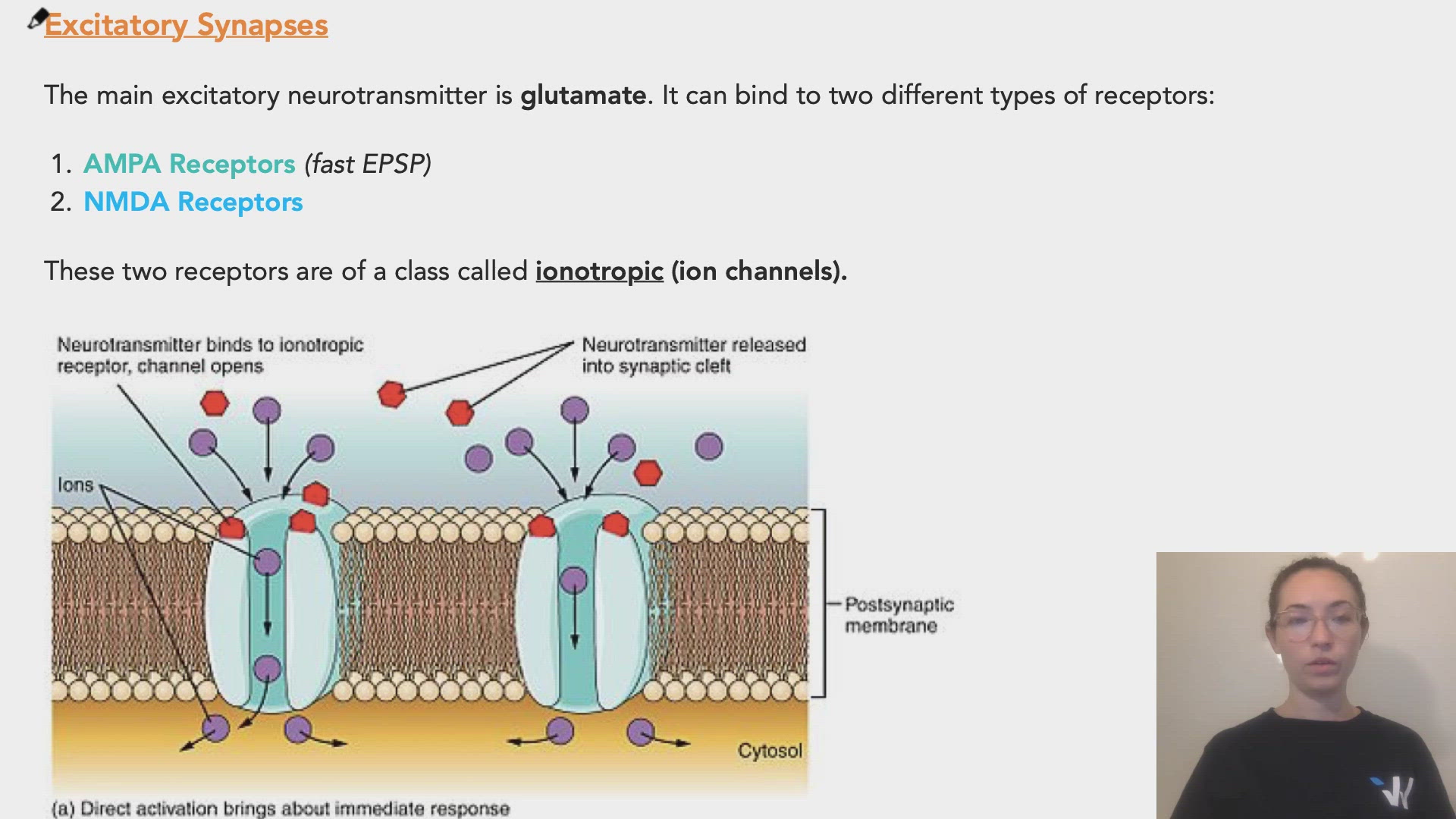
The main excitatory neurotransmitter is glutamate. It can bind to two different types of receptors:
- AMPA Receptors (fast EPSP)
- NMDA Receptors
These two receptors are of a class called ionotropic (ion channels).

commons.wikipedia.org
- The EPSP is a small, transient depolarization
- A single one is too small to reach down to the initial segment of the axon
- Rather, 50-100 EPSPs must add up to generate an action potential
AMPA Receptors
- Specific to Na+ ions
- Results in an influx of Na+ ––> an AP will fire in the post synaptic cell.
- This is an excitatory post-synaptic response/potential (EPSP)
- At the RMP, AMPA receptors are doing all the work
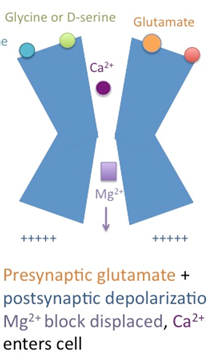
NMDA Receptors
- When cell is resting, the pore of the receptor is blocked by Mg2+ ion
- When depolarization occurs, magnesium leaves
- Allows for Ca2+ and other cations to enter
- Only occurs when the membrane is depolarized
Excitotoxicity
Excessive stimulation of a neuron by glutamate can kill the cell. This is called excitotoxicity.
- Thought to be linked to excessive Ca2+
- Can make things worse when neurons are already damaged
0:00 / 0:00
Inhibitory Synapses
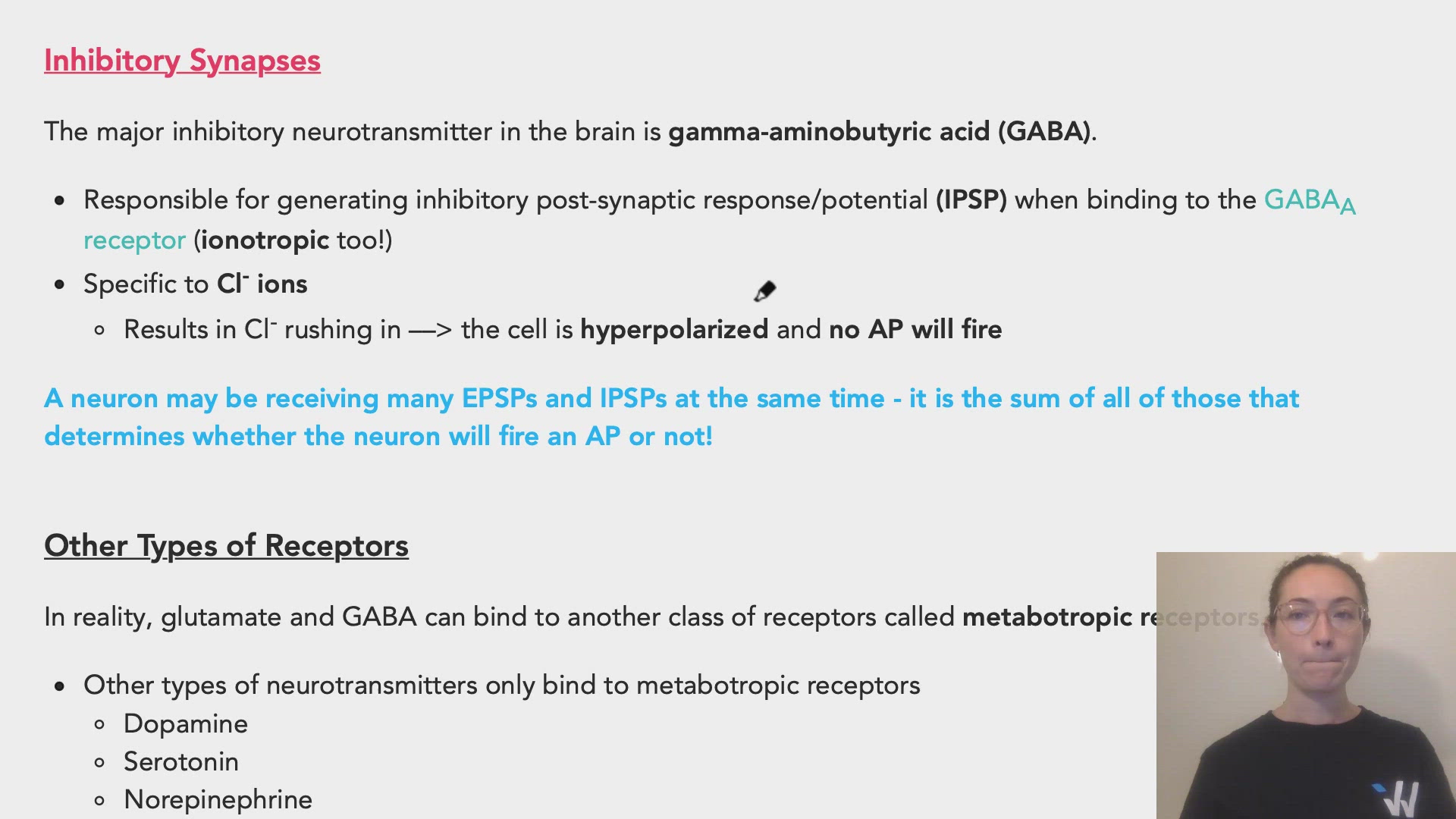
The major inhibitory neurotransmitter in the brain is gamma-aminobutyric acid (GABA).
- Responsible for generating inhibitory post-synaptic response/potential (IPSP) when binding to the GABAA receptor (ionotropic too!)
- Specific to Cl- ions
- Results in Cl- rushing in ––> the cell is hyperpolarized and no AP will fire
A neuron may be receiving many EPSPs and IPSPs at the same time - it is the sum of all of those that determines whether the neuron will fire an AP or not!
Other Types of Receptors
In reality, glutamate and GABA can bind to another class of receptors called metabotropic receptors.
- Other types of neurotransmitters only bind to metabotropic receptors
- Dopamine
- Serotonin
- Norepinephrine
- Endorphins

Put the steps of chemical synapse transmission in the correct order by inputing numbers 1 through 5:
This Ca2+ influx causes pre-prepared vesicles full of neurotransmitters to be released from the terminal into the synaptic cleft between the two cells.
Response in post-synaptic cell (in this case, AP propagation)
AP reaches the axon terminal, causing voltage gated Ca2+ channels to open.
The neurotransmitters bind to receptors on the post-synaptic cell.
Ca2+ rushes into the terminal.
Which of the following would cause neurotransmitter release from the presynaptic terminal?
Which of the following is true regarding synapses?