Wize University Psychology Textbook > Memory
Brain Regions & Mechanisms Involved in Memory
Popular Courses
MCAT
General Course
Psychology
University Study Guides
PSYC 100
Queen's University
PSYCH 1000
Western University
PSYCH 1X03
McMaster University
PSYCH 104
University of Alberta
PSYCHOL 1002A/B
Western University
Psychology
University Study Guides
PSYC*1000
University of Guelph
PSYC 100
McGill University
PSY100H1
University of Toronto
PSYC 101
University of British Columbia
HH/PSYC 1010 6.00
York University
PSYC 200
University of Calgary
PSYC 100B
Queen's University
PSYC 100A
University of Victoria
PSYC 200
Concordia University
PSYC 1004
Virginia Tech
PSYCH 100
Pennsylvania State University
PSY 2012
University of Florida
0:00 / 0:00
Brain Regions & Mechanisms Involved in Memory
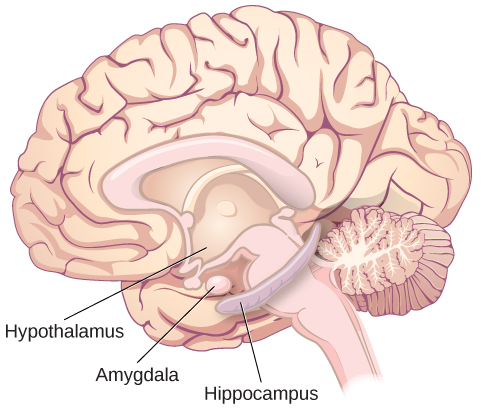
Hippocampus - formation of new explicit/declarative memories
Damage to the hippocampus impairs our ability to form new explicit/declarative memories, but not new implicit/nondeclarative memories.
The hippocampus is not where memories are stored - once memories are consolidated, the hippocampus does not play much of a role, if any, in retrieval.
Amygdala - emotional learning and the emotional aspects of memories
Cerebellum - important for implicit memory formation
Changes in Synaptic Connections
Long-term potentiation - often summarized as "neurons that fire together wire together". When a pair of neurons (presynaptic and postsynaptic) are repeatedly stimulated, it becomes easier for the presynaptic neuron to trigger the postsynaptic neuron to fire.
Synaptic consolidation - when memories are brand new (weeks to months), synaptic connections are just starting to form. As the memory ages, these connections get stronger.
Systemic consolidation - over time (months to years) memories become distributed throughout the brain, and the hippocampus is no longer needed to retrieve them. There is no one place in the brain where memories are stored.
Practice: Brain Regions and Memory
A patient whose hippocampus is removed will likely struggle to: