Wize University Psychology Textbook > Learning
Knowledge Emotions
Popular Courses
Psychology
University Study Guides
PSYC 100
Queen's University
Psychology
University Study Guides
PSYC 100B
Queen's University
PSYC 200
Concordia University
PSYC 1004
Virginia Tech
PSYCH 100
Pennsylvania State University
PSC 001
University of California - Davis
PSY 2012
University of Florida
PSY 101
Michigan State University
PSYCH10
University of California - Los Angeles
PSY 101
San Diego State University
PSC 001Y
University of California - Davis
PSY 101
University of Arizona
PSYC 1001
University of Cincinnati
PSY 101
Arizona State University - Tempe
PSY 200
North Carolina State University
PSY-P 101
Indiana University - Bloomington
PY 101
The University of Alabama
PSYC 1315
University of Texas at Arlington
0:00 / 0:00
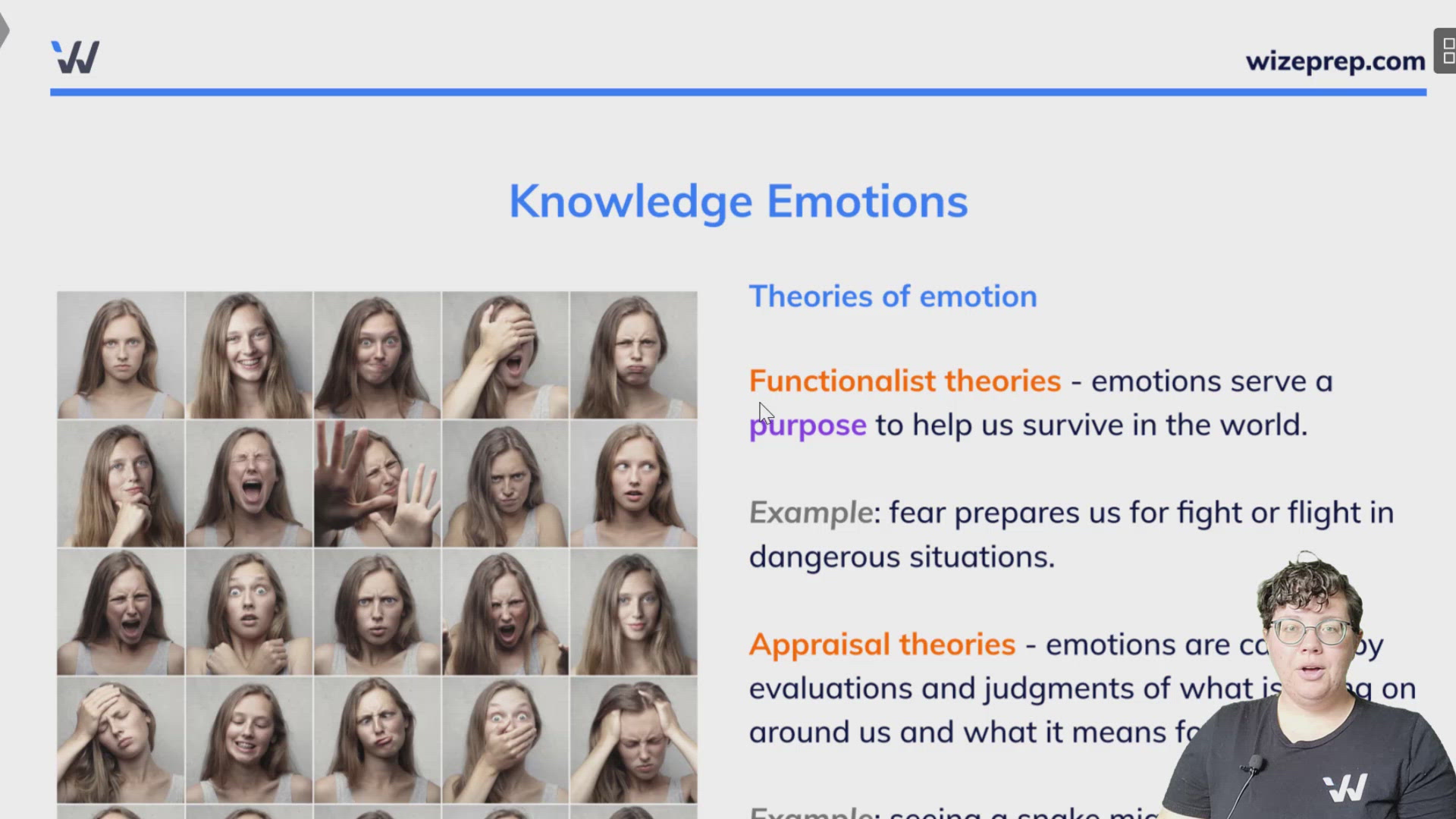
Knowledge Emotions

Theories of emotion
Functionalist theories - emotions serve a purpose to help us survive in the world.
Example: fear prepares us for fight or flight in dangerous situations.
Appraisal theories - emotions are caused by evaluations and judgments of what is going on around us and what it means for us.
Example: seeing a snake might cause fear if you are out in the wild in a place with dangerous snakes, but curiosity if you are at a reptile zoo.
Knowledge Emotions
Surprise - cues us that something is unexpected or different from its surroundings.
Interest - engages us with things that are novel or unusual. Interest provides intrinsic motivation to learn - motivation that comes from within.
Interest promotes faster, deeper, better, and more enjoyable learning.
Confusion - results from appraisal that the situation is unfamiliar and hard to understand.
Working through a problem that is confusing can result in deeper, more active learning.
Awe - fascination and wonder caused by profound experiences. Can result from shifting world views in response to new information or experiences.
Practice: Knowledge Emotions
Margaret's professor gives an assignment that has very few directions, and some of the directions that are there are conflicting. Which emotion is Margaret likely to experience?