Wize University Psychology Textbook > Intelligence
Defining & Measuring Intelligence
Popular Courses
Psychology
University Study Guides
PSYC 100
Queen's University
PSYCH 1X03
McMaster University
Psychology
University Study Guides
PSY100H1
University of Toronto
PSYCHOL 1003A/B
Western University
HH/PSYC 1010 6.00
York University
PSYC 200
University of Calgary
PSYC 102
University of British Columbia
PSYC 100B
Queen's University
PSYC 200
Concordia University
PSYCH 100
Pennsylvania State University
PSC 001
University of California - Davis
PSY 2012
University of Florida
PSY 101
Michigan State University
PSYCH10
University of California - Los Angeles
PSC 001Y
University of California - Davis
PSY 101
San Diego State University
PSY 101
University of Arizona
PSYC 1001
University of Cincinnati
0:00 / 0:00
Defining & Measuring Intelligence

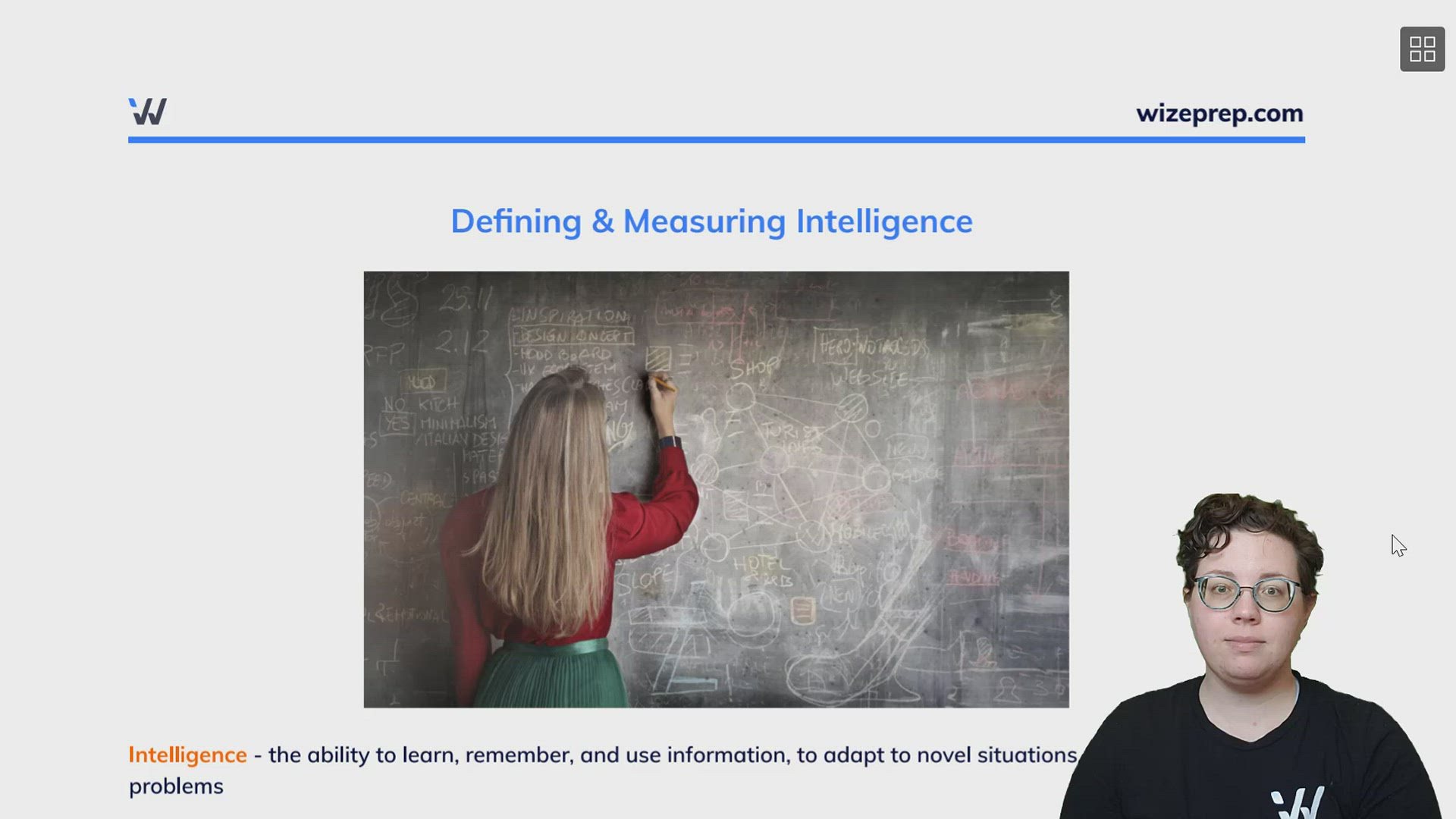
Intelligence - the ability to learn, remember, and use information, to adapt to novel situations, and to solve problems
- Spearman - intelligence is one thing, which he called general intelligence or g
- Galton - pioneered psychological measurement and idea that we could look at heritability by studying twins
- Binet & Simon - developed test of intelligence in children that became the first IQ test
Intelligence Quotient (IQ)
- Originally calculated as a ratio of mental age to physical age
- Now we use deviation IQ, which compares performance to those of the same age
Stanford-Binet Intelligence Test - first standardized intelligence test, developed by Terman
- Measured a large sample of children
- Could categorize and compare between individuals
- "normed" so that 100 = average
Wechsler Adult Intelligence Scale - measures ability to remember, calculate, comprehend language, reason, and process information
Flynn effect - when people today take older versions of IQ tests, average scores are above 100
Who developed the first widely used intelligence test?
Practice: Defining & Measuring Intelligence
Which of the following facts about IQ is incorrect?
Practice: Defining & Measuring Intelligence
Which of the following is NOT true of intelligence?
Which intelligence test first suggested the notion of "mental age"?