Wize University Psychology Textbook > Development
Social & Personality Development
Popular Courses
MCAT
General Course
Psychology
University Study Guides
PSYC 100
Queen's University
Psychology
University Study Guides
PSYC*1000
University of Guelph
PSYCH 1XX3
McMaster University
PSY100H1
University of Toronto
PSYCHOL 1003A/B
Western University
HH/PSYC 1010 6.00
York University
PSYC 102
University of British Columbia
PSYC 201
University of Calgary
PSYC 200
Concordia University
PSYC 1004
Virginia Tech
PSYCH 100
Pennsylvania State University
PSC 001
University of California - Davis
PSY 2012
University of Florida
PSY 101
Michigan State University
PSYCH10
University of California - Los Angeles
PSY 101
San Diego State University
PSC 001Y
University of California - Davis

0:00 / 0:00
Social & Personality Development

Emotions & Emotion Regulation
Social referencing - infants look to their parents for feedback on new situations
Children use the emotions of others as feedback to guide their own behaviour
Emotion regulation - process of evaluating and modifying our emotional reactions and responses. Increases with age
Emotional development is influenced by social interactions as well as temperament - biologically-based, general way of responding to situations
Temperament is classified into three groups:
- Easy infants - calm, playful, eat and sleep on schedule, adapt quickly to new situations
- Difficult infants - irritable, fussy sleepers and eaters, react poorly to new situations
- Slow to warm up infants - mild negative response to new situations, but adapt over time
Behavioural inhibition - temperament style based on responses to unfamiliar situations
- Inhibited infants are quiet, timid, and withdraw in unfamiliar situations
- Uninhibited infants are more vocal, outgoing, and sociable
- Predictive of childhood behaviour only for the most highly inhibited or uninhibited
Personality shaped by goodness of fit between temperament and environment
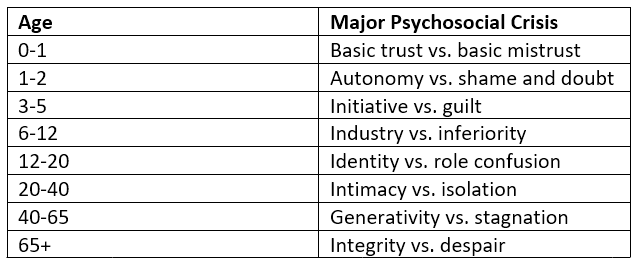
Erikson's Psychosocial Theory
Development is a series of crises - each one must be resolved to successfully move on to the next stage
Practice: Social & Personality Development
The crisis occurring in the first year, according to Erikson, is one involving;
Practice: Social & Personality Development
Elizabeth is struggling in adulthood to find happiness within herself, she struggles with intimacy but constantly feels isolated. This is a completely normal challenge of development, according to which theorist?