Create a free account to get started

Unlock full course notes by signing up

  • Video lessons taught by top educators
  • Practice questions with guided solutions
  • Written review notes for reference
  • Expert answers anytime from course tutors

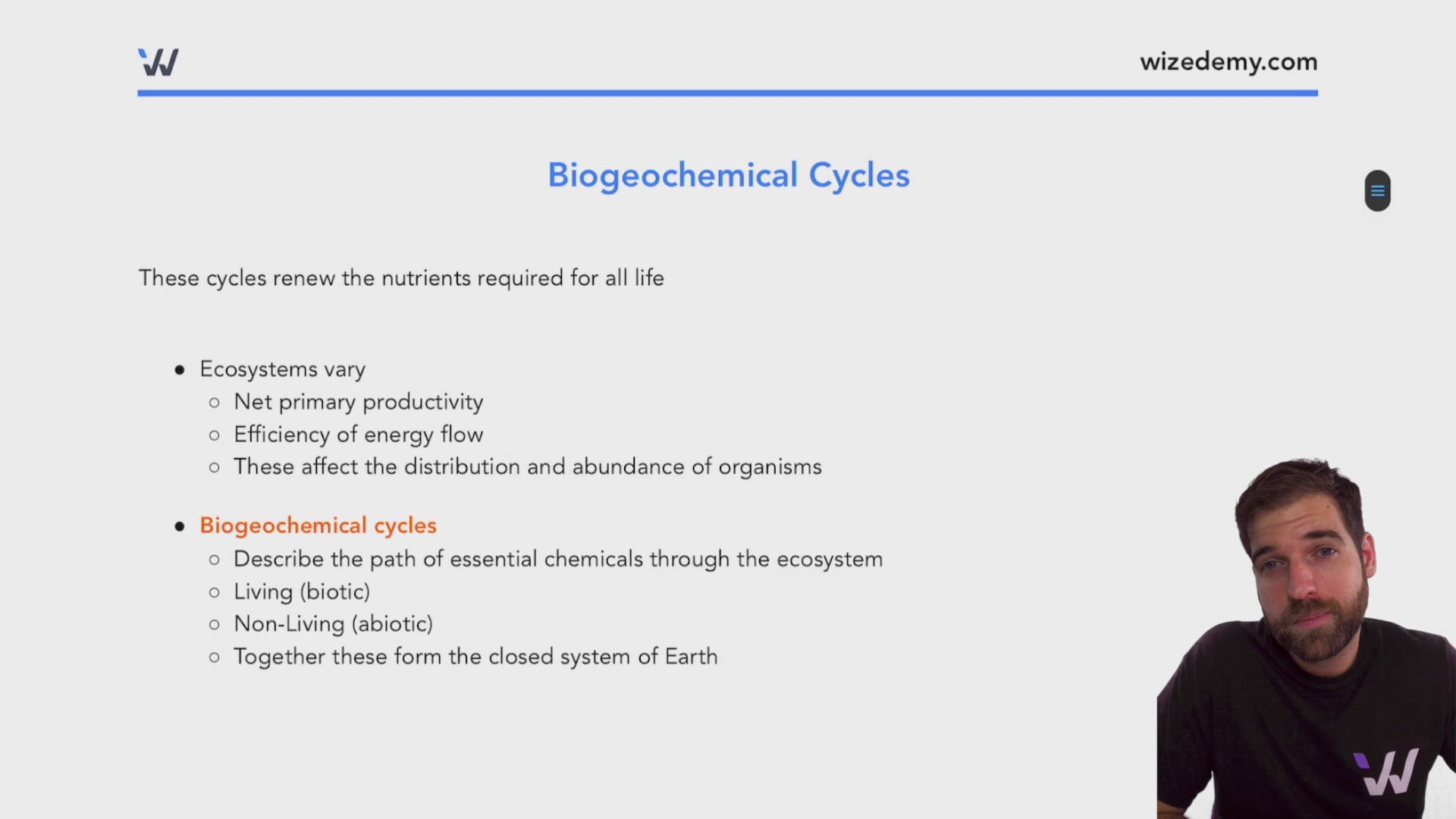
Biogeochemical Cycles


These cycles renew the nutrients required for all life


  • Ecosystems vary
  • Net primary productivity
  • Efficiency of energy flow
  • These affect the distribution and abundance of organisms
  • Biogeochemical cycles
  • Describe the path of essential chemicals through the ecosystem
  • Living (biotic)
  • Non-Living (abiotic)
  • Together these form the closed system of Earth


Carbon Cycle

Carbon

  • Essential building block of life
  • Exists in many minerals

Carbon Reservoirs

  • Most carbon is stored in reservoirs Examples: Fossil fuels, sediment, dissolved in ocean, stored in plant and animals

Atmospheric Carbon

  • Most available form for life
  • Found as CO2 gas
  • Removed from atmosphere by photosynthesis

Organic Carbon

  • Terrestrial
  • Plants remove CO2 from atmosphere
  • Consumers eat plants to obtain carbon
  • Release CO2 back into atmosphere through respiration (breathing)
  • Decomposers break down complex carbon molecules and release back into cycle
  • Aquatic Carbon
  • Removed from atmosphere through photosynthesis
  • Runs into water from terrestrial system


Image illustrating Carbon Cycle


Create a free account to get started

Unlock full course notes by signing up

  • Video lessons taught by top educators
  • Practice questions with guided solutions
  • Written review notes for reference
  • Expert answers anytime from course tutors

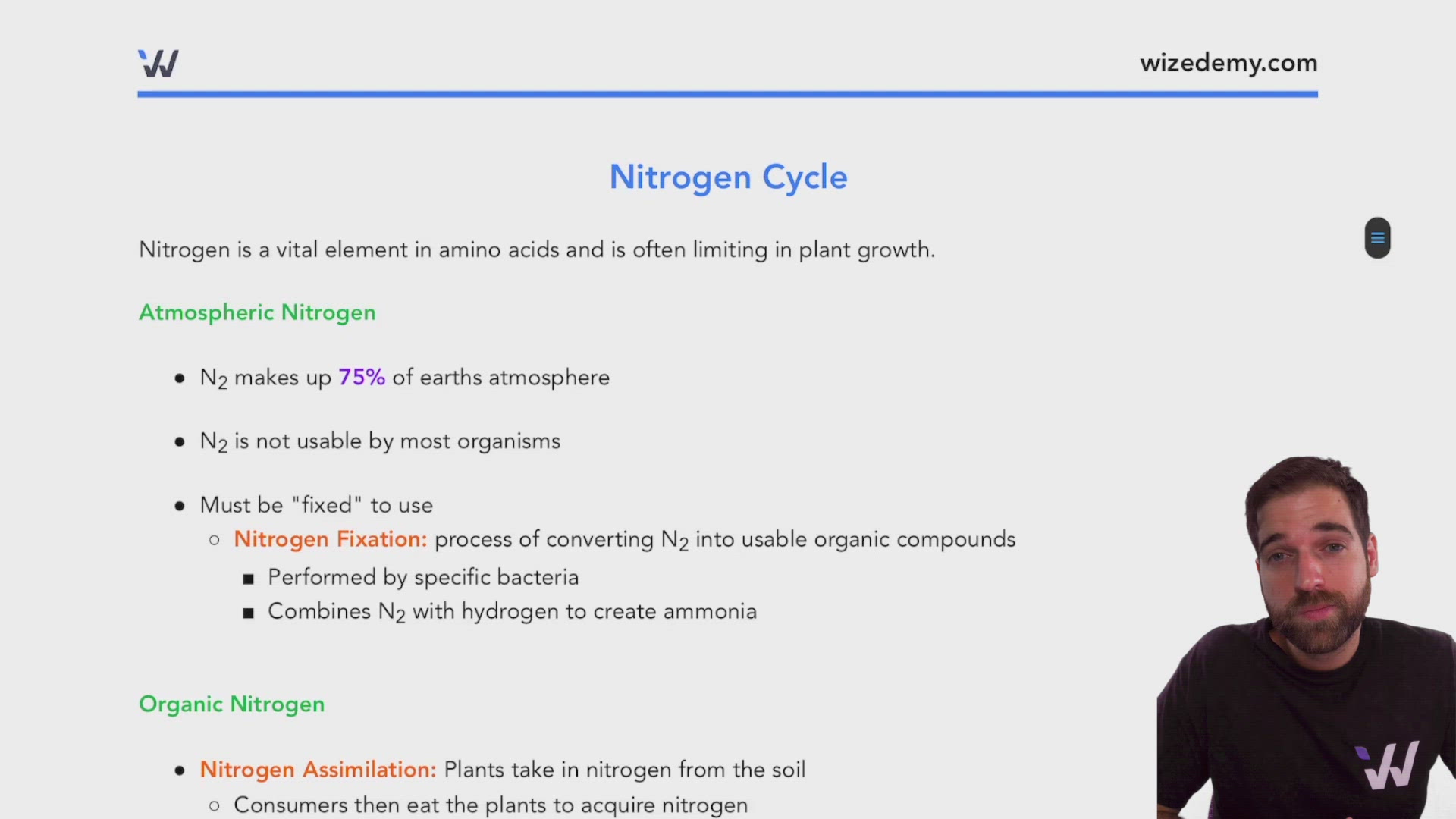
Nitrogen Cycle

Nitrogen is a vital element in amino acids and is often limiting in plant growth.

Atmospheric Nitrogen

  • N2 makes up 75% of Earth's atmosphere
  • N2 is not usable by most organisms
  • Must be "fixed" to use
  • Nitrogen Fixation: process of converting N2 into usable organic compounds
  • Performed by specific bacteria
  • Combines N2 with hydrogen to create ammonia

Organic Nitrogen

  • Nitrogen Assimilation: Plants take in nitrogen from the soil
  • Consumers then eat the plants to acquire nitrogen
  • Animal waste and decomposition contains nitrogen which is released back into the soil
  • Oceans cycle nitrogen in a similar way
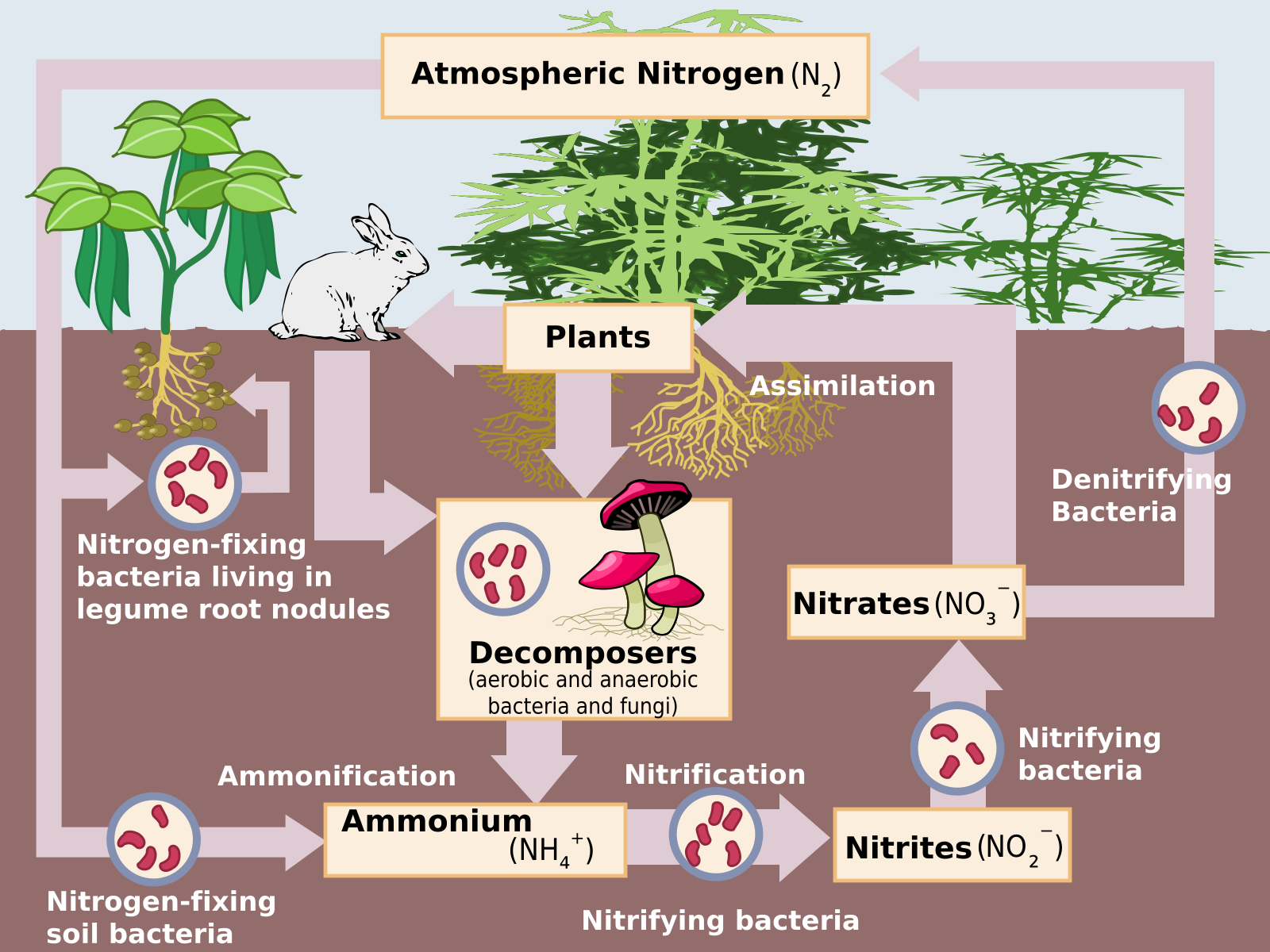
Image illustrating Nitrogen Cycle

Photo by Johann Dreo | CC BY

Create a free account to get started

Unlock full course notes by signing up

  • Video lessons taught by top educators
  • Practice questions with guided solutions
  • Written review notes for reference
  • Expert answers anytime from course tutors


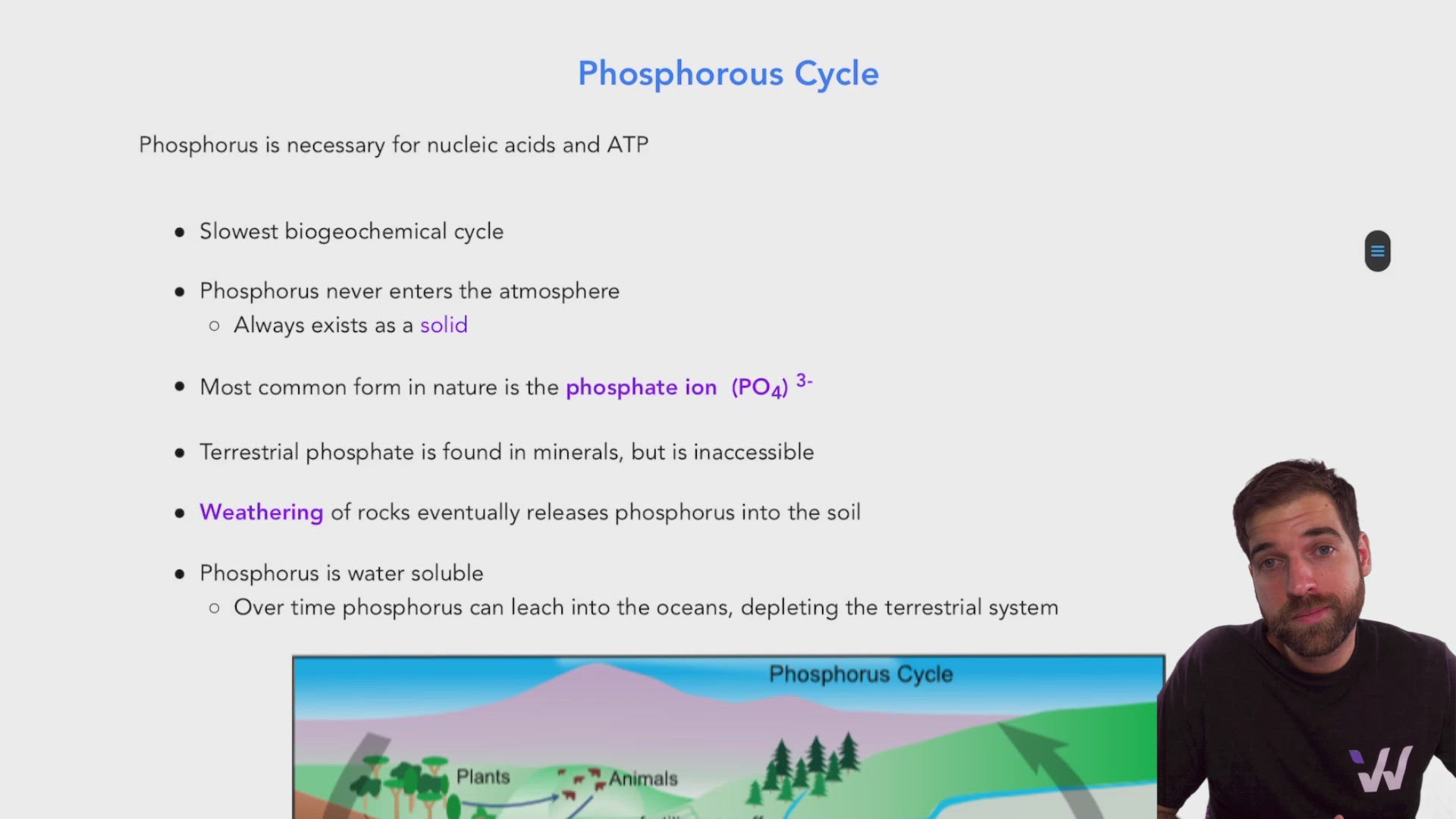
Phosphorous Cycle

Phosphorus is necessary for nucleic acids and ATP

  • Slowest biogeochemical cycle
  • Phosphorus never enters the atmosphere
  • Always exists as a solid
  • Most common form in nature is the phosphate ion (PO4) 3-
  • Terrestrial phosphate is found in minerals, but is inaccessible
  • Weathering of rocks eventually releases phosphorus into the soil
  • Phosphorus is water soluble
  • Over time phosphorus can leach into the oceans, depleting the terrestrial system
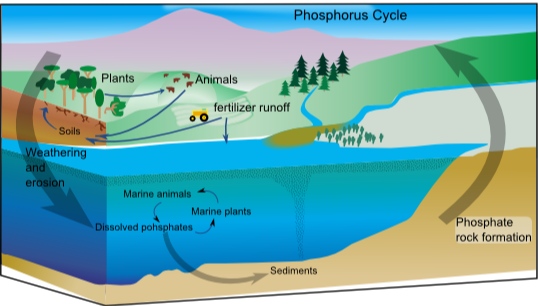
Image illustrating Phosphorous Cycle

Photo by Bonniemf | CC BY


Practice

Which biogeochemical cycle does not include an atmospheric (gas) stage?

Choose an answer

Create a free account to get started

Unlock full course notes by signing up

  • Video lessons taught by top educators
  • Practice questions with guided solutions
  • Written review notes for reference
  • Expert answers anytime from course tutors

Practice

Which of the following does NOT represent a Carbon reservoir?

Choose an answer

Create a free account to get started

Unlock full course notes by signing up

  • Video lessons taught by top educators
  • Practice questions with guided solutions
  • Written review notes for reference
  • Expert answers anytime from course tutors

Mark Yourself Question

  1. Grab a piece of paper and try this problem yourself.
  2. When you're done, check the "I have answered this question" box below.
  3. View the solution and report whether you got it right or wrong.

Practice

What would happen to the levels of N2 in the atmosphere if the nitrogen fixing bacteria ceased to exist?

Create a free account to get started

Unlock full course notes by signing up

  • Video lessons taught by top educators
  • Practice questions with guided solutions
  • Written review notes for reference
  • Expert answers anytime from course tutors