
Phylogenetic Trees
Phylogenetic trees are the best way to present how all life forms on earth are related to each other.
Phylogenetic Trees: branching diagrams that show the evolutionary history of organisms
- Phylogeny: evolutionary history of a species or group
- vs. Taxonomy: groups organisms based on similarities
- Show evolutionary relationships between taxa
- Represent hypotheses about evolutionary history
- Build trees using:
- Morphology
- Behavior
- DNA
- Biochemistry
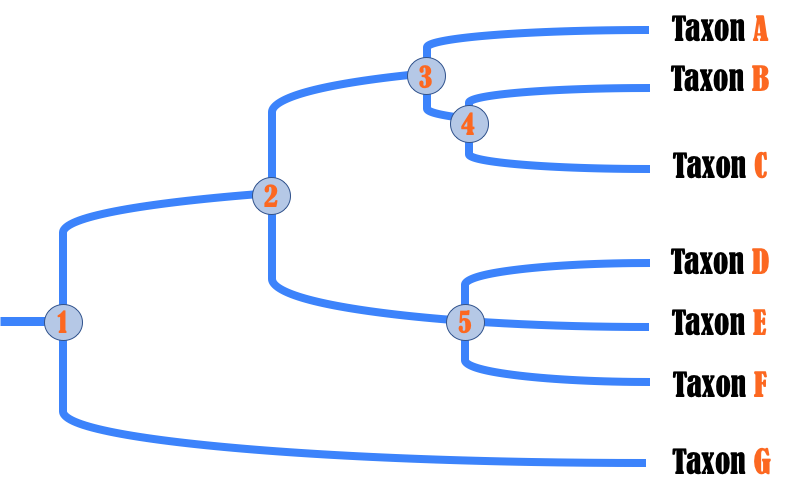
- Taxon (Taxa): the taxonomic unit at any level Example Animalia is the Kingdom taxon
- Sister taxa: Two or more taxa next to each other on the tree (i.e. closely related) Example: Taxon B and Taxon C are sister taxa
- Clade: A group of taxa that share a common ancestor Example: Taxon A, B, C form a clade
- In group: a group of interest usually the focus of a study
- Out group: one or more taxa that is distantly related to the In group
- Character: a specific characteristic Example: a wing or a tail
- State: a particular property of a character Example: the shape of the wing, or the color of the tail
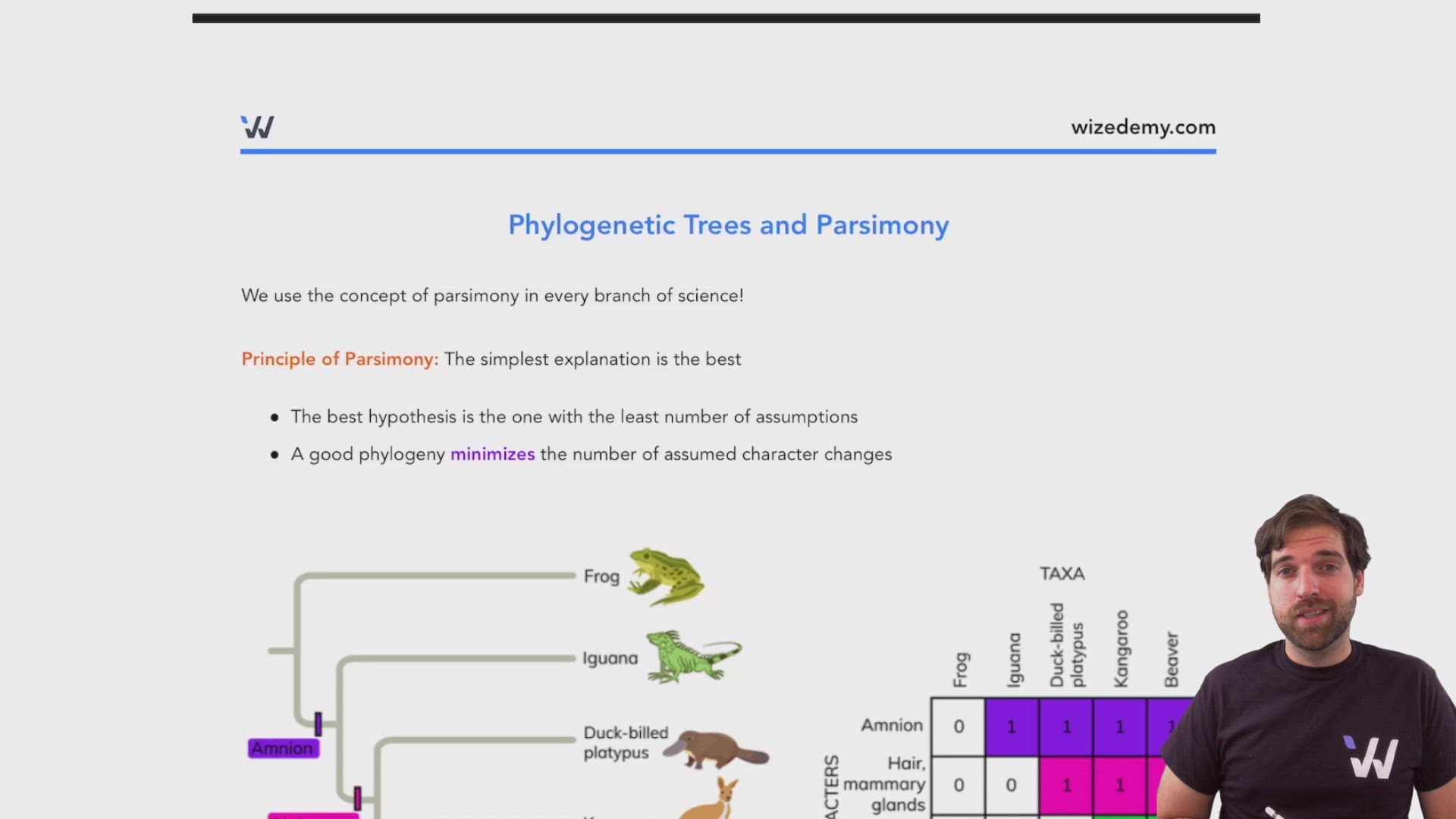
Phylogenetic Trees and Parsimony
We use the concept of parsimony in every branch of science!
Principle of Parsimony: The simplest explanation is the best
- The best hypothesis is the one with the least number of assumptions
- A good phylogeny minimizes the number of assumed character changes

- Synapomorphy: a shared, derived trait that unites a clade Example: Having four legs is a synapomorphy that unites Frogs, Turtles and Leopards
- Symplesiomorphy: a shared, ancestral trait Example: Within the clade of Frogs, Turtles and Leopards, having four legs is a symplesiomorphy

Photo by Petter Bockman and Peter Brown | CC BY
- Monophyletic groups (clade): group of organisms containing a common ancestor, all of its descendants and nothing else.
- Paraphyletic groups: do not include all descendants of the common ancestor (i.e. missing some taxa)
- Polyphyletic groups: have members whose ancestor is outside of the group (i.e. too many taxa)
Similar Traits
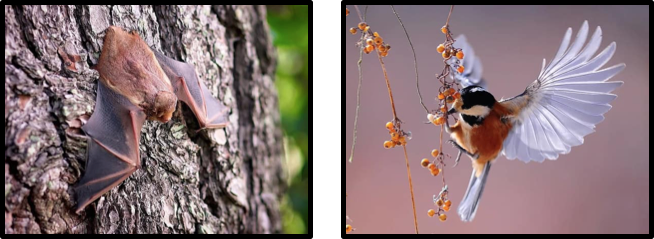
- Analogous traits: appear similar but actually evolved independently
- Convergent evolution: natural selection produces a similar trait from different starting points Example: bat and bird wings
- Homologous traits: similar due to true shared ancestry
- Descended from the same trait in a common ancestor Example: dolphin and whale flippers