Regulation of Glycolysis
- Glycolysis is regulated at 3 steps that are the most exergonic and irreversible.
- These 3 reactions are catalyzed by enzymes that are allosterically regulated.
- This means they are regulated by a molecule binding to another site that is not its active site.
The following three enzymes are allosterically regulated in glycolysis:
- Hexokinase
- Phosphofructokinase
- Pyruvate Kinase
Hexokinase
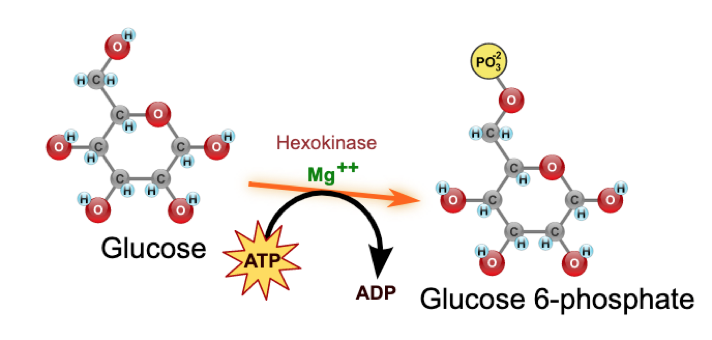
Photo by YassineMrabet / CC BY

- Inhibited by the product it makes: G6P.
- Enzyme active when G6P levels are low (when glycolysis is active).
- Enzyme inhibited when G6P levels are high (when glycolysis slows down).
Phosphofructokinase (PFK)

Photo by YassineMrabet / CC BY
- The key regulator of carbohydrate metabolism in the cell.
- PFK inhibitors:
- High levels of ATP
- When too much ATP is present, it can bind to the regulatory site on the enzyme and lower its affinity for the substrate.
- High levels of citrate
- As citrate builds up form TCA cycle, it causes glycolysis to slow down by inhibiting PFK.
- Protons (H+)
- Prevents excessive formation of lactic acid.
- Low pH (acidic conditions) will inhibit PFK.
- PFK activators:
- High levels of AMP
- AMP competes with ATP for binding the PFK regulatory site.
- AMP binding at the regulatory site prevents ATP binding → no inhibition of PFK by ATP.
- Think about it like this: if there's a lot of AMP, there's low ATP. Therefore, we need more glycolysis.
- High levels of Fructose-2,6-Bisphosphate (F-2,6-BP)
- Enhances PFK activity by increasing the affinity of PFK to its substrate F6P.
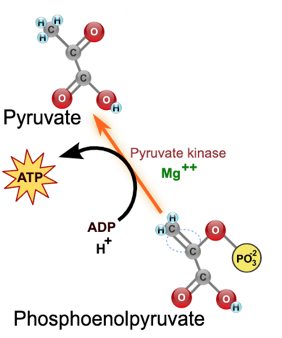
Pyruvate Kinase
- Main function is to produce pyruvate + ATP.
- Pyruvate kinase inhibitors:
- High levels of ATP
- The amino acid alanine
- Pyruvate kinase activators:
- High levels of Fructose-1,6-Bisphosphate (F-1,6-BP)