
Resonance Structures
Resonance structures: are used to describe molecules with delocalized electrons which cannot be described by a single Lewis structure.
Resonance structures follow the same rules as Lewis structures and the same features that make a good Lewis structure also make good resonance structures.
Example: Resonance structures for CO32-
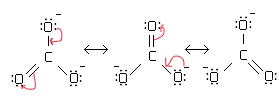
Resonance structures are not discrete molecules which exist individually, but rather the molecule exists as an average of all of its resonance structures.
Resonance hybrid: The "average" of all of a molecule's resonance structures (see below)

Average C-O bond order: 1 1/3
Average Charge on oxygen: -2/3

Equivalent Vs Non-Equivalent Resonance Structures
If there is more than one relatively good Lewis structure for a molecule, the molecule exhibits resonance.
Equivalent Resonance Structures
All resonance structures are equally stable.
Example:

In reality, the molecular structure will be the average (hybrid) of each resonance form:

Non-Equivalent Resonance Structures
One resonance structure is better than the other.
Example:

Out of these two non-equivalent resonance structures, which is the more stable one? The one on the left or right? ________
The resonance structure on the right has the negative charge on the N atom, while the resonance structure on the left has the negative charge on the C atom.
Nitrogen is a lot more electronegative than C and so it is a lot more favourable and stable for N to have the negative charge on it!
Example: Draw the Resonance Structures
Draw all the reasonable resonance structures for SO3F- . Are these equivalent or non-equivalent resonance structures?

These are 3 equivalent resonance structures. You can think of it as each oxygen atom wanted to take a turn to have a single bond :)
Example: Resonance Structures and Stability
Draw all reasonable resonance structures for the following compounds.
Are they equivalent or non-equivalent resonance structures?
If one resonance structure is more stable than the other(s), indicate which one is most stable.
a) N3–

These are non-equivalent resonance structures (2 have 1 triple bond, 1 single bond, 1 has 2 double bonds)
The resonance structure in the middle is most stable. It has the same net charges as the other two resonance structures (net charge =-1), but it is more stable to spread charge over two centers than localizing it on on one center.
b) PO43–

These are equivalent resonance structures.
All resonance forms are equivalent and equally stable