
Basis and Dimension
Let be a vector space, and let be a set of vectors in . is a basis for if:
- is linearly independent
- is a generating set of ( is the span of the vectors in )
In other words, a basis is the smallest set such that every vector in is a linear combination of the vectors in .
Example 1
is a basis for because:
- The vectors in are linearly independent
- Every vector in can be generated from the vectors in
Note: removing any vector would mean that the set is no longer a generating set, so it is as small as possible.
Example 2
is a basis for .
Dimension
The dimension of a vector space is the number of vectors in its basis, which we denote .
Example 1
is a basis for , so .
Example 2
is a basis for , so .
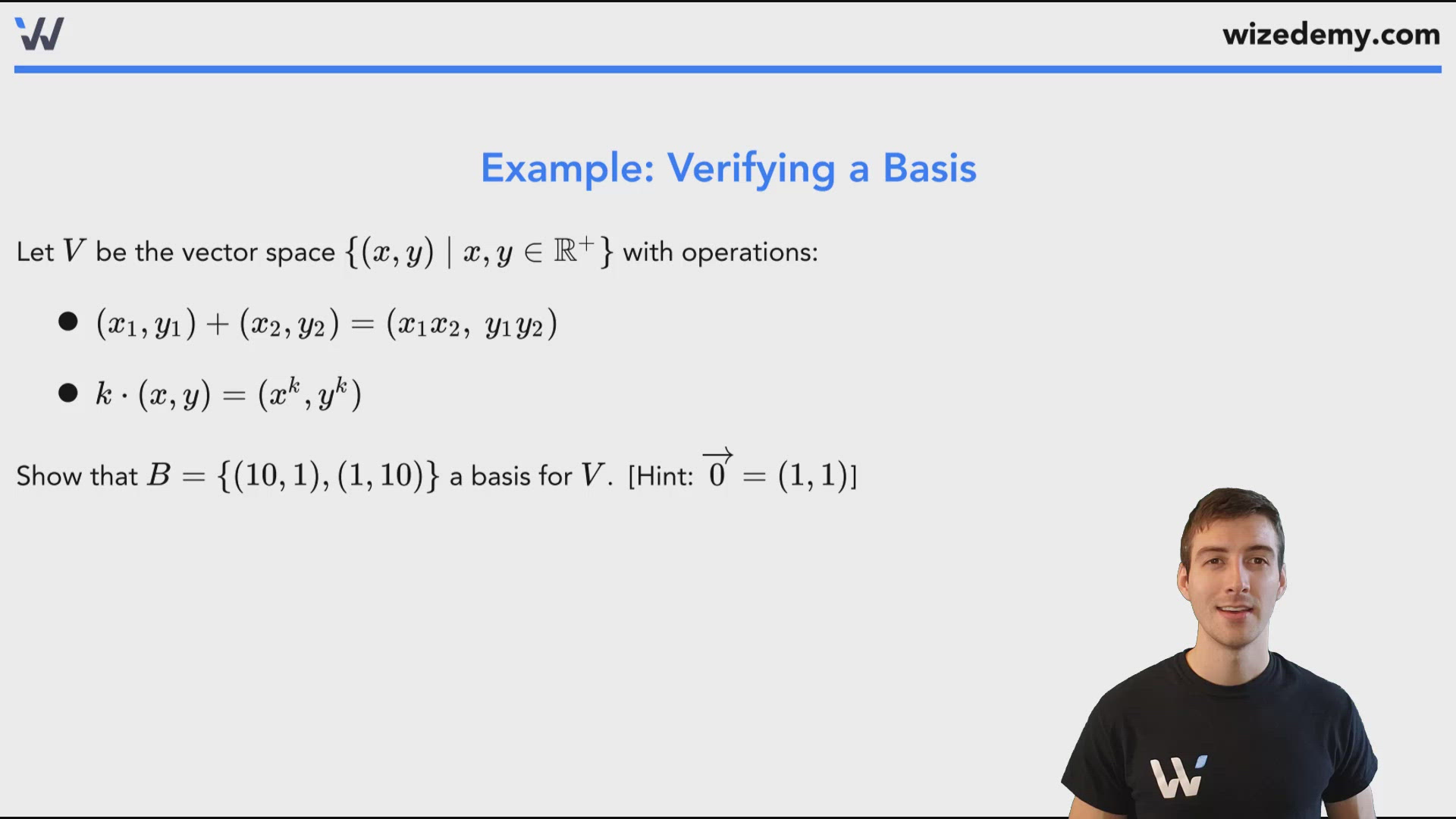
Example: Verifying a Basis
Let be the vector space with operations:
Show that a basis for . [Hint: ]
Step 1
Show that the vectors in are linearly independent.
So we need and .
The only solution to these equations is , so is linearly independent.
Step 2
Show that is a generating set for .
We must show that every vector in can be written as a combination of the vectors in :
From this we can see that:
For every pair :
Note that so the logarithms are well-defined.
Since we can find appropriate coefficients for any values of and , is a generating set for .
Therefore, is a basis of .
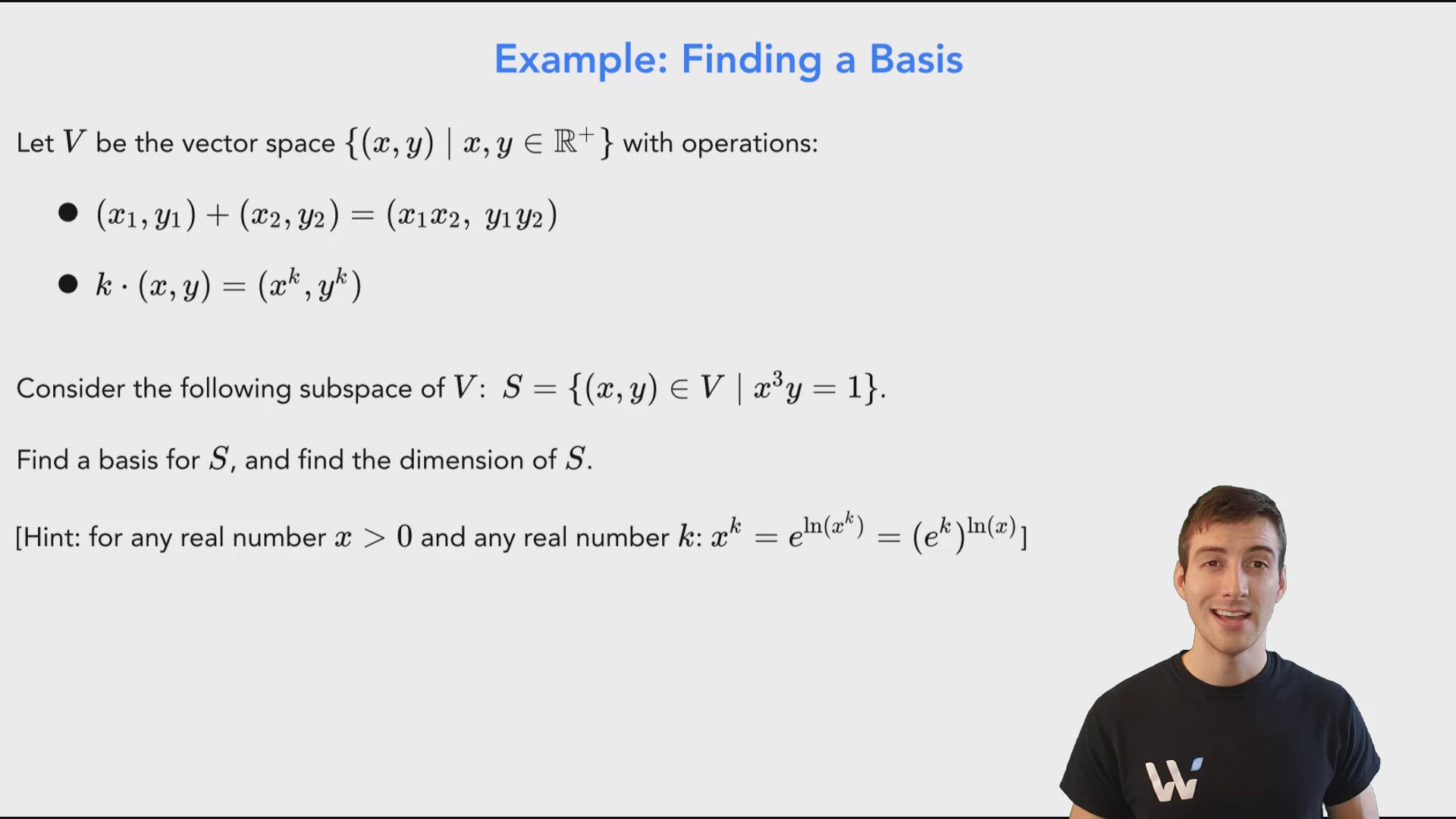
Example: Finding a Basis
Let be the vector space with operations:
Consider the following subspace of : .
Find a basis for , and find the dimension of .
[Hint: for any real number and any real number : ]
Step 1
To find a basis, first find a generating set for .
If is an arbitrary vector, then we know that:
So .
Goal: Write as a linear combination of vectors in .
We will "factor out" the variable using the defined operations of along with the hint:
Note that because (or simply: ).
We can generate any vector in as a scalar multiple of :
Therefore, the generating set is .
Step 2
is linearly independent because it contains only one vector (and it is not the zero vector).
Therefore, is a basis for . Since contains only one vector, is a 1-dimensional subspace of .