Wize University Biology Textbook > The Plasma Membrane
Passive Transport
Popular Courses
MCAT
General Course
AP Biology Exam Prep Course
AP Exam Prep
Biology
General Course
General Biology
University Study Guides
BIOLOGY 1002B
Western University
BIOL 211
University of Calgary
BIOL 107
University of Alberta
BIOL 102
Queen's University
BIOL 112
University of British Columbia
Grade 12 Biology
Canada High School
High School Biology
US High School
DAT
General Course
BIOL*1090
University of Guelph
General Biology
University Study Guides
BIOL 130
University of Waterloo
SC/BIOL 1000 3.00
York University
BIOL 200
University of British Columbia
BIO 1141
University of Ottawa
BLG 143
Toronto Metropolitan University
BIOL 112
McGill University
0:00 / 0:00
Membrane Permeability
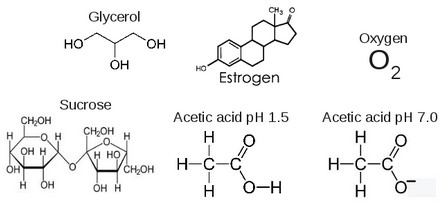
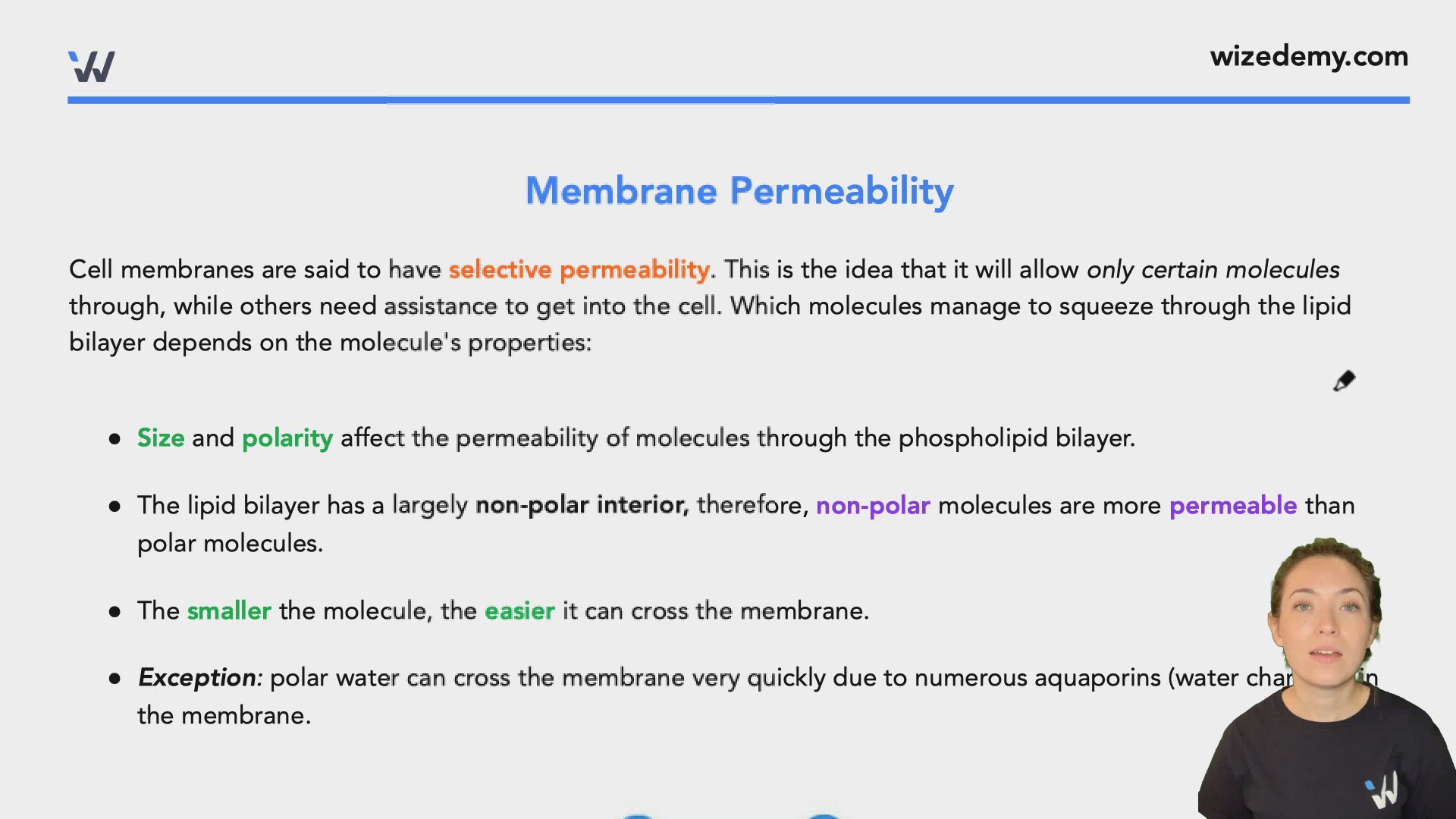
Cell membranes are said to have selective permeability. This is the idea that it will allow only certain molecules through, while others need assistance to get into the cell. Which molecules manage to squeeze through the lipid bilayer depends on the molecule's properties:
- Size and polarity affect the permeability of molecules through the phospholipid bilayer.
- The lipid bilayer has a largely non-polar interior, therefore, non-polar molecules are more permeable than polar molecules.
- The smaller the molecule, the easier it can cross the membrane.
- Exception: polar water can cross the membrane very quickly due to numerous aquaporins (water channels) in the membrane.

0:00 / 0:00
Introduction and Passive Transport
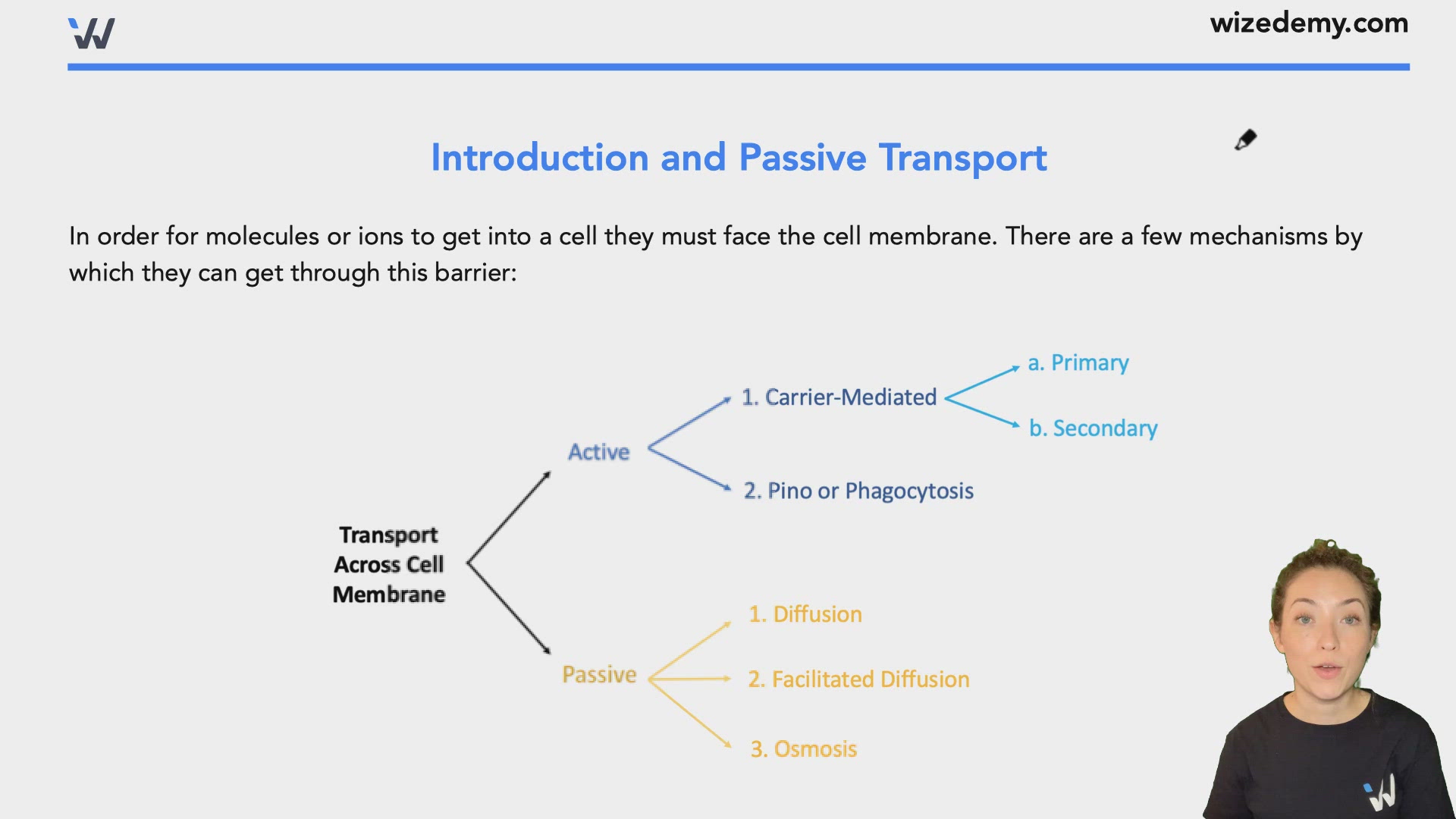
In order for molecules or ions to get into a cell they must face the cell membrane. There are a few mechanisms by which they can get through this barrier:

(Simple) Diffusion
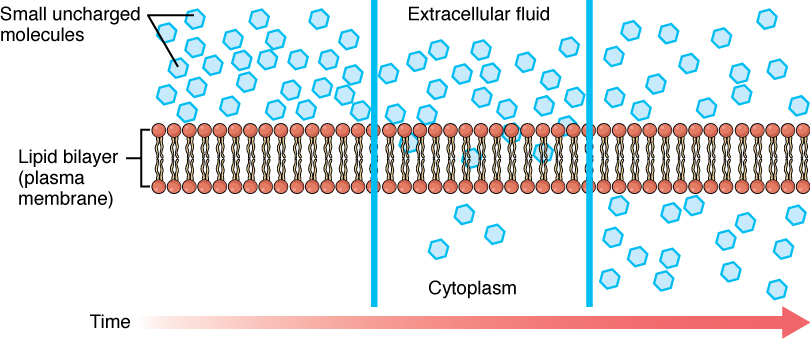
Simple diffusion occurs due to random thermal motion of molecules. When you add a drop of red dye to a glass of water, some time later the drop will have spread and the entire water will be pink. This is diffusion!
- Diffusion always occurs from high to low concentration regions (driving force), also known as the concentration gradient.
- When the concentrations are equal throughout, this system is said to be at equilibrium.
- In order for diffusion to occur across a membrane, the membrane must be permeable to the molecule.
Diffusion of Non-Electrolytes
Small, uncharged and lipophilic molecules can cross right through the lipid bilayer.
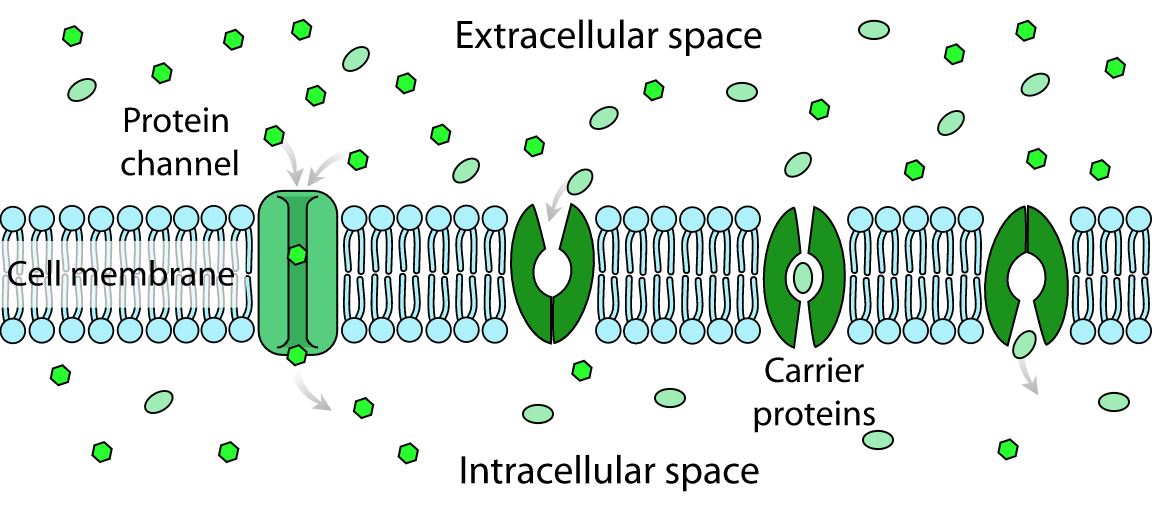
Facilitated Diffusion
Molecules that cannot diffuse through the membrane require additional help of transport proteins to get into a cell.
- No energy required just like simple diffusion but instead uses the help of a membrane protein.
- Down the concentration gradient (i.e. molecules go from areas of high to low concentration).
- Two types of membrane proteins that help in facilitated diffusion: Channel Proteins and Carrier Proteins
- Channel proteins
- Specific for a certain molecule;
- Can be open all the time or need a trigger ("gated"). Example: channels for Na+ or Cl- ions.
- Carrier proteins
- Not just a hollow channel: when its specific molecule binds, it changes shape (conformation) and enables the passage of the molecule inside. Example: glucose transporters.
Practice: Types of Passive Transport
Which of the following statement(s) are FALSE?

Mark Yourself Question
- Grab a piece of paper and try this problem yourself.
- When you're done, check the "I have answered this question" box below.
- View the solution and report whether you got it right or wrong.
Practice: Molecules Crossing the Lipid Bilayer
Place the following compounds under the appropriate category on their ability to cross a phospholipid bilayer: Fast, Slow, Can't Cross.