Popular Courses
Find My Course
0:00 / 0:00
Postulates

In geometry there are a few statements we can take to be true. Let's learn about them
Postulates
A postulate is a statement that is assumed to be true. You can use these as the foundation or starting point for complex statements and arguments.
Postulates about Measuring and Adding
- Line Measuring Postulate - Points on a line can be paired up with the real line. In this way we can measure points on lines and segments.
- Angle Measuring Postulate - The rays of an angle can be matched up with a protractor. In this way we can measure angles.
- Adding Segments Postulate - If points and are all on a line, with between and , then . If we are given that then it must be that point is between and .
- Adding Angles Postulate - If point is in the interior of angle , then
Postulates about points, lines, and planes.
Here are a few more postulates that we have seen so far:
- Through any two points, there is exactly one line.
- A line contains at least two points.
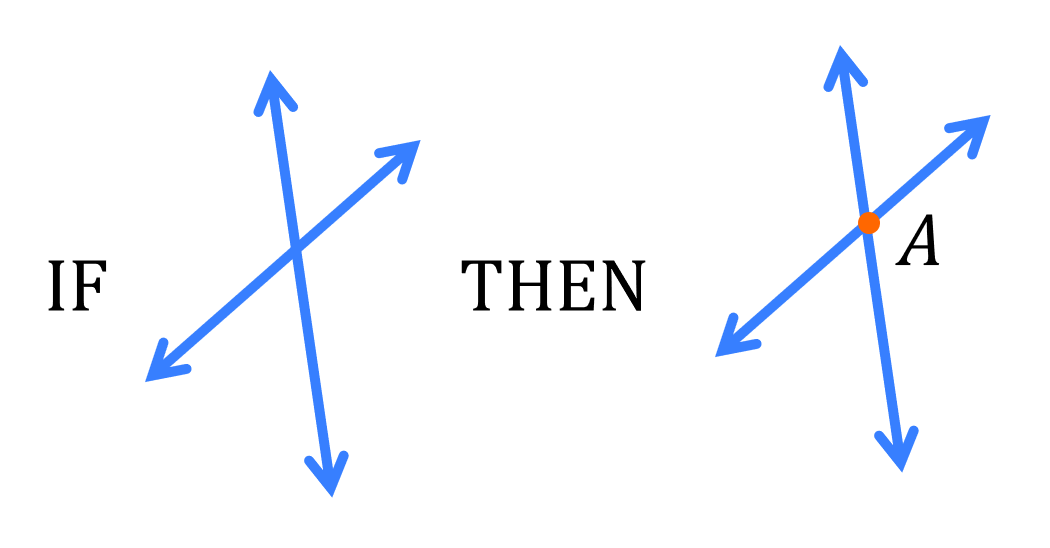
- If two lines intersect, the intersection is a point.
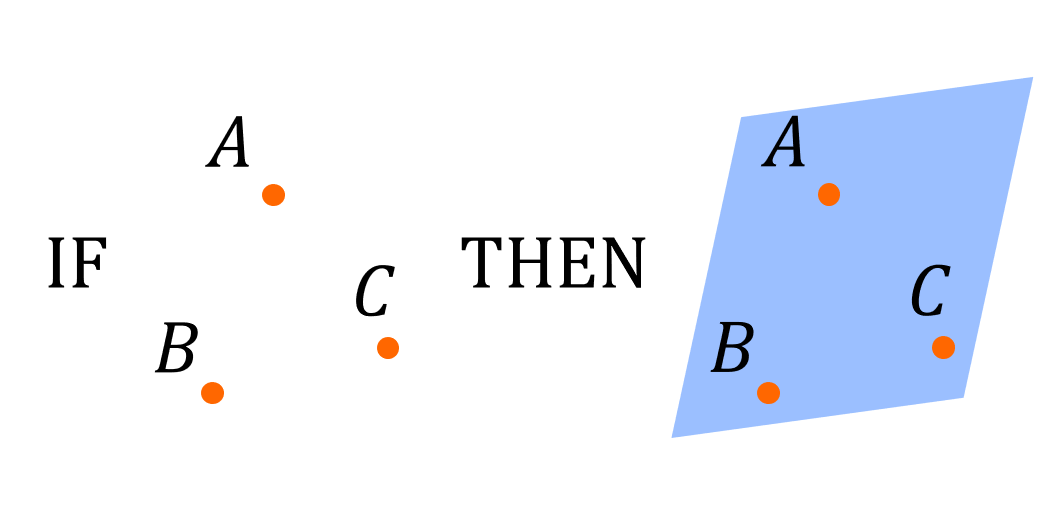
- Through any three points that are not on the same line, there is exactly one plane.
- A plane contains at least three points, not on the same line.
- If there are two points in a plane, then the line containing them is also in the plane.
- If two planes intersect, the intersection is a line.
Example
For each of the postulates above, draw an example.
0:00 / 0:00
Reasoning with Postulates
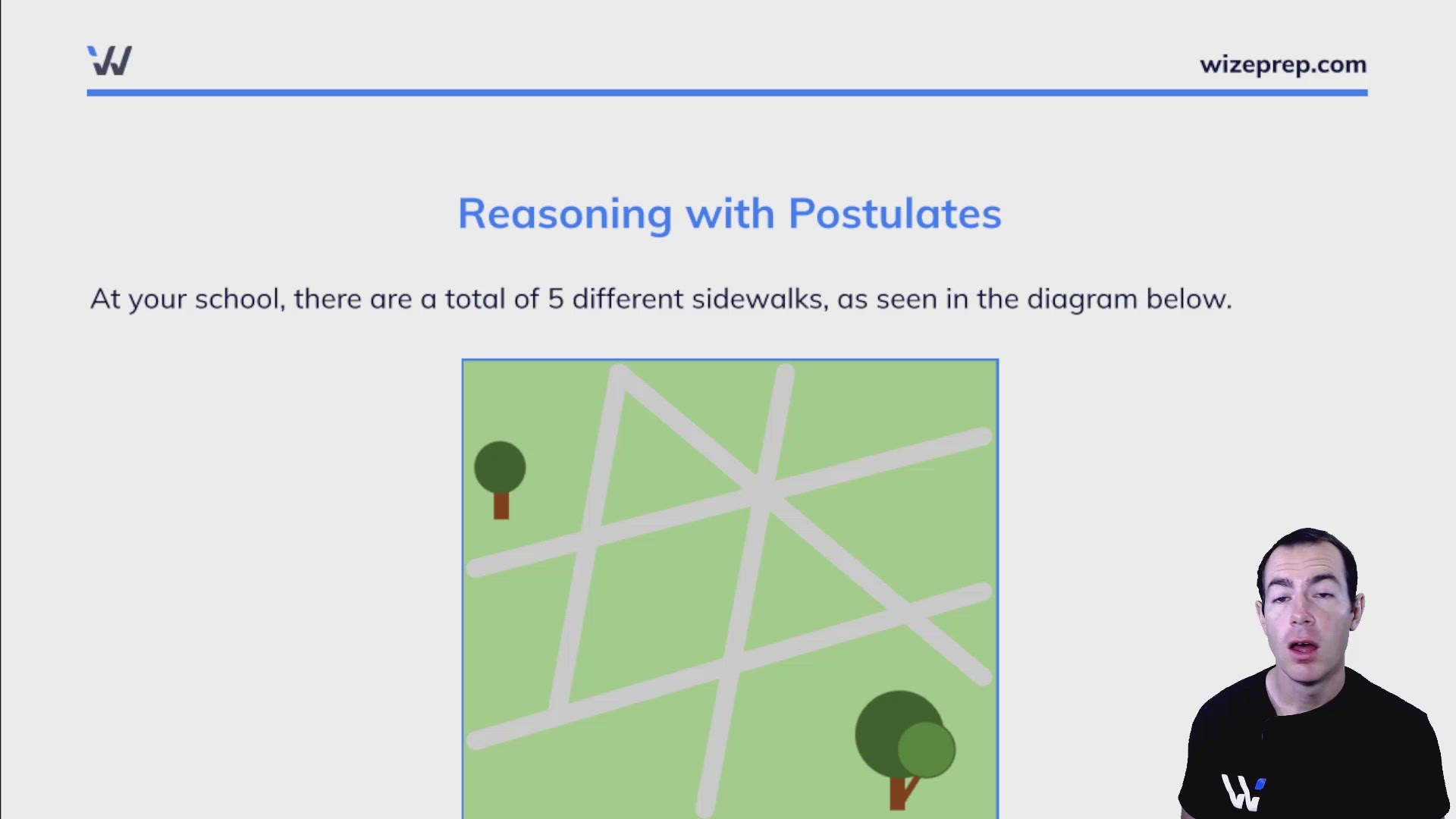
At your school, there are a total of 5 different sidewalks, as seen in the diagram below.

1. What is the smallest number of students needed such that every sidewalk has at least two students on it?
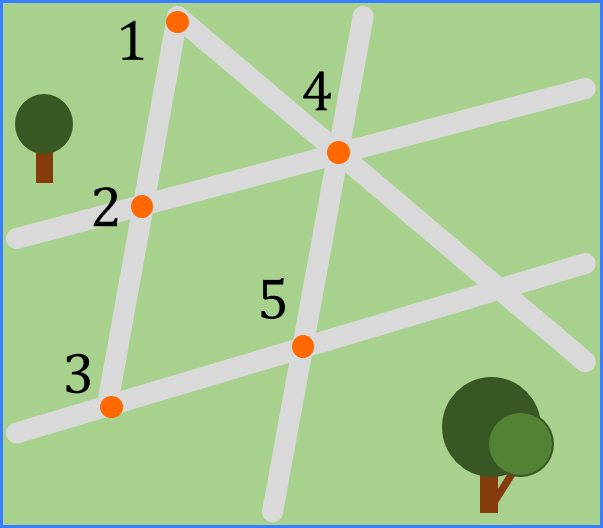
ANSWER: If placed carefully at the intersection of sidewalks, it will take 5 students to have at least two students on each sidewalk. One possible arrangement would be:
2. What postulate is being modeled in this situation?
ANSWER: This models the postulate that a line contains at least two points. The sidewalks are the lines, and the students are the points. Note that a line may contain more than two points, but the key phrase used says s "at least two points."
Postulates visualized
Having a diagram or picture for each of the postulates is a great way to get familiar with them.
Match each diagram with the corresponding postulate.
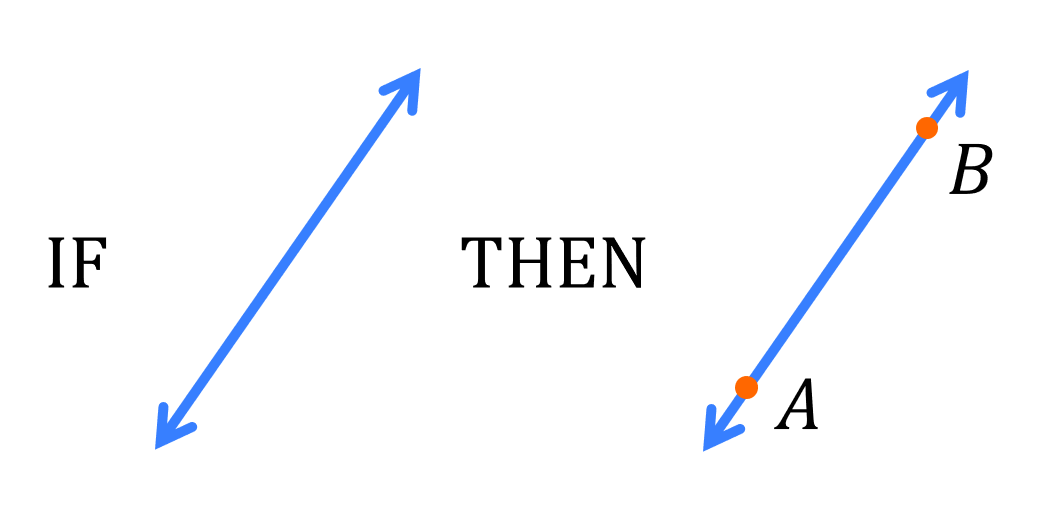
A.
A line contains at least two points.
B.
If points and are all on a line, with between and , then .
C.
If two lines intersect, the intersection is a point.
D.
Through any three points that are not on the same line, there is exactly one plane.

Interpreting a diagram
Often a diagram can give us a lot of information about how points, lines, and planes are related to one another.
We can use a diagram, along with postulates to make certain assumptions.
Use the diagram to mark each statement as "Assumed true" or "Can not assume."

1. Plane and plane meet at line .
2. Line is in the plane .
3. Lines and intersect.
1. Plane and plane meet at line .
The hands of a clock
The hands of a clock form various angles throughout the day. Use the diagram of a clock below the answer the following questions.
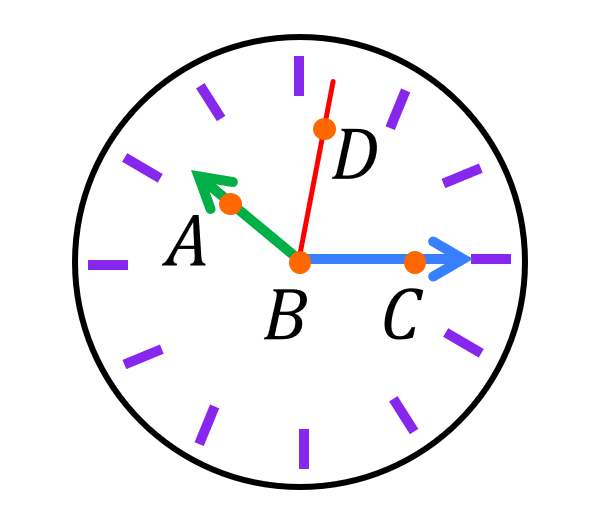
1. Suppose that we are given that , and that .
What is the name of the postulate that can help us solve for the measure of angle ?
2. What is the measure of angle ?
1. Suppose that we are given that , and that .
What is the name of the postulate that can help us solve for the measure of angle ?