
0:00 / 0:00
α-helix
- A right-handed helical structure which occurs through hydrogen bonding between atoms in the amino acid backbone
- Side chains are not involved in helix forming bonds, but different amino acids have different propensities to form α-helix
- Side chains protrude off the sides of the helix and are arranged to minimize steric clashes
- α-helix is stretchy not flexible
- Hydrogen bonds occur between the N-H (donor) of one residue and the C=O (acceptor) of the 4th residue from the donor.
- If N-H is residue i then the C=O acceptor is i – 4
- There are 3.6 residues per turn (360◦)
- 0.15nm (1.5Å) rise per residue
- 0.54nm (5Å) rise across backbone
- 100◦ between neighbouring residues
- The number of H-bonds present in a α-helix is calculated as: # of residues - 4
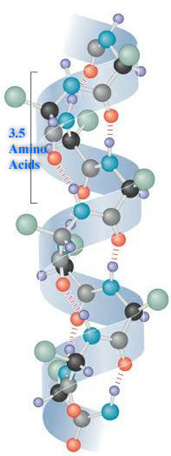
https://commons.wikimedia.org/wiki/File:AlphaHelixProtein.jpg. As a work of the U.S. federal government, the image is in the public domain.
0:00 / 0:00
Properties of an α-helix
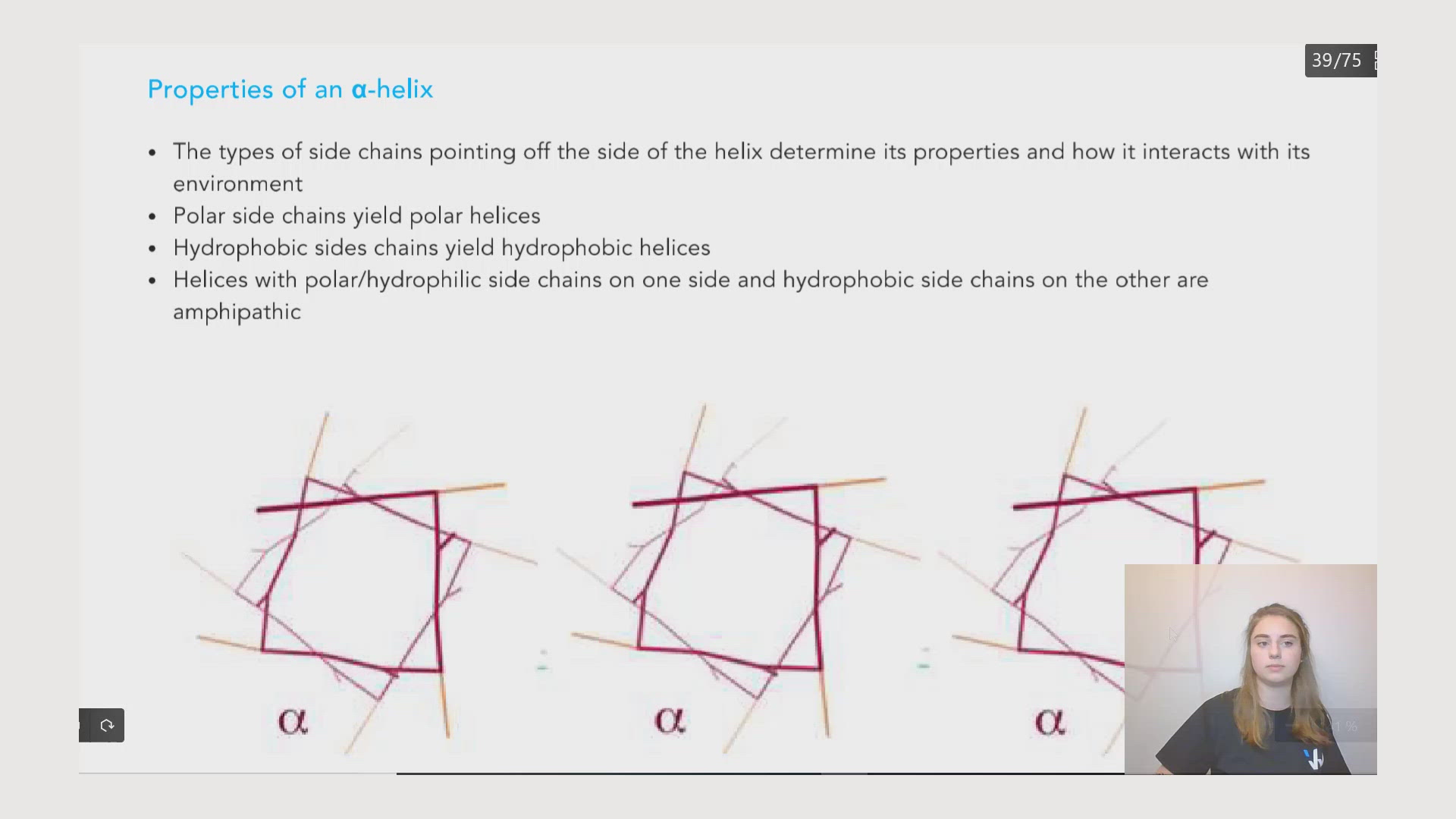
- The types of side chains pointing off the side of the helix determine its properties and how it interacts with its environment
- Polar side chains yield polar helices
- Hydrophobic sides chains yield hydrophobic helices
- Helices with polar/hydrophilic side chains on one side and hydrophobic side chains on the other are amphipathic
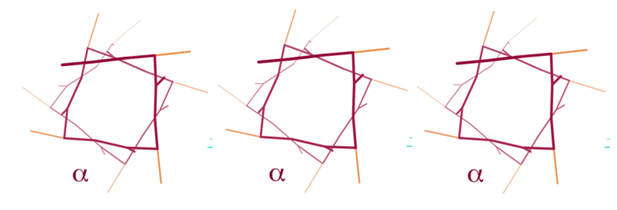
Polar/Hydrophilic Hydrophobic Amphipathic
https://fr.wikipedia.org/wiki/Fichier:Alpha_vs_310_helix_end_views.jpg. Author Dcrjsr Wheeler has the image licensed under the Creative Commons Attribution 3.0.
- Coiled-coil structures are formed between amphipathic helices
- Small residues present at interface
0:00 / 0:00
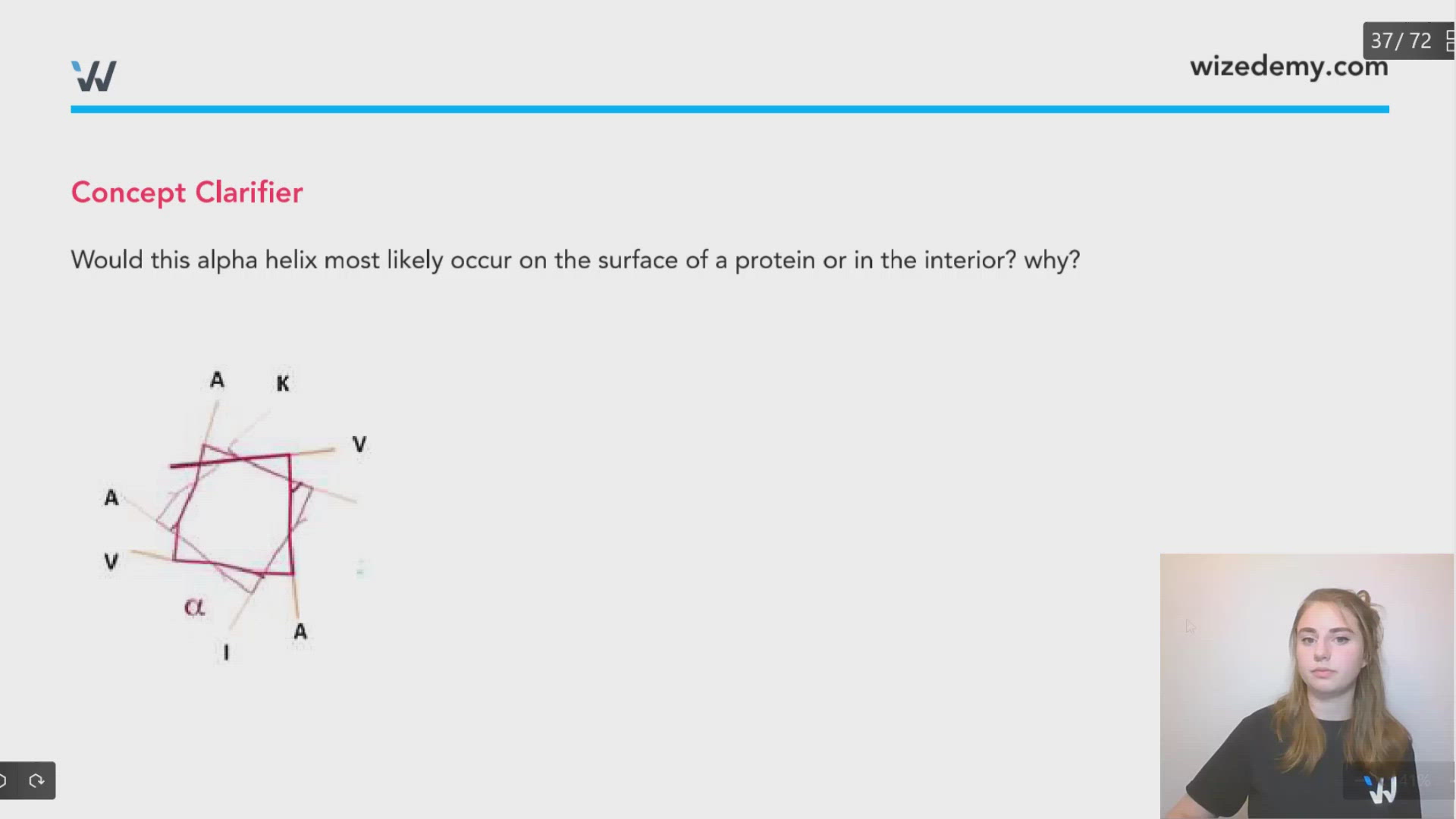
Would this alpha helix most likely occur on the surface of a protein or in the interior? why?
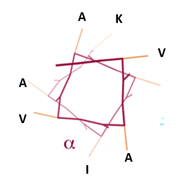
This would be located in the interior of the protein as it mainly consists of hydrophobic residues.
0:00 / 0:00
What would happen if an alanine in the middle of a alpha-helix is mutated to glycine?
The integrity of the helix will be compromised as glycine is more flexible than other amino acids and may result in the helix unwinding partially.
If the amino acid was mutated to proline?
Proline holds a cis conformation other than the regular trans conformation, resulting in the amino acid sequence to make a turn. This will result in kink in the helix.
What property of alpha-helices is NOT true?