Wize University Biochemistry Textbook > Protein Structure and Folding
Primary and Secondary Structure
0:00 / 0:00
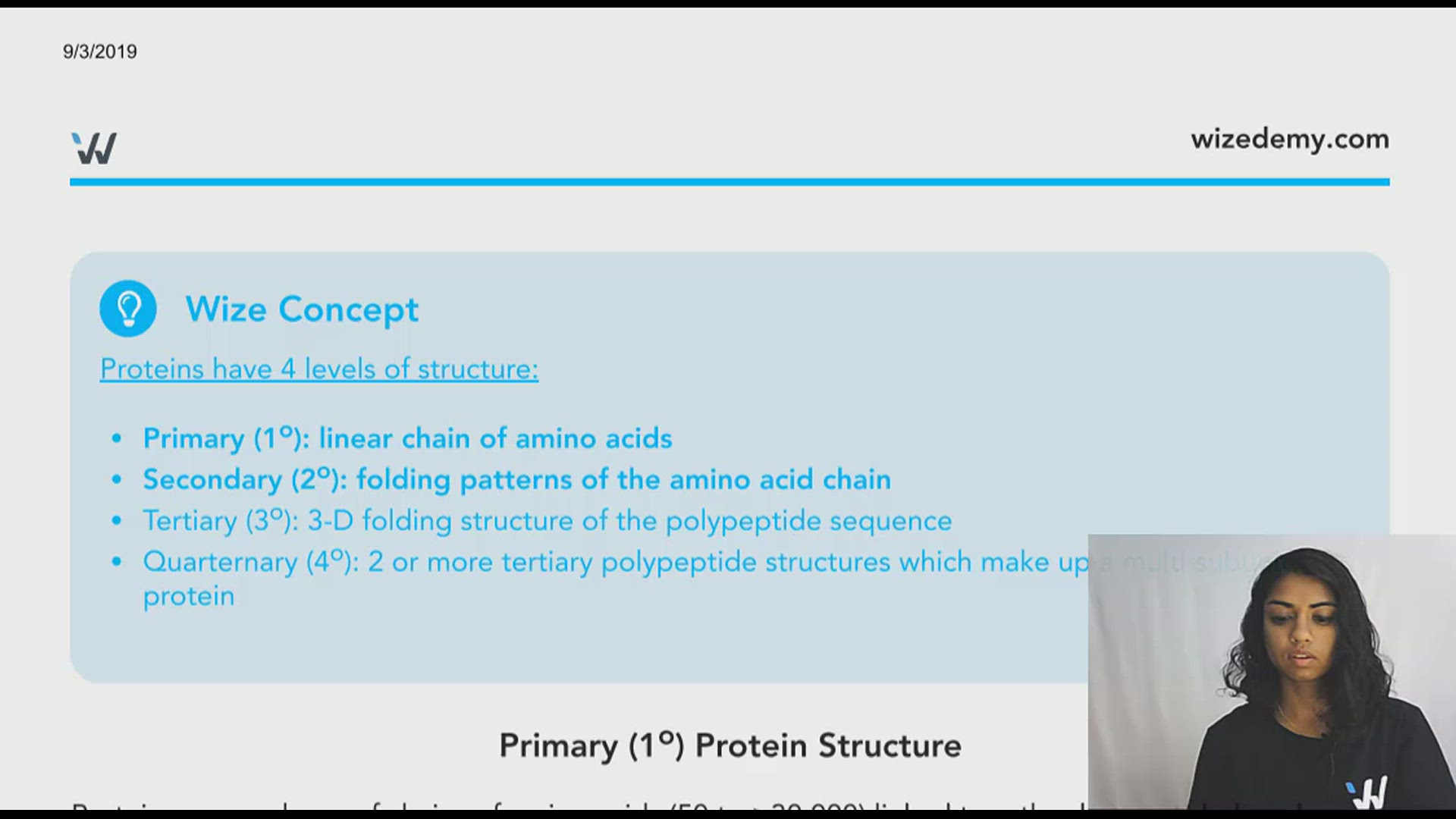
Wize Concept
Proteins have 4 levels of structure:
- Primary (1o): linear chain of amino acids
- Secondary (2o): folding patterns of the amino acid chain
- Tertiary (3o): 3-D folding structure of the polypeptide sequence
- Quarternary (4o): 2 or more tertiary polypeptide structures which make up a multi-subunit protein
Primary (1o) Protein Structure
Proteins are made up of chains of amino acids (50 to >30,000) linked together by peptide bonds.
This is referred to as a polypeptide chain.
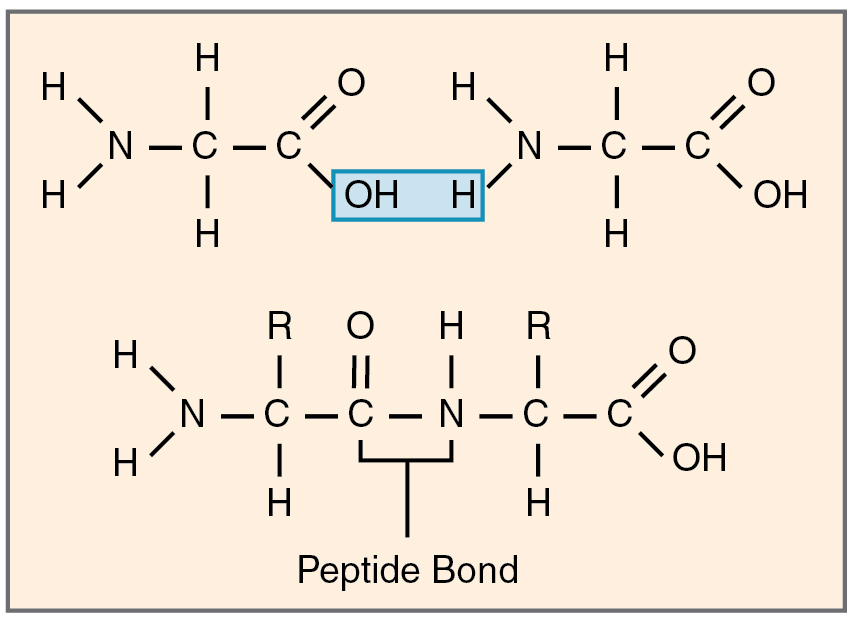
Peptide bonds are formed through a condensation/ dehydration chemical reaction.
Secondary (2o) Protein Structure
Secondary protein structure arises when hydrogen bonds form between the amino (N-H) and carboxyl (C=O) groups of the polypeptide backbone.
Wize Concept
A hydrogen bond forms between a hydrogen atom (H+) and a electronegative atom, such as the nitrogen in amino group or the oxygen in the carboxyl group. Hydrogen bonds are much weaker than covalent bonds.
There are two main types of secondary structure: alpha helices and beta sheets
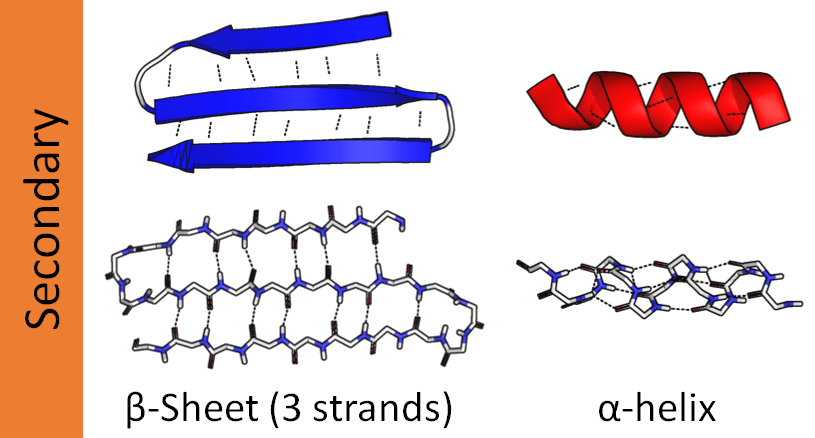
Alpha helix: has 3.6 amino acids per turn.
(Note: Proline causes an alpha helix to bend, creating kinks, because it cannot form a stabilizing hydrogen bond)
Beta sheet: can be parallel or anti-parallel (as shown in picture above)
0:00 / 0:00
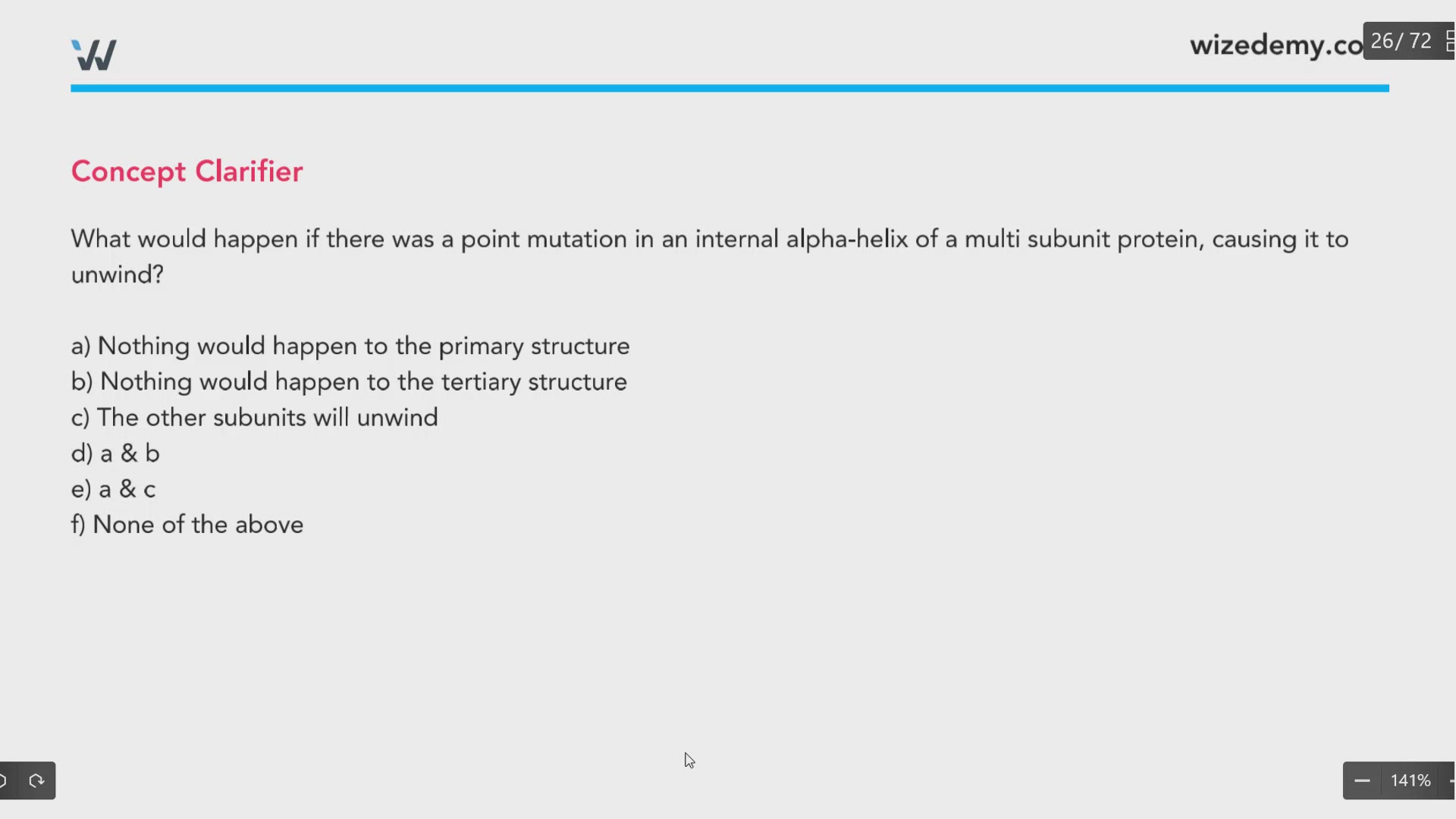
What would happen if there was a point mutation in an internal alpha-helix of a multi-subunit protein, causing it to unwind?
a) Nothing would happen to the primary structure
b) Nothing would happen to the tertiary structure
c) The other subunits will unwind
d) a & b
e) a & c
f) None of the above
f) the primary structure will be different due to the amino acid change, and the tertiary structure around the affected helix will change. Though the multiple subunits may separate they will not be unwind because of the faulty helix.