0:00 / 0:00
β-Sheet
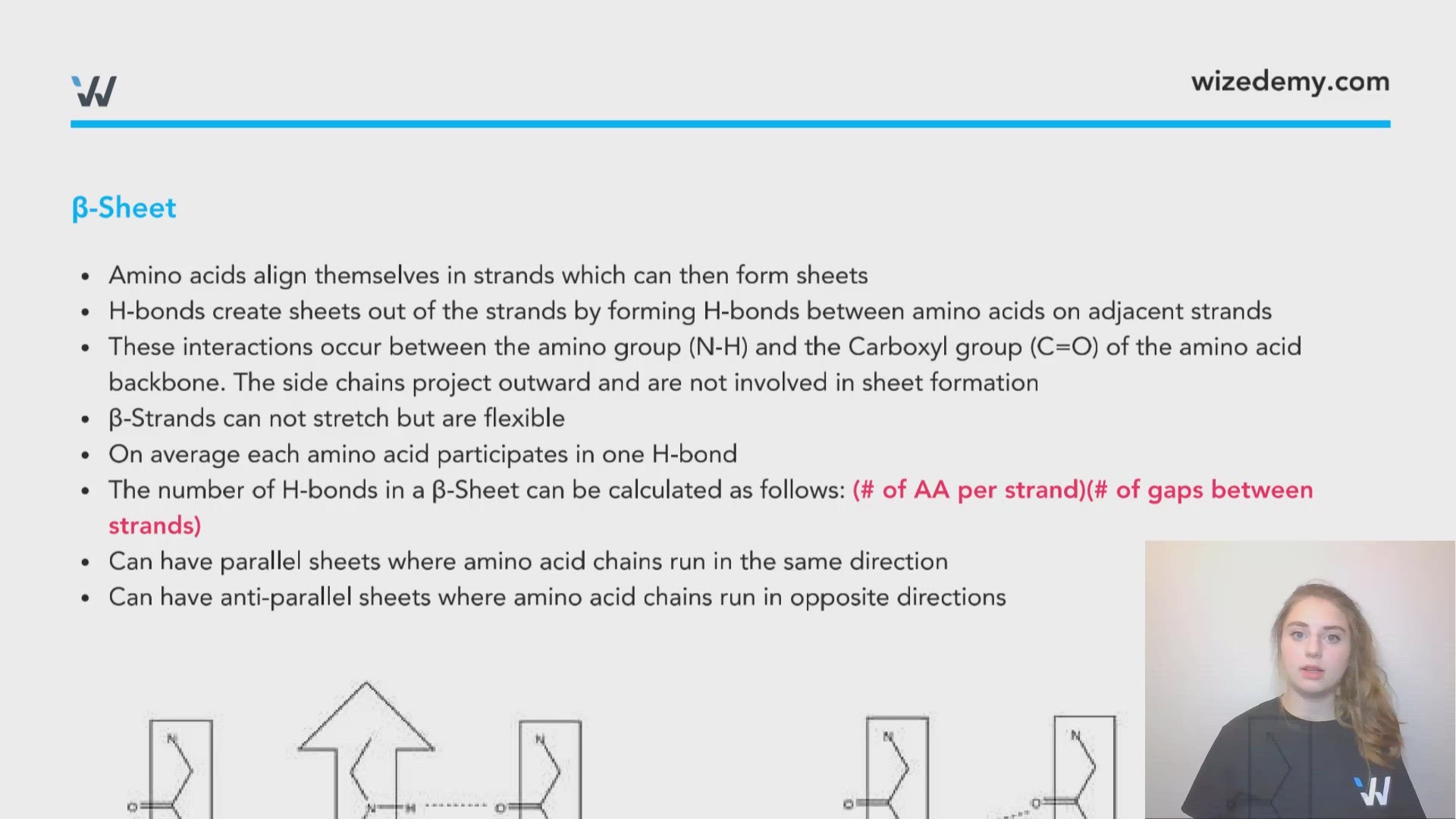
- Amino acids align themselves in strands which can then form sheets
- H-bonds create sheets out of the strands by forming H-bonds between amino acids on adjacent strands
- These interactions occur between the amino group (N-H) and the Carboxyl group (C=O) of the amino acid backbone. The side chains project outward and are not involved in sheet formation
- β-Strands can not stretch but are flexible
- On average each amino acid participates in one H-bond
- The number of H-bonds in a β-Sheet can be calculated as follows: (# of AA per strand)(# of gaps between strands)
- Can have parallel sheets where amino acid chains run in the same direction
- Can have anti-parallel sheets where amino acid chains run in opposite directions

https://commons.wikimedia.org/wiki/File:Beta_sheets.svg. The author Mysterioso has this image licensed under the Creative Commons Attribution-Share Alike 3.0 Unported license.

0:00 / 0:00
β-turns
- 180o turns that connect one strand of an anti-parallel β-sheet to the next
- Contain 1 hydrogen bond to form the turn
- Involve 4 amino acids , but only 2 of them participate in hydrogen bonding
- Two types of turns differing by a 180o rotation of the amino acid in position 2
- Glycine and Proline are very common in β-turns

https://fr.wikipedia.org/wiki/Fichier:Beta_turn.svg. Author Muskid has the image licensed under Creative Commons Attributions.
Wize Concept
In Type I turns proline is often in position two as it hold the cis conformation.
In Type II turns amino acid in position three is almost always Glycine as steric hindrance prohibits any other residue (This can be seen from Ramachandran plots)
Loops
- Connect strands and alpha helices in secondary structure.
- Connect the strands in a parallel β-sheet
- They are wide turns

https://commons.wikimedia.org/wiki/File:Beta_sheets.svg. The author Mysterioso has this image licensed under the Creative Commons Attribution-Share Alike 3.0 Unported license.
0:00 / 0:00
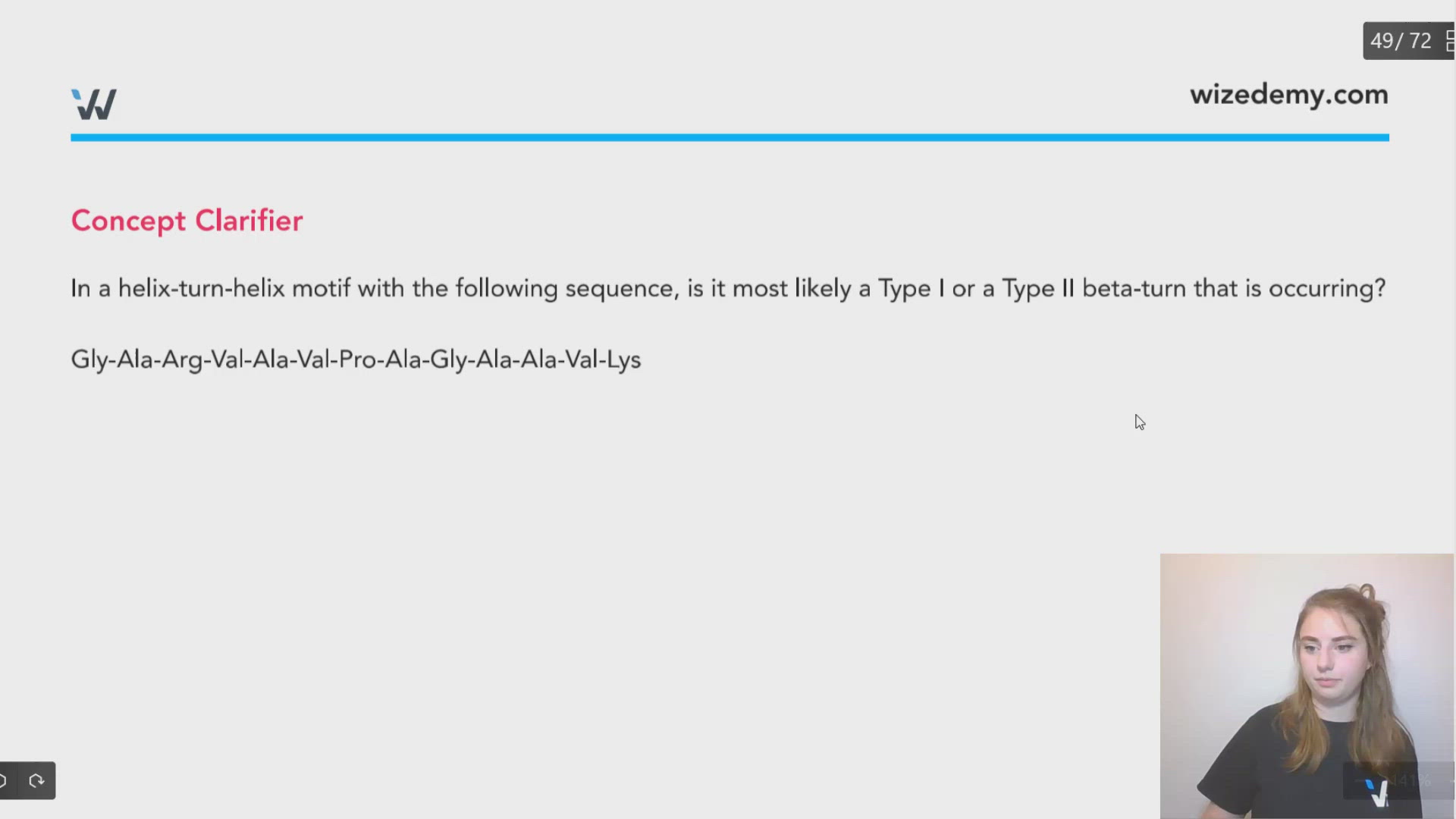
In a helix-turn-helix motif with the following sequence, is it most likely a Type I or a Type II beta-turn that is occurring?
Gly-Ala-Arg-Val-Ala-Val-Pro-Ala-Gly-Ala-Ala-Val-Lys
Type I. If the Alpha-helix involves the first five amino acids (i-4), then Pro is in position 2 of the turn, indicating a Type I turn.
0:00 / 0:00
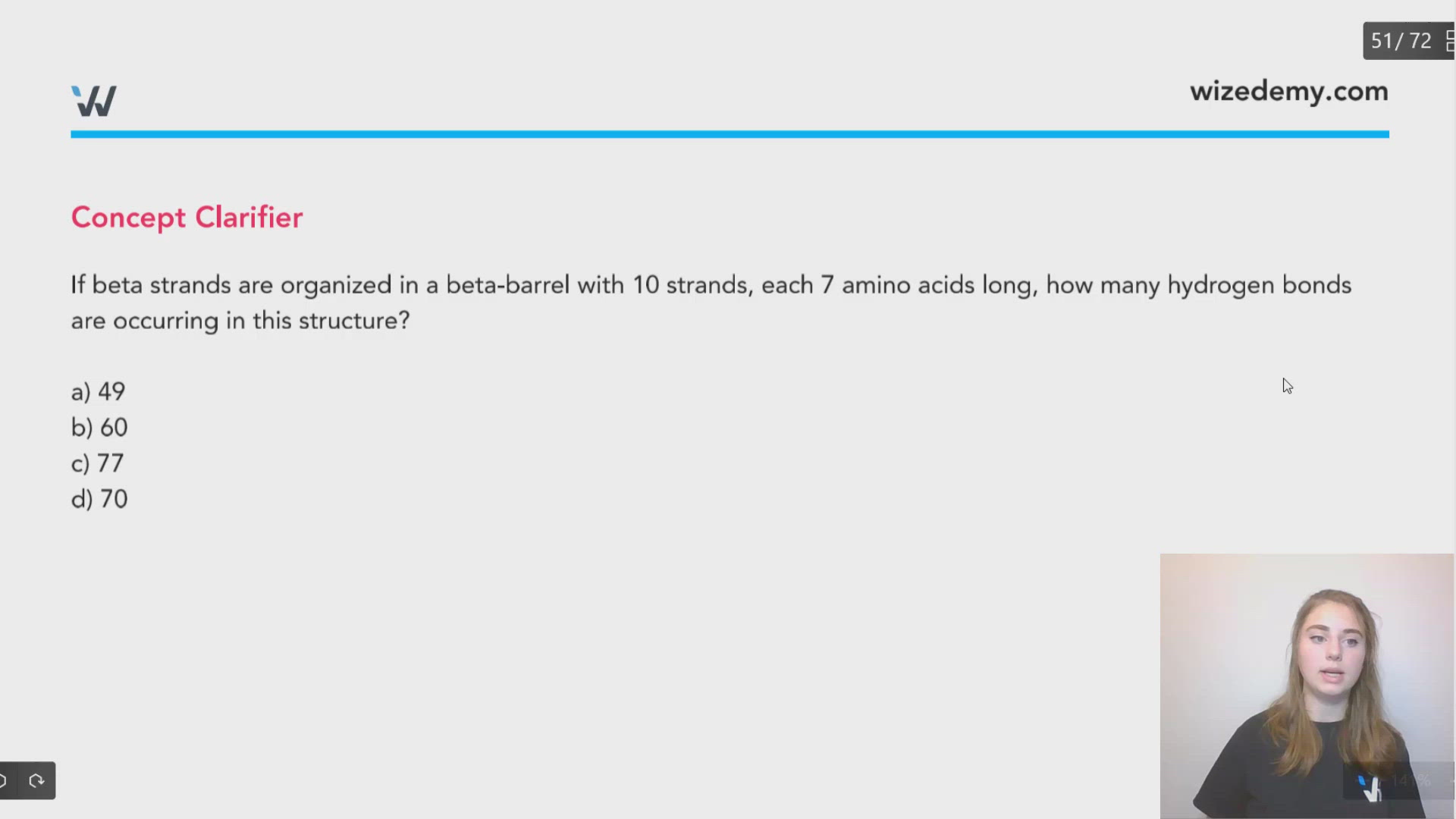
If beta strands are organized in a beta-barrel with 10 strands, each 7 amino acids long, how many hydrogen bonds are occurring in this structure?
a) 49
b) 60
c) 77
d) 70
d) 70. Typically you calculate H-bonds with: (#of gaps between strands)(# of AA in each strand), where the number of gaps is the number of strands - 1. But, in a beta-barrels the # of spaces = # of strands since they form a ring.
0:00 / 0:00
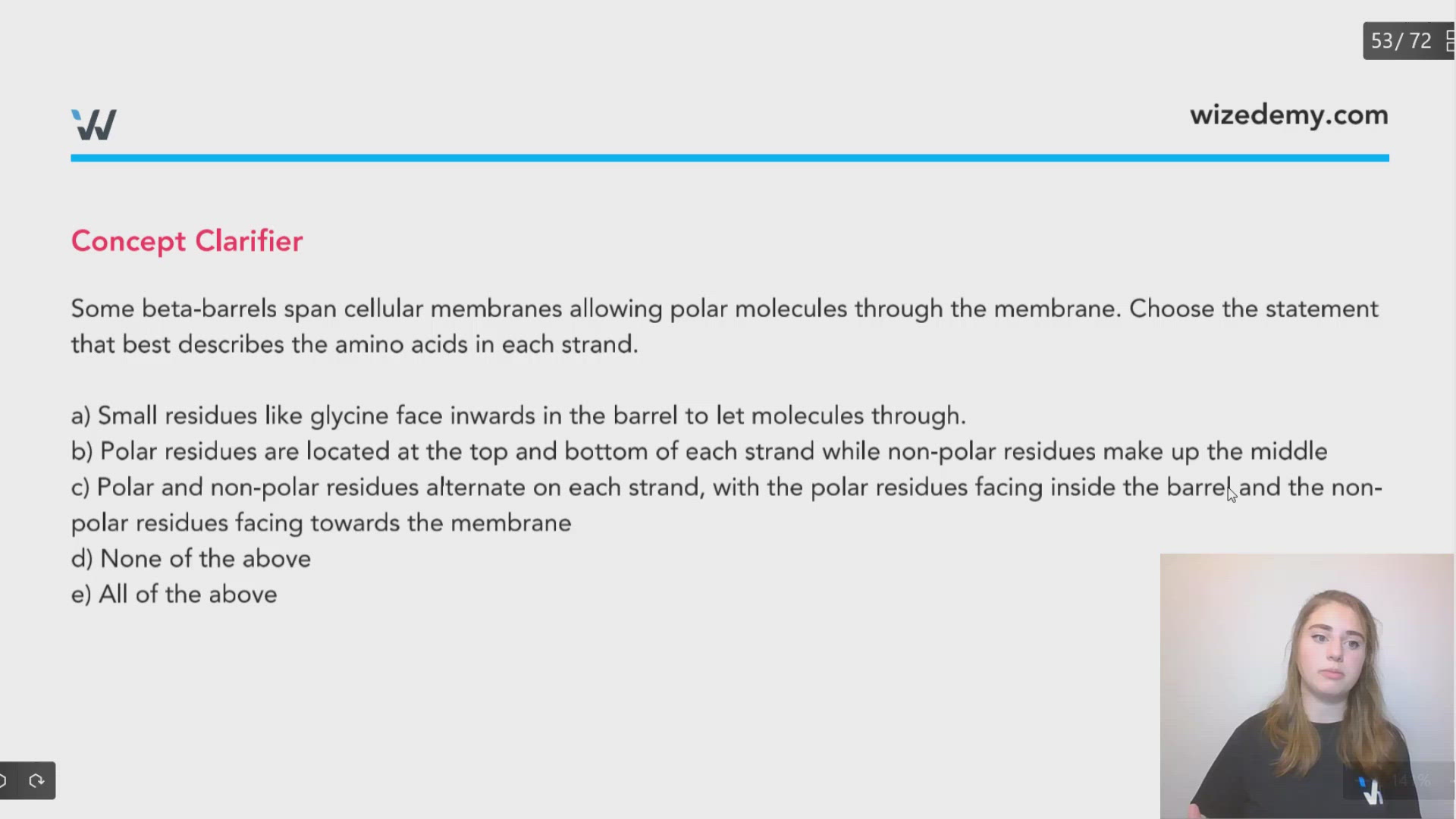
Some beta-barrels span cellular membranes allowing polar molecules through the membrane. Choose the statement that best describes the amino acids in each strand.
a) Small residues like glycine face inwards in the barrel to let molecules through.
b) Polar residues are located at the top and bottom of each strand while non-polar residues make up the middle
c) Polar and non-polar residues alternate on each strand, with the polar residues facing inside the barrel and the non-polar residues facing towards the membrane
d) None of the above
e) All of the above
c) Polar and non-polar residues alternate on each strand, with the polar residues facing inside the barrel and the non-polar residues facing towards the membrane
Which of these strands that make up beta-sheets would be best suited to make stacked beta-sheets?