Wize University Biochemistry Textbook > Protein Structure and Folding
Tertiary and Quaternary Structure

0:00 / 0:00
Wize Concept
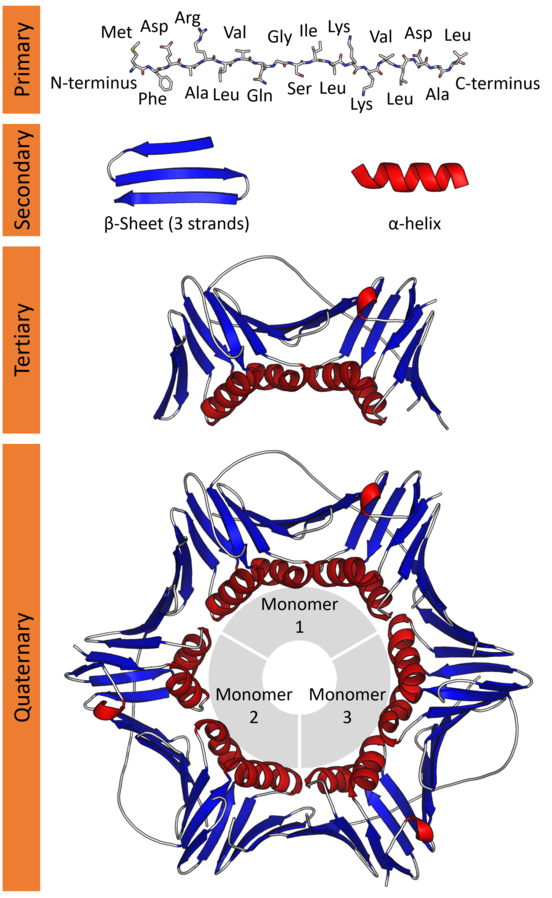
Proteins have 4 levels of structure:
- Primary (1o): linear chain of amino acids
- Secondary (2o): folding patterns of the amino acid chain
- Tertiary (3o): 3-D folding structure of the polypeptide sequence
- Quarternary (4o): 2 or more tertiary polypeptide structures which make up a multi-subunit protein
Tertiary (3o) Protein Structure
Tertiary structure of the protein is the 3-D arrangement of the polypeptide chain.
Interactions between distant amino acids are allowed to form.
There are many different types of forces that stabilize tertiary protein structure:
Hydrophobic interactions
In an aqueous solution, the hydrophobic (non-polar) amino acids will orient themselves towards the inside of the protein, away from the water.
The hydrophilic (polar) amino acids will orient themselves towards the outside of the protein and form hydrogen bonds with the water.
Weak forces
- Hydrogen bonds: can occur between backbones, between a side chain and a backbone, or between two side chains
- Van der waals forces
- Ionic bonds
Strong forces
- Disulfide bridges (covalent bond): occurs between two cysteines under oxidizing conditions
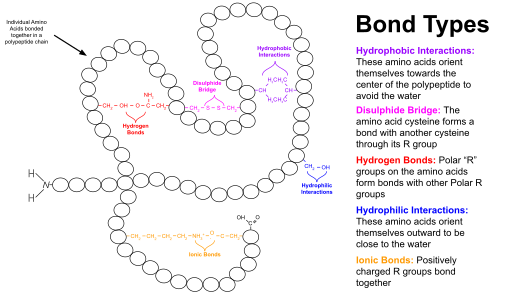
3o structure proteins can have different domains. (e.g. DNA binding domains, kinase domains, SH2 domains, etc.)
- Can fold into an independent, stable structure
- Have a specific function and can perform independently of the rest of the protein
- Can move relative to other domains. Domains are connected by flexible, unstructured lengths of polypeptide chain.
- Domains can be mixed and matched.
Quaternary (4o) Protein Structure
Quaternary structure is the 3-D arrangement of 2 or more tertiary structures into a multi-subunit protein.
4o structures are stabilized by all of the same forces 3o structures
- Hydrogen bonds
- Van der Waals forces
- Ionic bonds
- Disulfide bridges
Some proteins only function as multimeric proteins but not all proteins have quaternary structure. Some proteins function with a single 3o structure protein unit.
0:00 / 0:00
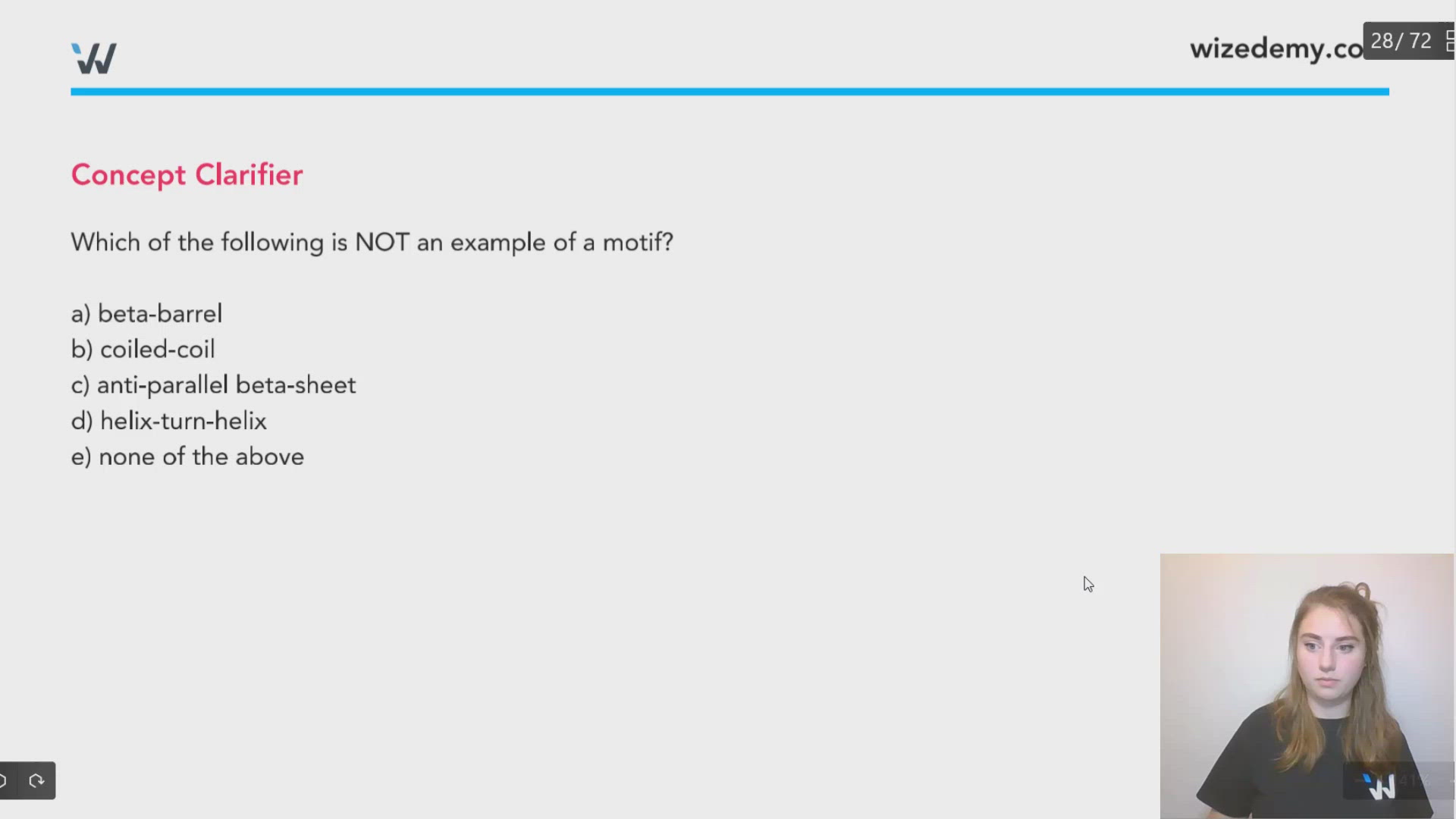
Which of the following is NOT an example of a motif?
a) beta-barrel
b) coiled-coil
c) anti-parallel beta-sheet
d) helix-turn-helix
e) none of the above
c) the anti-parallel beta sheet is a secondary structure. A motif is a recognizable folding pattern involving two or more secondary structures and their connecting segments

Mark Yourself Question
- Grab a piece of paper and try this problem yourself.
- When you're done, check the "I have answered this question" box below.
- View the solution and report whether you got it right or wrong.
Multi-subunit proteins sometimes perform what is called cooperative binding. This occurs in hemoglobin where binding of oxygen to one subunit facilitates the binding of oxygen to the other three subunits. Propose an explanation for this phenomena.