Wize University Biochemistry Textbook > Protein Function & Enzymes
Macromolecules: Fibers
0:00 / 0:00
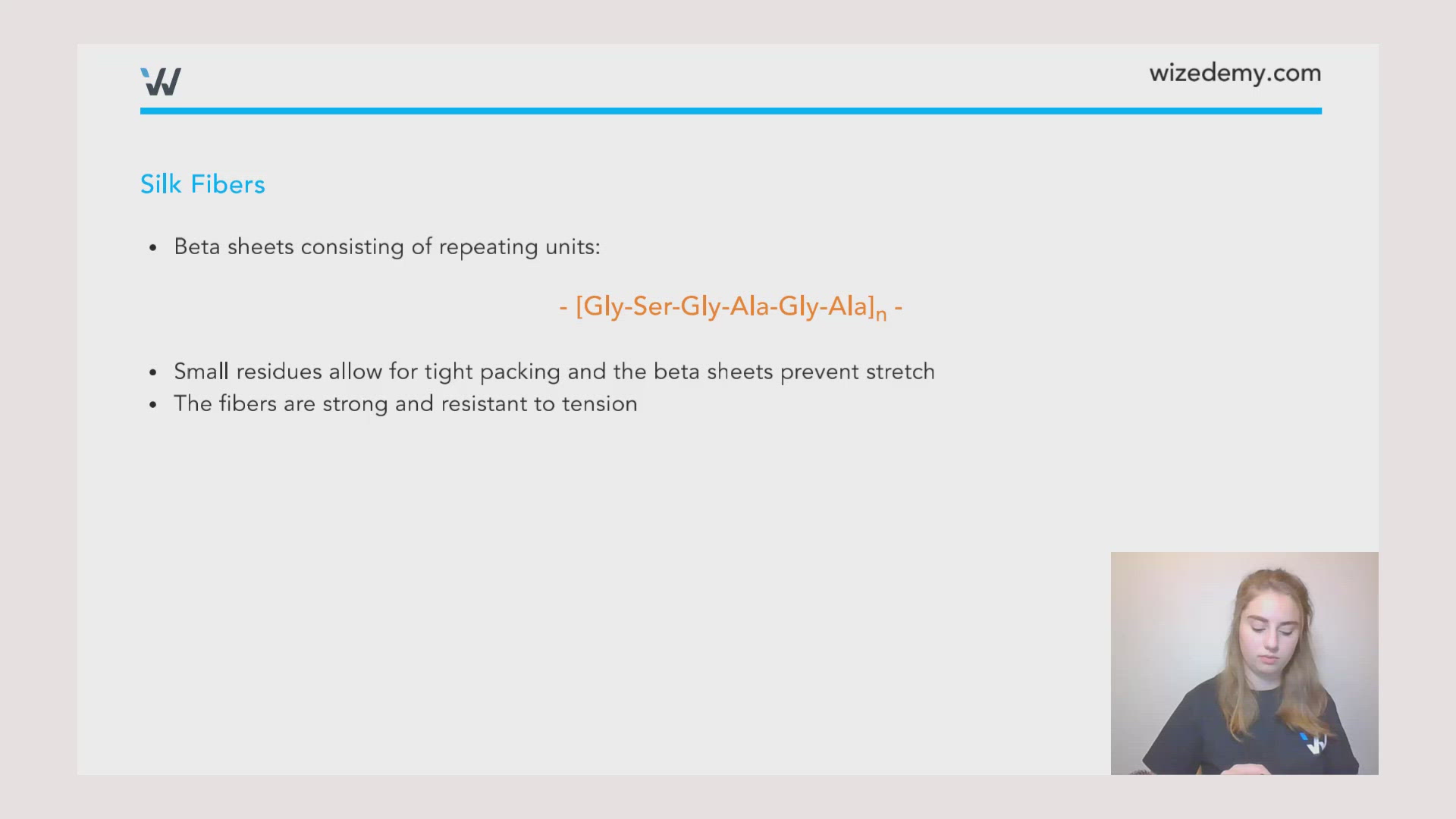
Silk Fibers
- Beta sheets consisting of repeating units:
- [Gly-Ser-Gly-Ala-Gly-Ala]n -
- Small residues allow for tight packing and the beta sheets prevent stretch
- The fibers are strong and resistant to tension
0:00 / 0:00
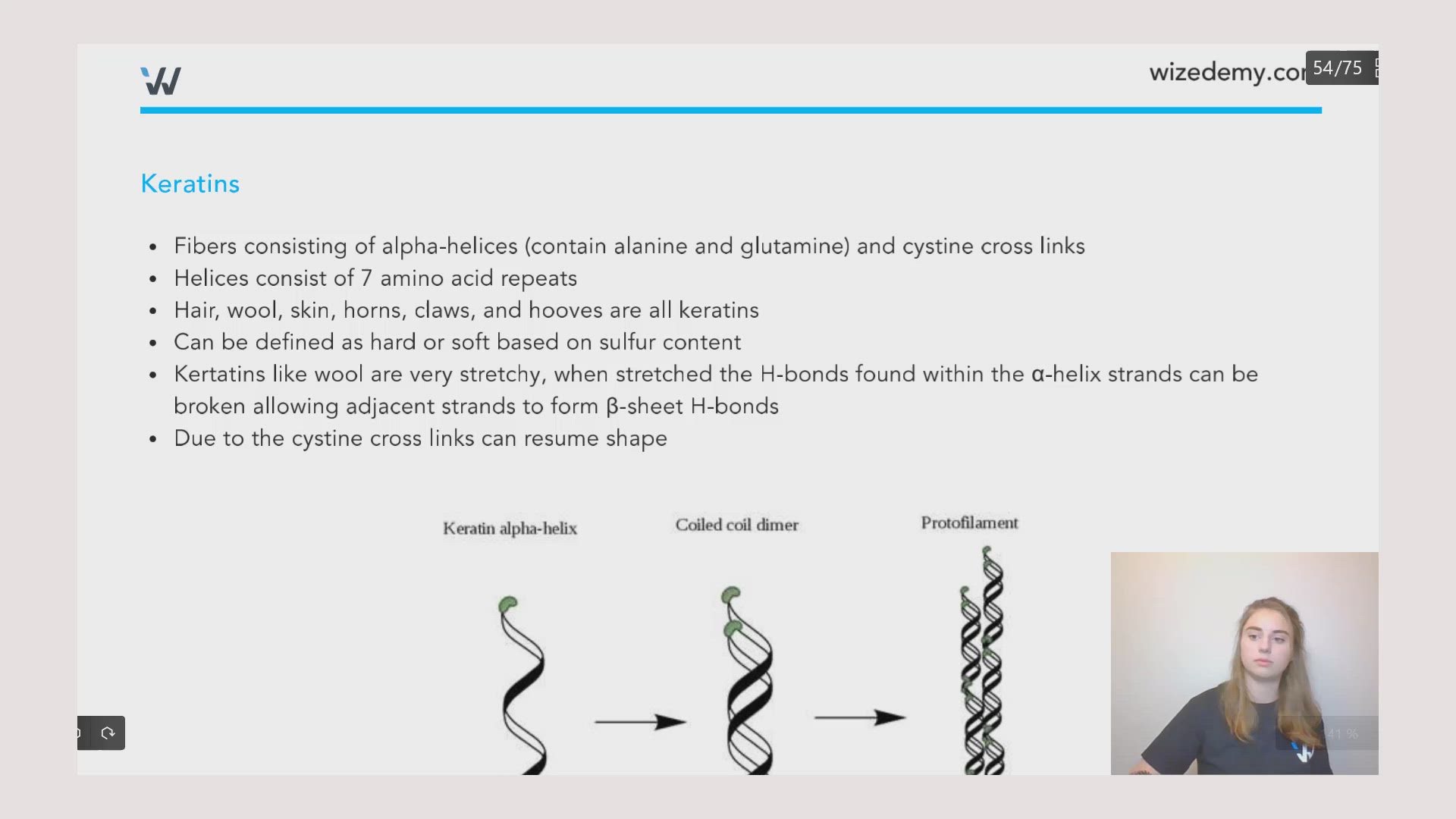
Keratins
- Fibers consisting of alpha-helices (contain alanine and glutamine) and cystine cross links
- Helices consist of 7 amino acid repeats
- Hair, wool, skin, horns, claws, and hooves are all keratins
- Can be defined as hard or soft based on sulfur content
- Kertatins like wool are very stretchy, when stretched the H-bonds found within the α-helix strands can be broken allowing adjacent strands to form β-sheet H-bonds
- Due to the cystine cross links they can resume shape

https://commons.wikimedia.org/wiki/File:Alpha_Keratin_Basic_Structure.svg#/media/File:Alpha_Keratin_Basic_Structure.svg. Author Mlpatton has image licensed under the Creative Commons Attribution-Share Alike 4.0 International license.
0:00 / 0:00
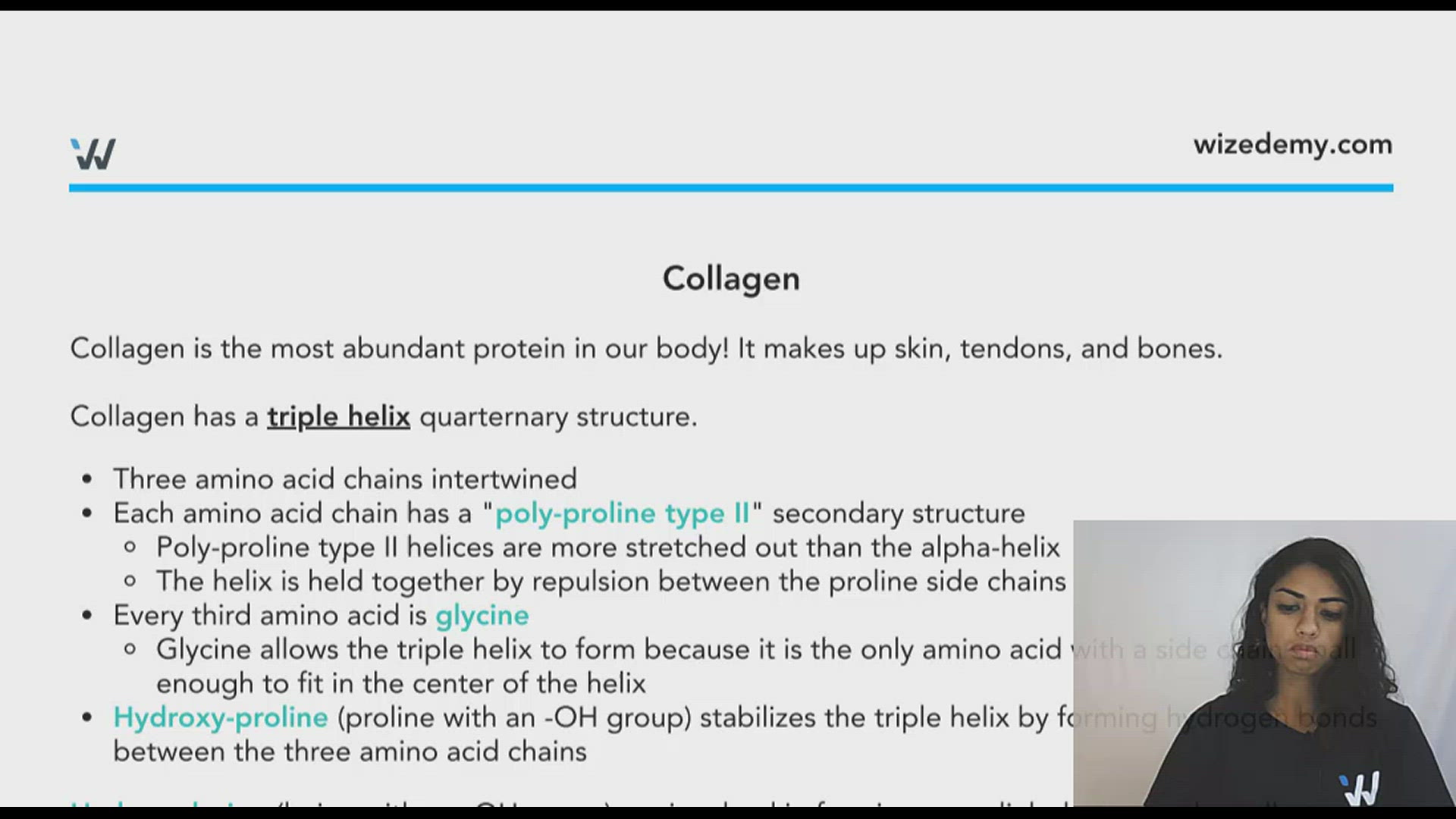
Collagen
Collagen is the most abundant protein in our body! It makes up skin, tendons, and bones.
Collagen has a triple helix quaternary structure.
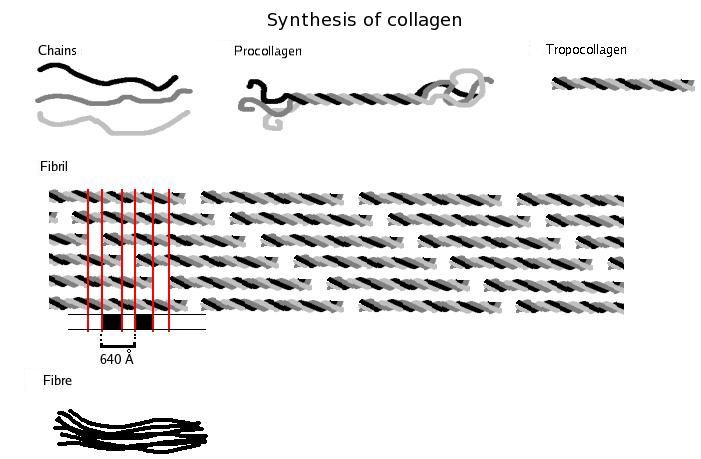
- Three amino acid chains intertwined
- Each amino acid chain has a "poly-proline type II" secondary structure
- Poly-proline type II helices are more stretched out than the alpha-helix
- The helix is held together by repulsion between the proline side chains
- Every third amino acid is glycine
- Glycine allows the triple helix to form because it is the only amino acid with a side chain small enough to fit in the center of the helix
- Hydroxy-proline (proline with an -OH group) stabilizes the triple helix by forming hydrogen bonds between the three amino acid chains
Hydroxy-lysine (lysine with an -OH group) are involved in forming cross-links between the collagen strands to stabilize the collagen fibril
Collagen-related Diseases
- Scurvy: Lack of Vitamin C, which is needed by the enzyme that hydroxylates proline--> unstable collagen
- Osteogenesis imperfecta: Glycine mutations lead to a lack of collagen---> malformed or absent bones
- Ehlers-Danlos syndrome: Mutations in the collagen gene---> inherited connective tissue disorder
0:00 / 0:00
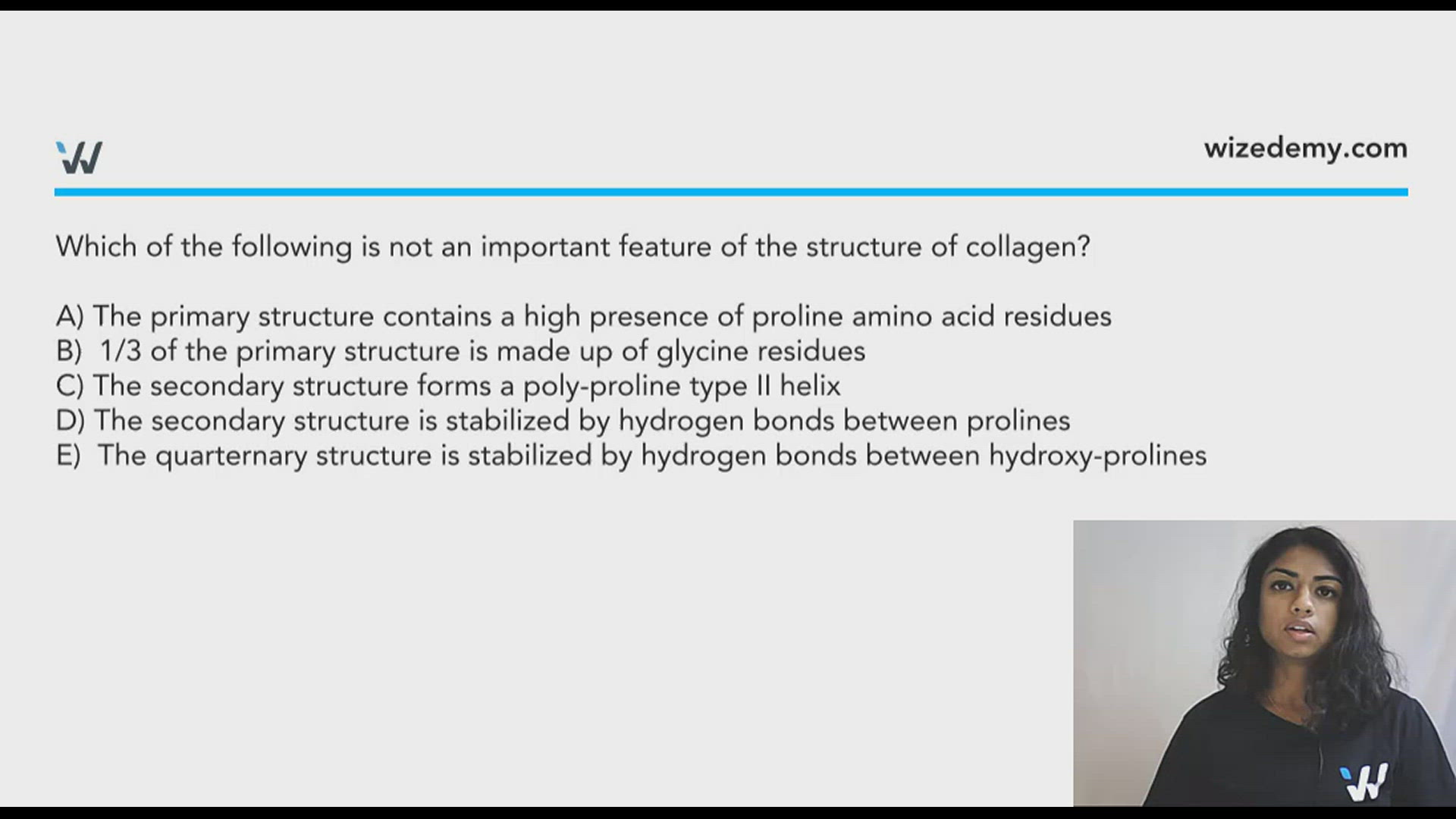
Which of the following is not an important feature of the structure of collagen?
A) The primary structure contains a high presence of proline amino acid residues
B) 1/3 of the primary structure is made up of glycine residues
C) The secondary structure forms a poly-proline type II helix
D) The secondary structure is stabilized by hydrogen bonds between prolines
E) The quarternary structure is stabilized by hydrogen bonds between hydroxy-prolines
The correct answer is D.
Proline residues are unable to form hydrogen bonds due to their amino acid side chain properties. The secondary structure of collagen is in stead stabilized by the REPULSION of proline side chains.
0:00 / 0:00
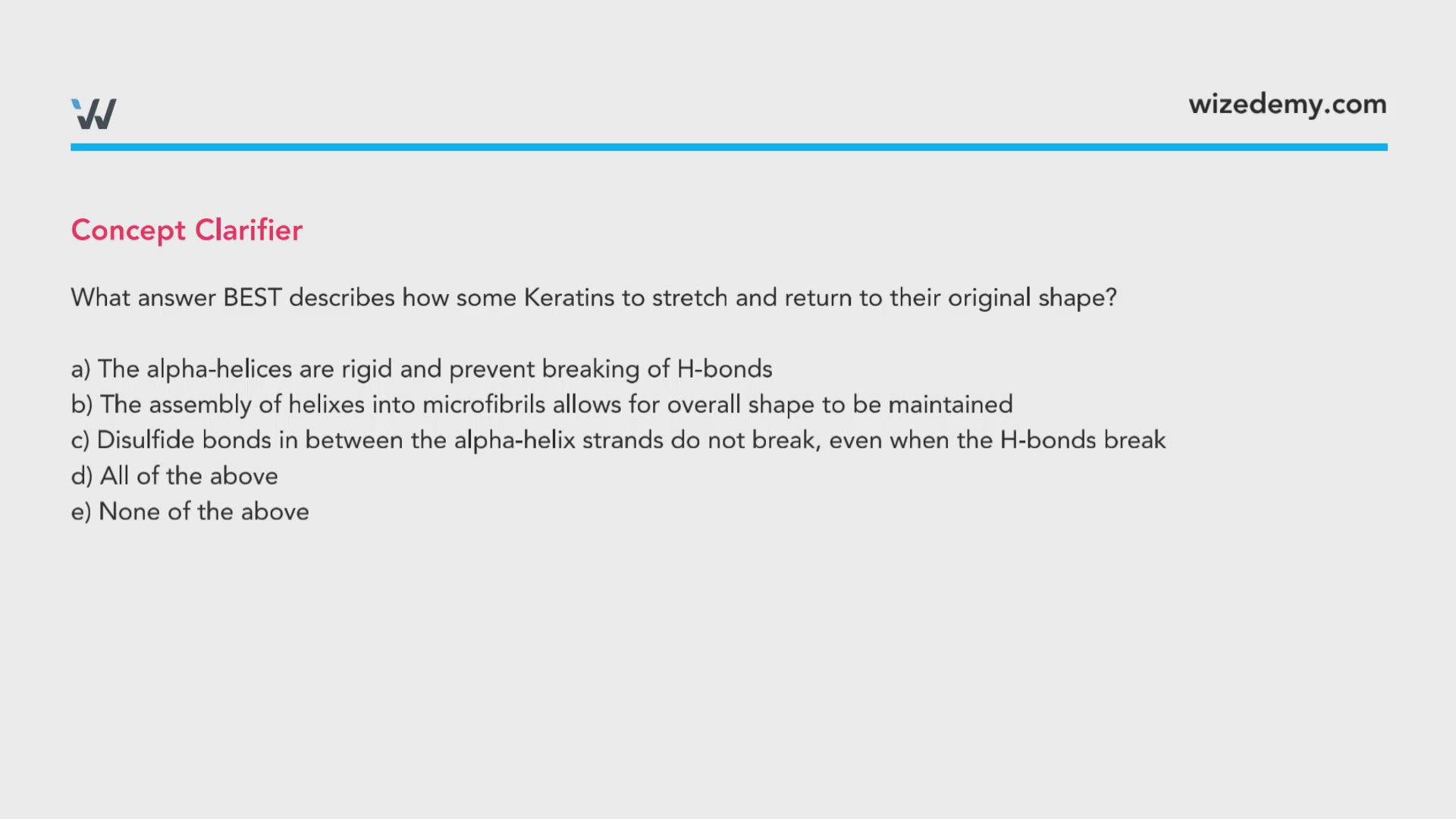
What answer BEST describes how some Keratins can stretch and return to their original shape?
a) The alpha-helices are rigid and prevent breaking of H-bonds
b) The assembly of helixes into microfibrils allows for overall shape to be maintained
c) Disulfide bonds in between the alpha-helix strands do not break, even when the H-bonds break
d) All of the above
e) None of the above
c) Disulfide bonds in between the alpha-helix strands do not break, even when the H-bonds break
Which statement is FALSE about fibers?