Wize University Biochemistry Textbook > Prokaryotic Transcription
Prokaryotic Transcription: Operons

0:00 / 0:00
The Lac Operon & Glucose Regulation
When lactose is present AND glucose is absent…
- Permease transports lactose into the cell.
- β-galactosidase converts lactose to allolactose.
- Low glucose levels activates adenylyl cyclase that synthesizes cAMP.
- cAMP activates the CAP protein.
- CAP is an activator protein.
- cAMP is an inducer.
- Active CAP binds the CAP sequence in the Lac promoter.
- CAP binding to the promoter promotes RNA polymerase binding and transcription = high transcription levels.

When lactose AND glucose is present…
- Permease transports lactose into the cell.
- β-galactosidase converts lactose to allolactose.
- High glucose levels inactivate adenylyl cyclase, thus decreases cAMP levels.
- No cAMP inactivates the CAP protein.
- Inactive CAP cannot bind promoter and promote transcription = low transcription levels.

Wize Tip
Think about it like this: if glucose is available, lactose does not need to be broken down to be used for energy.

0:00 / 0:00
The Tryptophan (Trp) Operon
Tryptophan is an amino acid involved in an operon in some bacteria.
- The goal of this operon is to produce tryptophan when it is low in the cell.
- Tryptophan metabolism is under the control of a single promoter.
- Genes encoded in the trp operon are involved in trp biosynthesis.
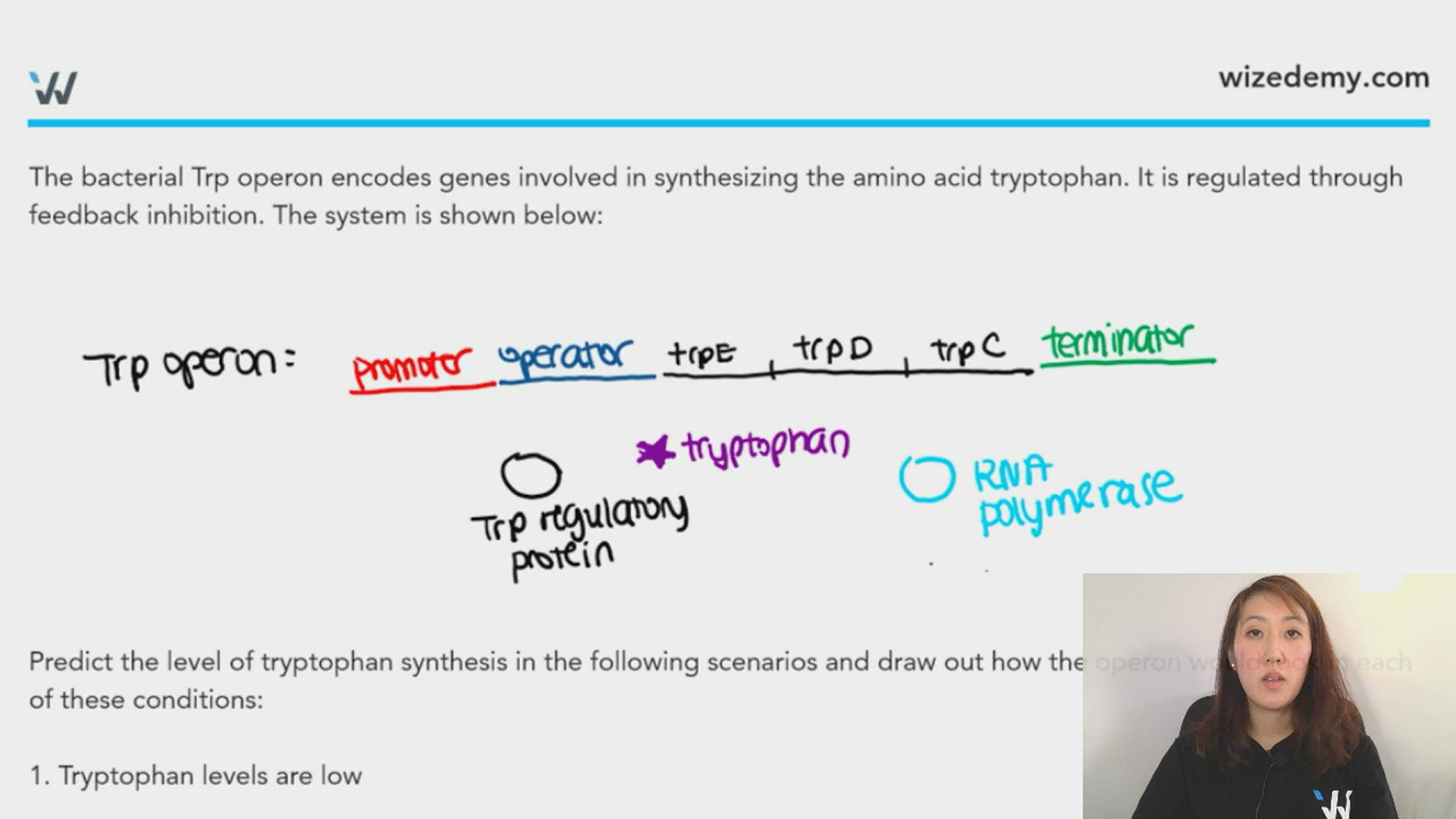
- TrpR is a repressor protein; it binds to the operator (O).
- Trp is a co-repressor.
- The structural (trpA - E) genes are proteins required for production of trp.

If tryptophan is present…
- High Trp concentrations binds the allosteric site of the trp repressor and activates it.
- Activation of the trp repressor blocks transcription of the operon, thus no biosynthesis enzymes and no tryptophan.
If tryptophan is absent….
- Low Trp concentrations inactivates the trp repressor.
- Inactive Trp repressor allows the transcription of the operon, thus increasing expression of trp biosynthesis enzymes and tryptophan can be produced.
0:00 / 0:00
The bacterial Trp operon encodes genes involved in synthesizing the amino acid tryptophan. It is regulated through feedback inhibition. The system is shown below:
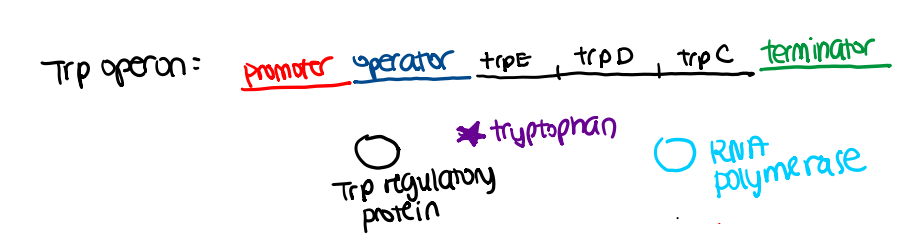
Predict the level of tryptophan synthesis in the following scenarios and draw out how the operon would look in each of these conditions:
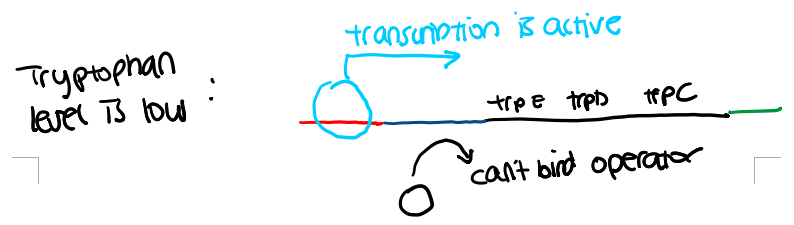
1. Tryptophan levels are low
Tryptophan normally binds to the regulatory protein causing a conformational change so that it can bind to DNA (specifically the operator). Without tryptophan or when there is very little tryptophan in the cell, the regulatory protein is not bound to the tryptophan and cannot bind to the operator. RNA polymerase, however, is bound to the promoter as it normally has a high affinity for the Trp operon promoter. Since there is nothing blocking its way, it will actively transcribe the tryptophan synthesis genes.
2. Tryptophan levels are high
When tryptophan is present in high amounts, it will start to bind the regulatory protein causing a conformational change that triggers its binding to the operator. The operator region is downstream of the promoter. RNA polymerase is still going to bind the promoter because it has a high affinity for it but it will not be able to move downwards towards the gene due to the blockage that the regulatory protein causes. Therefore, transcription would not occur.

3. Why is this an example of feedback inhibition per se?
This is an example of feedback inhibition because the final product which is tryptophan made by the enzymes encoded in the Trp operon (ie. TrpE, TrpD, TrpC are enzymes that make tryptophan) can regulate its own production. When the operon has resulted in enough enzymes to make lots of tryptophan, the final product itself will stop synthesis of more tryptophan to regulate the level of tryptophan in the cell. This is feedback inhibition.