Wize University Biochemistry Textbook > Translation
Overview of Translation
0:00 / 0:00
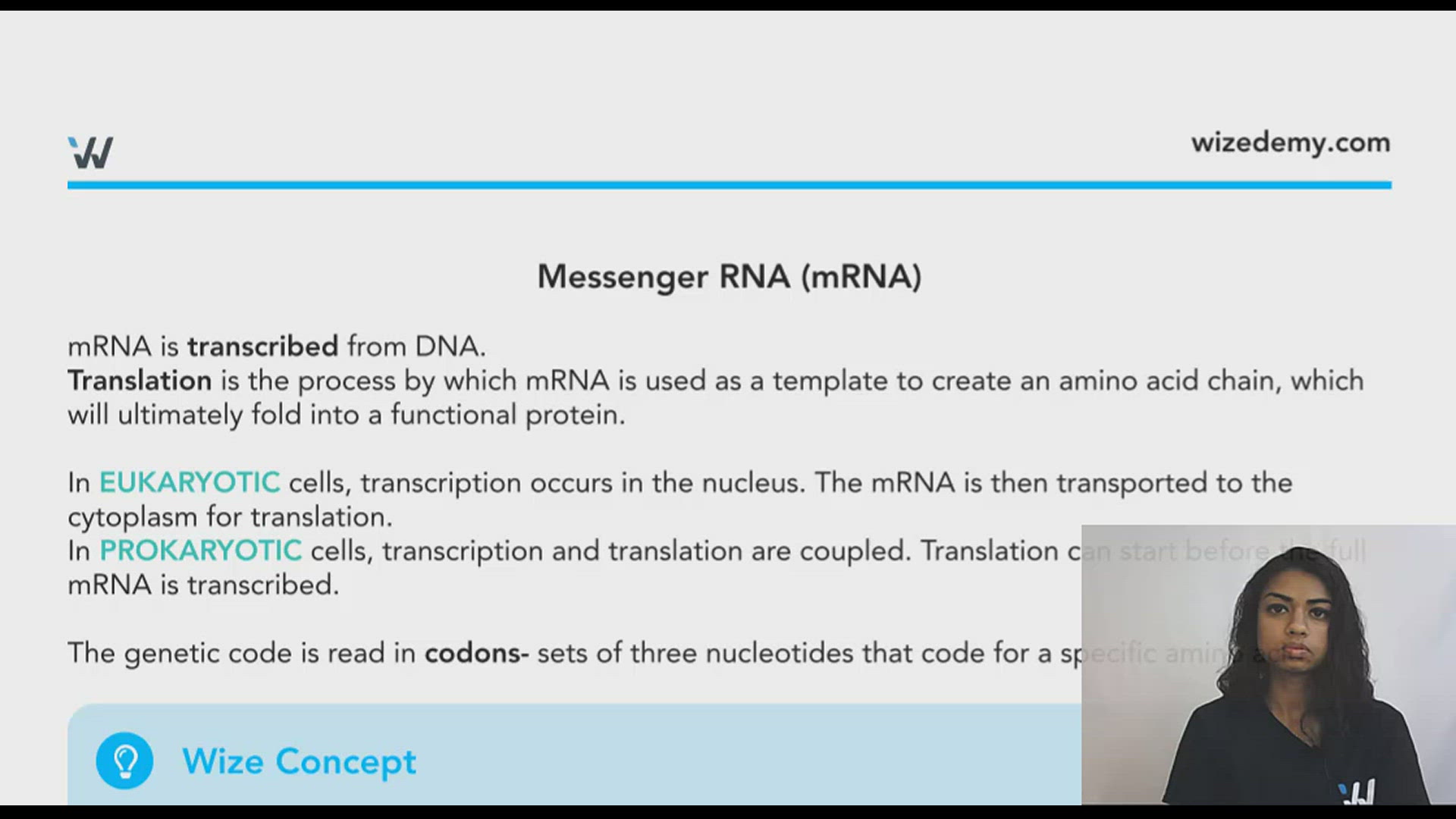
Messenger RNA (mRNA)
mRNA is transcribed from DNA.
Translation is the process by which mRNA is used as a template to create an amino acid chain, which will ultimately fold into a functional protein.
In EUKARYOTIC cells, transcription occurs in the nucleus. The mRNA is then transported to the cytoplasm for translation.
In PROKARYOTIC cells, transcription and translation are coupled. Translation can start before the full mRNA is transcribed.
The genetic code is read in codons- sets of three nucleotides that code for a specific amino acid.
Wize Concept
Given that there are 4 bases (A, G, C and T) and a codon consists of 3 nucleotides, there are 43= 64 possible codons
However, there are only 20 different amino acids (not including stop codons). This is because the DNA sequence is degenerate. Multiple codons code for the same amino acid but only one amino acid is coded for by each codon.
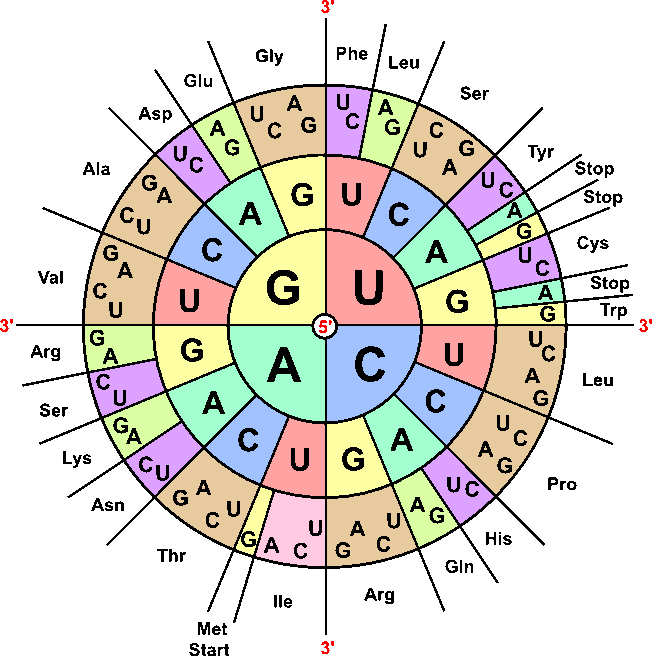
ALL amino acid chains start with the codon AUG= Methionine (or very rarely CUG or GUG)
Amino acid chains end at stop codons: UAA, UGA or UAG
There are THREE types of mutations that can impact translation:
- Missense mutation- A point mutation in the DNA results in an amino acid substitution (e.g. CAC (Histidine) --> CAA (Glutamine))
- Nonsense mutation- A point mutation in the DNA results in a premature stop codon (e.g UAU (Tyrosine)--> UAA (stop))
- Reading Frameshift
The sequence between the start codon and the stop codon is called a reading frame
Usually, a sequence has only one reading frame but sometimes, because stop codons are encountered in the other two reading frames before a full amino acid chain can be translated.
But sometimes, a reading frame shift can occur, leading to different polypeptides being formed.

0:00 / 0:00
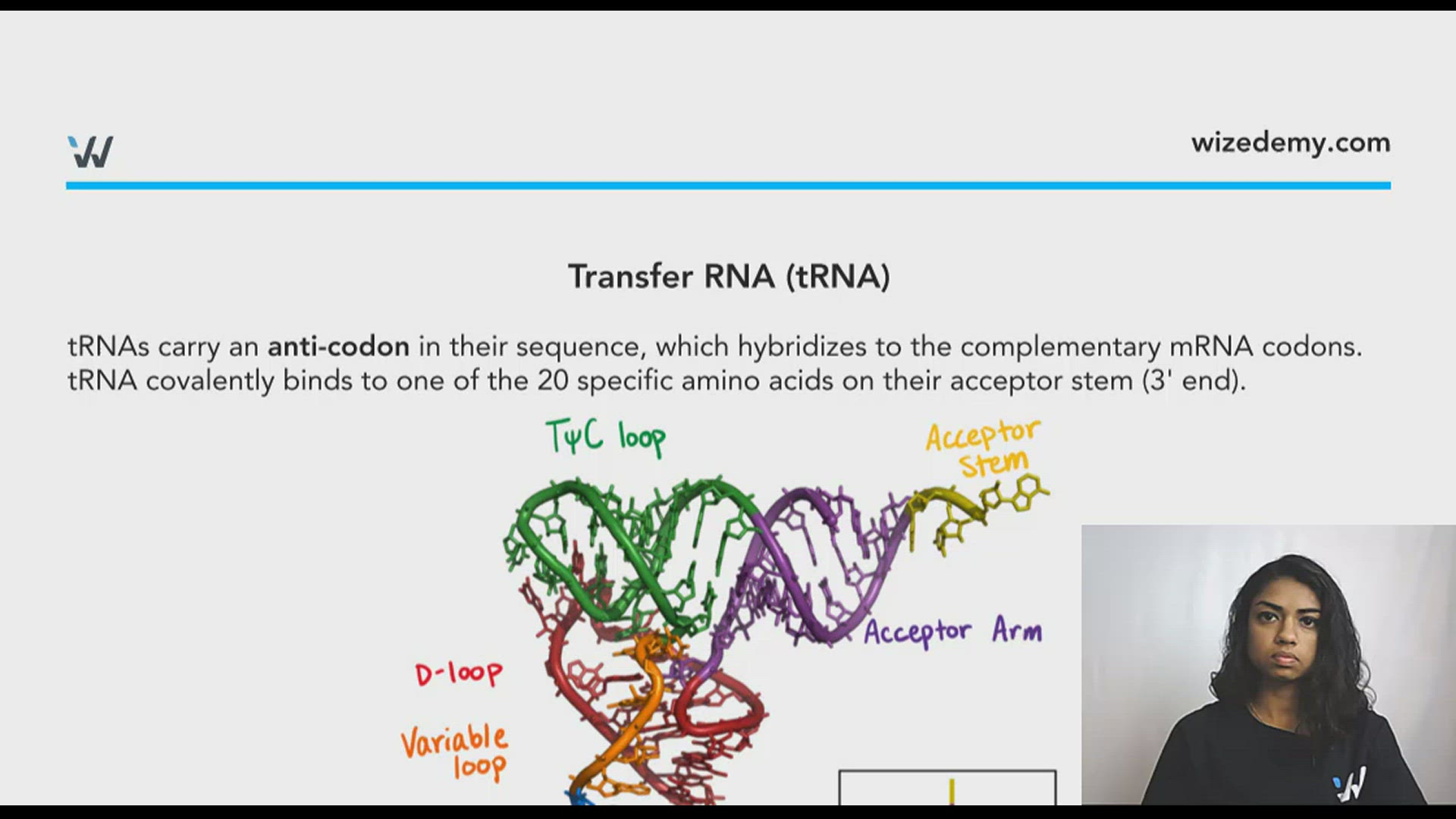
Transfer RNA (tRNA)
tRNAs carry an anti-codon in their sequence, which hybridizes to the complementary mRNA codons.
tRNA covalently binds to one of the 20 specific amino acids on their acceptor stem (3' end).
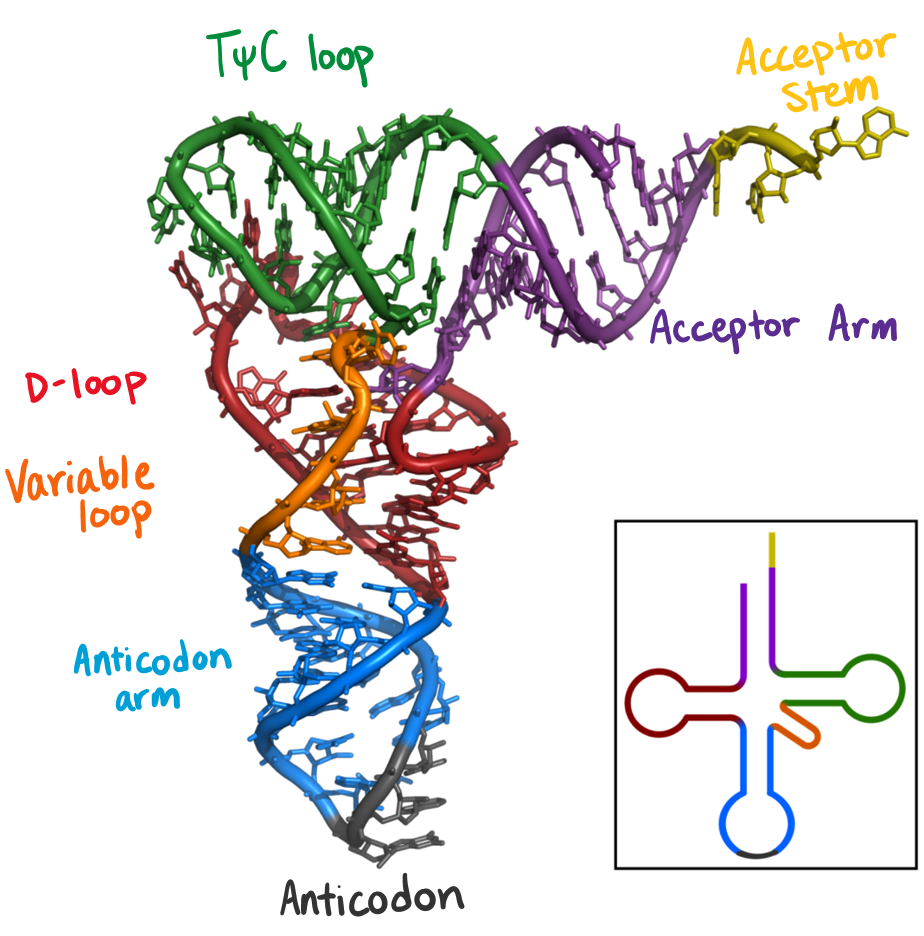
Wobble: sometimes, only the first two bases are needed for the tRNA to match with the correct amino acid
- For example: CCA, CCC, CCU and CCG all code for Proline
Amino acids are ACTIVATED by an enzyme called aminoacyl-tRNA synthetase.
- Provides energy (ATP) so that the amino acid can form a peptide bond
- Provides specificity- matches the correct amino acid to the tRNA
There are more tRNAs than there are amino acids so many amino acids have more than one tRNA that can attach them to the amino acid chain.
Ribosomes and Ribosomal RNA (rRNA)
rRNAs form a complex with other proteins to form ribosomes.
- Small subunit: 33 proteins + 1 rRNA -- Matches tRNA to the codons
- Large subunit: 49 proteins + 3 rRNAs -- Catalyzes the formation of peptide bonds
Ribosomes physically move along the mRNA sequence and catalyze the synthesis of the amino acid chain.
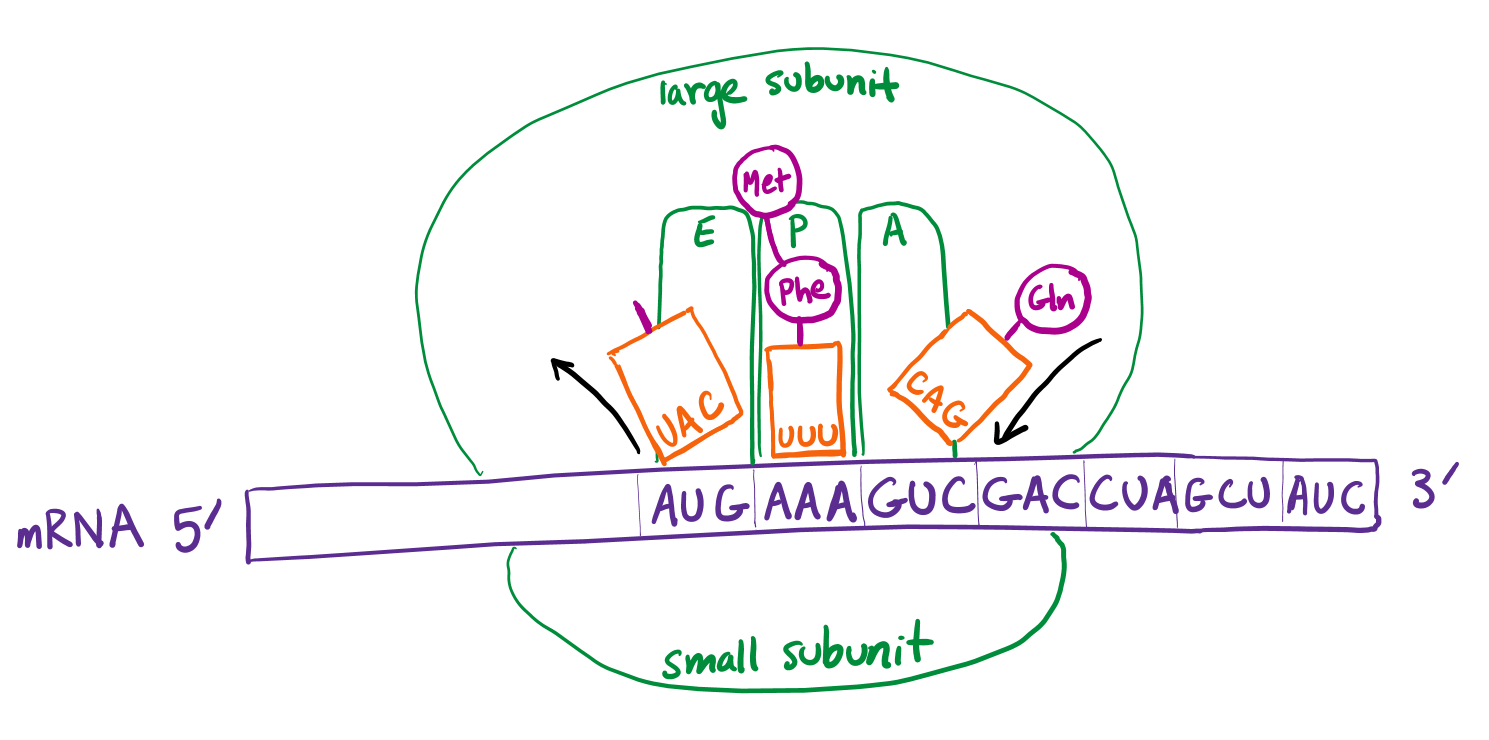
There are three sites for tRNAs to bind on the ribsome:
- A site (aminoacyl tRNA site)
- P site (peptidyl tRNA site)
- E site (exit site)
mRNA is bound close the the A and P sites and is read in the 5'-->3' direction.

0:00 / 0:00
Translation into Proteins
Recall that translation of mRNA into proteins is done by a cellular organelle called the ribosome.
- The ribosome is composed of a small subunit and a large subunit made from rRNA and proteins.
- The ribosome contains three sites:
- A (aminoacyl) site: the acceptor site for an aminoacyl-tRNA.
- P (peptidyl) site: the site where the peptide bond forms between the amino acid and the growing polypeptide chain.
- E (exit) site: the site where the tRNAs exit the ribosome.
- Translation occurs in three steps: (1) initiation, (2) elongation, and (3) termination.
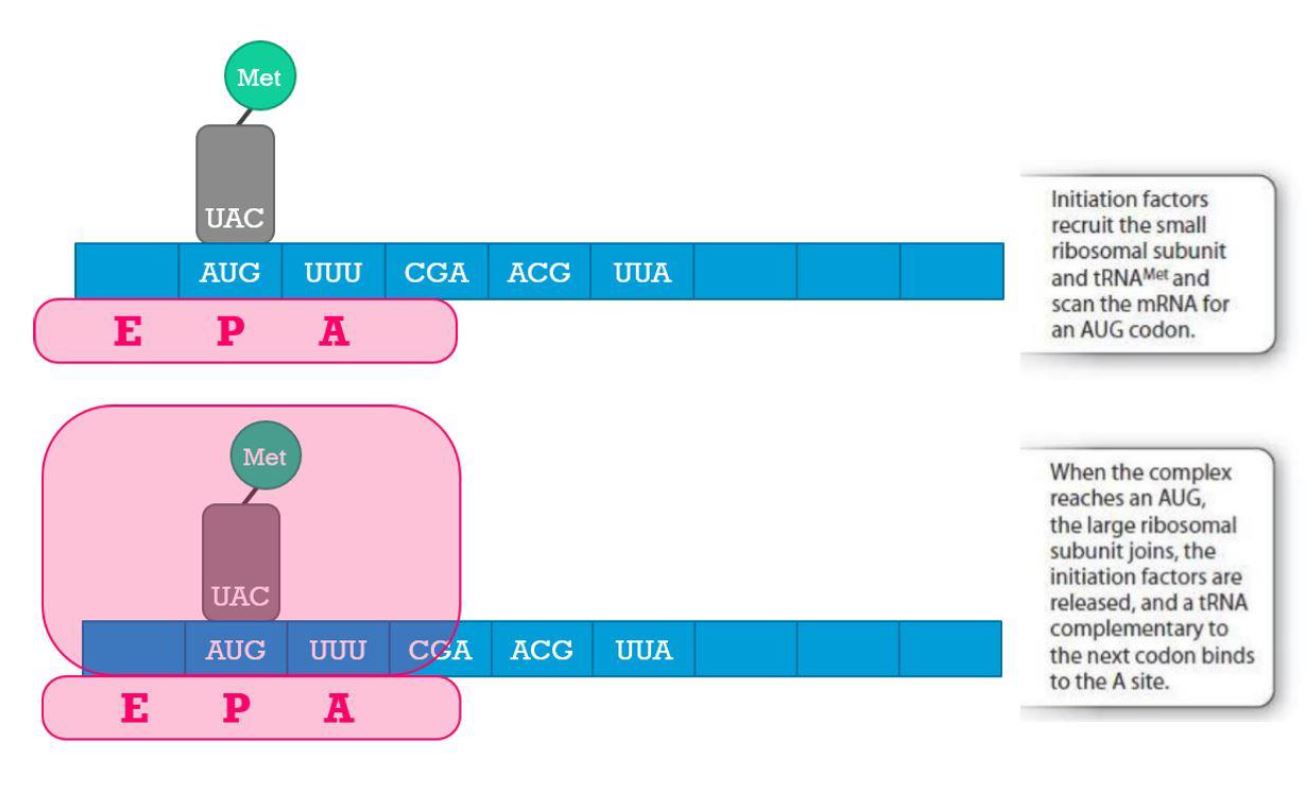
Initiation
- When the mRNA enters the cytosol, the 5' end of the mRNA binds to the small subunit of the ribosome.
- A tRNA carrying the amino acid methionine arrives at the P site (peptidyl site) of the ribosome and binds to the start codon (AUG).
- Next, the large subunit binds and completes the initiation complex.
Elongation
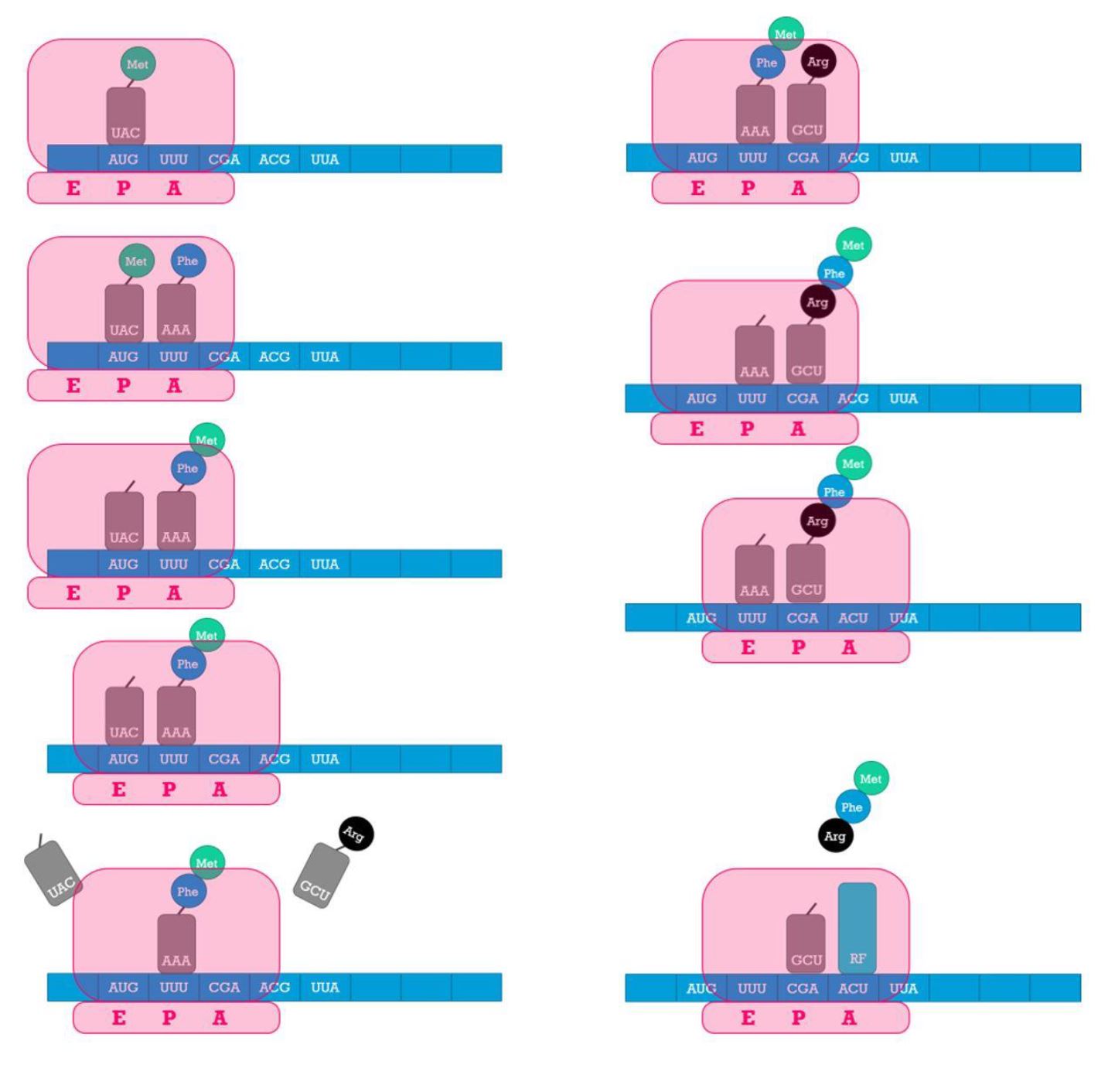
- A tRNA for the next codon attaches to the A site (aminoacyl site). The carboxyl end (C-terminus) of the methionine forms a peptide bond with the amine end (N-terminus) of the amino acid at the A site (catalyzed by peptidyl transferase).
- The ribosome shifts three nucleotides toward the 3' end of the mRNA in a step called translocation, shifting the tRNA that held the methionine to the E site (exit site), and the tRNA carrying the dipeptide moves from the A site to the P site.
- The A site is now available for another tRNA.
Termination
When a stop codon is reached, release factor proteins bind to the A site, releasing the polypeptide from the tRNA and ribosome.

0:00 / 0:00
Translation
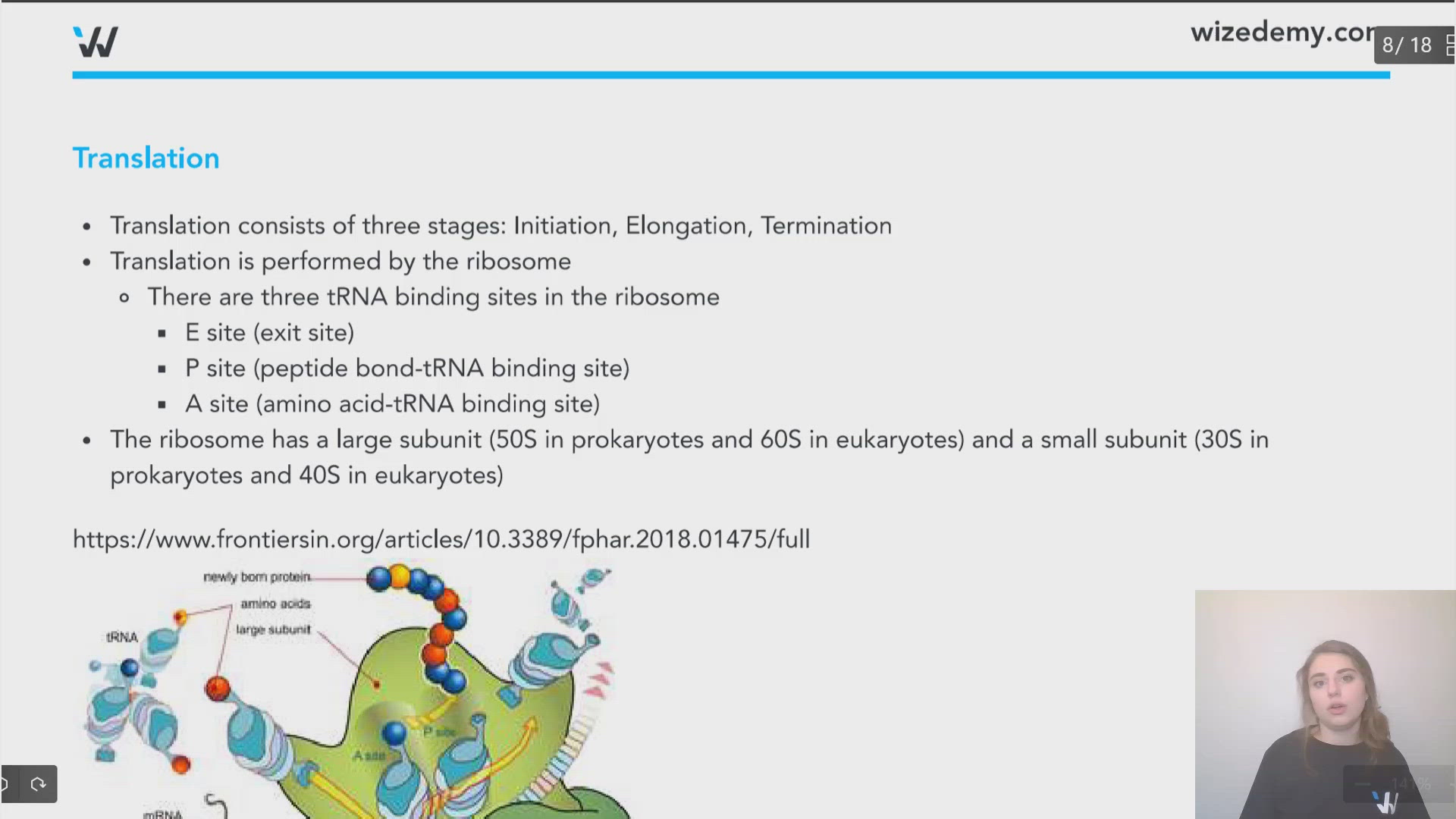
- Translation consists of three stages: Initiation, Elongation, Termination
- Translation is performed by the ribosome
- There are three tRNA binding sites in the ribosome
- E site (exit site)
- P site (peptide bond-tRNA binding site)
- A site (amino acid-tRNA binding site)
- The ribosome has a large subunit (50S in prokaryotes and 60S in eukaryotes) and a small subunit (30S in prokaryotes and 40S in eukaryotes)
https://www.frontiersin.org/articles/10.3389/fphar.2018.01475/full
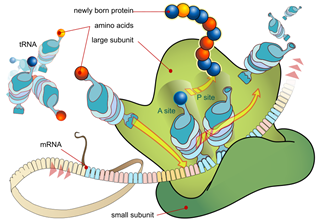
https://commons.wikimedia.org/wiki/File:Ribosome_mRNA_translation_en.svg. LadyofHats. Public Domain.
Initiation:
- How are the start codons differentiated from internal Met codons?
- There are sequences nad markers that happen before the start codon that indicate the translational start site
- In Prokaryotes this is the Shine-Dalgarno sequence: AGGAGG
- In Eukaryotes this is the 5' CAP
- Initiation in Prokaryotes:
- The initial Met site is modified with a formyl group to fMet
- IF1 and 3 bind the 30S unit preventing premature binding to the 50S unit
- GTP bound IF2 binds the fMet-tRNA, the Shine-Dalgarno sequence, and 30S subunit
- IF1 and 3 are released allowing the 50S unit to bind
- GTP gets hydrolyzed releasing IF2 and forming the 70S initiation complex
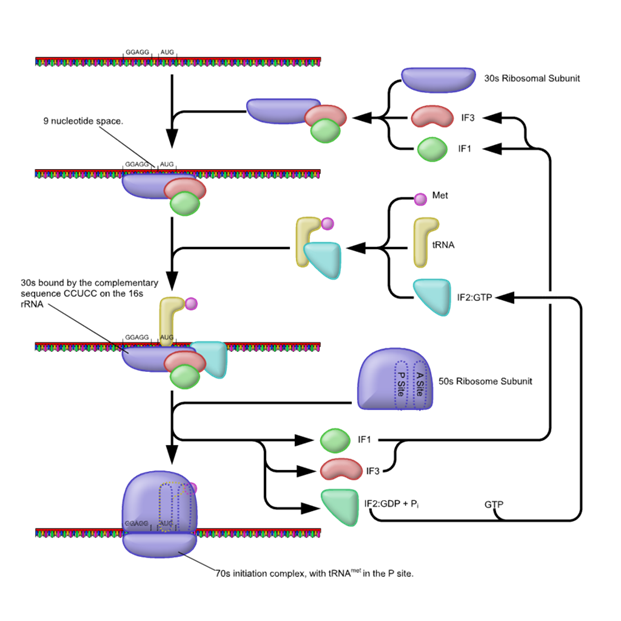
https://commons.wikimedia.org/wiki/File:Prokaryotic_Translation_Initiation.png. Chewie. Creative Commons Attribution-Share Alike 3.0 Unported license.
- Initiation in Eukaryotes:
- The preinitiation complex (PIC) forms: eIFs, 40S unit, GTP, and Met-tRNA all bind the 5' CAP
- eIF-4E recruits eIF-4G which binds Poly A binding protein I (PABPI) circularizing the mRNA
- The PIC moved in the 3' direction until Met-tRNA binds AUG, then the IFs leave when the 60S unit binds, forming the 80S initiation complex
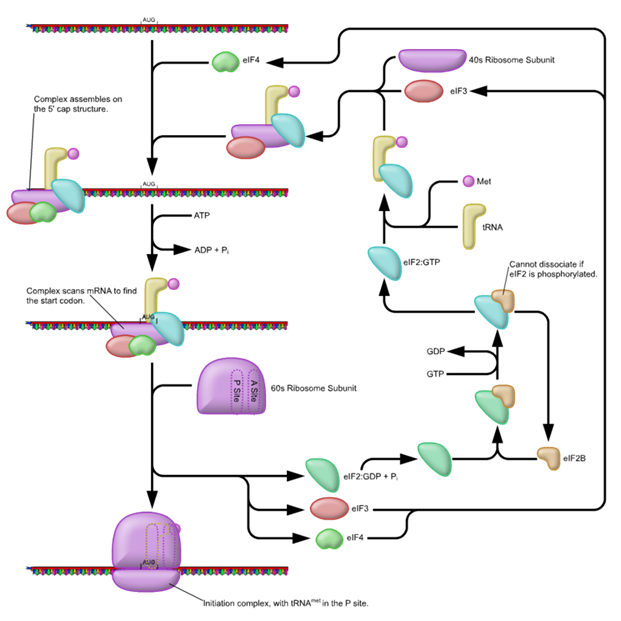
https://commons.wikimedia.org/wiki/File:Eukaryotic_Translation_Initiation.png. Chewie. Creative Commons Attribution-Share Alike 3.0 Unported license.
Elongation:
- The Met-tRNA (or fMet-tRNA) is bound to the p-site
- Elongation factor Tu (EF-Tu) bound to GTP is allowed to bind the next aminoacyl-tRNA and bring it to the A-site on the large ribosomal subunit
- In eukaryotes the EF-Tu counterpart is EF1α
- If the anticodon matches the codon, then GTP is hydrolized and EF-Tu leaves the large ribosomal subunit
- Peptidyl transferase catalyses the formation of the peptide bond
- EF-G (bound to GTP) binds the EF-Tu ribosomal binding site and, upon hydrolysis of GTP, shifts the mRNA through the ribosome by one codon length
- the now empty tRNA (that initially carried Met) is in the E-site and free to leave
- The EF-G and GDP are released and the cycle repeats
- EF-G is replaced by EF2 in eukaryotes
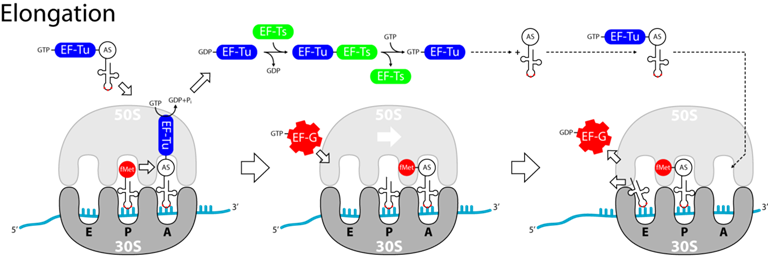
https://commons.wikimedia.org/wiki/File:Elongation_der_Translation.png. User07. Creative Commons Attribution-Share Alike 3.0 Unported license.
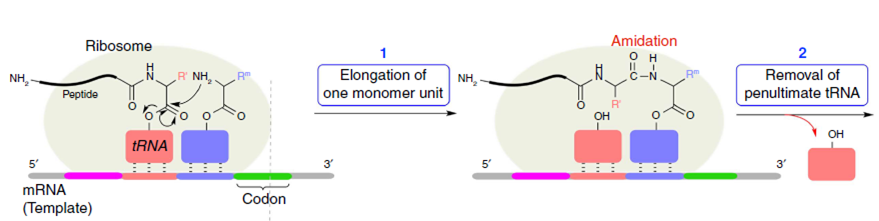
https://commons.wikimedia.org/wiki/File:Transcription_and_translation_process.png. Yusuke Hibi et al. Creative Commons Attribution-Share Alike 4.0 International license.
Termination:
- There are no tRNA with anticodons complementary to stop codons
- Release factors (RF) bind stop codons
- Contain a methylated glutamine residue that catalyzes the hydrolysis of the polypetide chain from the P-site, releasing it from the ribosome
- Prokaryotes contain RF1 and 2, while eukaryotes just have eRF1
- RF3 (a GTPase) releases RF1/2 from the ribosome allowing it to be used again
Wize Tip
Things to Know!
- The role of the ribosomal A-site, P-site, and E-site
- The components of the 70S initiation complex and 80S initiation complex
- Know the order of assemble of all the initiation factors
- The order of events in elongation
- The role of GTP, EF-Tu, peptidyl transferase, and EF-G
- The different release factors (RF) and the difference between prokaryotic and eukaryotic translation termination
0:00 / 0:00
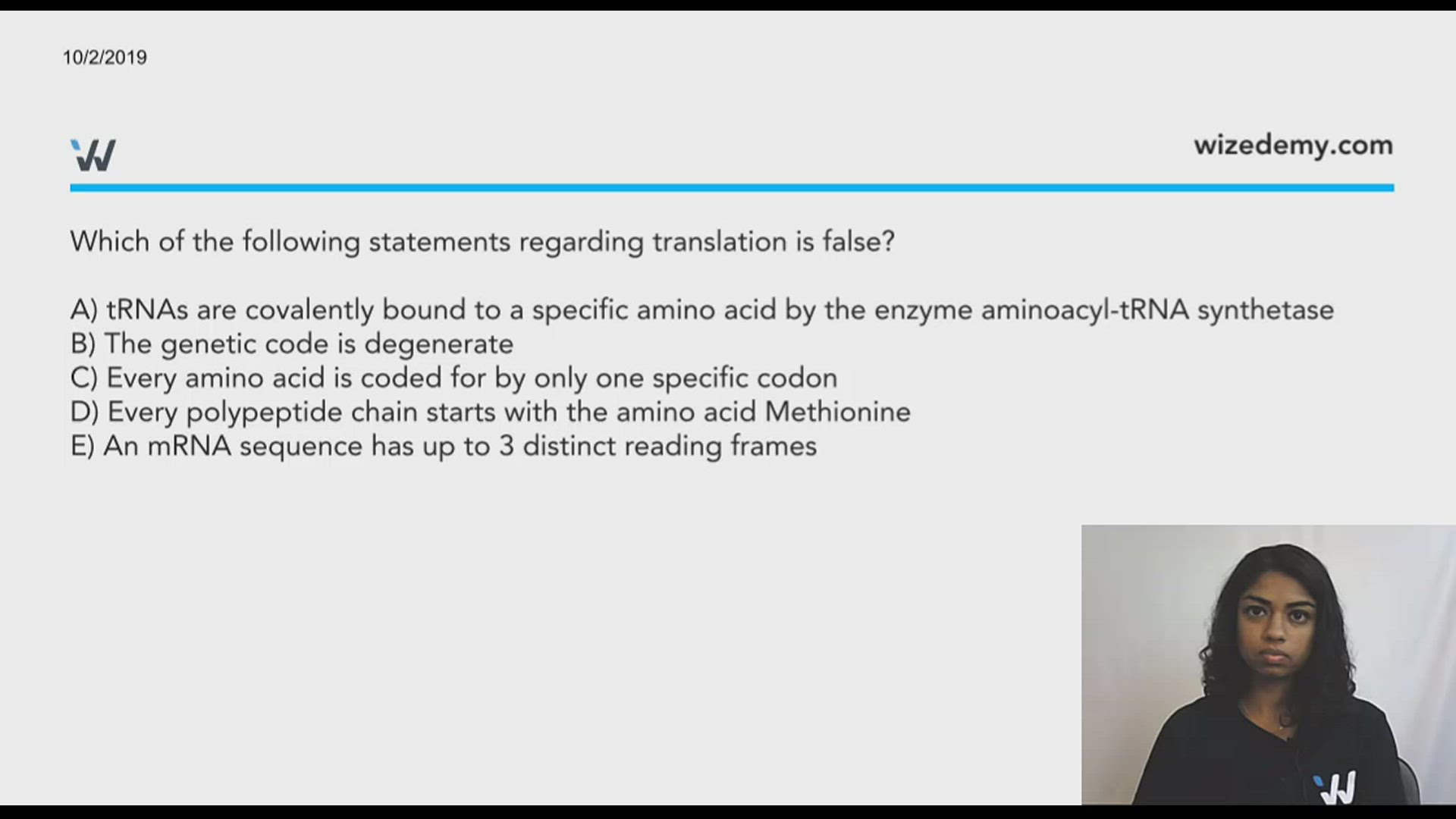
Which of the following statements regarding translation is false?
A) tRNAs are covalently bound to a specific amino acid by the enzyme aminoacyl-tRNA synthetase
B) The genetic code is degenerate
C) Every amino acid is coded for by only one specific codon
D) Every polypeptide chain starts with the amino acid Methionine
E) An mRNA sequence has up to 3 distinct reading frames
The correct answer is C. An amino acid may be encoded for by only one specific codon but most are coded for by many different codons.
All the other answers are true statements regarding translation.
0:00 / 0:00
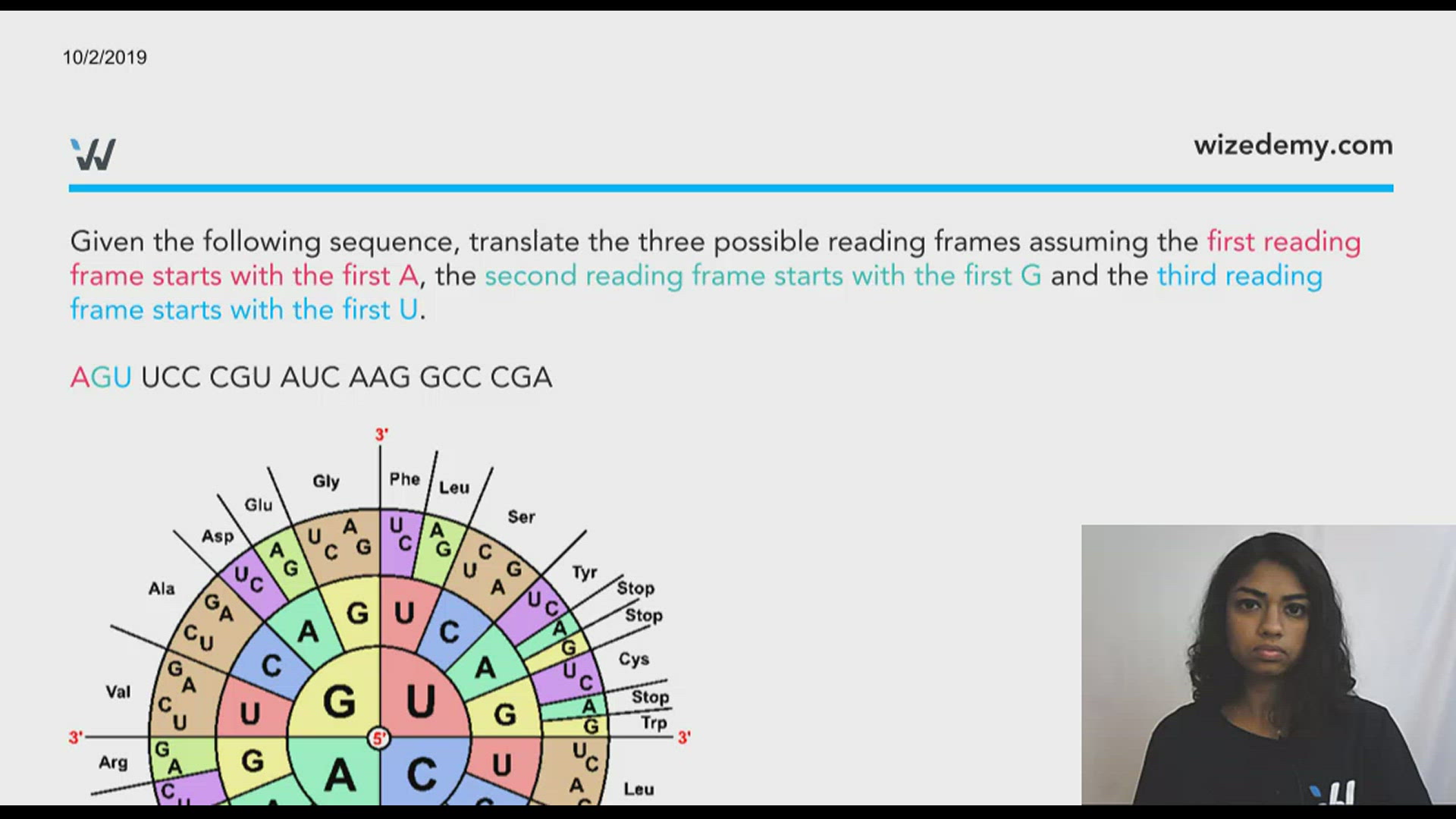
Given the following sequence, translate the three possible reading frames assuming the first reading frame starts with the first A, the second reading frame starts with the first G and the third reading frame starts with the first U.
AGU UCC CGU AUC AAG GCC CGA

Reading frame 1 (starting with AGU): Ser-Ser-Arg-Ile-Lys-Ala-Arg
Reading frame 2 (starting with GUU): Val-Pro-Val-Ser-Arg-Pro
Reading frame 3: (starting with UUC): Phe-Pro-Tyr-Gln-Gly-Pro
0:00 / 0:00
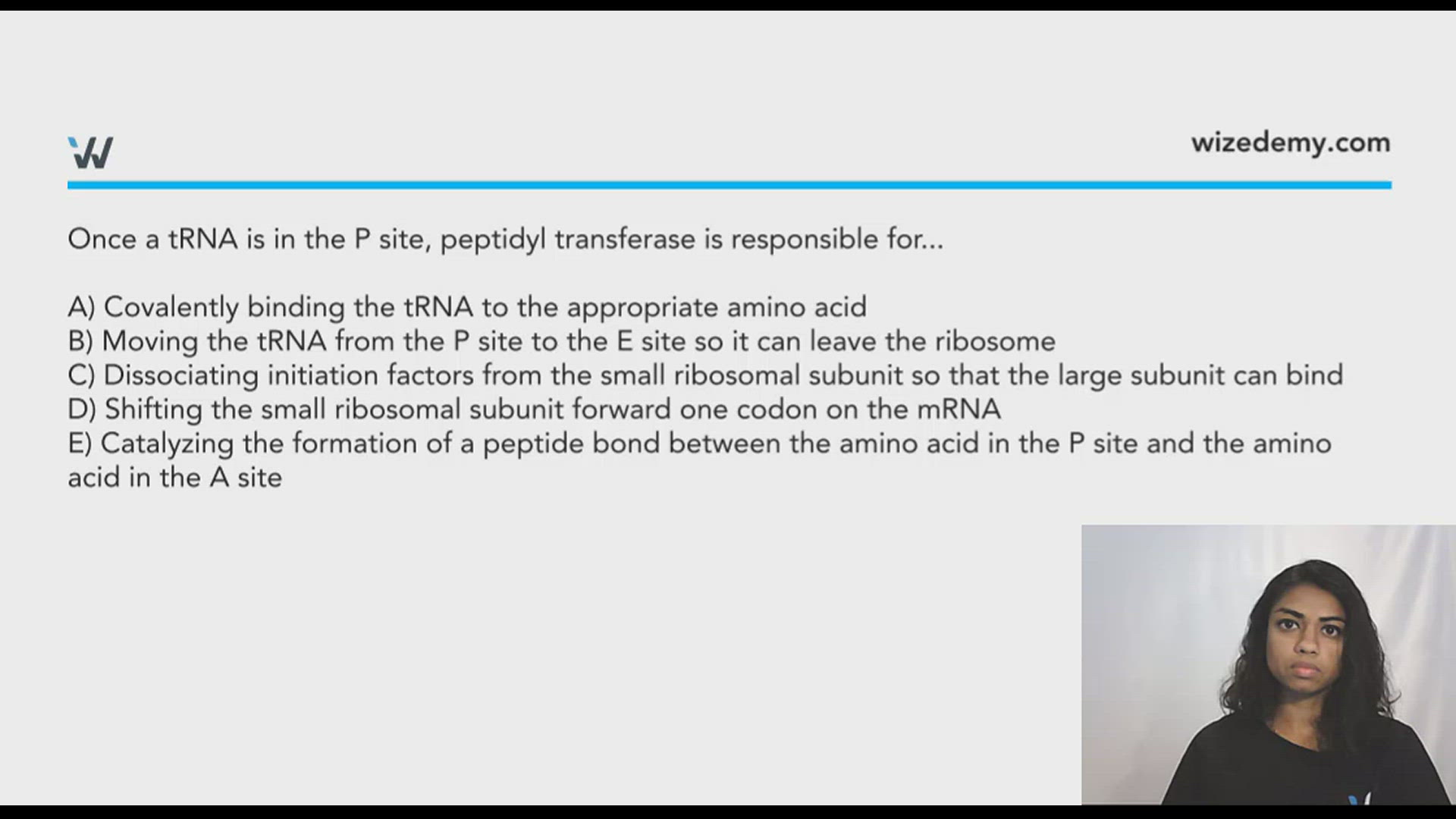
Once a tRNA is in the P site, peptidyl transferase is responsible for...
A) Covalently binding the tRNA to the appropriate amino acid
B) Moving the tRNA from the P site to the E site so it can leave the ribosome
C) Dissociating initiation factors from the small ribosomal subunit so that the large subunit can bind
D) Shifting the small ribosomal subunit forward one codon on the mRNA
E) Catalyzing the formation of a peptide bond between the amino acid in the P site and the amino acid in the A site
The correct answer is E. Peptidyl transferase is an enzyme associated with the ribosome that facilitates peptide bond formation.
A) False- aminoacyl tRNA transferase is responsivle for creating a high energy bond between the tRNA and the correct amino acid
B) False- When the large ribosomal subunit shifts down the mRNA, the tRNA from the P site naturally moves to the E site.
C) False- Once the initation complex locates a starting AUG codon, the initation factors naturally dissociate to allow the large subunit to bind
D) False- The small ribosomal subunit shifts down the mRNA after the large subunit moves downstream