Wize University Biochemistry Textbook > Translation
Translation: Eukaryotes
0:00 / 0:00
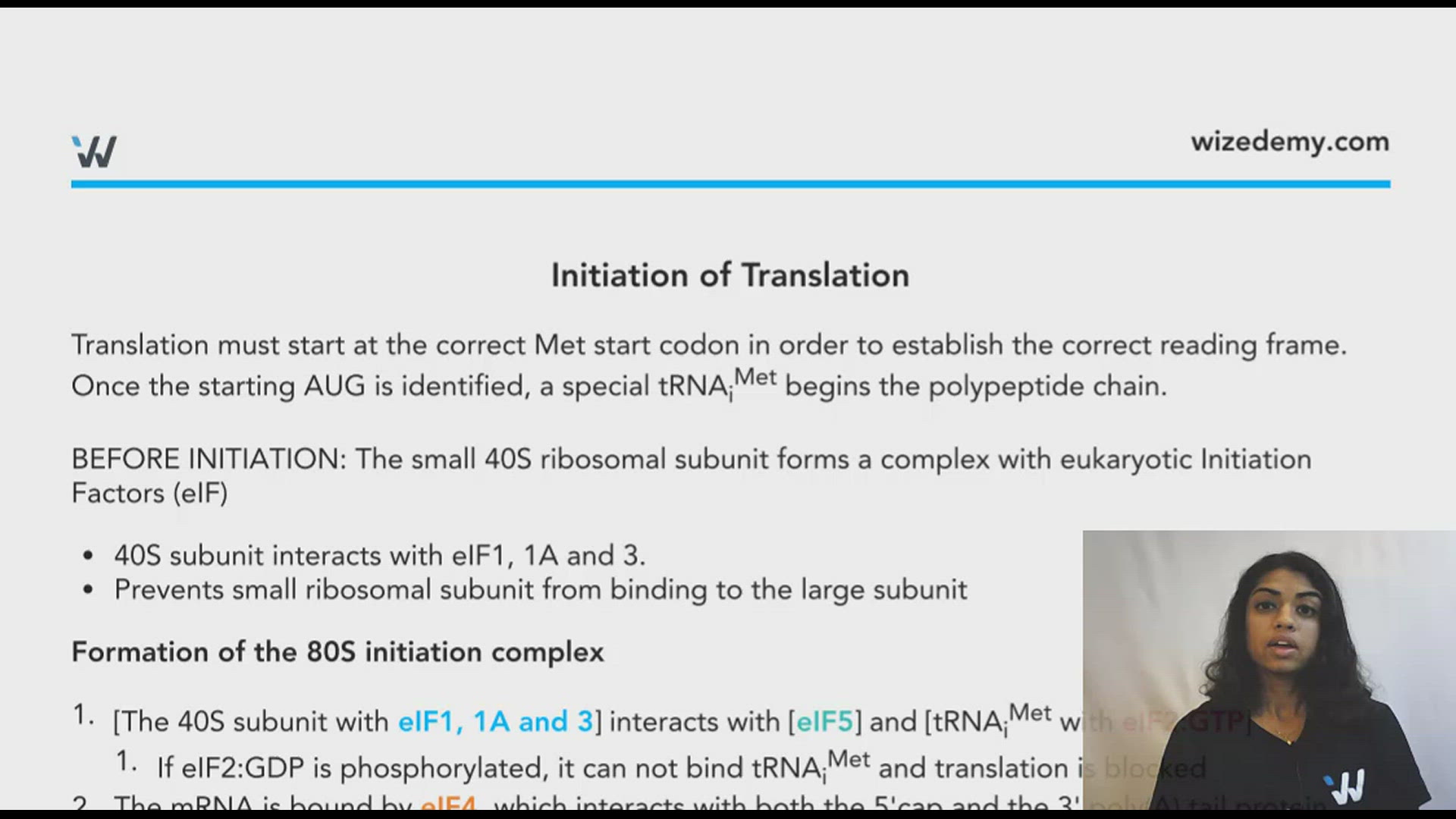
Initiation of Translation
Translation must start at the correct Met start codon in order to establish the correct reading frame.
Once the starting AUG is identified, a special tRNAiMet begins the polypeptide chain.
BEFORE INITIATION: The small 40S ribosomal subunit forms a complex with eukaryotic Initiation Factors (eIF)
- 40S subunit interacts with eIF1, 1A and 3.
- Prevents small ribosomal subunit from binding to the large subunit
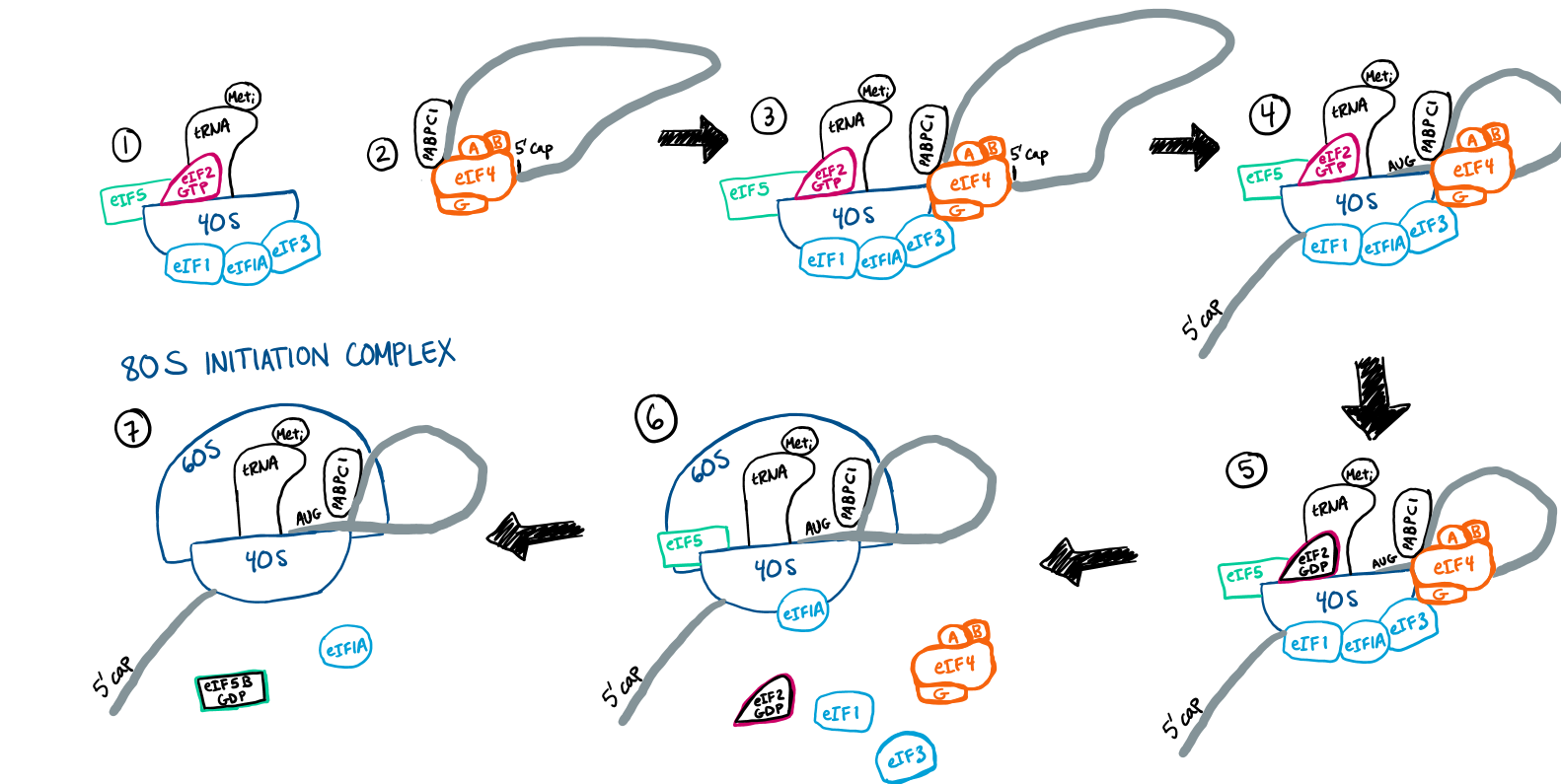
Formation of the 80S initiation complex
- [The 40S subunit with eIF1, 1A and 3] interacts with [eIF5] and [tRNAiMet with eIF2:GTP]
- If eIF2:GDP is phosphorylated, it can not bind tRNAiMet and translation is blocked
- The mRNA is bound by eIF4, which interacts with both the 5'cap and the 3' poly(A) tail protein PABPC1
- This leads to a CIRCULAR mRNA structure
- Forms a scaffold for other eIF4 subunits
- eIF4G interacts with eIF3
- The complex moves along the mRNA (5'--> 3') until it finds a start site (AUG)
- eIF4A (stimulated by eIF4B) has helicase activity which unwinds the RNA's secondary structure
- eIF2:GTP is irreversibly hydrolyzed to eIF2:GDP stop scanning
- Facilitatied by eIF5, a GTPase activating protein
- eIF5B:GTP mediates the large ribosomal subunit associating with the small subunit
- eIF5B:GTP is hydrolyzed to eIF5B:GDP
- eIF5B:GDP and eIF1A are released from the mRNA
Internal Ribosome Entry Site (IRES): located far downstream from the 5' end
- IRES forms a complex with eIF4A and eIF4G
- These associate with the 40S subunit, eIF1, 1A and 3
- These associate with eIF2 and tRNAiMet
Allows for internal initiation of translation on polycistronic genes in bacteria.
0:00 / 0:00
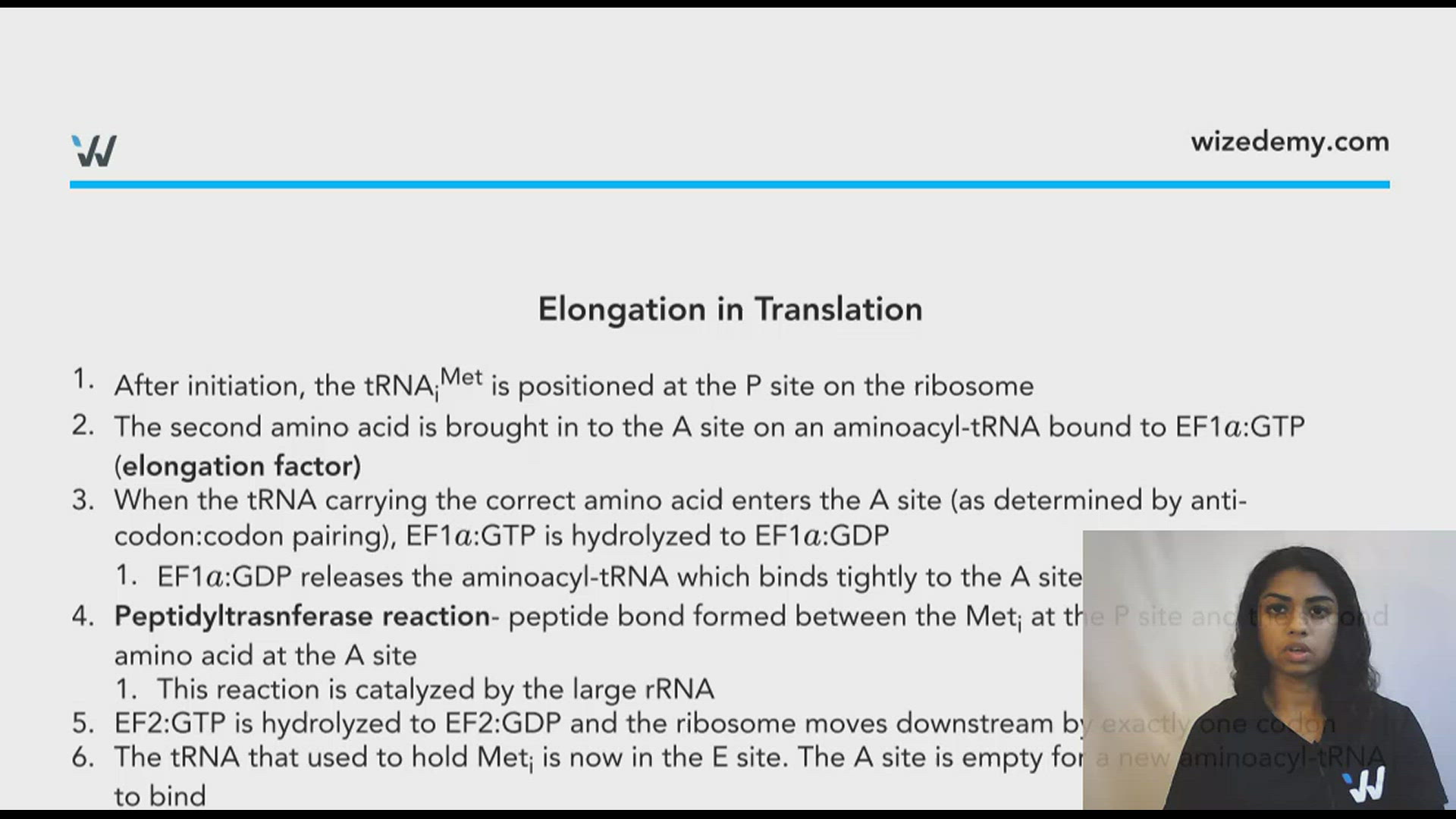
Elongation in Translation
- After initiation, the tRNAiMet is positioned at the P site on the ribosome
- The second amino acid is brought in to the A site on an aminoacyl-tRNA bound to EF1:GTP (elongation factor)
- When the tRNA carrying the correct amino acid enters the A site (as determined by anti-codon:codon pairing), EF1:GTP is hydrolyzed to EF1:GDP
- EF1:GDP releases the aminoacyl-tRNA which binds tightly to the A site
- Peptidyltrasnferase reaction- peptide bond formed between the Meti at the P site and the second amino acid at the A site
- This reaction is catalyzed by the large rRNA
- EF2:GTP is hydrolyzed to EF2:GDP and the ribosome moves downstream by exactly one codon
- The tRNA that used to hold Meti is now in the E site. The A site is empty for a new aminoacyl-tRNA to bind
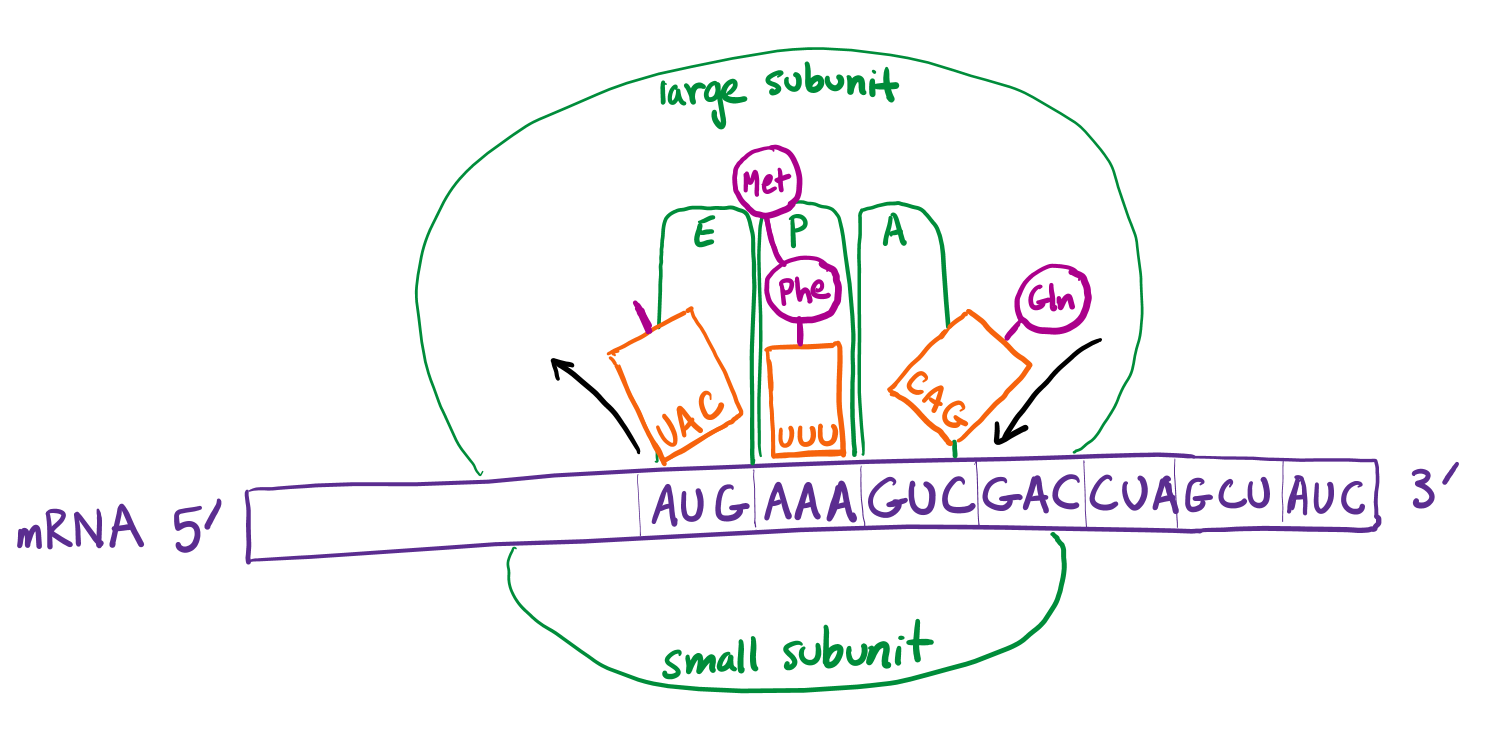
Wize Tip
A site: where the Aminoacyl-tRNA binds
P site: where the Peptidyl chain is elongated
E site: where the empty tRNA Exits the ribosome
0:00 / 0:00
Termination of Translation
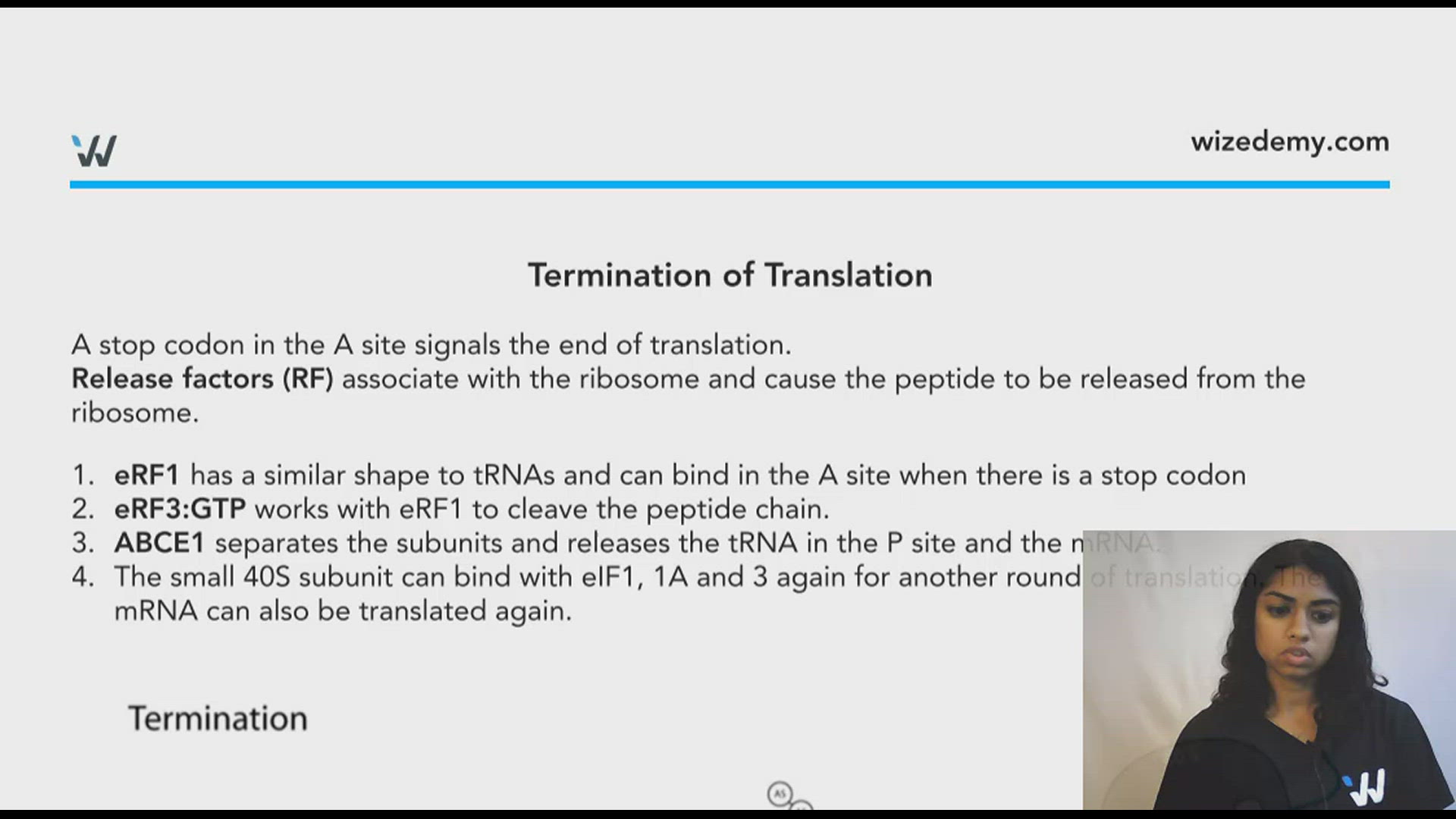
A stop codon in the A site signals the end of translation.
Release factors (RF) associate with the ribosome and cause the peptide to be released from the ribosome.
- eRF1 has a similar shape to tRNAs and can bind in the A site when there is a stop codon
- eRF3:GTP works with eRF1 to cleave the peptide chain.
- ABCE1 separates the subunits and releases the tRNA in the P site and the mRNA.
- The small 40S subunit can bind with eIF1, 1A and 3 again for another round of translation. The mRNA can also be translated again.
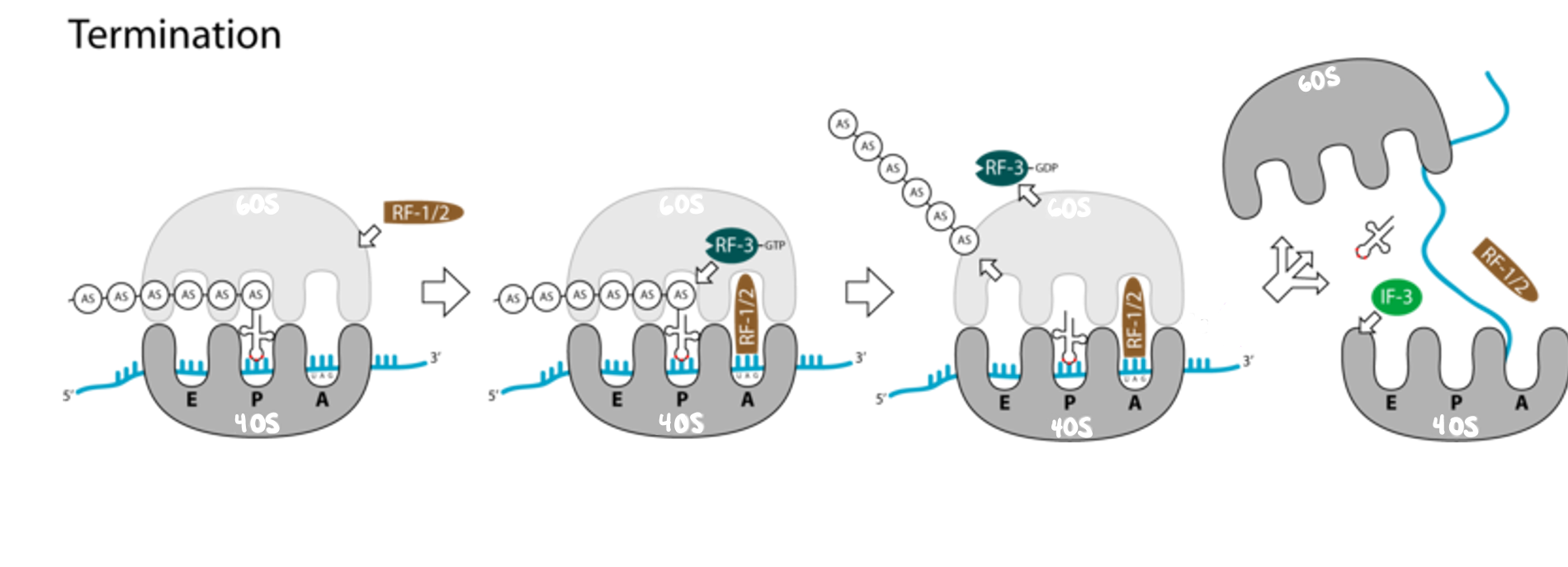
Bacteria have two release factors RF1 and RF2 that are analagous to eRF1.