0:00 / 0:00
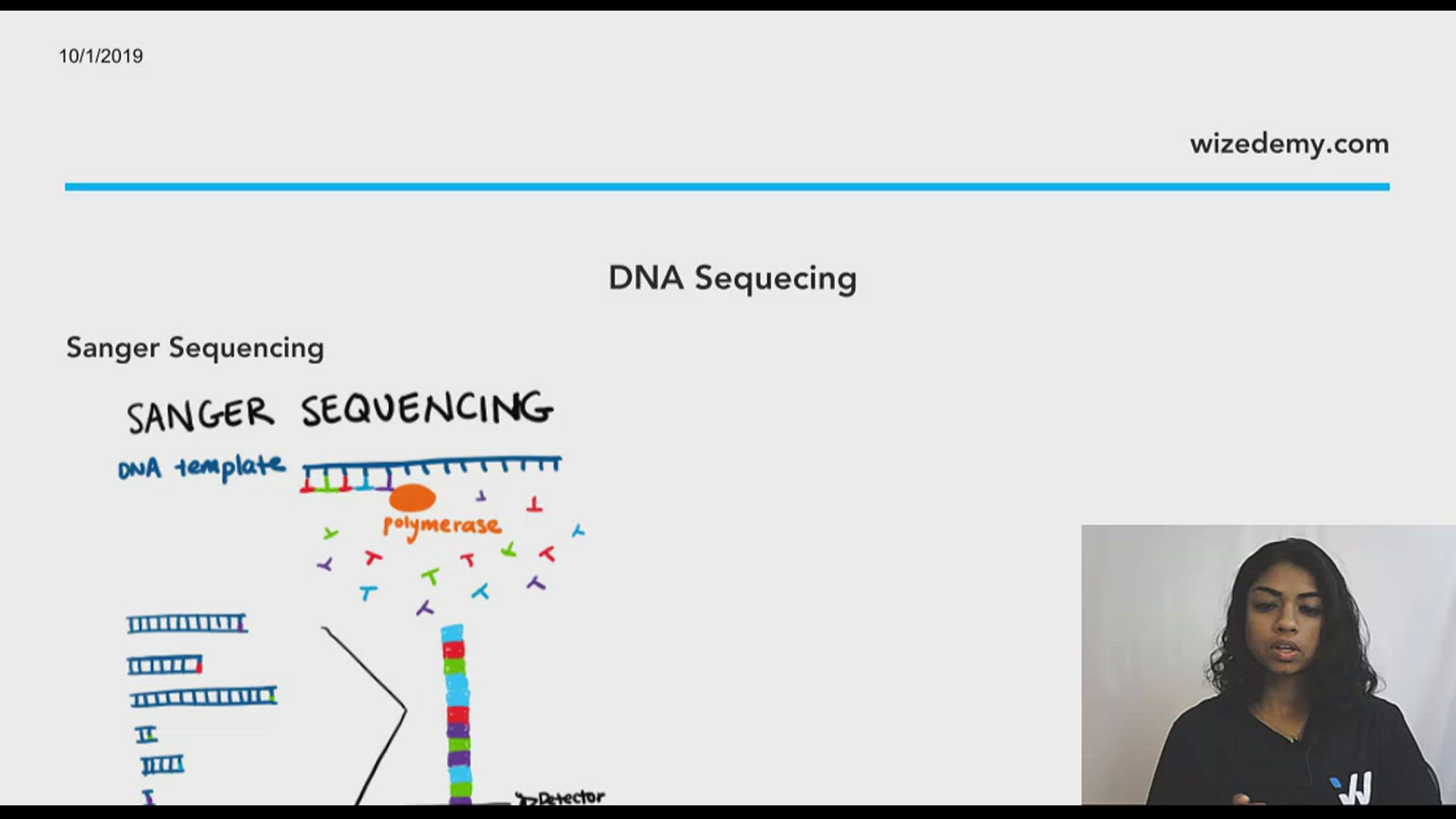
DNA Sequecing
Sanger Sequencing
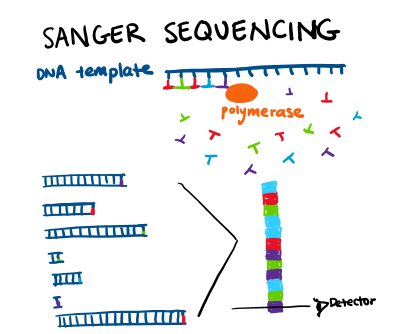
Sanger Sequencing is limited because each DNA fragment requires it's own sequencing reaction so the number of reactions you can perform at one time limits the rate of DNA sequencing.
Next-generation Sequencing
Allows one sequencing instrument to carry out billions of sequencing reactions at the same time.
- DNA fragments prepared by adding double stranded linkers to both ends of the fragment
- Fragments are amplified using PCR primers that are complementary to linkers
- Primers are then used to covalently bond the DNA fragments to a solid surface in a tight cluster
- The fragments are analyzed using a special microscope that detects which fluorescent labeled base is added to the DNA template by polymerase
Whole Genome Shotgun sequencing
There are two ways to sequence the whole genome of an organism
- Isolate a collection of DNA clones that have overlapping sequences. Sequence one fragment and then create primers complementary to that sequence to figure out the overlapping sequences. Continue until the whole genome is sequenced
- Whole-genome shotgun sequencing- sequencing enough clones so that on average, each clone would be sequenced 10x. A computer algorithm then figures out which sequences overlap and puts all the sequences in order.
Whole genome sequencing is cost-effective and fast!!! It has been used to sequence long DNA fragments and entire genomes.
0:00 / 0:00
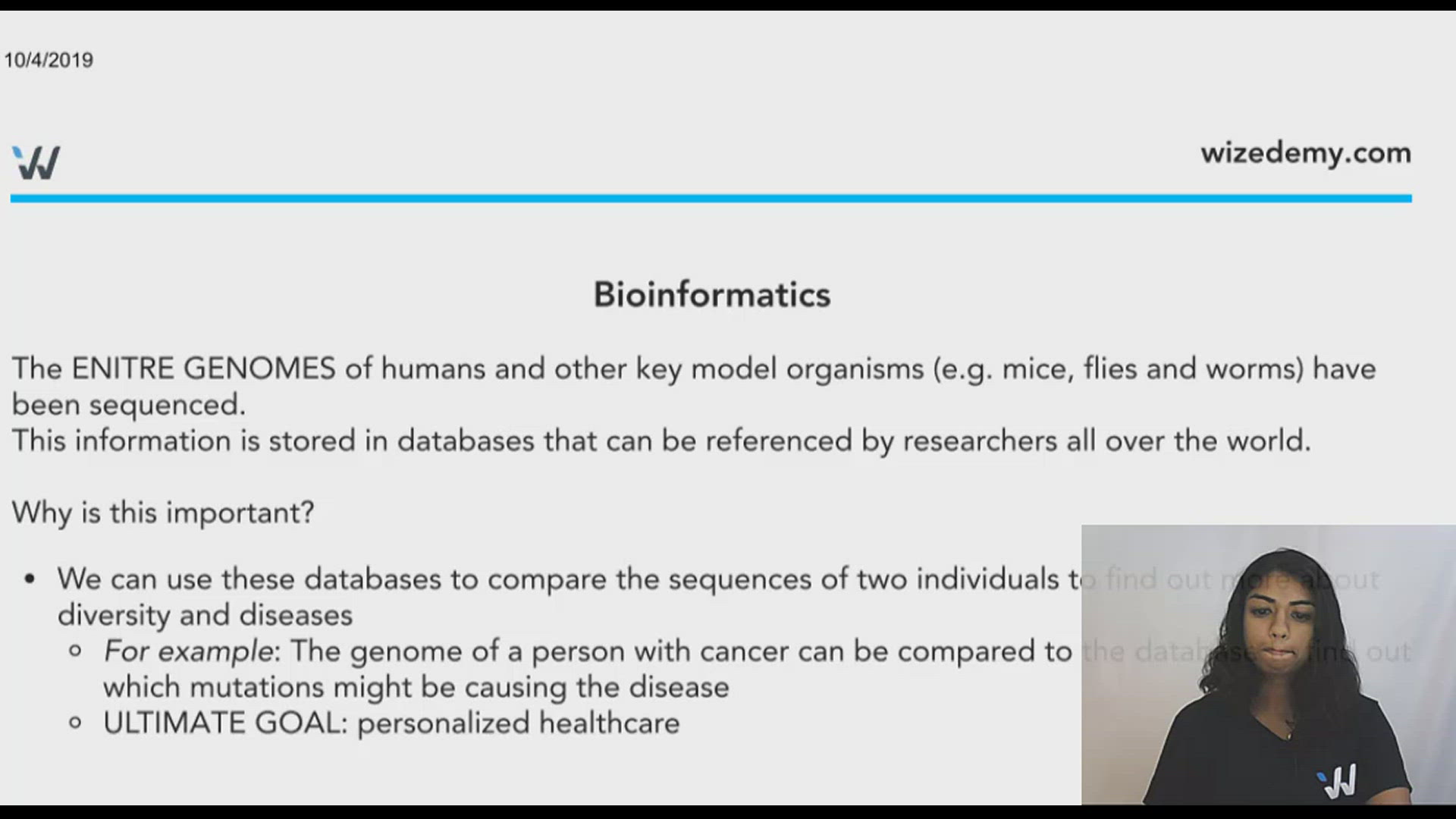
Bioinformatics
The ENITRE GENOMES of humans and other key model organisms (e.g. mice, flies and worms) have been sequenced.
This information is stored in databases that can be referenced by researchers all over the world.
Why is this important?
- We can use these databases to compare the sequences of two individuals to find out more about diversity and diseases
- For example: The genome of a person with cancer can be compared to the database to find out which mutations might be causing the disease
- ULTIMATE GOAL: personalized healthcare
BLAST (Basic Local Alignment Search Tool)- method used to compare amino acid sequences
- More useful than comparing DNA sequences because the genetic code is degenerate
- Can find exact matches between sequences
- Can find near matches between sequences with related amino acids
- For example: Mutations in the NF1 gene in humans is associated with neurofibromatosis 1. Using BLAST, researchers found NF1 is similar to protein in yeast called Ira, which modulates the activity of a monomeric G protein called Ras. In humans, NF1 has the same function and neurobibromatosis 1 patients were found to have high Ras signaling.
- Can measure the similarity between two sequences
- This can reveal new members of gene families
- This can give clues to the evolutionary tree
- Can find structural motif matches between two proteins
- In yeast and bactera: can be used to find new genes by scanning for Open Reading Frames (ORFs)
- To find new human genes, researchers use a combination of BLAST, cDNA sequences, and other algorithms
How many genes does an organism have??
The roundworm C. elegans has more protein coding genes than the fly Drosophila.
Humans have only 5% more genes than C. elegnans.
Biological complexity is NOT a good measure of how many genes an organism has.
WHY???
- Higher eukaryotes may undergo more ALTERNATIVE SPLICING- leads to more protein diversity
- Post-translational modifications
- The more cells an organism has, the more ways those cells can interact
0:00 / 0:00
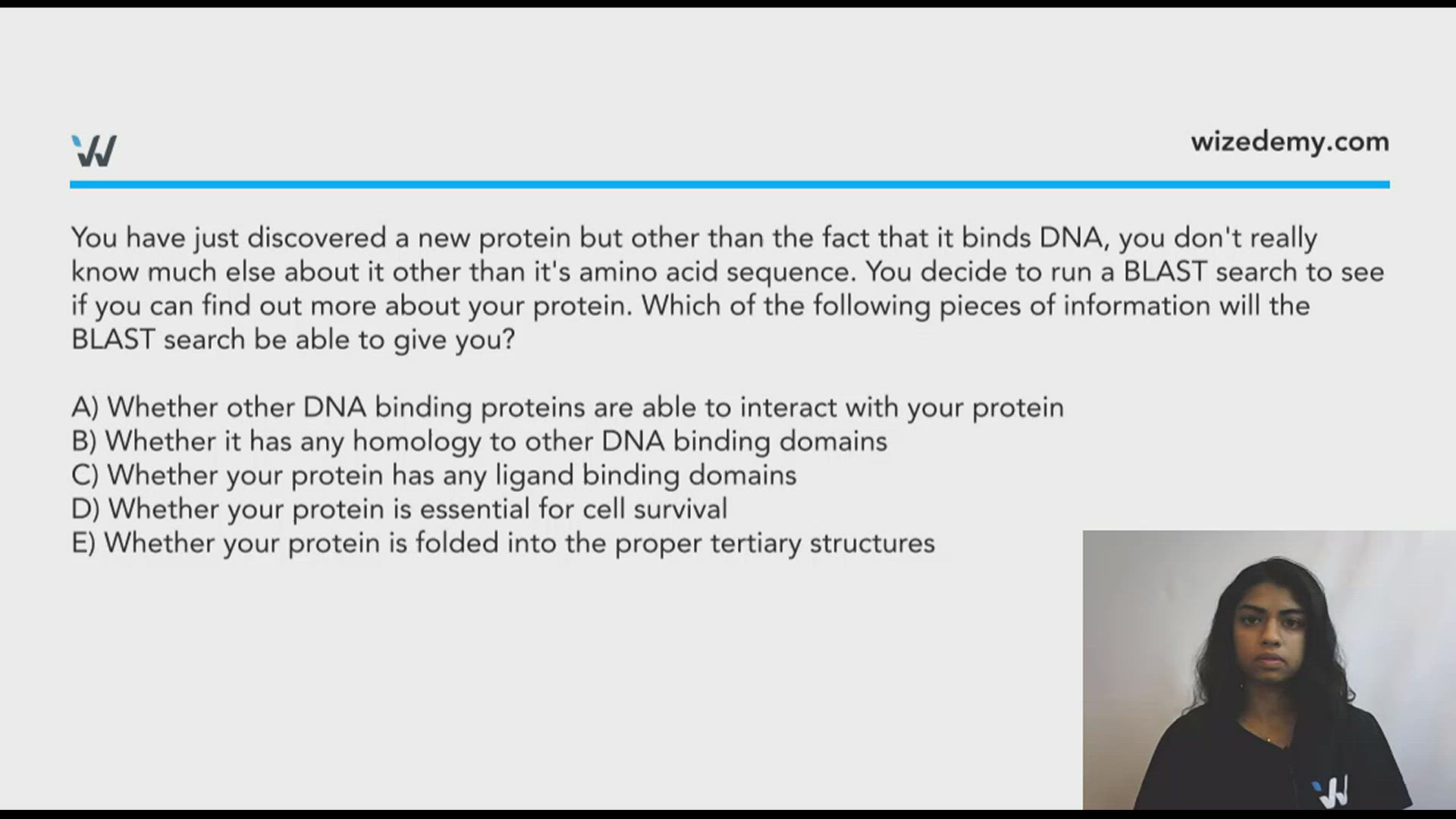
You have just discovered a new protein but other than the fact that it binds DNA, you don't really know much else about it other than it's amino acid sequence. You decide to run a BLAST search to see if you can find out more about your protein. Which of the following pieces of information will the BLAST search be able to give you?
A) Whether other DNA binding proteins are able to interact with your protein
B) Whether it has any homology to other DNA binding domains
C) Whether your protein has any ligand binding domains
D) Whether your protein is essential for cell survival
E) Whether your protein is folded into the proper tertiary structures
Which of the following is not an appropriate use for BLAST?