Wize University Biochemistry Textbook > Protein Structure and Folding
Denaturation & Protein Folding and Stability
0:00 / 0:00
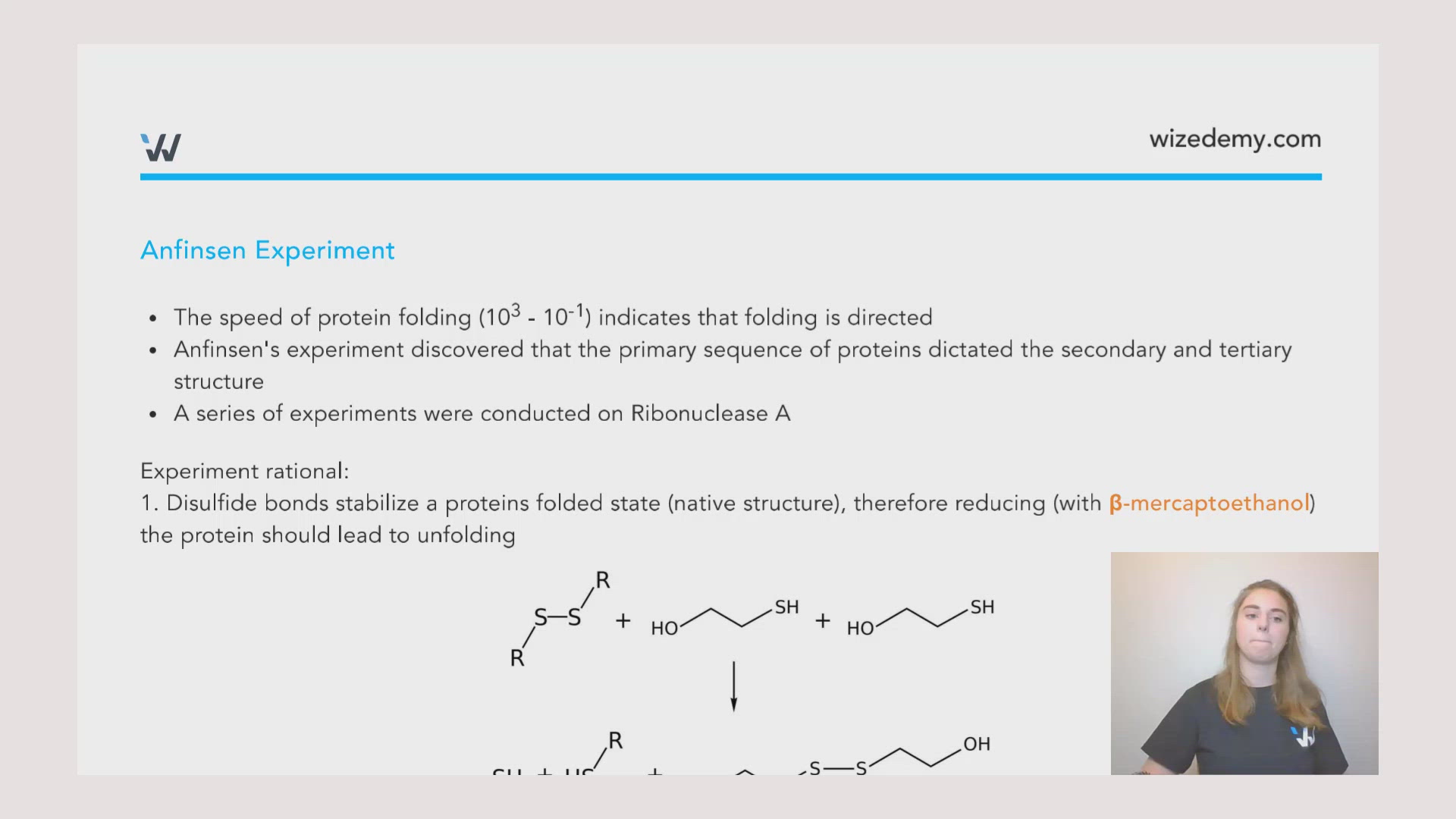
Anfinsen Experiment
- The speed of protein folding (103 - 10-1 sec) indicates that folding is directed
- Anfinsen's experiment discovered that the primary sequence of proteins dictated the secondary and tertiary structure
- A series of experiments were conducted on Ribonuclease A
Experiment rational:
1. Disulfide bonds stabilize a proteins folded state (native structure), therefore reducing (with β-mercaptoethanol) the protein should lead to unfolding

https://commons.wikimedia.org/wiki/File:Disulfide-bond-cleavage-by-2-mercaptoethanol-2D-skeletal.svg. Author Slashme released this image into public domain.
2. Unfolding did not occur fully unless a denaturing agent (urea or guanidine) is present
- Denaturing agents disrupt non-covalent interactions
- Urea can form H-bonds with the amino acid backbones, breaking secondary structures
3. Urea and β-mercaptoethanol were removed through dialysis, the protein was able to re-fold, and the reduced sulfhydryl groups are oxidized by air
- Dialysis involves a semi-permeable membrane that allows some molecules to move from a place of high concentration to low concentration while others remain
- Protein did not re-fold correctly, only 1% of activity was recovered, there must be assisted folding
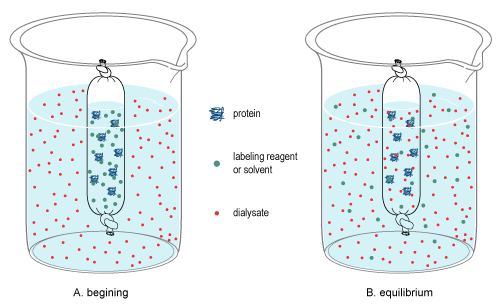
https://commons.wikimedia.org/wiki/File:Dialysis_Figure.png. Author Illustrator CS5 has image licensed under the Creative Commons Attribution 3.0 Unported license.
0:00 / 0:00
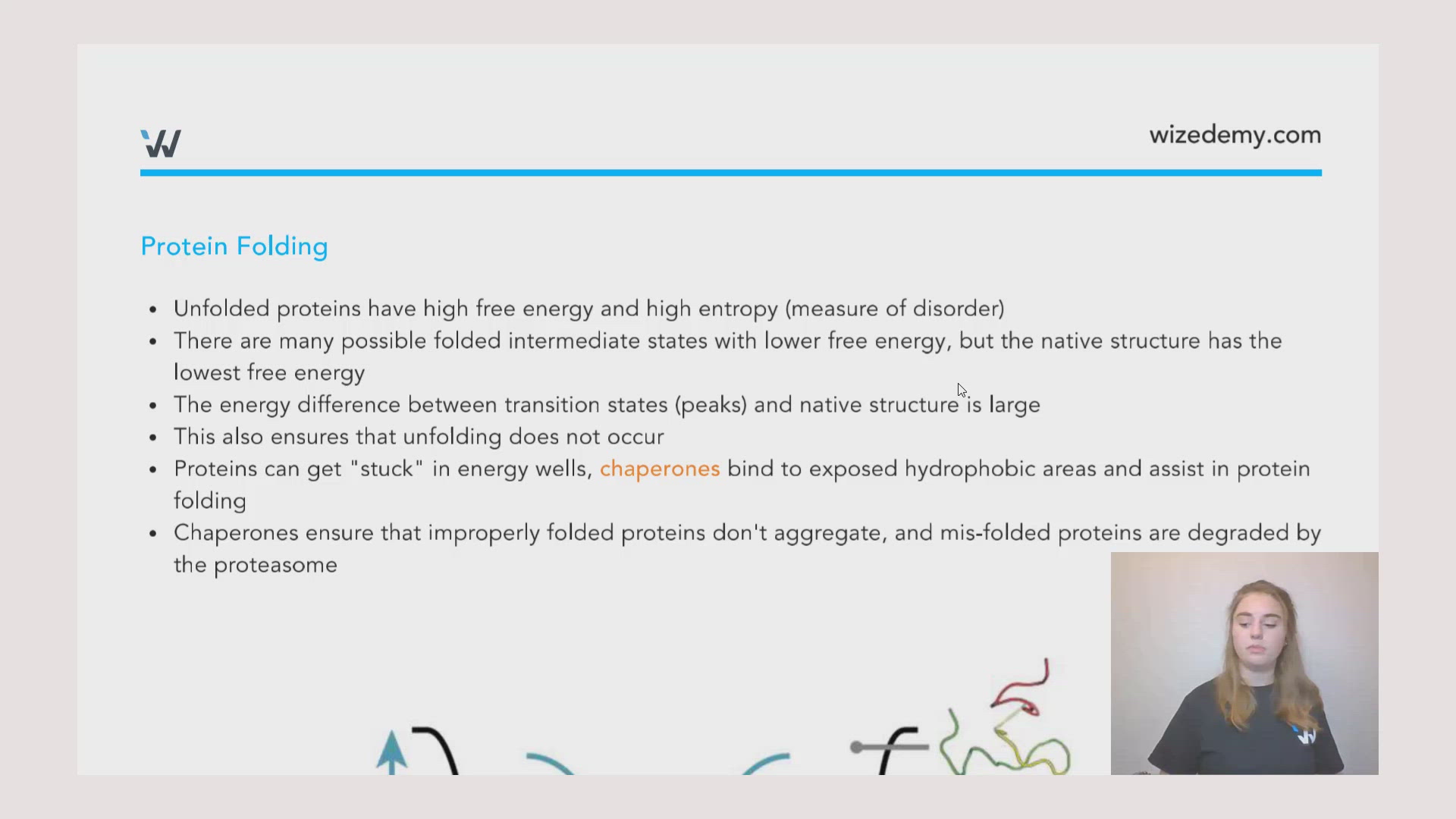
Protein Folding
- Unfolded proteins have high free energy and high entropy (measure of disorder)
- There are many possible folded intermediate states with lower free energy, but the native structure has the lowest free energy
- The energy difference between transition states (peaks) and native structure is large
- This also ensures that unfolding does not occur
- Proteins can get "stuck" in energy wells, chaperones bind to exposed hydrophobic areas and assist in protein folding
- Chaperones ensure that improperly folded proteins don't aggregate, and mis-folded proteins are degraded by the proteasome
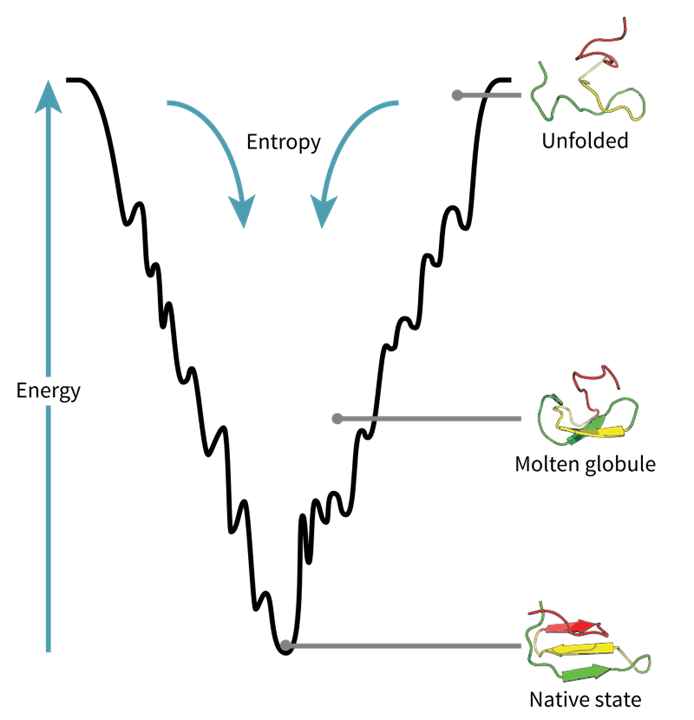
https://en.wikipedia.org/wiki/File:Folding_funnel_schematic.svg. Author Splette has image licensed under the Creative Commons Attribution-Share Alike 3.0 Unported license.
0:00 / 0:00
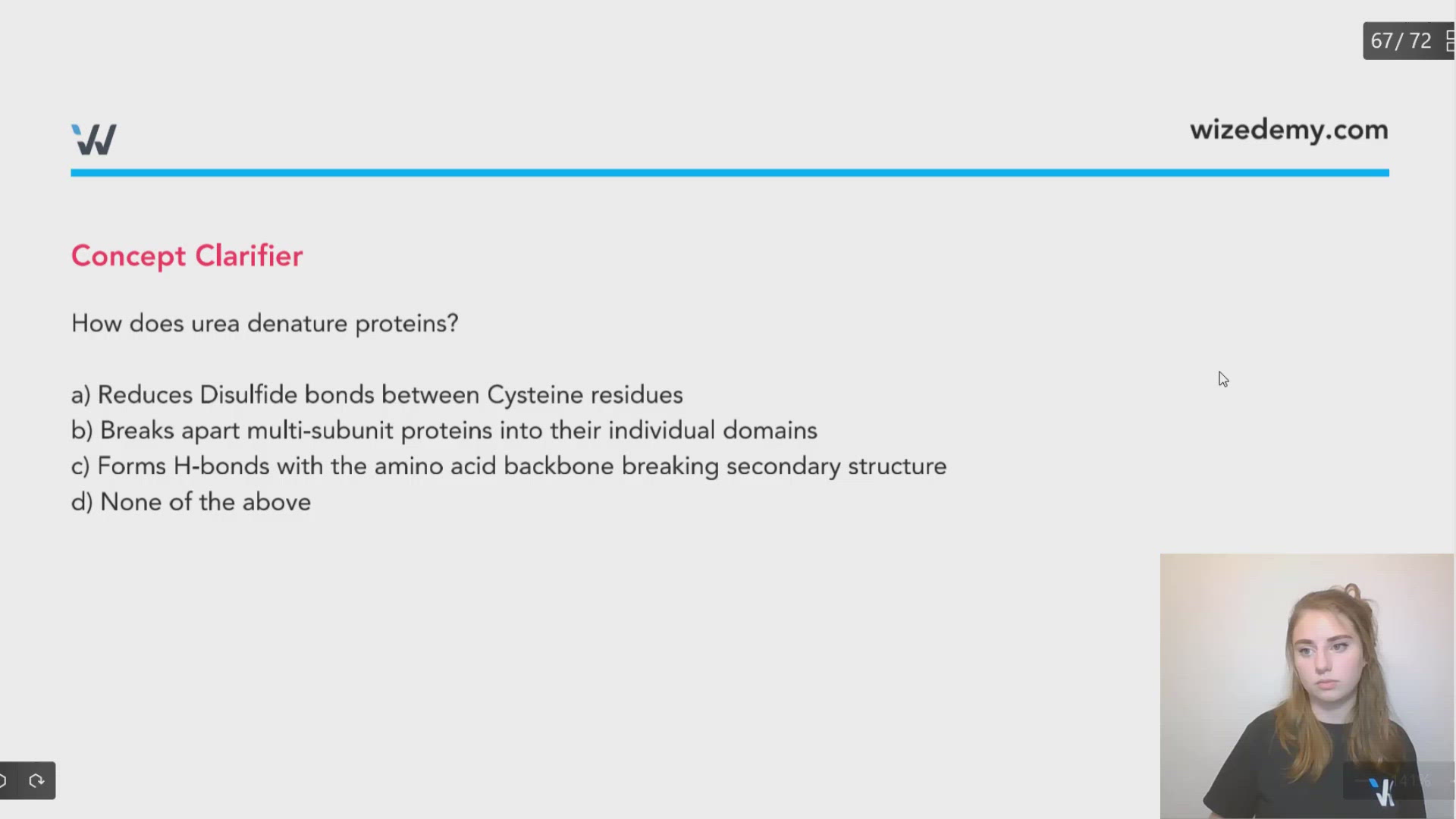
How does urea denature proteins?
a) Reduces Disulfide bonds between Cysteine residues
b) Breaks apart multi-subunit proteins into their individual domains
c) Forms H-bonds with the amino acid backbone breaking secondary structure
d) None of the above
c) Forms H-bonds with the amino acid backbone breaking secondary structure
What statement BEST explains the role of chaperones in protein folding?