Wize University Biochemistry Textbook > Enzyme Catalysis
Enzyme Inhibition
0:00 / 0:00
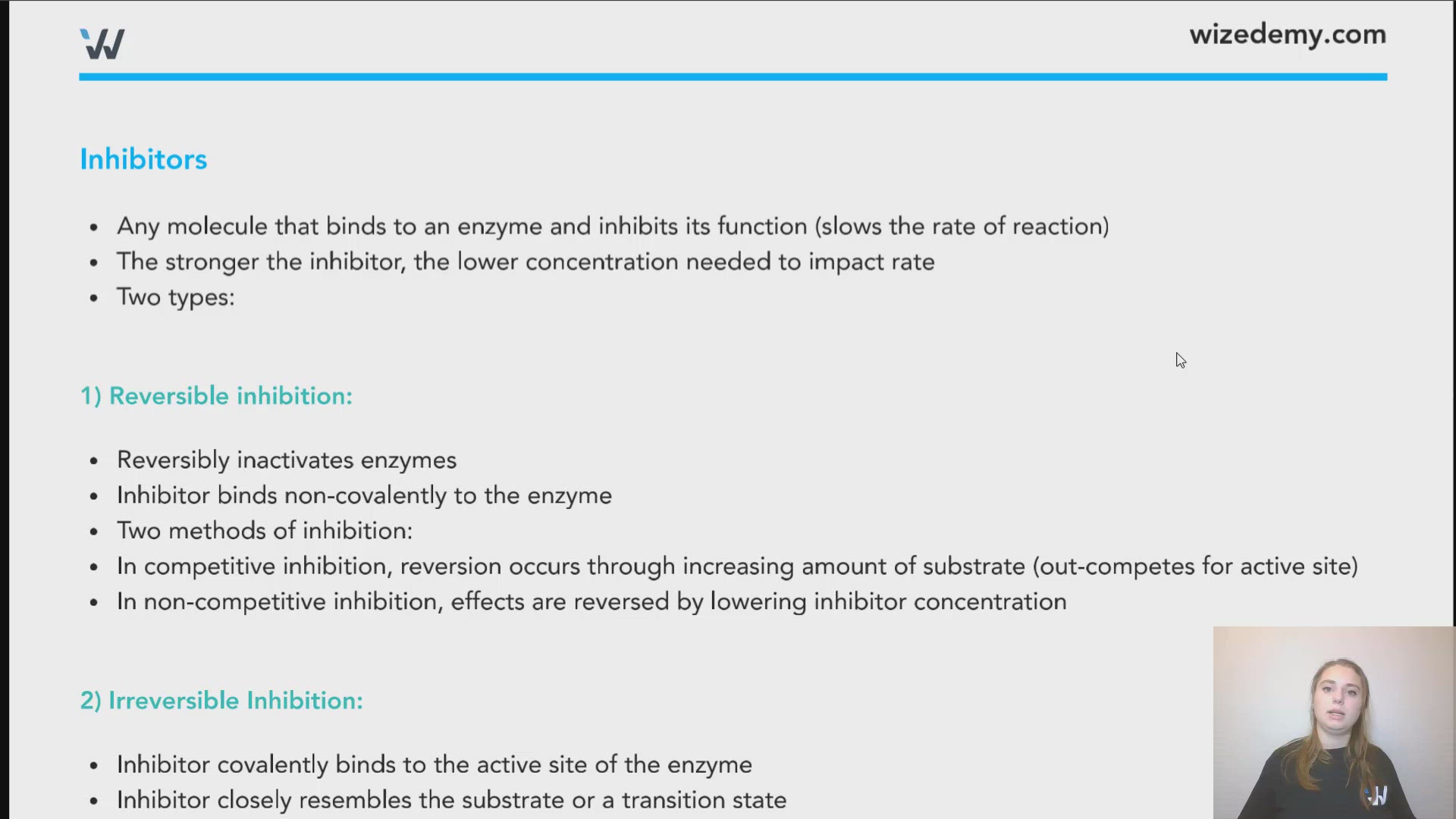
Inhibitors
- Any molecule that binds to an enzyme and inhibits its function (slows the rate of reaction)
- The stronger the inhibitor, the lower concentration needed to impact rate
- Two types:
1) Reversible inhibition:
- Reversibly inactivates enzymes
- Inhibitor binds non-covalently to the enzyme
- Two methods of inhibition:
- In competitive inhibition, reversion occurs through increasing amount of substrate (out-competes for active site)
- In non-competitive inhibition, effects are reversed by lowering inhibitor concentration
2) Irreversible Inhibition:
- Inhibitor covalently binds to the active site of the enzyme
- Inhibitor closely resembles the substrate or a transition state
0:00 / 0:00
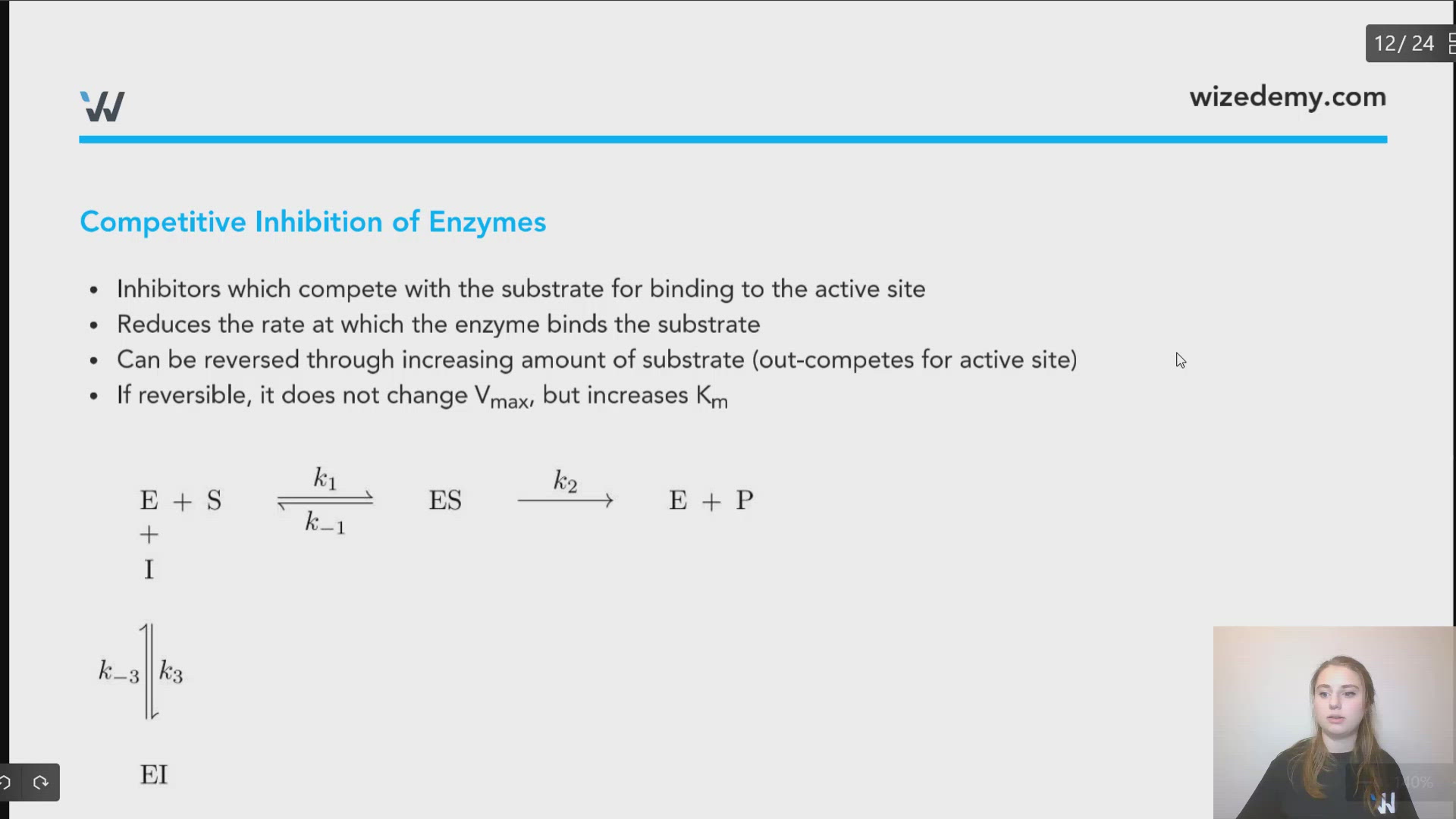
Competitive Inhibition of Enzymes
- Inhibitors which compete with the substrate for binding to the active site
- Reduces the rate at which the enzyme binds the substrate
- Can be reversed through increasing amount of substrate (out-competes for active site)
- If reversible, it does not change Vmax, but increases Km
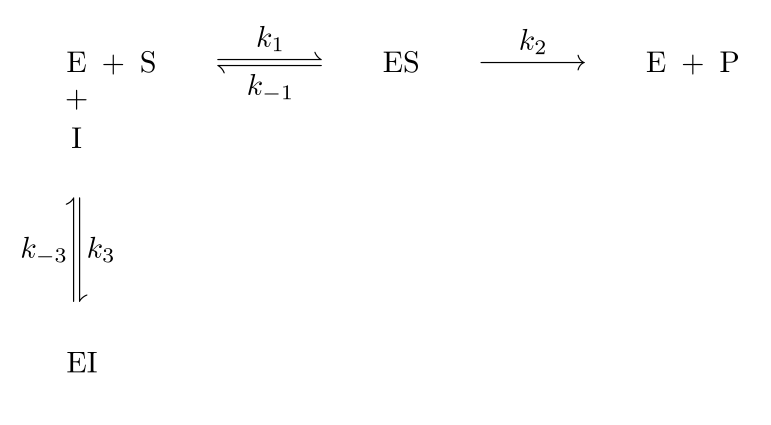
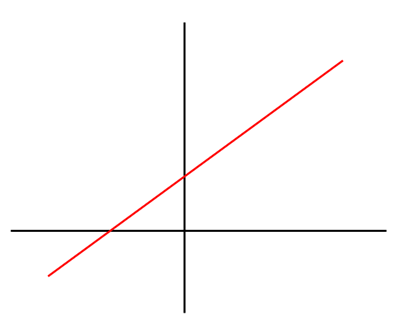
https://commons.wikimedia.org/wiki/File:Reaction_scheme_competitive_enzyme_inhibition.svg. Sponk. public domain.
0:00 / 0:00
Non-Competitive Inhibition of Enzymes
- Binds to a site on the enzyme somewhere other than the active site
- Effects are reversed by lowering inhibitor concentration
- Results in a lower Vmax, but Km is unchanged
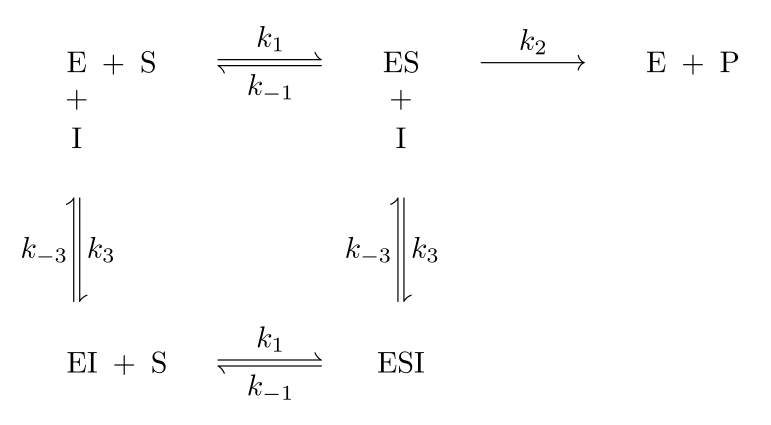
https://commons.wikimedia.org/wiki/File:Reaction_scheme_non-competitive_enzyme_inhibition.svg. Sponk. public domain.
0:00 / 0:00
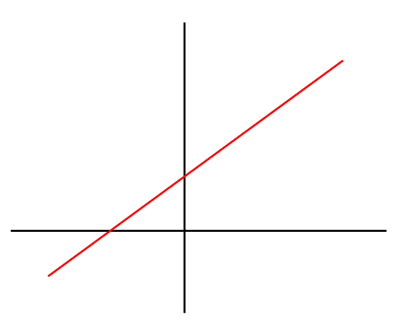
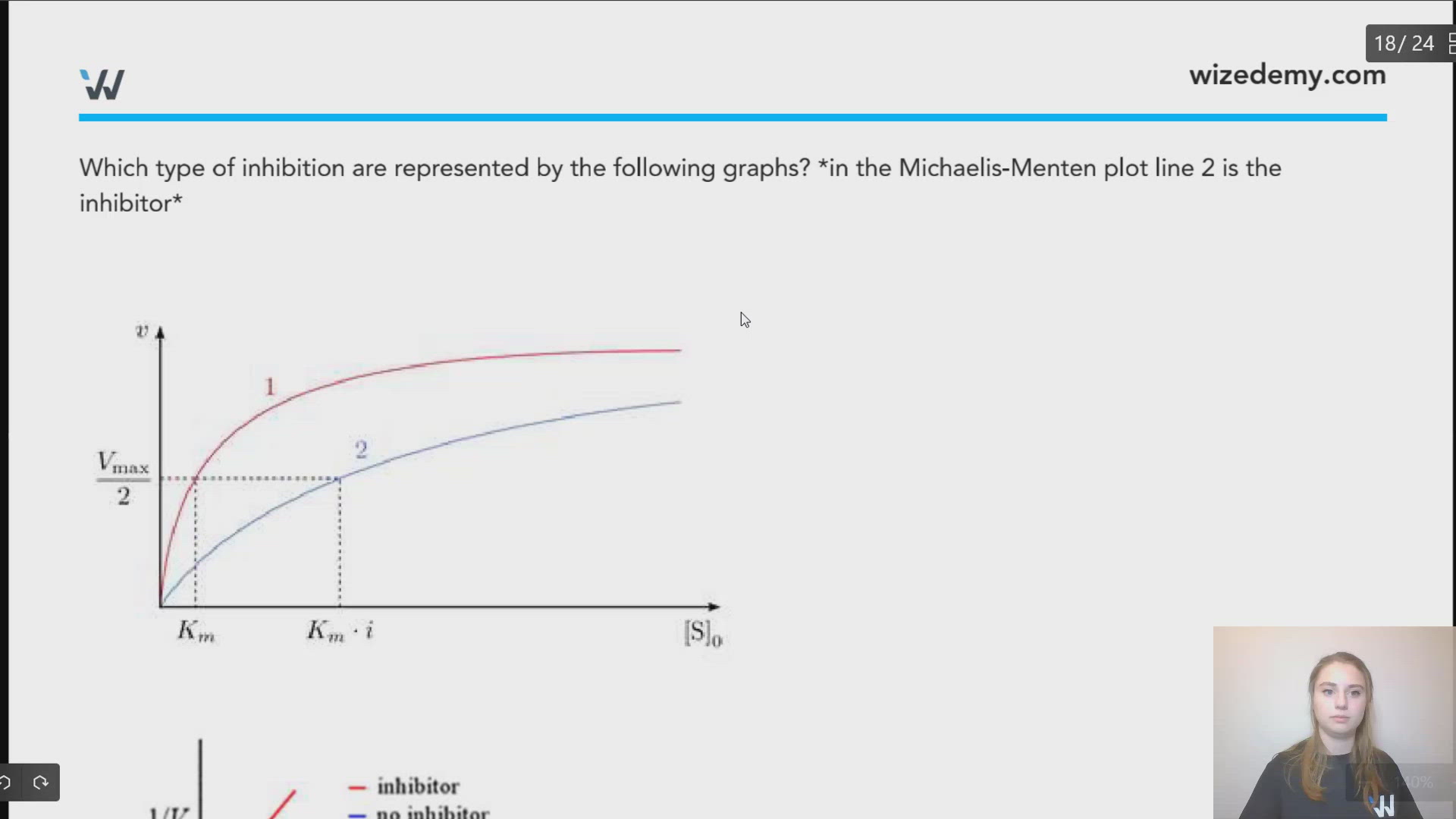
Which type of inhibition are represented by the following graphs? *in the Michaelis-Menten plot line 2 is the inhibitor*
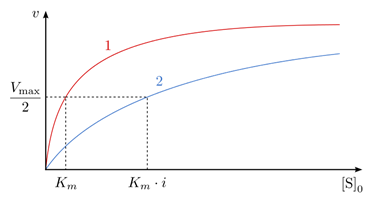
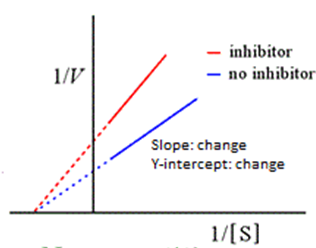
a) The Michaelis-Menten plot is showing competitive inhibition and the Lineweaver--Burke plot is showing competitive inhibition
b) The Michaelis-Menten plot is showing competitive inhibition and the Lineweaver--Burke plot is showing non-competitive inhibition
c) The Michaelis-Menten plot is showing non-competitive inhibition and the Lineweaver--Burke plot is showing competitive inhibition
d) The Michaelis-Menten plot is showing non-competitive inhibition and the Lineweaver--Burke plot is showing non-competitive inhibition
b) The Michaelis-Menten plot is showing competitive inhibition and the Lineweaver--Burke plot is showing non-competitive inhibition
Effects of inhibitors on Reaction Rate
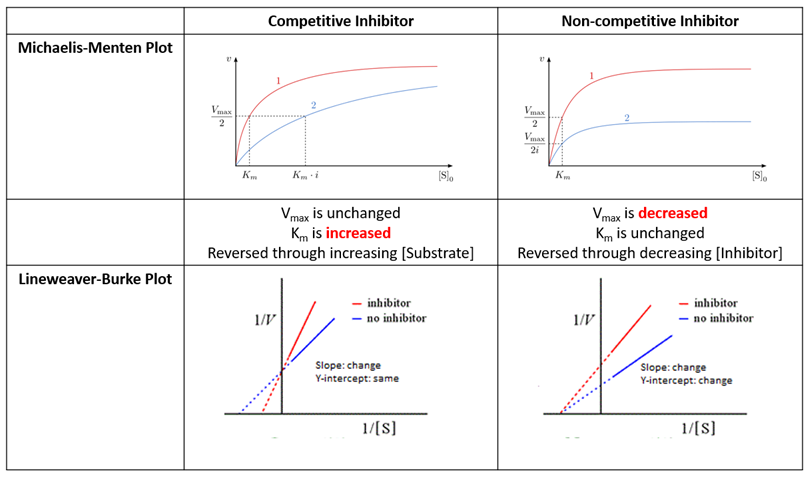
- In Michaelis-Mentan plots the blue lines (number 2) represent the curve in the presence of the designated inhibitor
- *These are for reversible inhibitors, but the effects of irreversible inhibitors are the same as what is seen for Non-Competitive inhibitors*
- Irreversible inhibitors compete for the active site, but effects can only be diminished through decreasing the concentration of inhibitor
https://de.wikipedia.org/wiki/Datei:Michaelis-Menten_plot_competitive_inhibition.svg. Sponk. public domain.
https://en.wikipedia.org/wiki/File:Enzyme_Inhibition_lineweaver-burk_plots.gif. Bizz1111. This file is made available under the Creative Commons CC0 1.0 Universal Public Domain Dedication.
https://commons.wikimedia.org/wiki/File:Michaelis-Menten_plot_non-competitive_inhibition.svg. Sponk. public domain.