Wize University Biochemistry Textbook > Nucleic Acid Structure + DNA Denaturation
Nucleic Acid Structure
0:00 / 0:00
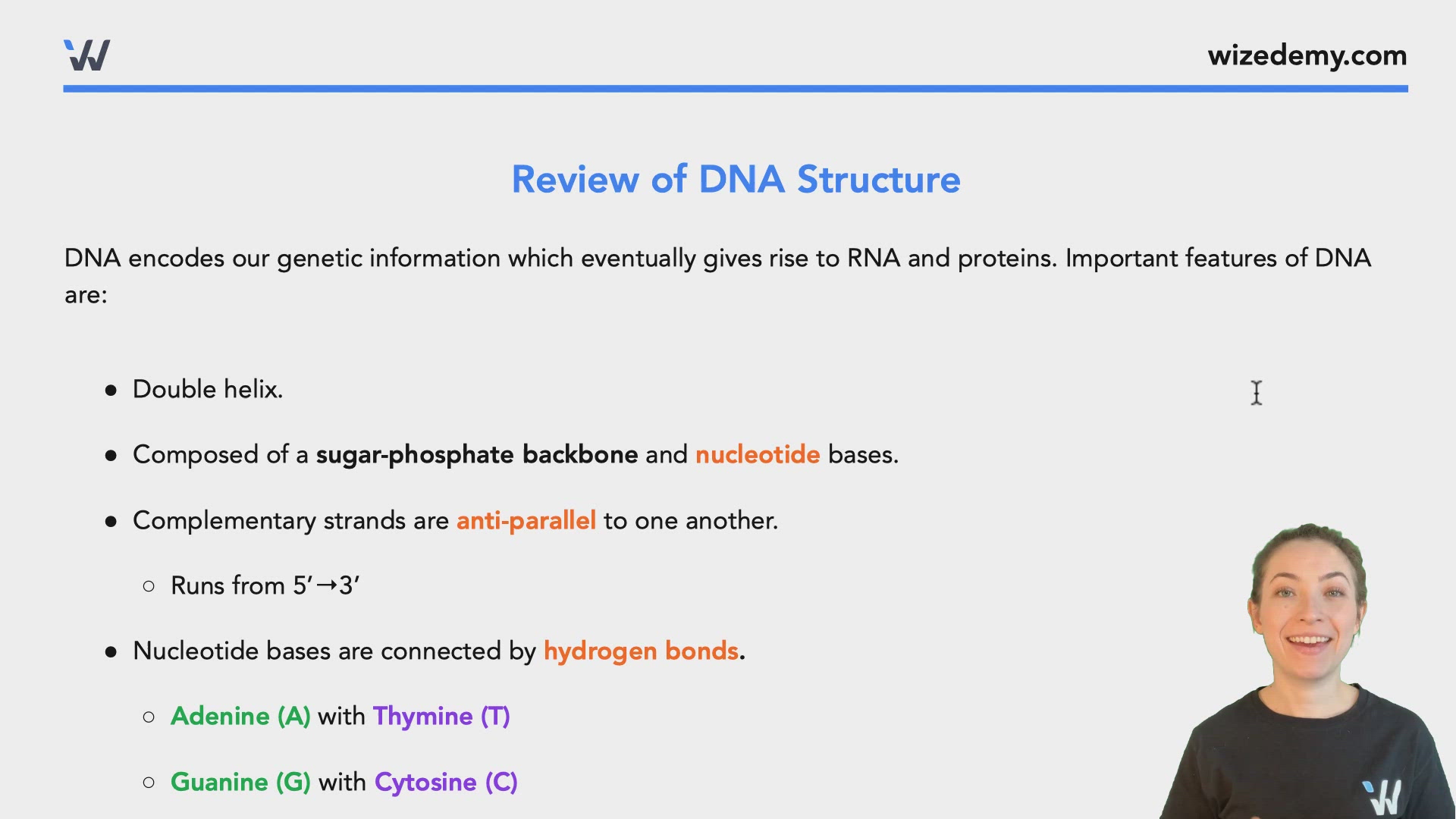
Review of DNA Structure
DNA encodes our genetic information which eventually gives rise to RNA and proteins. Important features of DNA are:
- Double helix.
- Composed of a sugar-phosphate backbone and nucleotide bases.
- Complementary strands are anti-parallel to one another.
- Runs from 5’→3’
- Nucleotide bases are connected by hydrogen bonds.
- Adenine (A) with Thymine (T)
- Guanine (G) with Cytosine (C)
- Purines hydrogen bond with pyrimidines:
- Purines = A & G
- Pyrimidines = T & C
- In RNA, Uracyl (U) replaces T
- C and G have 3 hydrogen bonds between one another, while A and T have only two.
- This makes the bonds between C and G harder to break, requiring more energy (i.e. higher temperature).
Wize Tip
Remember the mnemonic below to memorize which nucleotides are purines and which are pyrimidines:
- CUT the Py = Cytosine, Uracil and Thymine are Pyrimidines.
- Pure As Gold = Purines are adenine and Guanine.

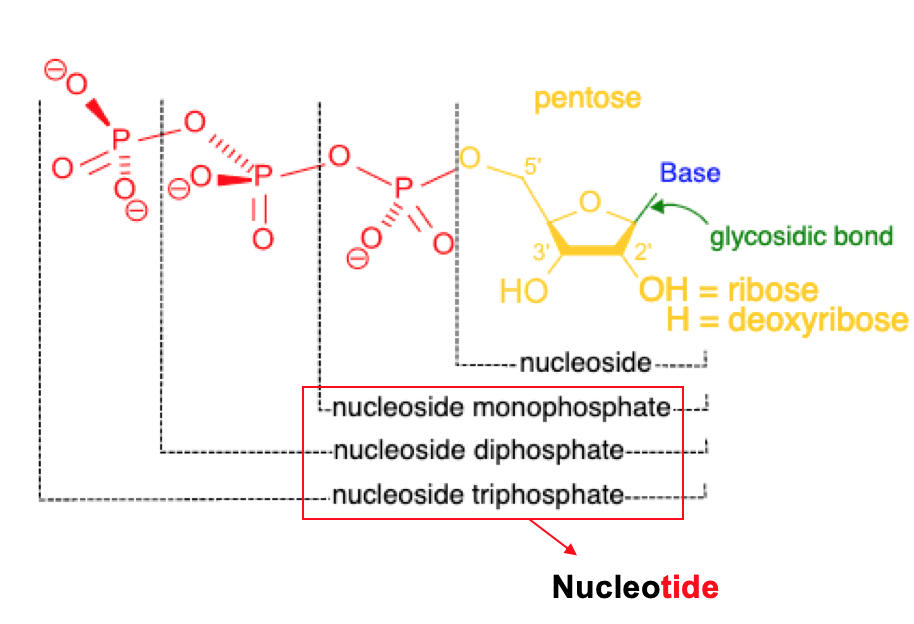
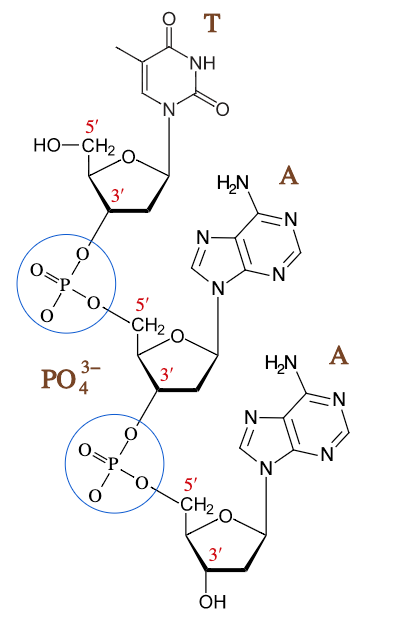
How is the DNA backbone elongated?
- Phosphodiester bonds form between the 3' -OH group of one nucleoside to the 5' phosphate group of an incoming nucleoside.
0:00 / 0:00
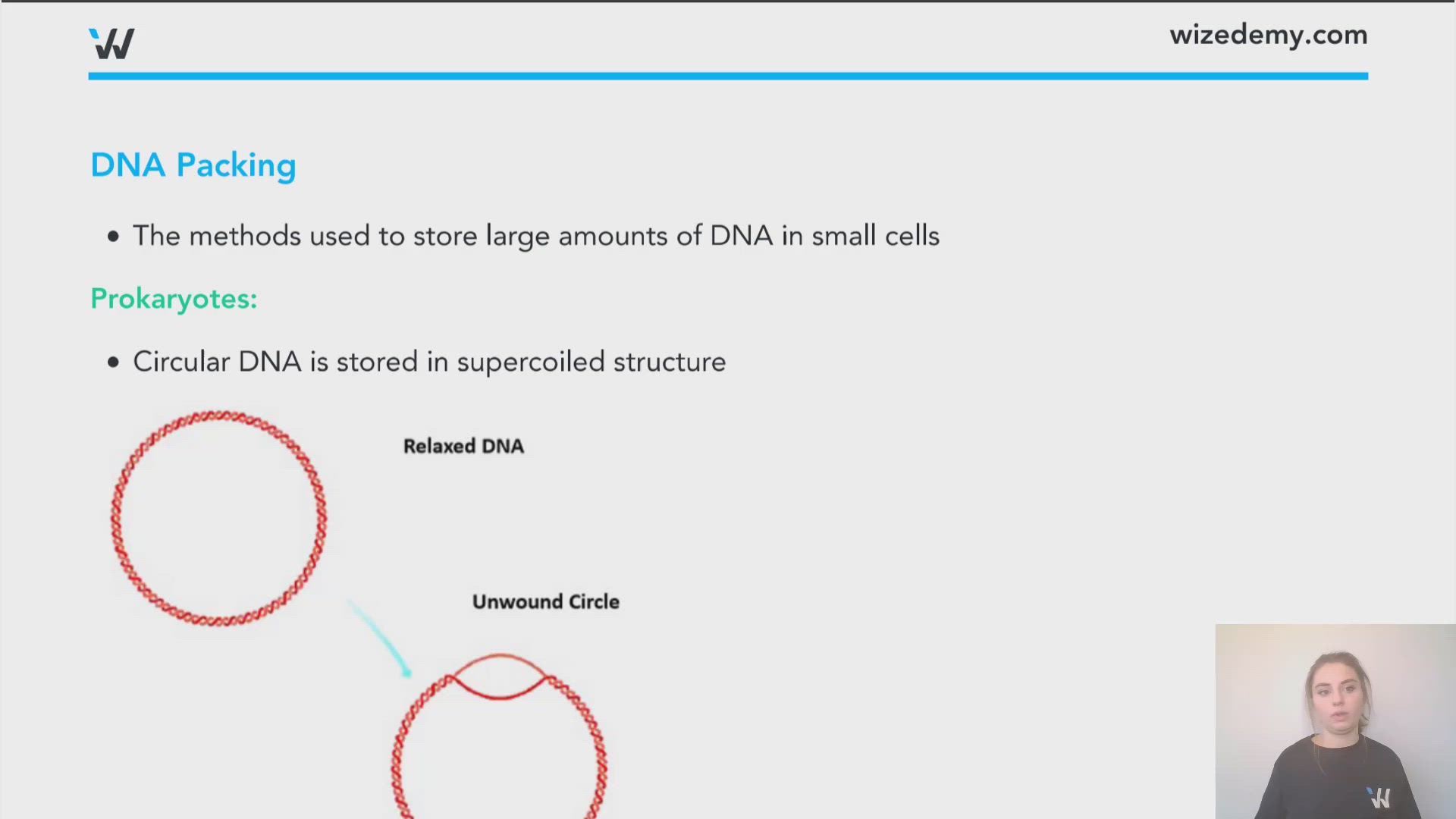
DNA Packing
- The methods used to store large amounts of DNA in small cells
Prokaryotes:
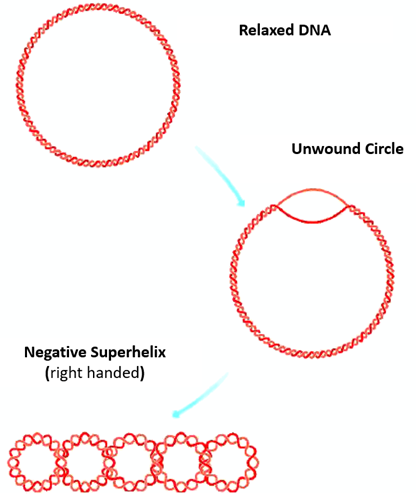
- Circular DNA is stored in supercoiled structure
Eukaryotes:
- DNA is packed into nucleosomes
- Nucleosomes are arranged into chromatin
- DNA is wrapped around histone octamers
- Histones = 2 x H2A, H2B, H3, H4
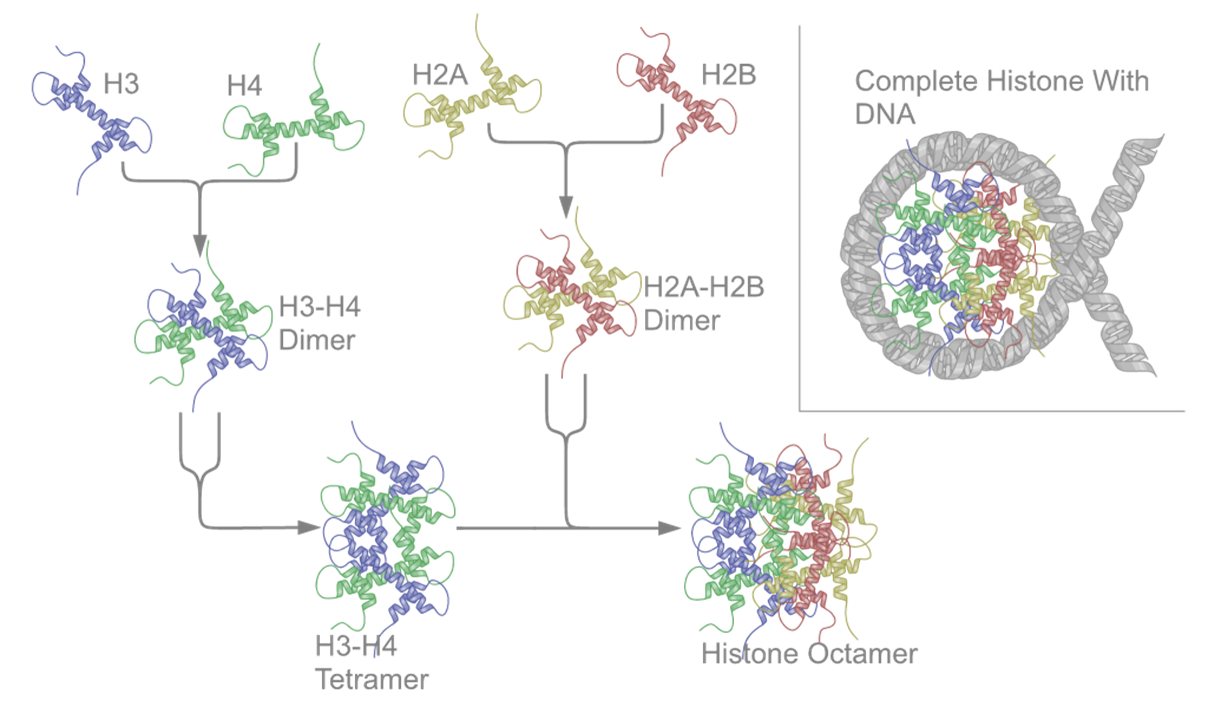
https://commons.wikimedia.org/wiki/File:Nucleosome_structure.png. Richard Wheeler. Creative Commons Attribution-Share Alike 3.0 Unported license.
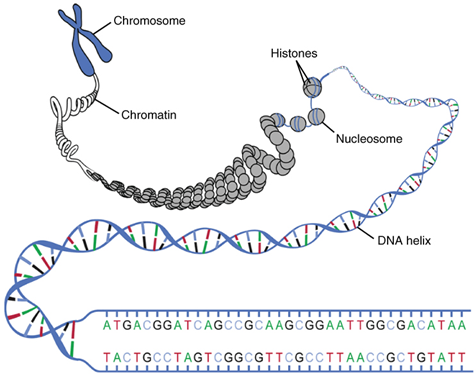
https://commons.wikimedia.org/wiki/File:0321_DNA_Macrostructure.jpg. OpenStax. Creative Commons Attribution 4.0 International license.
0:00 / 0:00
Structure of RNA
There are three main types of RNA in the cell:
- rRNA (ribosomal RNA) that is a part of the ribosome and helps in protein synthesis during translation
- tRNA (transfer RNA) which carries amino acids to aid in protein synthesis during translation
- mRNA (messenger RNA) which is made during transcription and hold the code needed for protein synthesis during translation
Note: transcription and translation are part of gene expression and will be discussed in Chapter 4
RNA versus DNA Structure
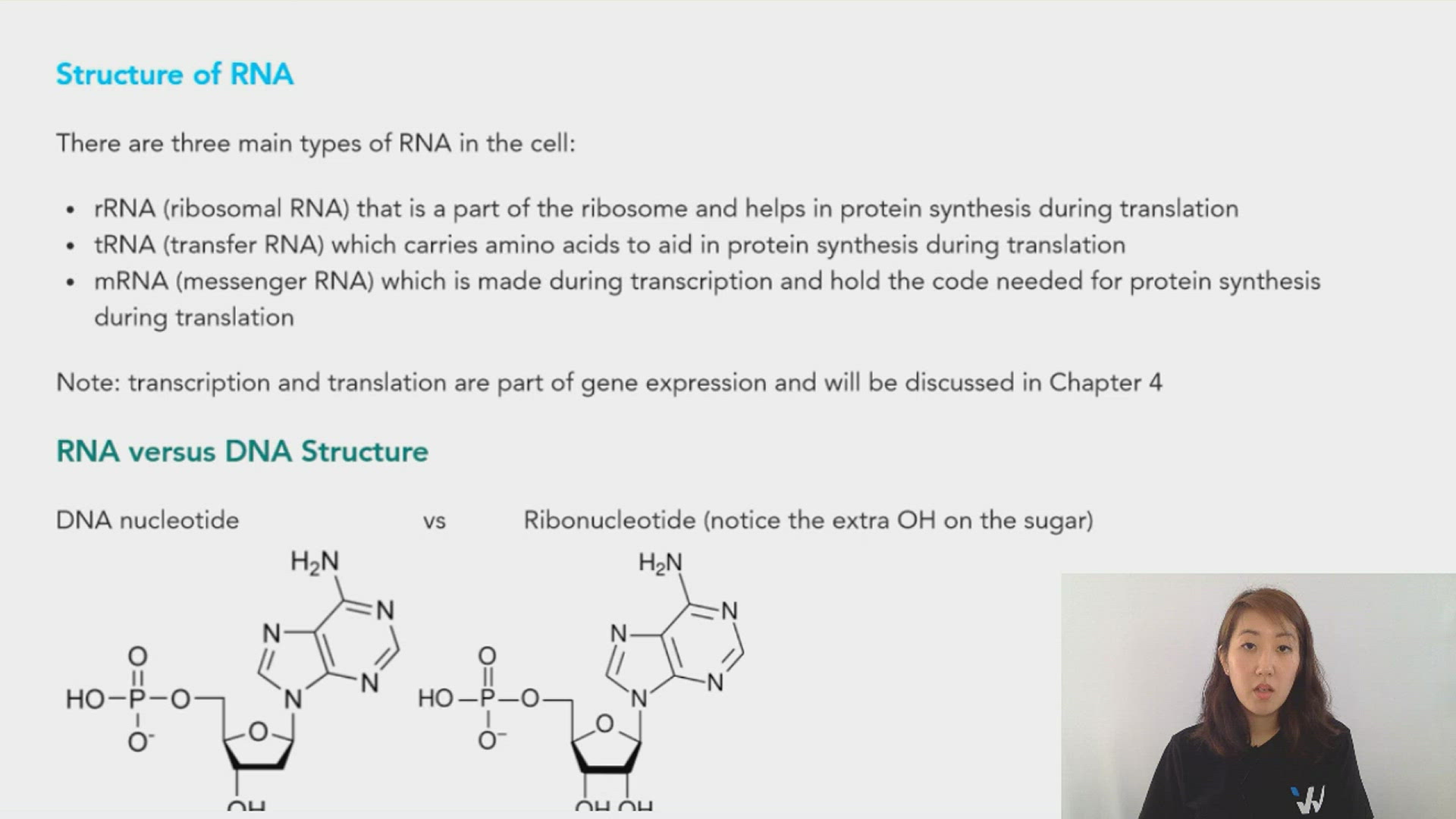
DNA nucleotide vs Ribonucleotide (notice the extra OH on the sugar)
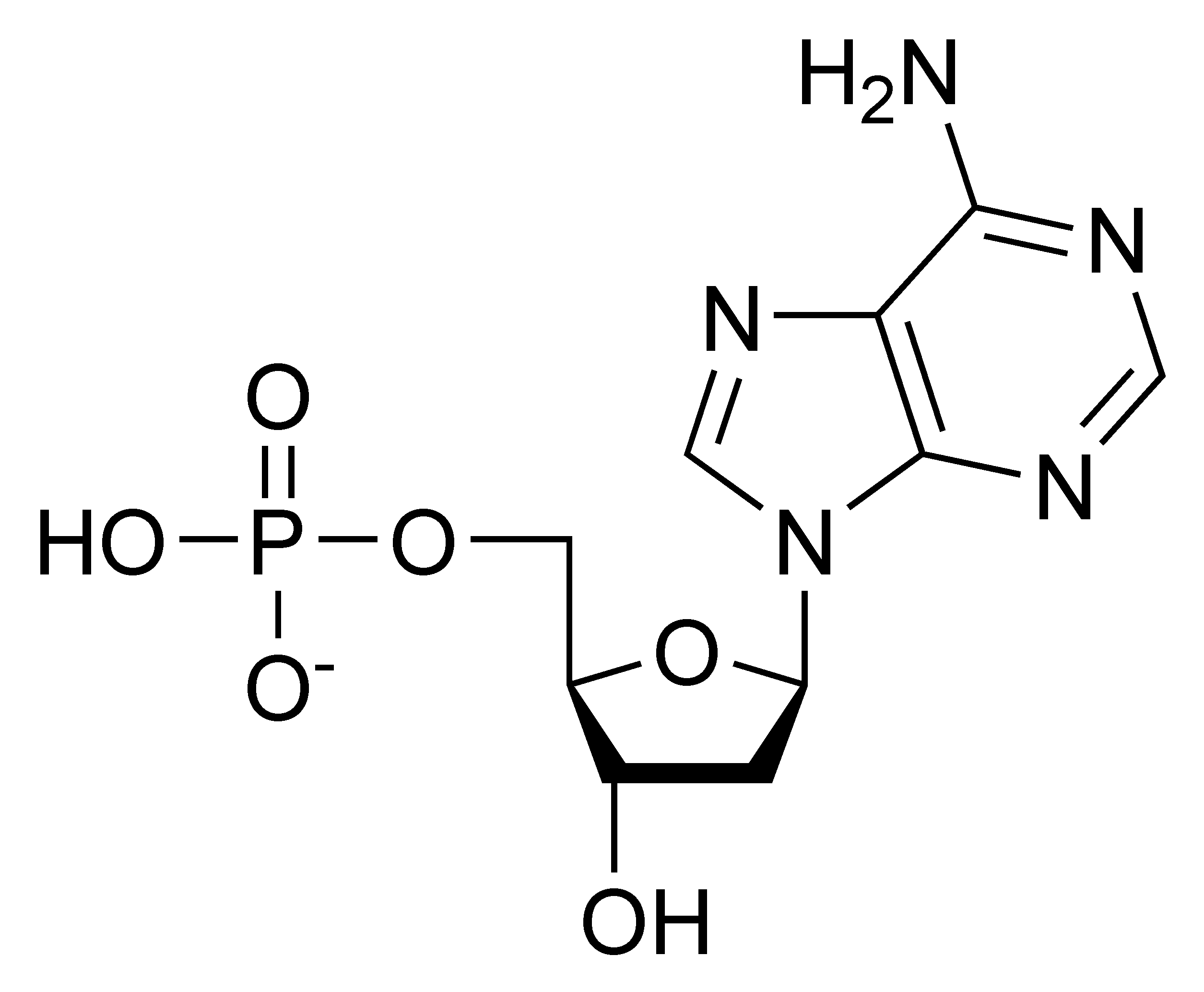

- The ribonucleotide has an extra hydroxyl (-OH) on the central sugar molecule
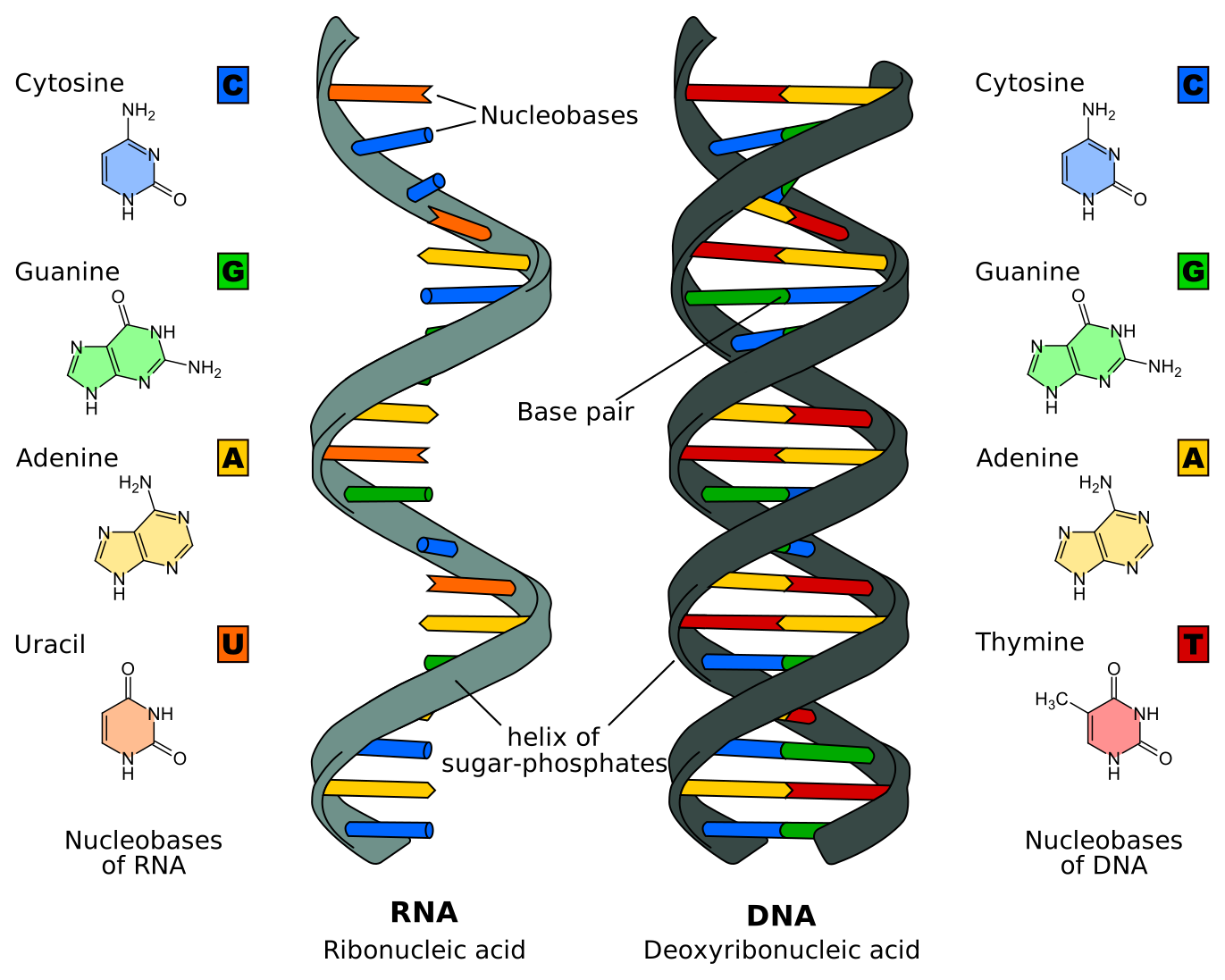
- RNA is always single stranded whereas DNA is mostly found as double-stranded
- RNA uses uracil instead of thymine which are both complimentary to adenine
- RNA is less stable than DNA
0:00 / 0:00
Chromosomes & Chromatin
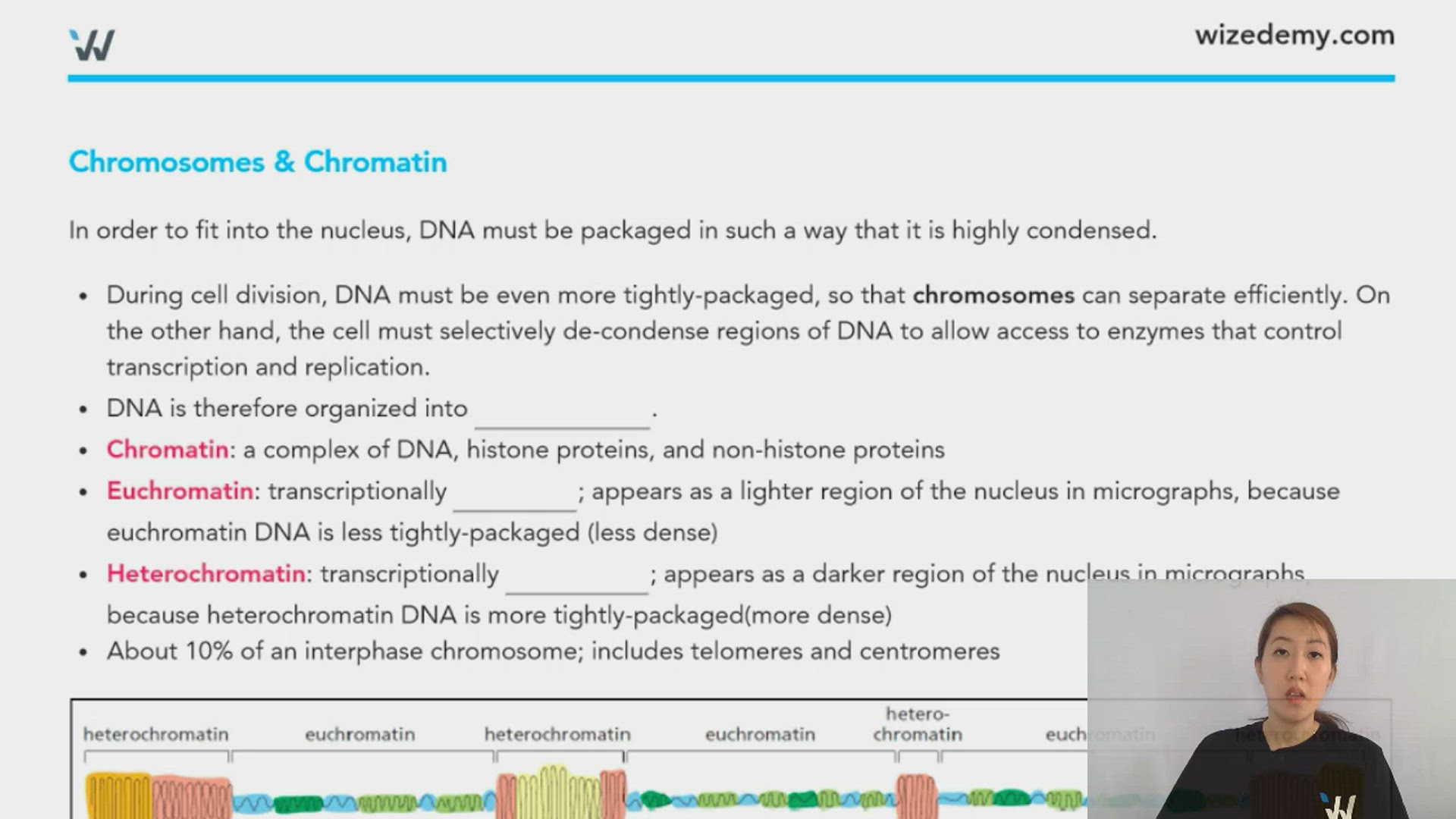
In order to fit into the nucleus, DNA must be packaged in such a way that it is highly condensed.
- During cell division, DNA must be even more tightly-packaged, so that chromosomes can separate efficiently. On the other hand, the cell must selectively de-condense regions of DNA to allow access to enzymes that control transcription and replication.
- DNA is therefore organized intoChromatin.
- Chromatin: a complex of DNA, histone proteins, and non-histone proteins
- Euchromatin: transcriptionallyactive; appears as a lighter region of the nucleus in micrographs, because euchromatin DNA is less tightly-packaged (less dense)
- Heterochromatin: transcriptionallyinactive; appears as a darker region of the nucleus in micrographs, because heterochromatin DNA is more tightly-packaged(more dense)
- About 10% of an interphase chromosome; includes telomeres and centromeres

Histone proteins: five histone proteins (H1, H2A, H2B, H3, H4); wrap and condense DNA
- Many basic amino acids; promotes interaction with DNA (which has a negative charge)
Non-histone proteins: e.g. proteins involved in DNA replication/repair/transcription
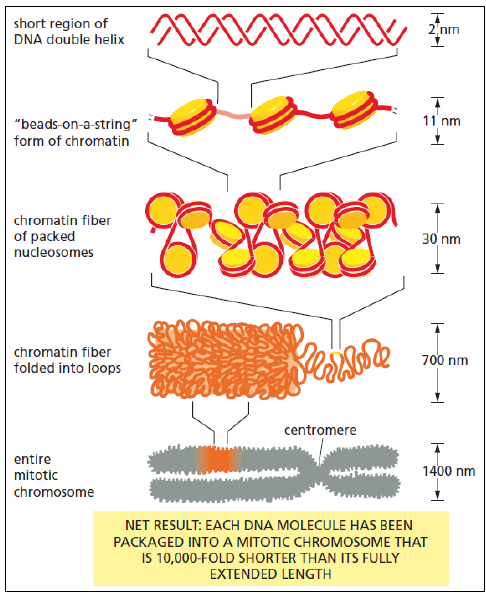
- It is useful to describe the organization of chromatin at different levels, starting from the smallest structures. These may be described by the size of the structure (in nm).
Type A fibers (11 nm fiber): nucleosomes + linker DNA
- Nucleosome: basic level of DNA packaging, with DNA wound approx. twice around a histone octamer (2 each of histone proteins H2A, H2B, H3, H4)
- Looks like “beads on a string”: about 146 base pairs associated with the nucleosome core, and about 54 base pairs of linker DNA between nucleosomes
Type B fibers (30 nm fiber): interphase chromatin generally takes this form
- Histone protein H1 interacts with linker DNA of a type A fiber to further condense it
- Non-histone proteins also contribute to condense chromatin
Chromosomes: highly-condensed form of DNA and associated proteins, formed in preparation for mitosis or meiosis
- Telomere: DNA sequence at chromosome ends, protects the chromosome from shortening during repeated replication
- Centromere: spindle binding site, holds sister chromatids together
- Chromatin can be unwound to expose regions of DNA (e.g. for transcription or replication).
- Chromatin-remodelling complexes: protein complexes that use ATP hydrolysis to change the position of the DNA wrapped around the nucleosome cores
- Histone-modifying enzymes: reversibly alter the tails of nucleosome core histones (e.g. via methylation, phosphorylation, acetylation)
0:00 / 0:00
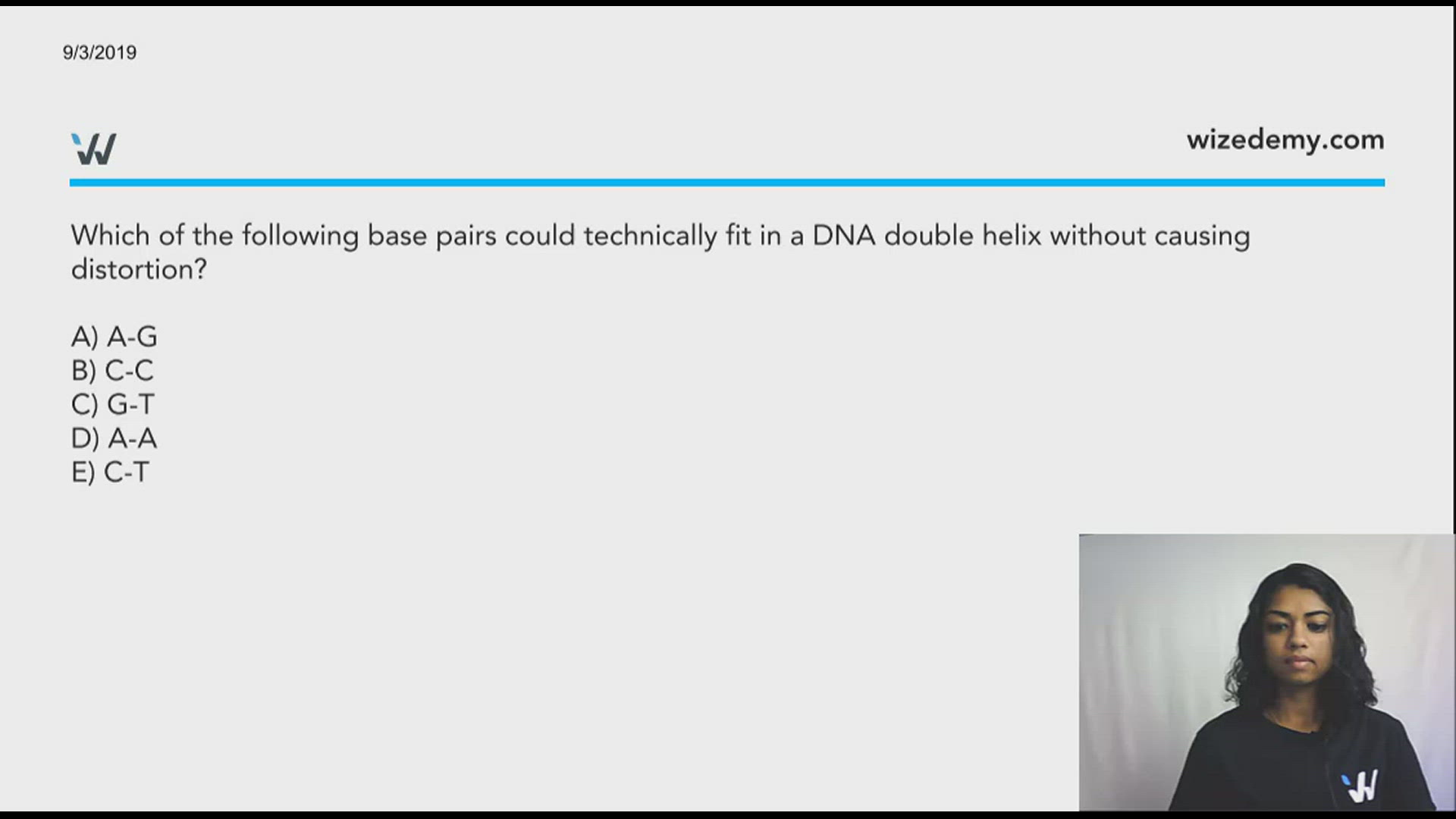
Which of the following base pairs could technically fit in a DNA double helix without causing distortion?
A) A-G
B) C-C
C) G-T
D) A-A
E) C-T
The correct answer is C.
Two purines cannot pair with each other because they would be too large to fit in the backbone.
Therefore, choice (A) and (D), which have two purines binding would not be able to fit into the double helix.
Two pyrimidines also cannot pair with each other because they are too small to effectively bind to each other.
Therefore, Choice (B) and Choice (E), which have two pyrimidines binding would not be able to fit into the double helix
Since G-T is a purine-pyrimidine pair, they technically can exist (as can A-C and U-G in mRNA). None of these pairs are found in nature but they can be synthesized in laboratories.
0:00 / 0:00
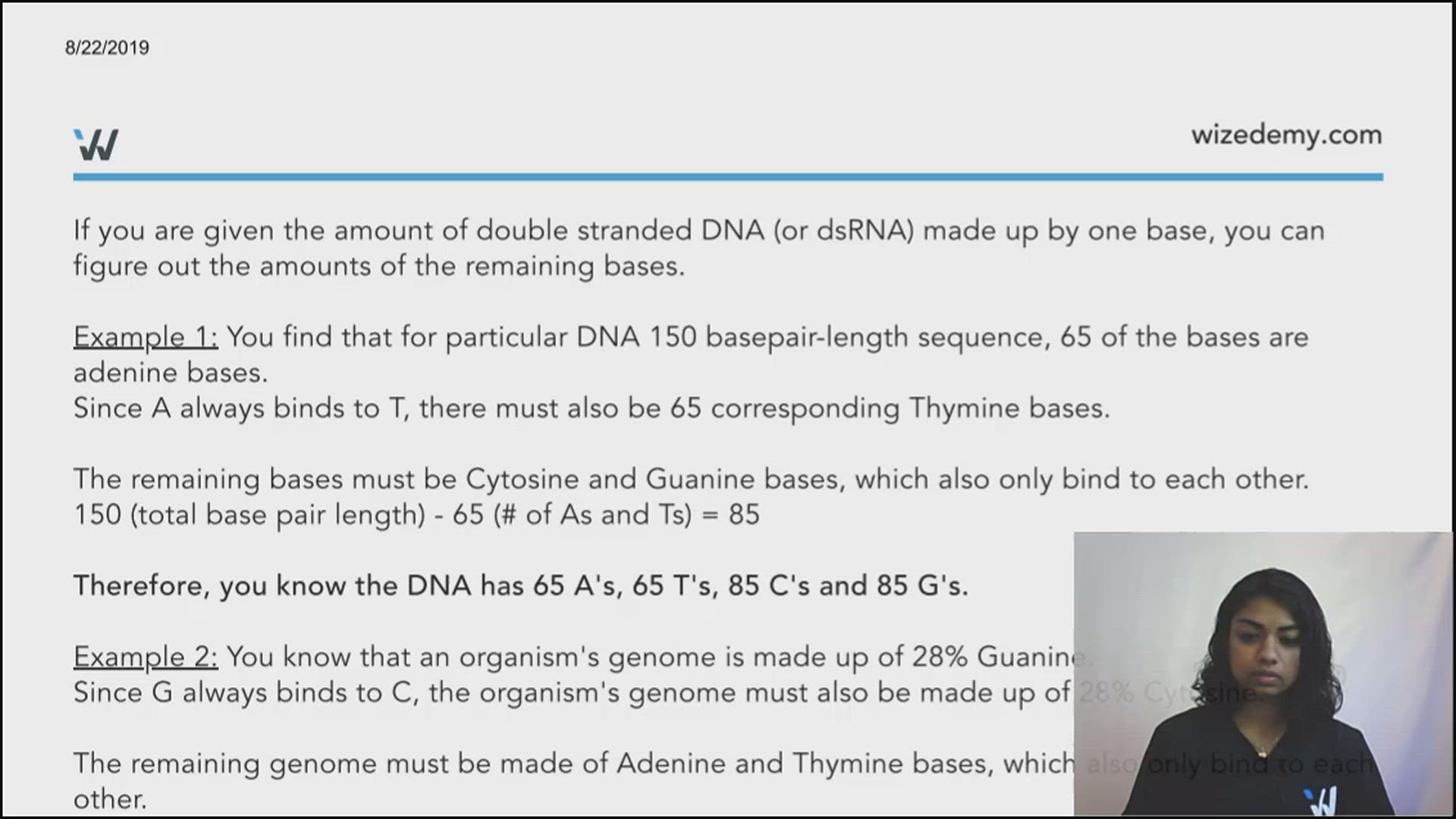
Question 1: You find that for a particular DNA 150 basepair-length sequence, 65 of the bases are adenine bases. How many Ts, Gs and Cs are present?
Since A always binds to T, there must also be 65 corresponding Thymine bases.
The remaining bases must be Cytosine and Guanine bases, which also only bind to each other.
150 (total base-pair length) - 65 (# of As and Ts) = 85
Therefore, you know the DNA has 65 A's, 65 T's, 85 C's and 85 G's.
Question 2: You know that an organism's genome is made up of 28% Guanine. What are the percentages of the remaining three base pairs?
Since G always binds to C, the organism's genome must also be made up of 28% Cytosine.
The remaining genome must be made of Adenine and Thymine bases, which also only bind to each other.
100% (total genome) - 28% (G's) - 28% (C's) = 44%
Since there must be equal parts of A's and T's, divide the 44% by 2.
Therefore, the organism's genome is made up of 28% G's, 28% C's, 22% A's and 22% T's.