Popular Courses
Find My Course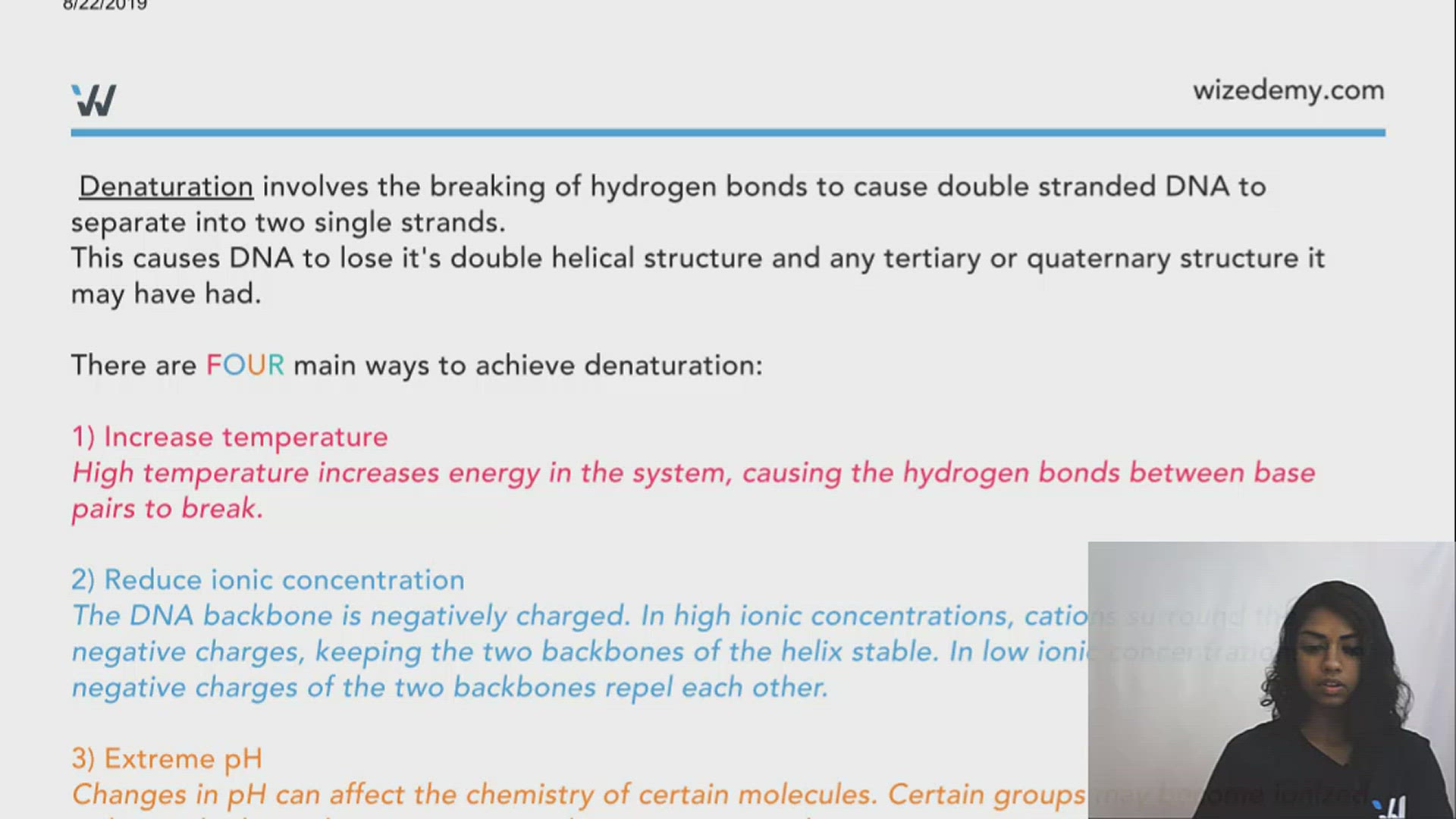
0:00 / 0:00
Denaturation involves the breaking of hydrogen bonds to cause double stranded DNA to separate into two single strands.
This causes DNA to lose it's double helical structure and any tertiary or quaternary structure it may have had.
There are FOUR main ways to achieve denaturation:
1) Increase temperature
High temperature increases energy in the system, causing the hydrogen bonds between base pairs to break.
2) Reduce ionic concentration
The DNA backbone is negatively charged. In high ionic concentrations, cations surround the negative charges, keeping the two backbones of the helix stable. In low ionic concentrations, the negative charges of the two backbones repel each other.
3) Extreme pH
Changes in pH can affect the chemistry of certain molecules. Certain groups may become ionized at low or high pH that are not ionized at a more neutral pH.
4) Adding chemicals that destabilize hydrogen bonds
Chemicals like formamide and urea can be used to break the hydrogen bonds between two strands of DNA.
Denaturation is a reversible process!!
Wize Concept
The denaturation and re-naturation of DNA is an important property scientists take advantage of to study genetic sequences by using experimental techniques like PCR.
0:00 / 0:00
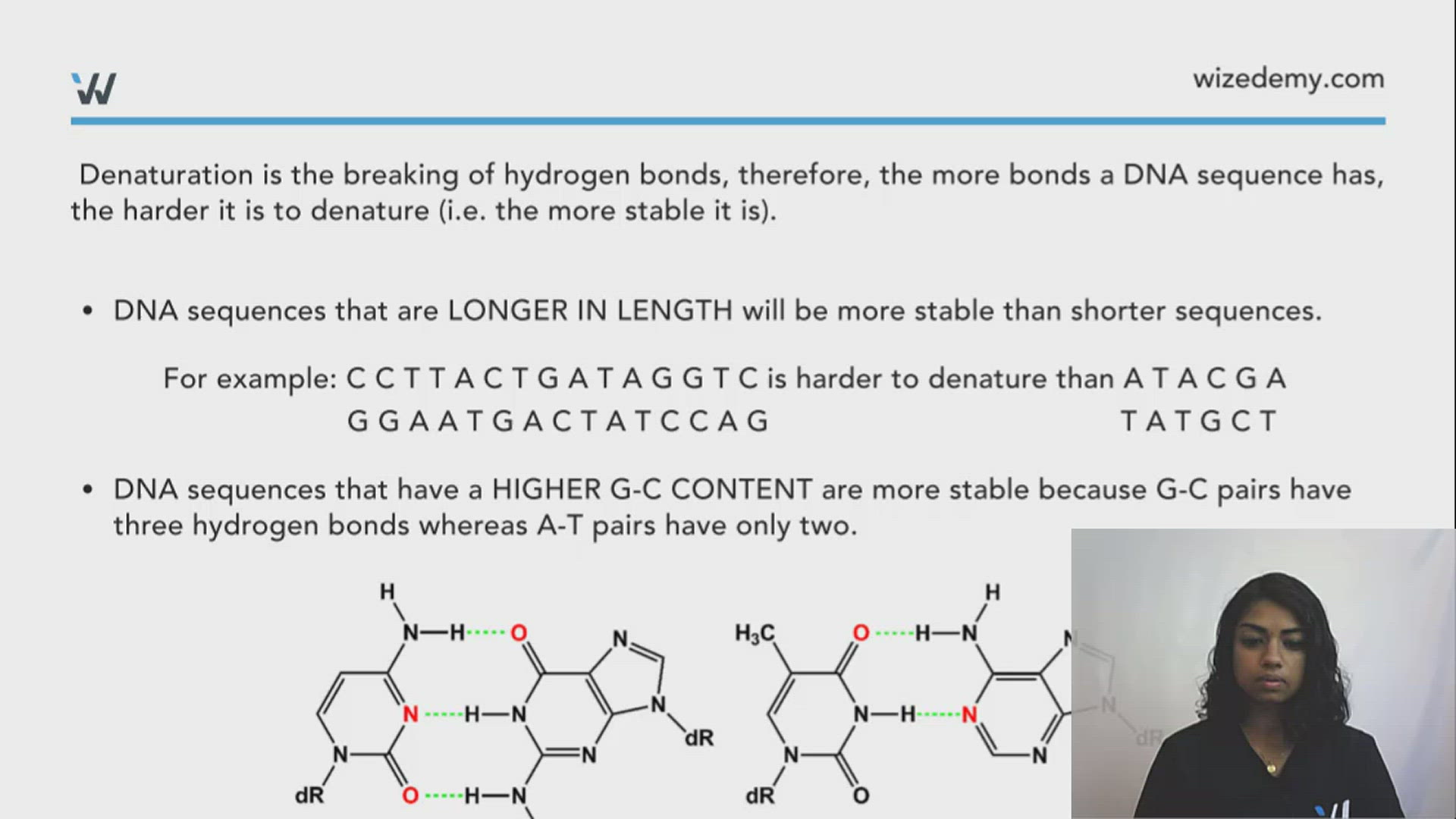
Denaturation is the breaking of hydrogen bonds, therefore, the more bonds a DNA sequence has, the harder it is to denature (i.e. the more stable it is).
- DNA sequences that are LONGER IN LENGTH will be more stable than shorter sequences.
For example: C C T T A C T G A T A G G T C is harder to denature than A T A C G A
G G A A T G A C T A T C C A G T A T G C T
- DNA sequences that have a HIGHER G-C CONTENT are more stable because G-C pairs have three hydrogen bonds whereas A-T pairs have only two.
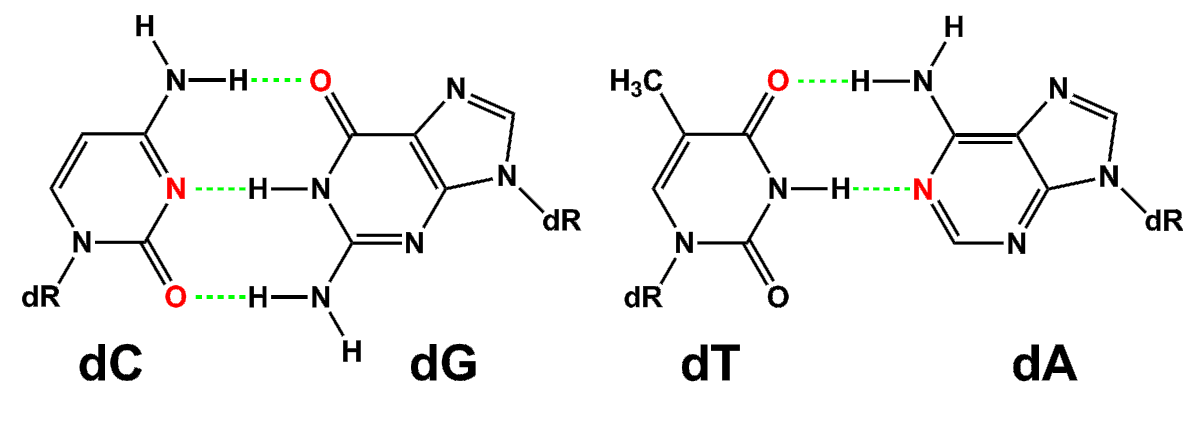
For example: A C G C G T C G C G G C is harder to denature than A A T A C A T G A T A
T G C G C A G C G C C G T T A T G T A C T A T
Even though both sequences are the same length, the G-C content is higher in the first sequence.