Wize University Biochemistry Textbook > Membrane Protein & Transporters
Characteristics of Membrane Proteins

0:00 / 0:00
Proteins in the Lipid Bilayer
- Two types of proteins: Peripheral and Integral
- Glycoproteins are proteins with lipid post-translational modifications that aid in membrane insertion and cell recognition
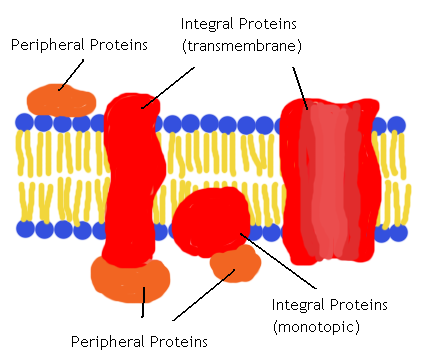
https://commons.wikimedia.org/wiki/File:Membrane_protein.png. Meng-jou wu. This work has been released into the public domain.
0:00 / 0:00
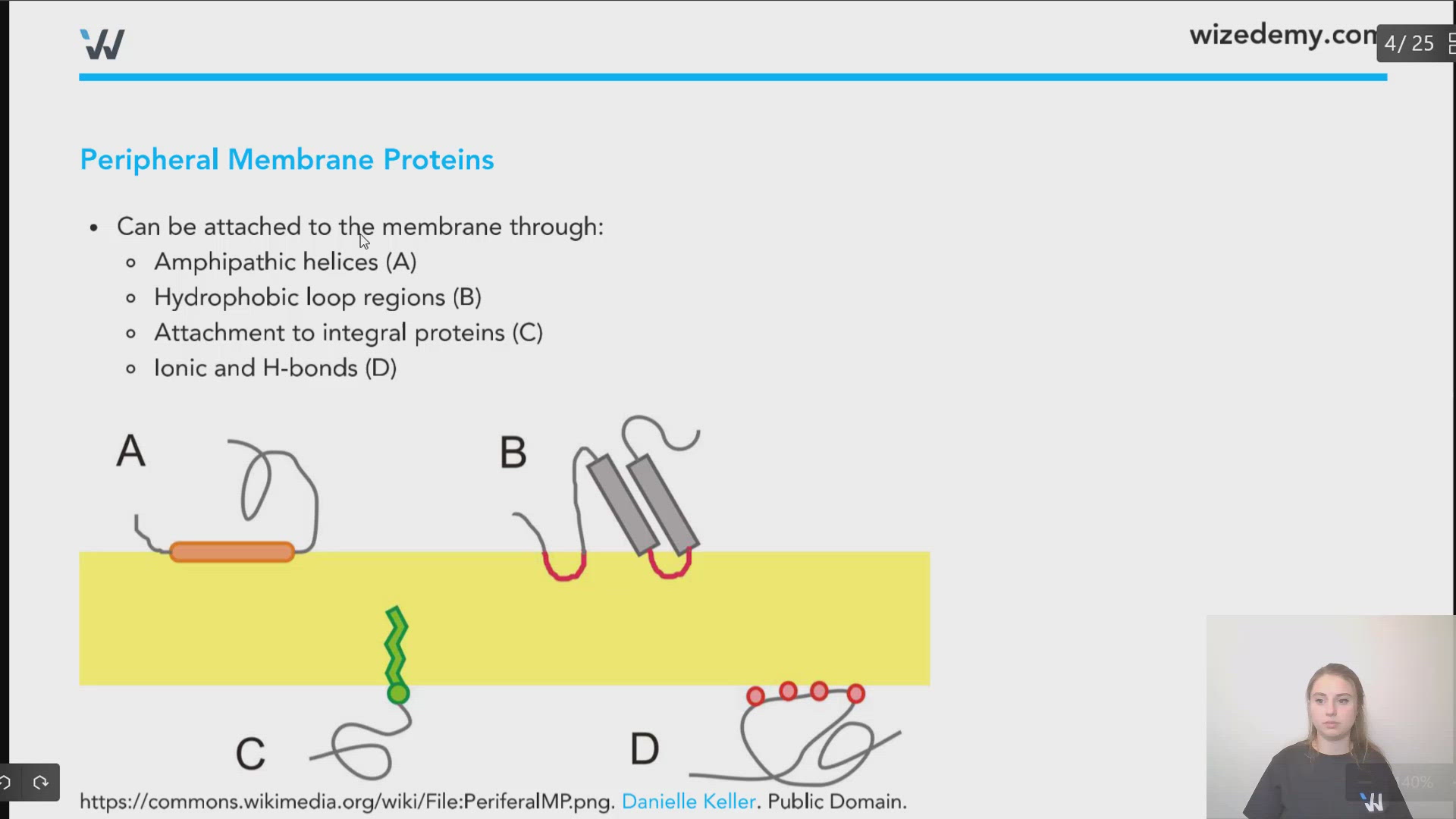
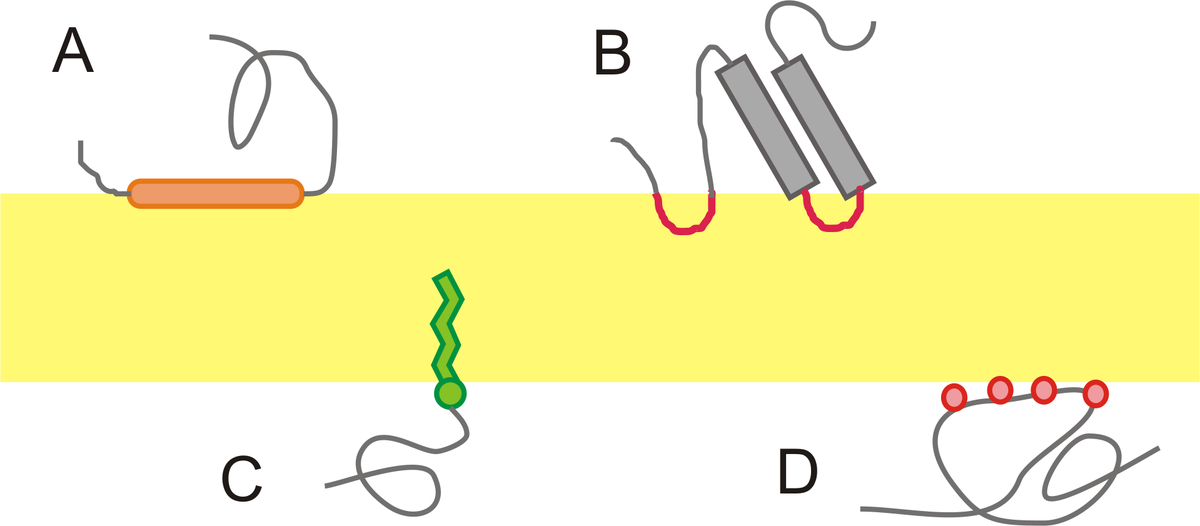
Peripheral Membrane Proteins
- Can be attached to the membrane through:
- Amphipathic helices (A)
- Hydrophobic loop regions (B)
- Attachment to integral proteins (C)
- Ionic and H-bonds (D)
Removal of Peripheral Membrane Proteins
- High salt method:
- Neutralizes or "shields" charges using ions in salt
- Breaks hydrogen bonds and ionic interactions
- pH change:
- Protonates/deprotonates charged amino acids
- Breaks hydrogen bonds and ionic interactions
0:00 / 0:00
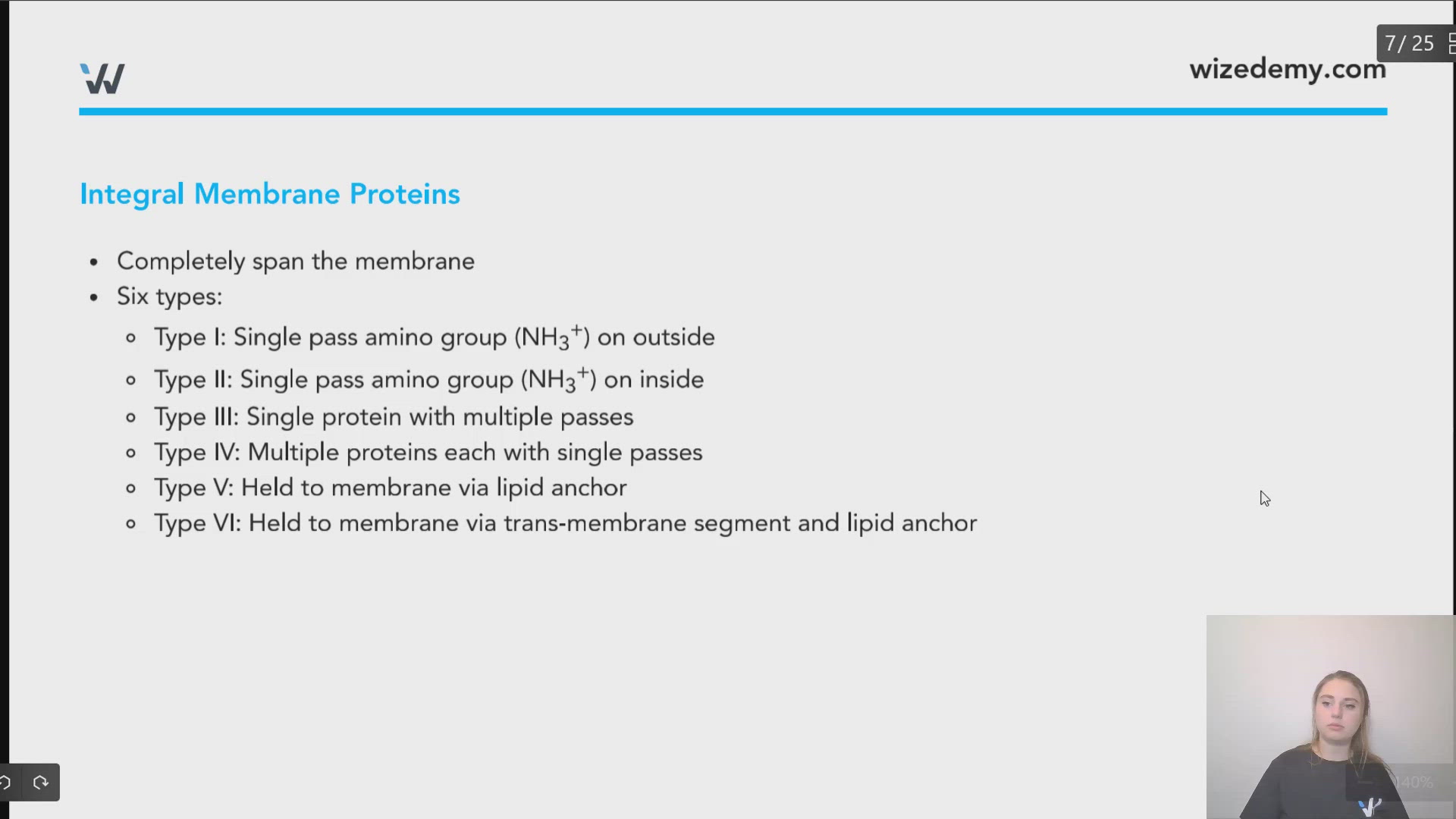
Integral Membrane Proteins
- Completely span the membrane
- Six types:
- Type I: Single pass amino group (NH3+) on outside
- Type II: Single pass amino group (NH3+) on inside
- Type III: Single protein with multiple passes
- Type IV: Multiple proteins each with single passes
- Type V: Held to membrane via lipid anchor
- Type VI: Held to membrane via trans-membrane segment and lipid anchor
Three regions, each with their own properties
- Extracellular-facing region:
- Play roles in signalling, transport, and cell recognition and communication (Lipids and glycosylated proteins)
- Membrane spanning regions:
- ~20 amino acids long and mostly hydrophobic
- Intracellular-facing region:
- Transmit signals to the cytosol through "tails" and are involved in transport
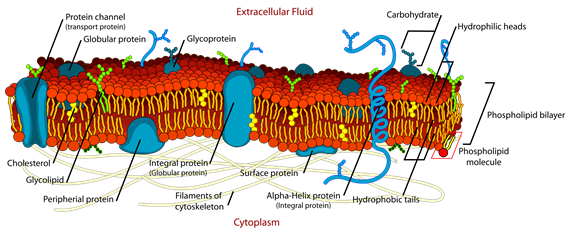
https://commons.wikimedia.org/wiki/File:Cell_membrane_detailed_diagram_en.svg. Mariana Ruiz. This work has been released into the public domain.
Removal of Integral Membrane Proteins
- Requires harsh removal: detergents or organic solvents
- Detergents separate proteins from lipids
0:00 / 0:00
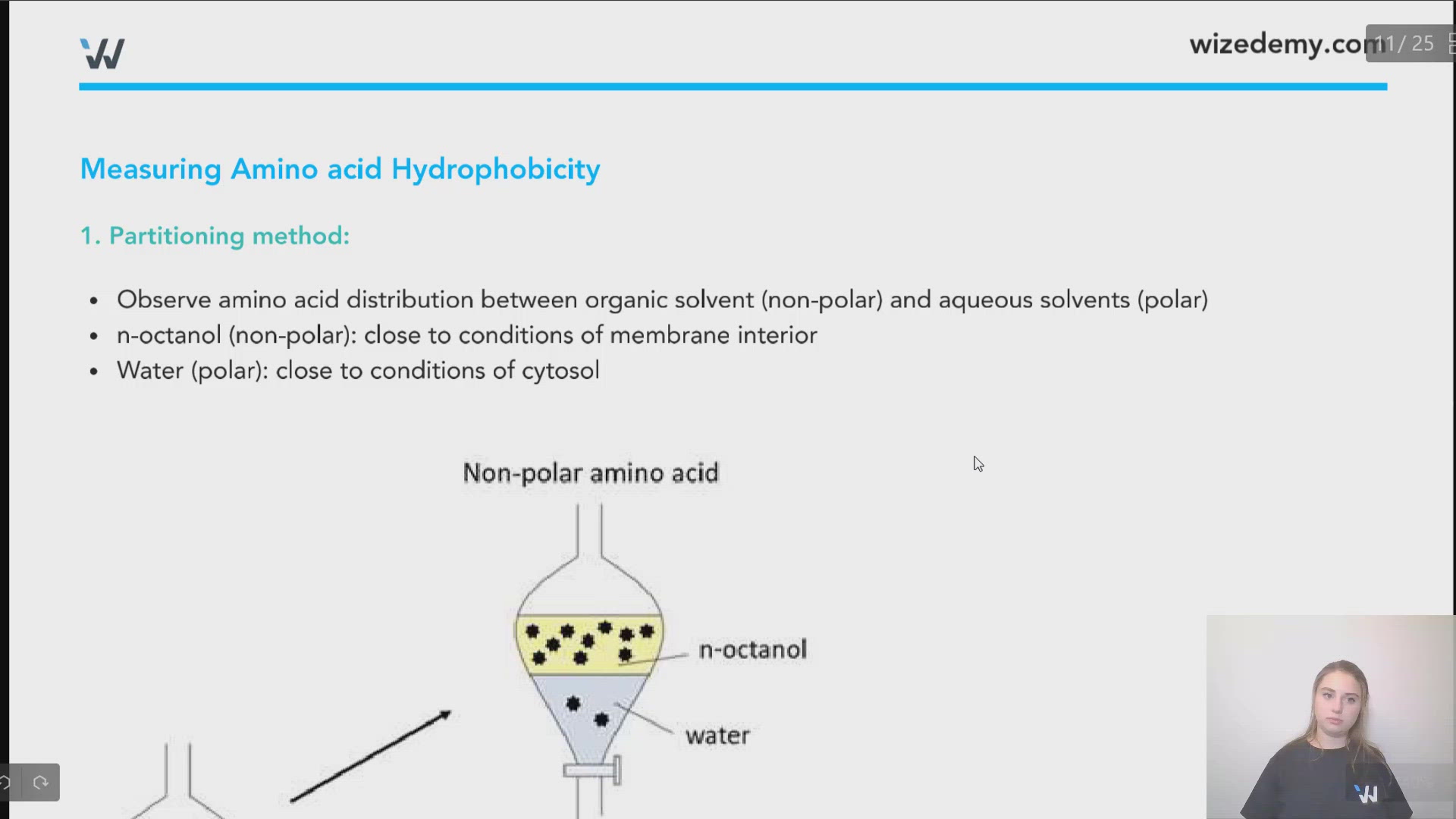
Measuring Amino acid Hydrophobicity
1. Partitioning method:
- Observe amino acid distribution between organic solvent (non-polar) and aqueous solvents (polar)
- n-octanol (non-polar): close to conditions of membrane interior
- Water (polar): close to conditions of cytosol
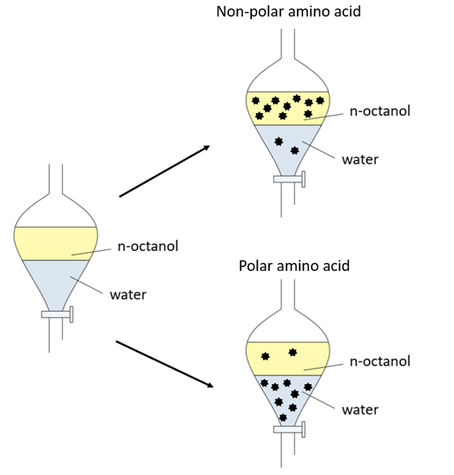
Determine partition coefficient:
Often reported as log of this value
2. Surface Exposure:
- Polar amino acids are found on the surface of proteins
- Non-polar amino acids are found in the interior
- Average accessibility of each amino acid was determined from the coordinates of 12 model globular proteins
- Hydropathy is calculated as the fraction of the total number of the protein that is at least 95% buried from the surface
Assigning Transmembrane Sequences based on Hydropathy
1. Assign hydropathy value to each residue in the protein (either a positive or negative value) - using Kyte-Doolittle Hydropathy scale
2. In a series of 7 residues the average of the seven values is assigned to amino acid in position 4
3. Move over one residue and perform calculation
4. Plot on grid
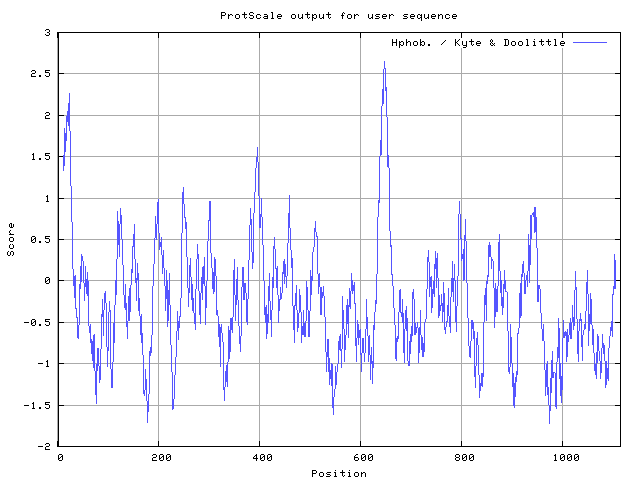
https://commons.wikimedia.org/wiki/File:RET_Kyte-Doolittle-Hydropathy_Plot_RTAHIR.gif. RaihaT. This file is licensed under the Creative Commons Attribution-Share Alike 3.0 Unported license.
0:00 / 0:00
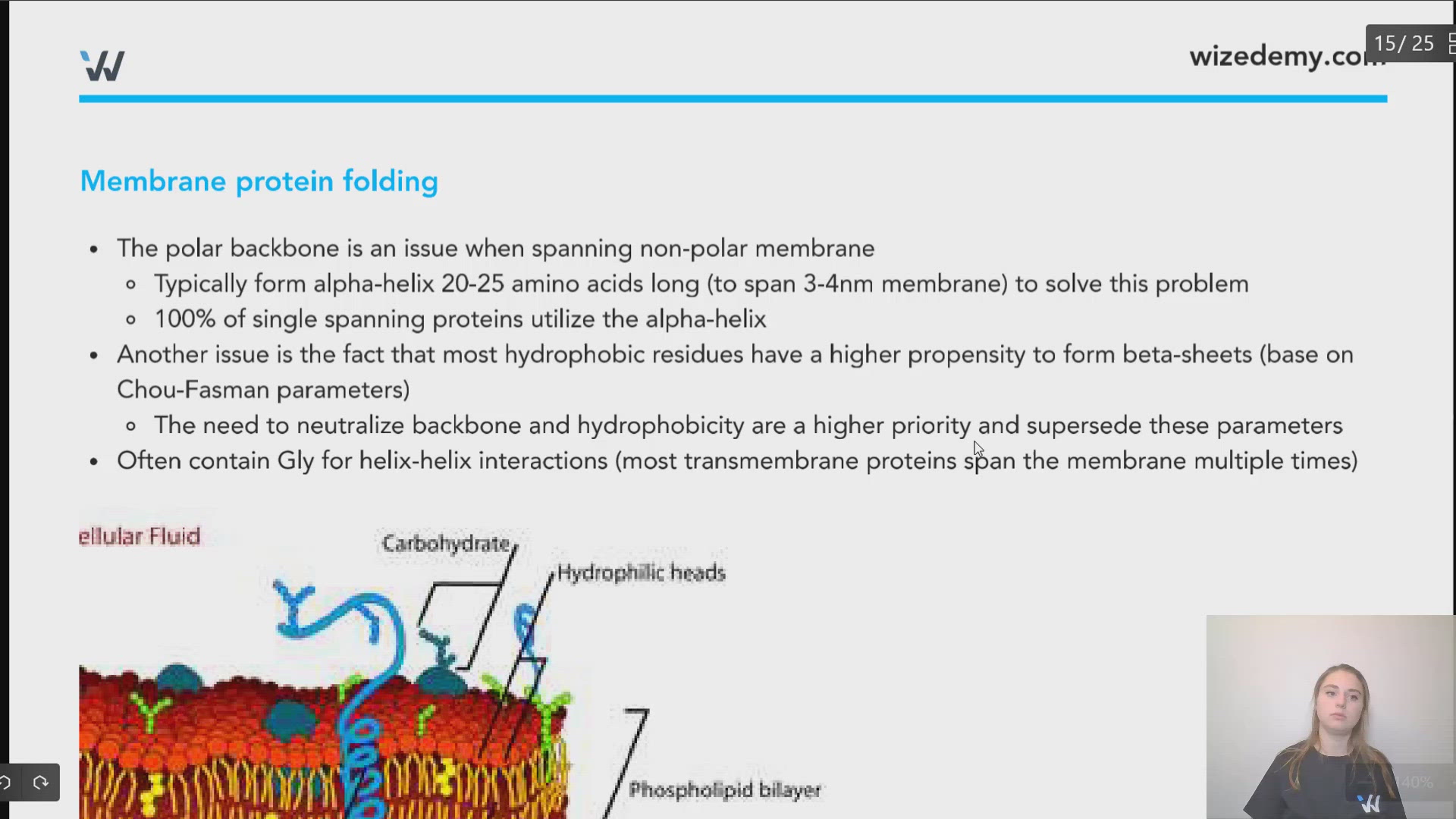
Membrane protein folding
- The polar backbone is an issue when spanning non-polar membrane
- Typically form alpha-helix 20-25 amino acids long (to span 3-4nm membrane) to solve this problem
- 100% of single spanning proteins utilize the alpha-helix
- Another issue is the fact that most hydrophobic residues have a higher propensity to form beta-sheets (base on Chou-Fasman parameters)
- The need to neutralize backbone and hydrophobicity are a higher priority and supersede these parameters
- Often contain Gly for helix-helix interactions (most transmembrane proteins span the membrane multiple times)
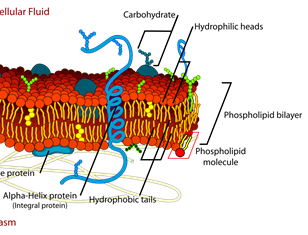
https://commons.wikimedia.org/wiki/File:Cell_membrane_detailed_diagram_en.svg. Mariana Ruiz. This work has been released into the public domain.
0:00 / 0:00
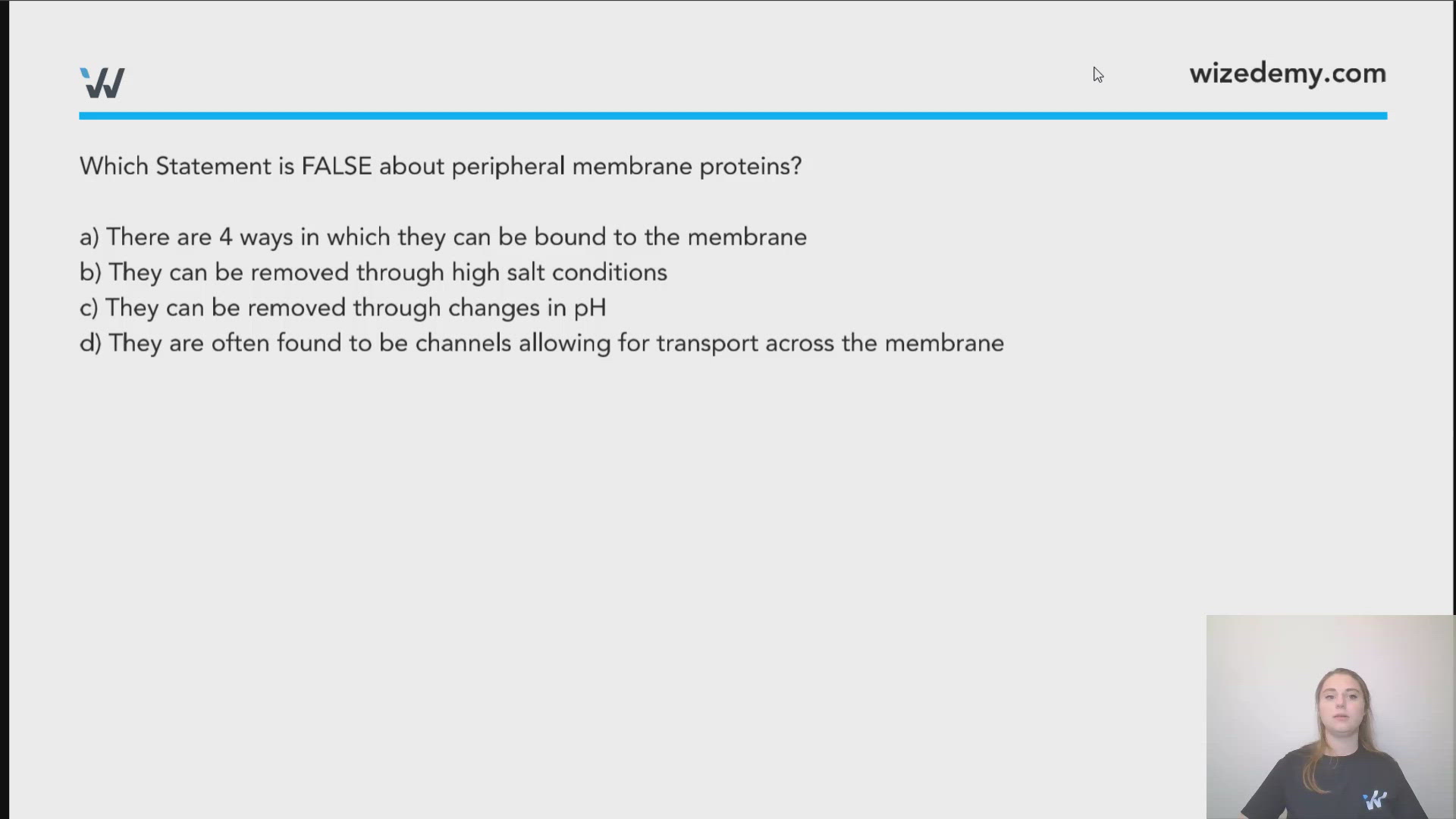
Which statement is FALSE about peripheral membrane proteins?
a) There are 4 ways in which they can be bound to the membrane
b) They can be removed through high salt conditions
c) They can be removed through changes in pH
d) They are often found to be channels allowing for transport across the membrane
d) They can no be channels unless they span the membrane. I would encourage you to know what the 4 types of peripheral proteins there are as well as the mechanism of protein removal with both high salt and change in pH.
0:00 / 0:00
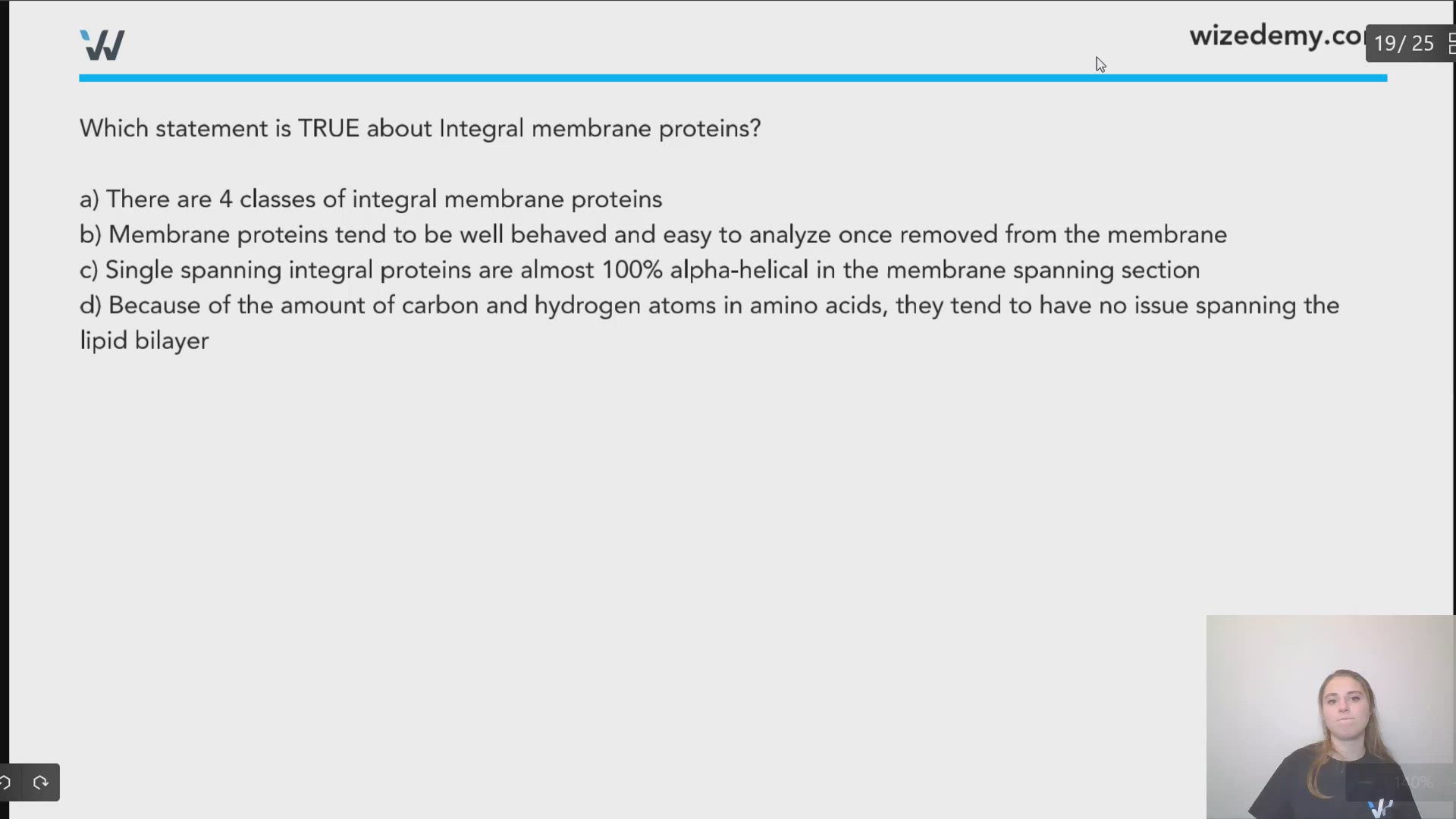
Which statement is TRUE about Integral membrane proteins?
a) There are 4 classes of integral membrane proteins
b) Membrane proteins tend to be well behaved and easy to analyze once removed from the membrane
c) Single spanning integral proteins are almost 100% alpha-helical in the membrane-spanning section
d) Because of the amount of carbon and hydrogen atoms in amino acids, they tend to have no issue spanning the lipid bilayer
c) Because the amino acid backbones have polar residues, alpha-helices are often found spanning the membrane with non-polar residues pointing outwards toward the hydrophobic center of the lipid bilayer.
0:00 / 0:00
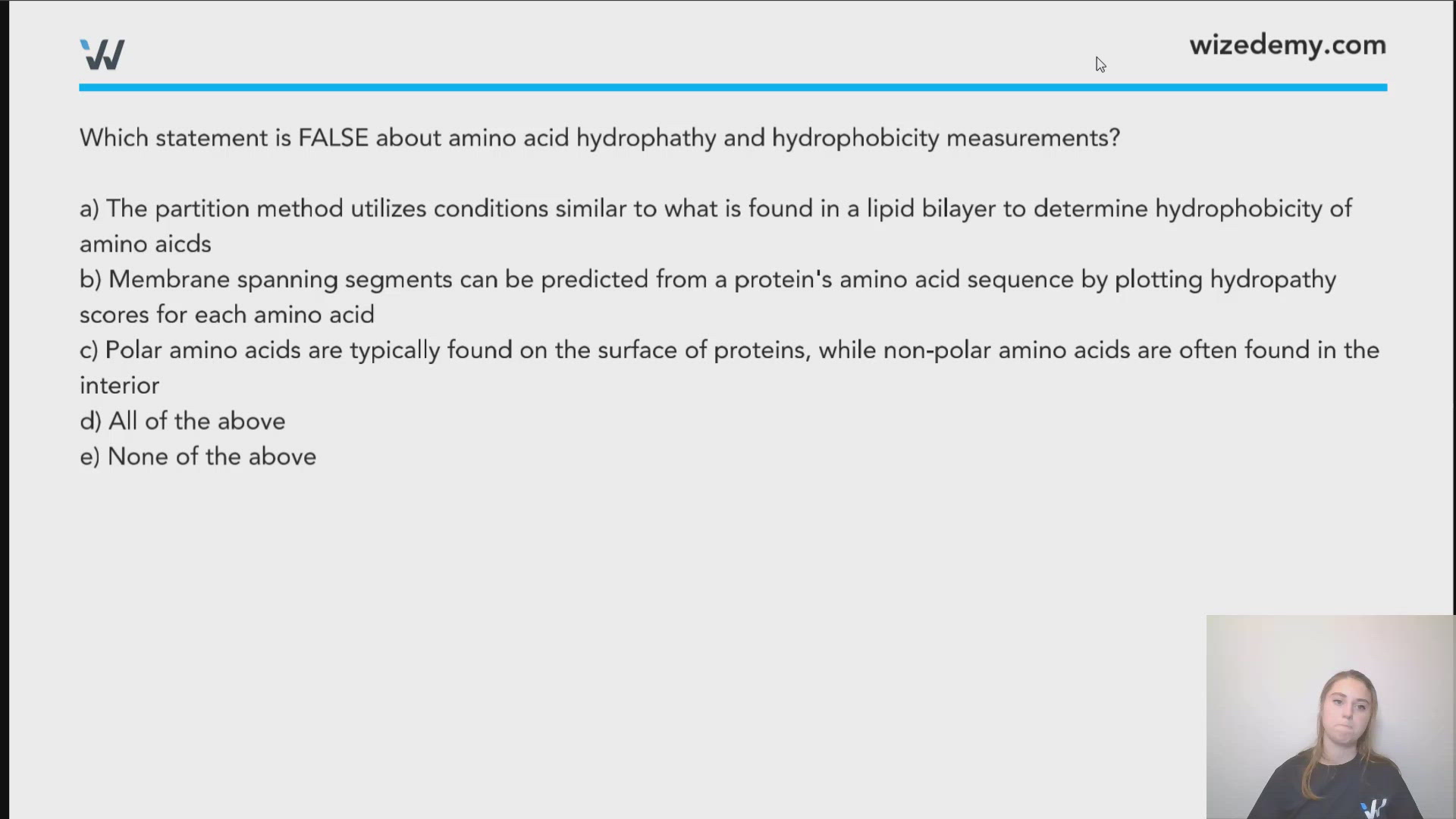
Which statement is FALSE about amino acid hydropathy and hydrophobicity measurements?
a) The partition method utilizes conditions similar to what is found in a lipid bilayer to determine hydrophobicity of amino acids
b) Membrane spanning segments can be predicted from a protein's amino acid sequence by plotting hydropathy scores for each amino acid
c) Polar amino acids are typically found on the surface of proteins, while non-polar amino acids are often found in the interior
d) All of the above
e) None of the above
e) None of the above
Which is NOT a common feature of integral membrane proteins?