0:00 / 0:00
Oxidation-Reduction Reactions
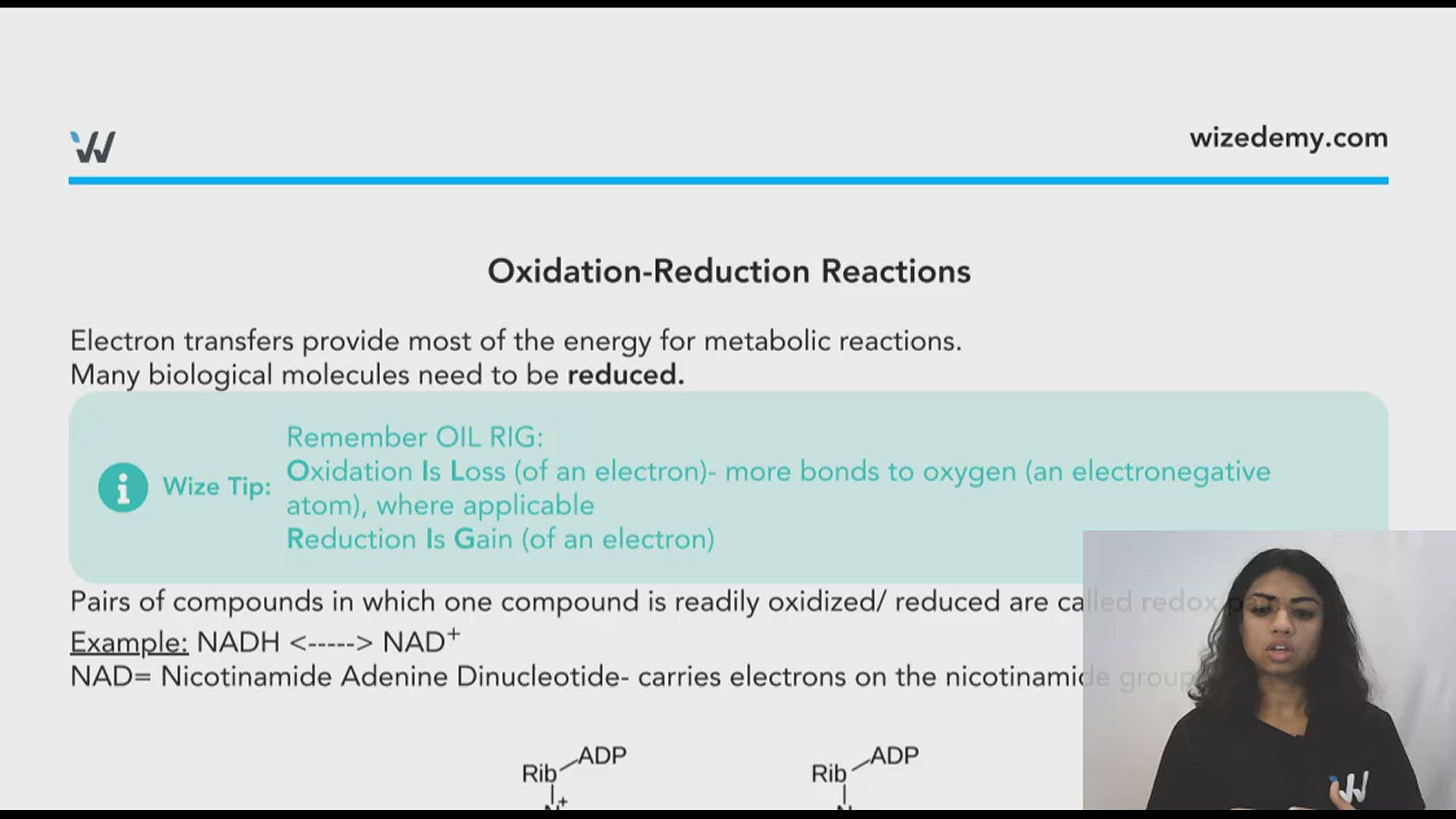
Electron transfers provide most of the energy for metabolic reactions.
Many biological molecules need to be reduced.
Wize Tip
Remember OIL RIG:
Oxidation Is Loss (of an electron)- more bonds to oxygen (an electronegative atom), where applicable
Reduction Is Gain (of an electron)
Pairs of compounds in which one compound is readily oxidized/ reduced are called redox pairs.
Example: NADH <-----> NAD+
NAD= Nicotinamide Adenine Dinucleotide- carries electrons on the nicotinamide group

NAD+ can accept two electrons (2e-) in the form of a hydride anion (an H atom with 2 electrons, rather than the normal 1)
Reducing power of NADH is important in ATP synthesis.
Example: NADPH <------NADP+
NADP= Nicotinamide Adenine Dinucleotide Phosphate
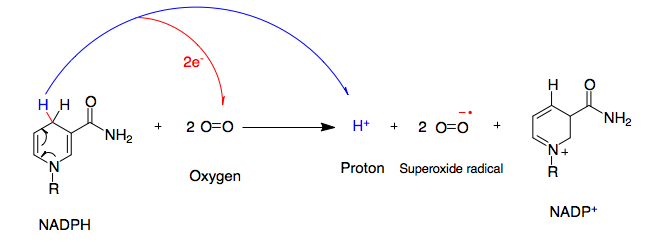
Reducing power of NADPH is important in biosynthesis of bio-molecules (e.g. lipids, cholesterol, etc.)
0:00 / 0:00
Electrochemistry
INTRODUCTION
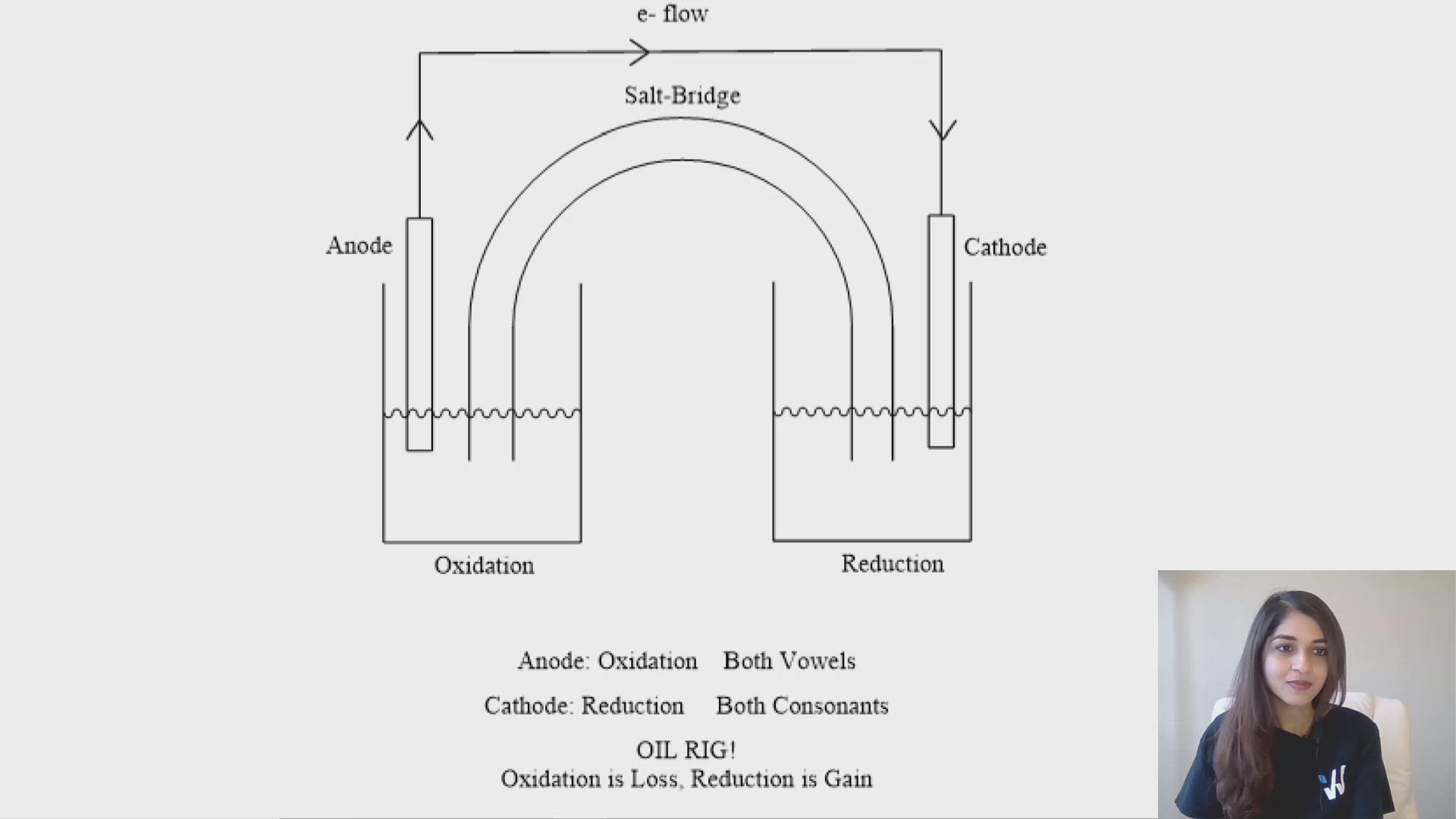
- A galvanic cell is constructed from two isolated half-cell’s connected by a salt bridge as shown below. One half-cell is the cathode, where reduction takes place, and the other is the anode, where oxidation takes place.
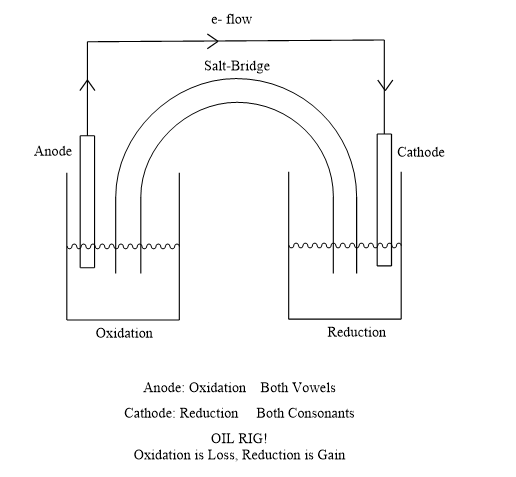
- Standard Cell notation is as follows
** If a half cell does not contain a solid species, then an inert electrode must be used. eg. Pt(s)**
- is the variable for standard electromotive force, or voltage, of a cell.
- is related to the of each half cell
Gibbs free energy and voltage, are related by the following equation
Where F = Faraday's constant = 96,500 C/mol
From the above equation, we can see that for a spontaneous process (Δ𝐺o < 0) the will be positive.

0:00 / 0:00
Cell Potentials and Gibbs Free Energy
- Free energy (ΔrG°) and cell potential (E°cell) are related through the following equation:
ΔrG° = Free energy difference between products and reactants in their standard states
n = # moles of electrons
F = Faraday constant
E°cell = Standard electrochemical reduction potential
Watch Out!
If E°cell is positive, the process is spontaneous
- ΔrG° and E° are for the cell at standard conditions (1 atm for gases and 1M for solutions)
- Under non-standard conditions we have:
- We can correct the E° to reflect the non-standard conditions by using the Nernst equation
R = gas constant
T = temperature
n = # of electrons
F = Faradays Constant
Summary Free Energy, Equilibrium and Electromotive Force
0:00 / 0:00
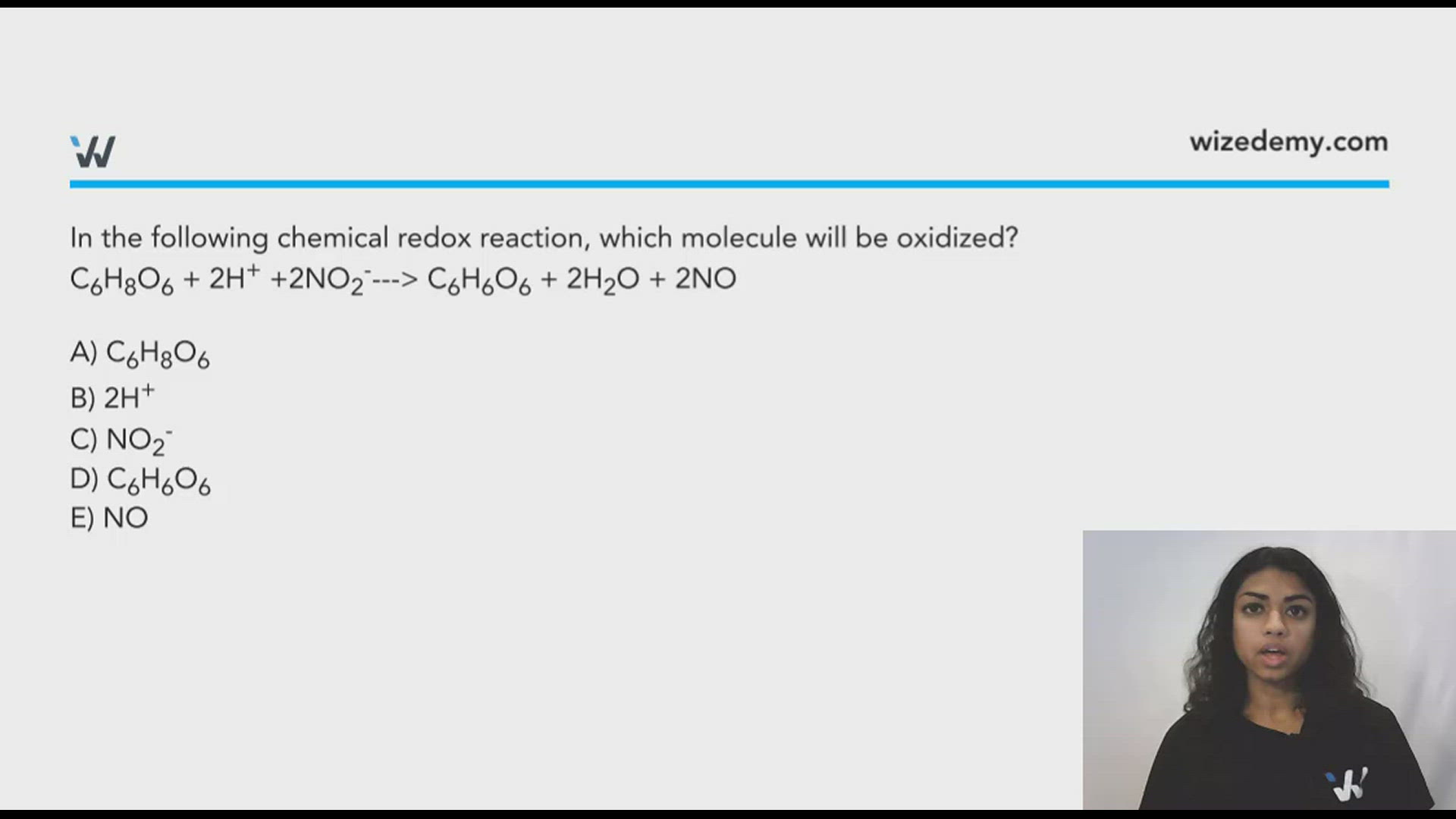
In the following chemical redox reaction, which molecule will be oxidized?
C6H8O6 + 2H+ +2NO2----> C6H6O6 + 2H2O + 2NO
A) C6H8O6
B) 2H+
C) NO2-
D) C6H6O6
E) NO
The correct answer is A)
C6H8O6 will become C6H6O2, which means that it has given up two hydrogen atoms. This means it has given up (lost) electrons (because hydrogen atoms have a -1 charge since they have one electron) so it has been oxidized.
(Remember Oxidation Is Loss of electrons)
NO2- on the other hand, will be reduced. It will accept electrons to form NO, which has double bond with oxygen, as opposed to NO2- which has a resonance structure with 2 stable bonds and one resonant bond.