Wize University Biology Textbook > DNA Replication & Repair
Meselson-Stahl Experiment
Popular Courses
MCAT
General Course
BIOLOGY 1001A
Western University
Biology
General Course
General Biology
University Study Guides
Grade 12 Biology
Canada High School
DAT
General Course
High School Biology
US High School
BIOL 200
McGill University
BIOL*1090
University of Guelph
General Biology
University Study Guides
BIOL 130
University of Waterloo
SC/BIOL 1000 3.00
York University
BIOL 111
McGill University
BIO 1141
University of Ottawa
BLG 143
Toronto Metropolitan University
BIOLOGY 2581A/B
Western University
BIOL 112
McGill University
BIOL 1010
Dalhousie University
BIOL-1101
University of Windsor
BIOL 1201
Western University

0:00 / 0:00
The Meselson-Stahl Experiment
In 1953, there were 3 theories as to how DNA might replicate:
- Conservative: The entire DNA molecule is copied making a second, completely new DNA molecule.
- Semi-conservative: The two strands of DNA separate, with each strand acting as a template to copy a new strand.
- Dispersive: The DNA was cleaved into small fragments, the fragments were copied and then re-attached.
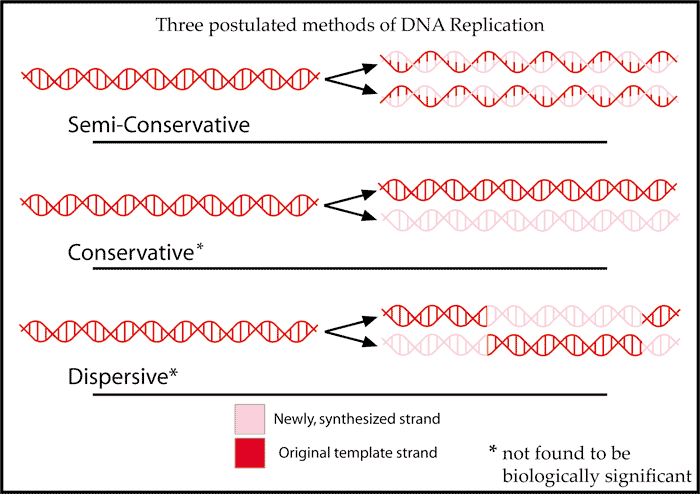
Matthew Meselson and Franklin Stahl designed an experiment in Escherichia Coli (E. coli) bacteria to determine which of the 3 was happening in cells. The procedure was as follows:
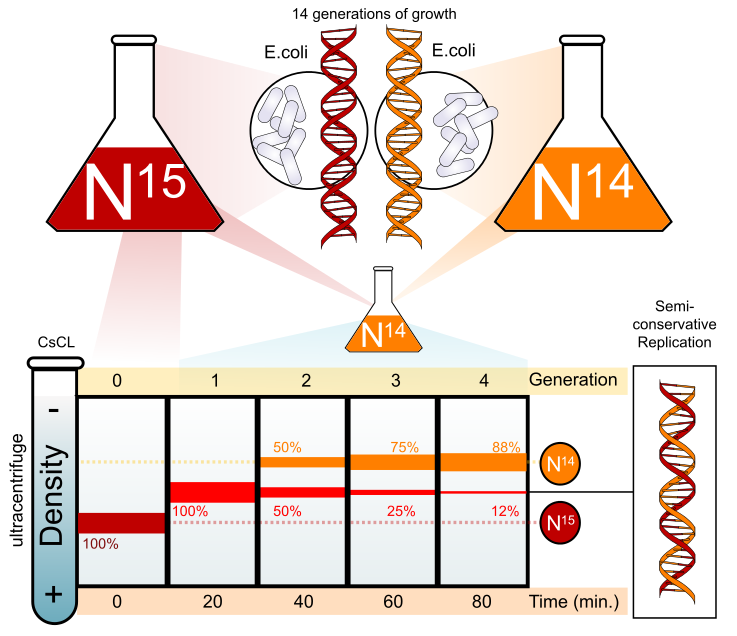
- Grow E. coli in "heavy" nitrogen (15N) so that all the DNA in the bacterial was labelled with 15N.
- When DNA was extracted and centrifuged (separated by weight), all DNA= "heavy."
- Transfer cells to "light" nitrogen (14N) and let DNA replicate once.
- When DNA was extracted and centrifuged, all DNA= 50% "heavy"/ 50% "light."
- This rules out the conservative theory which predicted that template DNA molecule would be all "heavy" and the new DNA would be all "light."
- Let DNA replicate in "light" nitrogen (14N) one more time.
- When DNA was centrifuged, DNA was either 50% "heavy"/ 50% "light" OR all "light."
- This rules out the dispersive theory which predicts that all the DNA would continue to be 50% "heavy"/ 50% "light."
Wize Concept
The Meselson-Stahl Experiment showed that DNA replicated using the semi-conservative mechanism.
0:00 / 0:00
Example: Applying the Meselson-Stahl Experiment
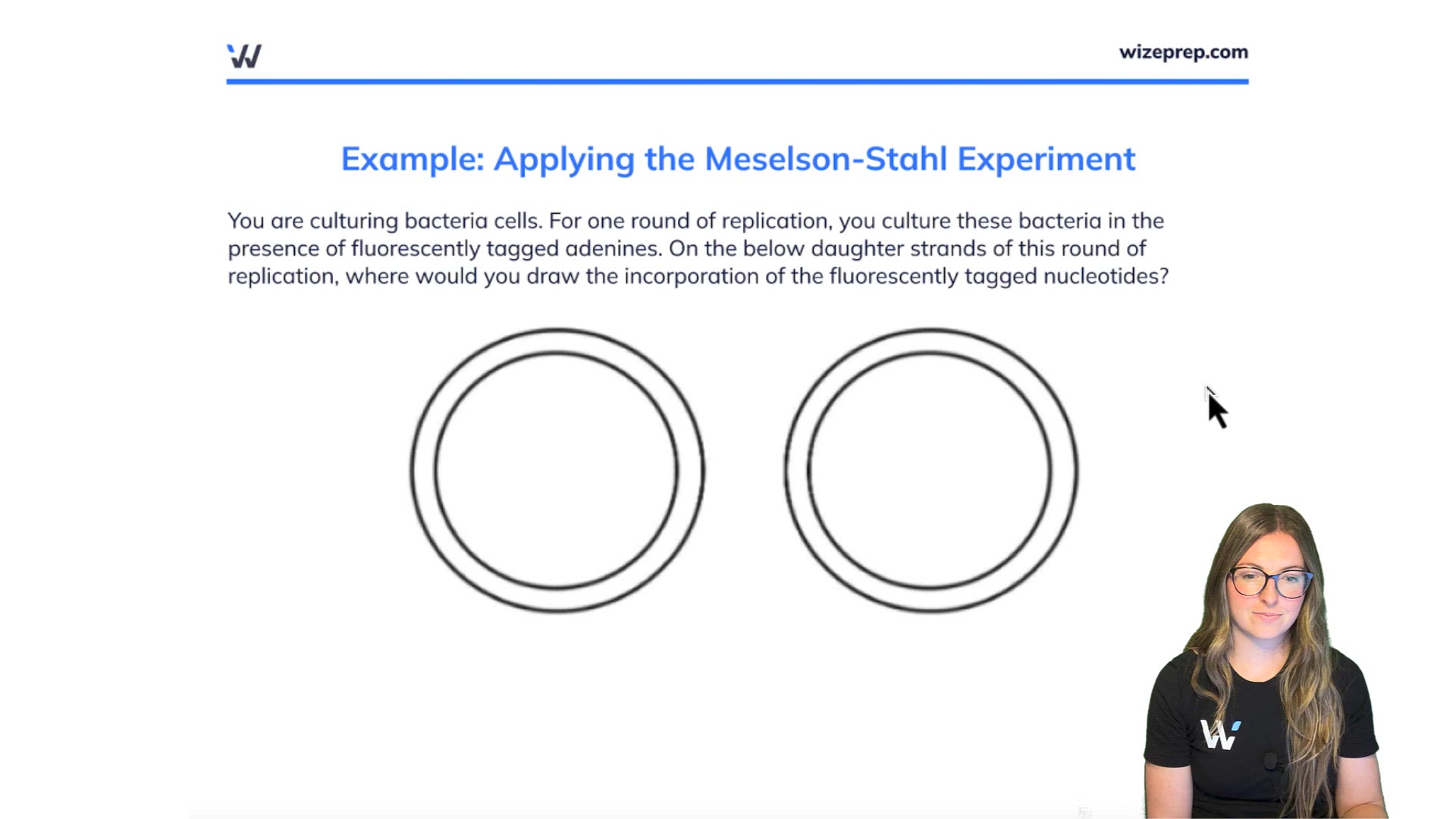
You are culturing bacteria cells. For one round of replication, you culture these bacteria in the presence of fluorescently tagged adenines. On the below daughter strands of this round of replication, where would you draw the incorporation of the fluorescently tagged nucleotides?

Practice: Meselson-Stahl Experiment
Which of the following statements is true regarding the Meselson-Stahl experiment?