Wize University Biology Textbook > DNA Replication & Repair
In vivo DNA Replication
Popular Courses
MCAT
General Course
BIOLOGY 1001A
Western University
Biology
General Course
General Biology
University Study Guides
BIOL 107
University of Alberta
BIOL 102
Queen's University
BIOL 112
University of British Columbia
Grade 12 Biology
Canada High School
DAT
General Course
High School Biology
US High School
BIOL 200
McGill University
BIOL*1090
University of Guelph
General Biology
University Study Guides
BIOL 130
University of Waterloo
SC/BIOL 1000 3.00
York University
BIOL 111
McGill University
BIO 1141
University of Ottawa
BLG 143
Toronto Metropolitan University
BIOLOGY 2581A/B
Western University
BIOL 112
McGill University

0:00 / 0:00
DNA Replication in Cells
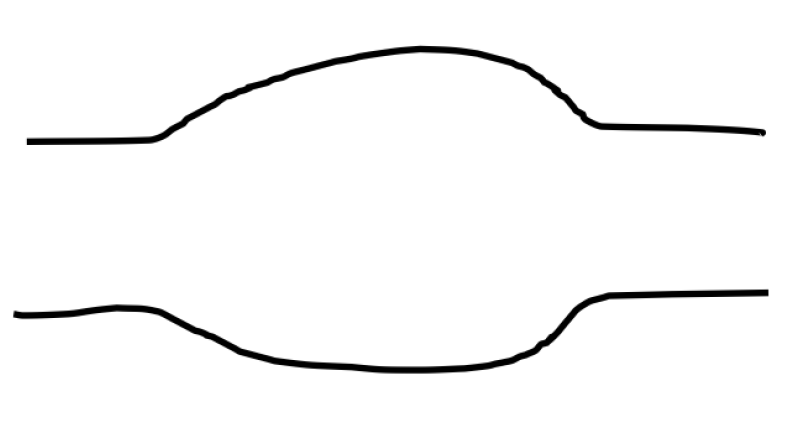
Because DNA within eukaryotic cells is very large, the two strands are not completely separated prior to replication. Instead, replication begins at specific locations designated origins of replication.
- The replication bubbles extend out and eventually the multiple new strands of DNA meet one another and come together to form a brand new strand.
- Prokaryotic chromosomes have one origin of replication and eukaryotic chromosomes have multiple.
- DNA replication is semi-conservative: the newly double stranded DNA contains one strand from the original DNA and one newly synthesized strand.

- The origin of replication in prokaryotes has a special name and is called Ori.
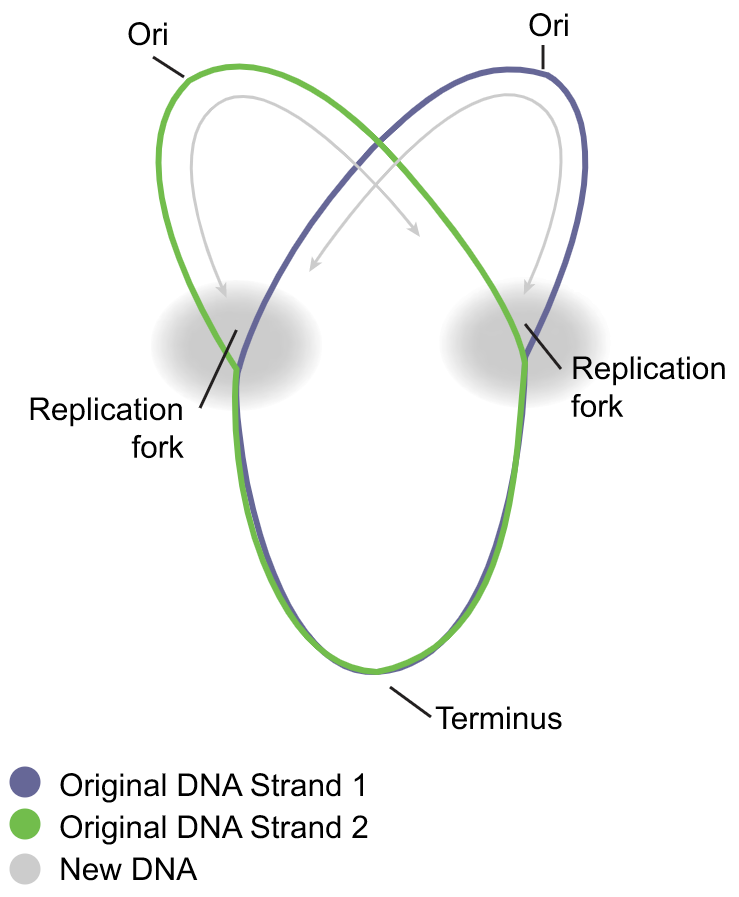
Synthesis of New DNA: Prokaryotic Cells Example
- At the origin of replication, the enzyme helicase begins to unwind the DNA, leaving two anti-parallel strands and creating a replication fork. There are single stranded binding proteins (ssb) that keep the strands apart.
- Topoisomerase is responsible for "relaxing" the supercoiling of DNA.
- The enzyme responsible for grabbing new nucleotides and matching them to the original DNA to create a new strand is DNA polymerase III.
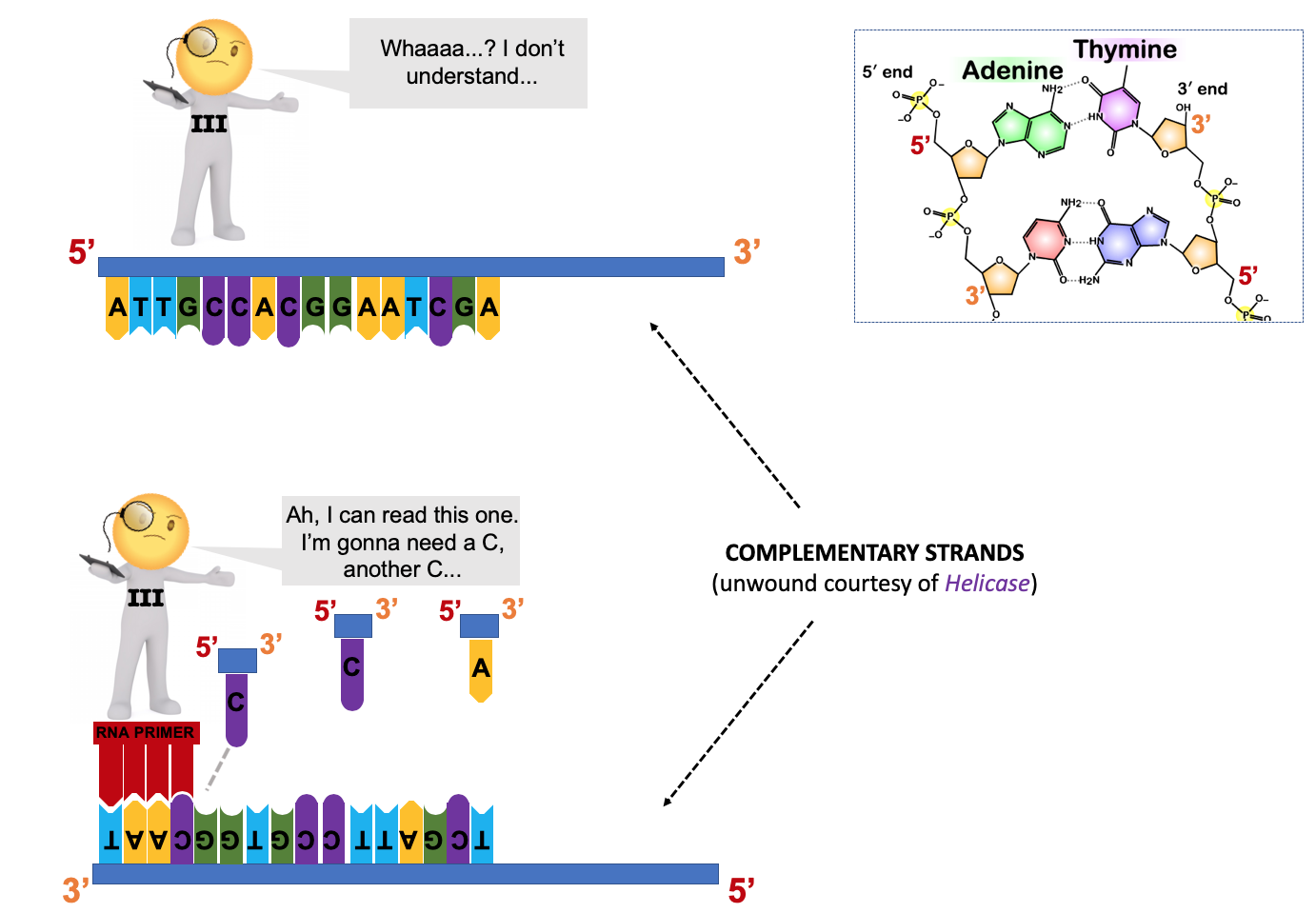
- It can only bind to the parental DNA and start creating a new strand if there is an RNA primer (short RNA sequence) bound to the original strand. This primer is created by an enzyme called primase.
- It can only read DNA in the 3' to 5' direction and creates a new strand in the 5' → 3' direction)
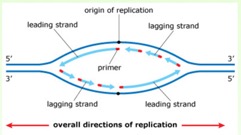
- However, DNA goes both ways (3' to 5' is matched with 5' to 3'); therefore, for one strand the polymerase will move towards the replication fork (leading strand), and for the other strand the polymerase will be moving away from the replication fork (lagging strand).
- Sliding clamp protein tethers DNA polymerase to the strand and replication continues until the adjacent replication bubble is met.
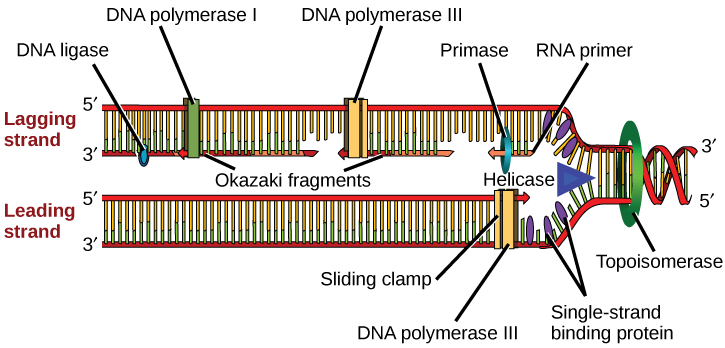
- Leading strand: As the helicase unwinds the DNA at the replication fork, the DNA polymerase III for the leading strand will continue adding more nucleotides to the newly forming strand.
- Lagging strand: The newly exposed parental DNA at the replication fork will require a new primer and DNA polymerase III in order for that region to be replicated. The lagging strand, thus, has multiple primers and polymerases that are added as the DNA unwinds, creating Okazaki Fragments.
- DNA polymerase I removes the primer and replaces it with deoxyribonucleotides and a DNA Ligase moves along the lagging strand and ties the Okazaki fragments together.
Watch Out!
The process of DNA replication is understood super well in prokaryotes, which is why it is typically taught in detail. This process in eukaryotes is very similar, the main difference is that some enzymes are called different names. See the chart below for the comparisons.


0:00 / 0:00
Example: Leading and Lagging Strands
Label the following diagram and include the DNA strand directionalities.

Practice: DNA Replication
On the leading strand of the replication fork, new DNA synthesis occurs:
Practice: Okazaki Fragments
Okazaki fragments are:
0:00 / 0:00
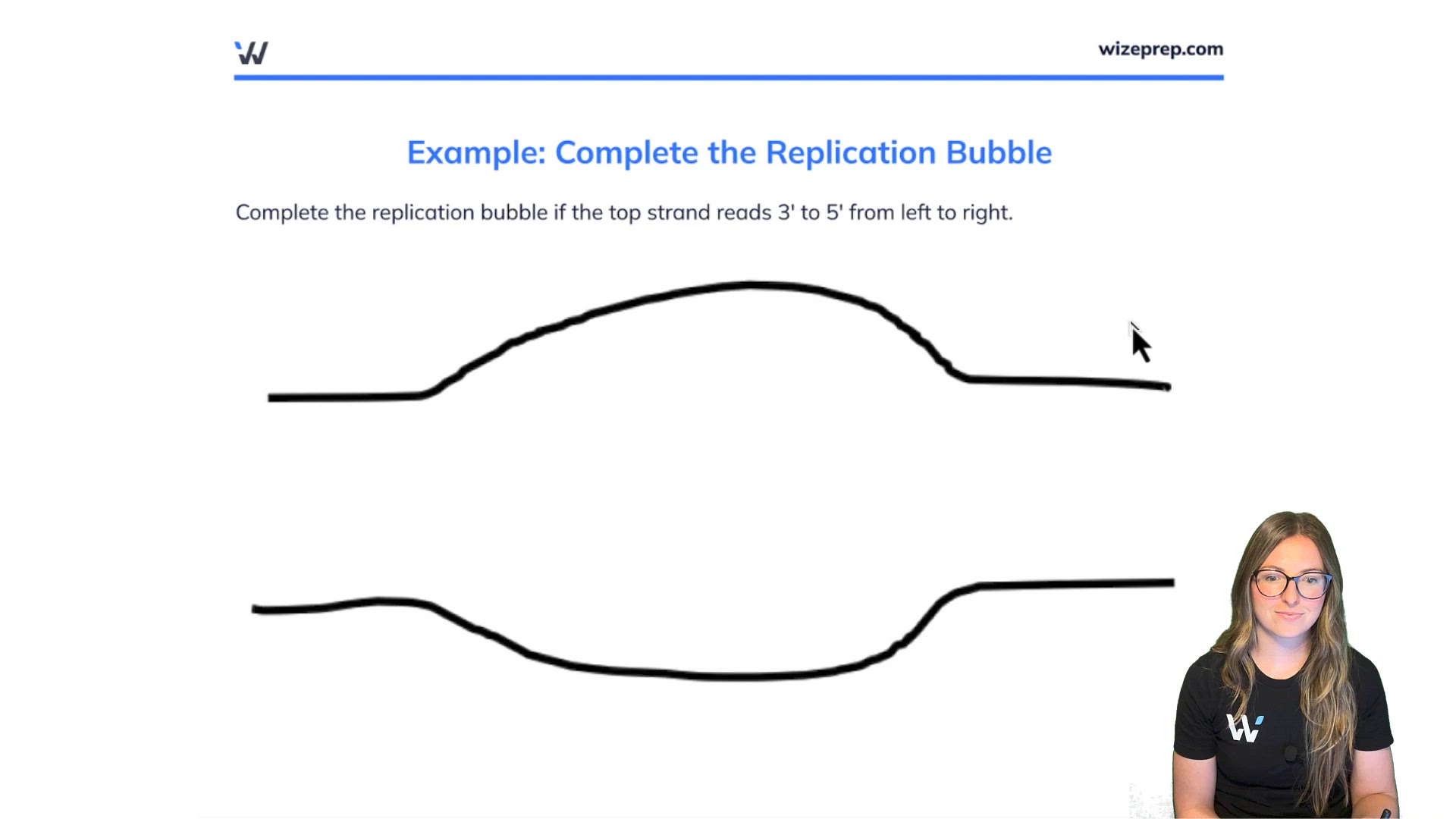
Example: Complete the Replication Bubble
Complete the replication bubble if the top strand reads 3' to 5' from left to right.