Wize University Biology Textbook > Gene Expression & Regulation
Eukaryotic Translational/Post-Translational Regulation
Popular Courses
MCAT
General Course
Biology
General Course
General Biology
University Study Guides
BIOLOGY 1002B
Western University
DAT
General Course
Grade 12 Biology
Canada High School
BIOL 200
McGill University
General Biology
University Study Guides
BIOL 130
University of Waterloo
SC/BIOL 1000 3.00
York University
BIOL 311
University of Calgary
BLG 143
Toronto Metropolitan University
BIOLOGY 2581A/B
Western University
BIOL 112
McGill University
BIO230H1
University of Toronto
BIOL 1201
Western University
BIOL 1P91
Brock University
BS 161
Michigan State University
BIOL 1020
University of Manitoba
BIOL 331
University of Calgary
0:00 / 0:00
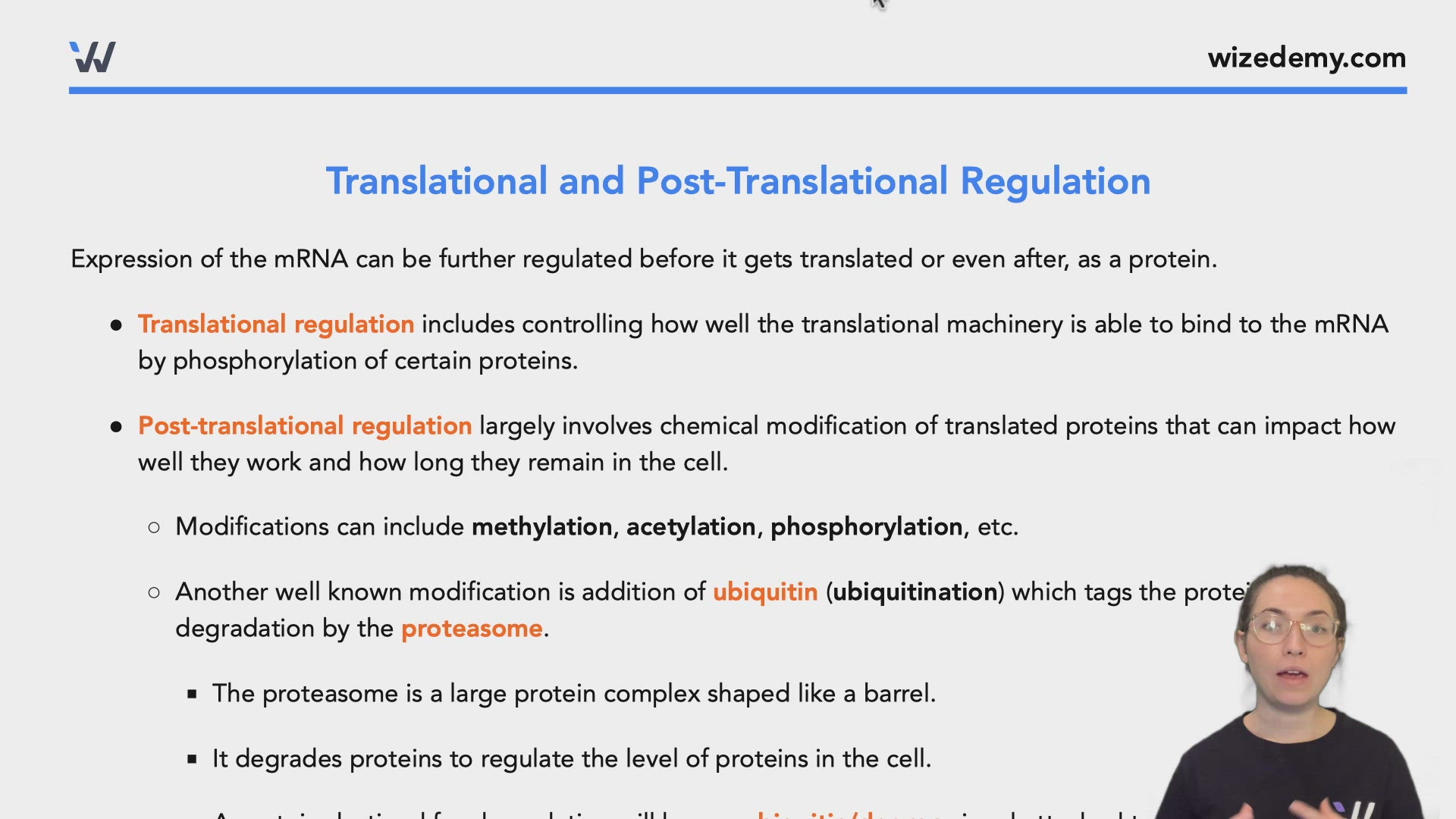
Translational and Post-Translational Regulation
Expression of the mRNA can be further regulated before it gets translated or even after, as a protein.
- Translational regulation includes controlling how well the translational machinery is able to bind to the mRNA by phosphorylation of certain proteins.
- Post-translational regulation largely involves chemical modification of translated proteins that can impact how well they work and how long they remain in the cell.
- Modifications can include methylation, acetylation, phosphorylation, etc.
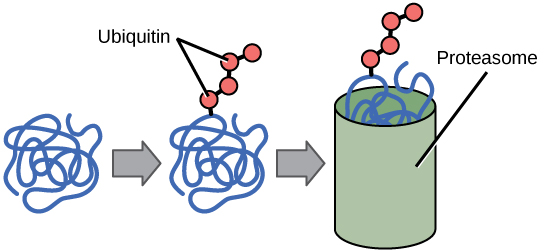
- Another well known modification is addition of ubiquitin (ubiquitination) which tags the protein for degradation by the proteasome.
- The proteasome is a large protein complex shaped like a barrel.
- It degrades proteins to regulate the level of proteins in the cell.
- A protein destined for degradation will have a ubiquitin/degron signal attached to it.
- Recognin is a chaperone that recognizes the degron signal and brings the protein to the proteasome to be broken down and recycled.
Practice: Addition of Ubiquitin
Addition of ubiquitin...
i - Often tags a proteins for degradation
ii - Often tags RNA for degradation
iii - Signals to the proteasome to act on the molecule
iv - Stabilizes the molecule