Popular Courses
MCAT
General Course
Biology
General Course
General Biology
University Study Guides
BIOL 102
Queen's University
DAT
General Course
High School Biology
US High School
BIOL 121
University of British Columbia
BIOL*1090
University of Guelph
General Biology
University Study Guides
SC/BIOL 1000 3.00
York University
BIOL 311
University of Calgary
BIOLOGY 2581A/B
Western University
HMB265H1
University of Toronto
BIOL-1101
University of Windsor
BIOL 1201
Western University
BIOL 1P91
Brock University
BIOL 1020
University of Manitoba
BIOL 331
University of Calgary
BIOA01H3
University of Toronto
BIOLOGY 2C03
McMaster University

0:00 / 0:00
Genetic Linkage
When genes are located on different chromosomes or far apart on the same chromosome they follow the law of independent assortment and are said to be unlinked. However, when genes are located close together on the same chromosome, they don't follow the law of independent assortment and are said to be linked.
Genes Located on Different Chromosomes: Unlinked
Genes located on different chromosomes sort independently due to the random lining up of homologous chromosomes during metaphase I.
Example: chromosome #1 may line up with the maternal chromosome on the left and the paternal chromosome on the right, while chromosome #2 may line up with the maternal one on the right and the paternal one on the left. This leads to random assortment of the homologous chromosomes during meiosis I.

Genes Located Far Apart on the Same Chromosome: Unlinked
Genes located on the same chromosome but far apart also follow the law of independent assortment because of crossing over during prophase I.

Possible Gametes:
Ab, AB, ab, aB
Genes Located Close Together on the Same Chromosome: Linked
Crossing over occurs randomly along the homologous chromosomes. When genes are located very close together, the chance of recombination occurring between them is low. Therefore, genes that are close together tend to stick together during gamete formation.
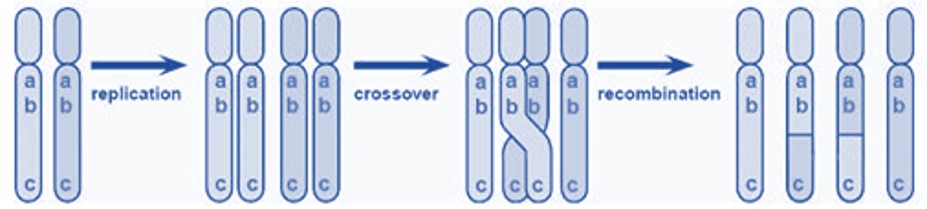
Possible Gametes: (let's say the chromosome on the left is 1 and the other is 2)
a1b1c1, a1b1c2, a2b2c1, a2b2c2

0:00 / 0:00
Calculating Recombination Frequencies
Recombination frequencies can be used to determine how close together two genes are on the same chromosome.
To do this, a cross is done using a fly that is heterozygous for both genes of interest and a fly that is homozygous recessive for both genes of interest. The heterozygous individual will therefore completely determine the phenotype of the offspring.

Because the four types of offspring are not produced in equal numbers, we know these genes are linked. To calculate the recombination frequency:
Recombination Frequency (RF) = (Recombinants / Total offspring) x 100%
In the above example:
RF = (206 + 185) / (944 + 965 + 206 + 185) x 100% = 17%
Linkage Maps
We can use the recombination frequency to determine how close together genes are located on a chromosome, allowing us to create a linkage map. Linkage maps determine the relative distance and order of genes on a chromosome.
For example, lets say we have three genes: A, C, and F and we calculate the following recombination frequencies:
RF (A - C) = 12%
RF (A - F) = 26%
RF (C - F) = 14%
Note that one % is equal to one centimorgan (cM).

Practice: Recombination Frequency Calculation
A fly which has the genotype AaBb is cross with a fly that is homozygous recessive. The following offspring are obtained:
AaBb: 953
aabb: 910
Aabb: 200
aaBb: 192
a) Are these genes linked?
b) What is the recombination frequency? (one decimal place)
Practice: Gene Order
Genes A, B, C, and D are located on the same chromosome. The distances between the genes are below:
D-A = 11
D-B = 7
D-C = 22
B-C = 15
A-B = 4
Which of the following represent the order of those genes on the chromosome?
Practice: Gene Distance
AABB and aabb individuals were crossed to each other, and the F1 generation was backcrossed to the aabb parent. The results were 775 AaBb, 715 aabb, 4 Aabb, and 6 aaBb offspring. How far apart are the A and B loci?
Practice: Gene Location
You are investigating three genes in different species of a tropical plant (genes A, B, and C). When testcrossing a certain species of the plants, you always get a 1:1 ration of parental and recombinant types for the A and B, and the A and C genes. You also get a ratio of 3:1 of parental and recombinant types for the B and C genes. What best explains this phenomena?