Wize University Biology Textbook > Modern Concepts of Inheritance
Duplications, Deletions and Chromosomal Inversions
Popular Courses
MCAT
General Course
BIOLOGY 1001A
Western University
Biology
General Course
General Biology
University Study Guides
BIOL 102
Queen's University
DAT
General Course
High School Biology
US High School
BIOL 200
McGill University
BIOL 121
University of British Columbia
BIOL*1090
University of Guelph
General Biology
University Study Guides
SC/BIOL 1000 3.00
York University
BIOL 311
University of Calgary
BIOLOGY 2581A/B
Western University
HMB265H1
University of Toronto
BIOL 1010
Dalhousie University
BIOL-1101
University of Windsor
BIOL 1201
Western University
MBG*2040
University of Guelph
BIOL 1P91
Brock University

0:00 / 0:00
Duplications, Deletions and Inversions
Gene duplication leads to the production of new genetic information over time and involves the duplication of a region of DNA containing one or more genes.
- Gene duplication can result from unequal crossing-over during meiosis.
- The resulting cell now has two copies of the same gene, which means one can mutate and change function while the other retains the original function.
- Gene deletions occur when an entire gene is deleted from a chromosome.

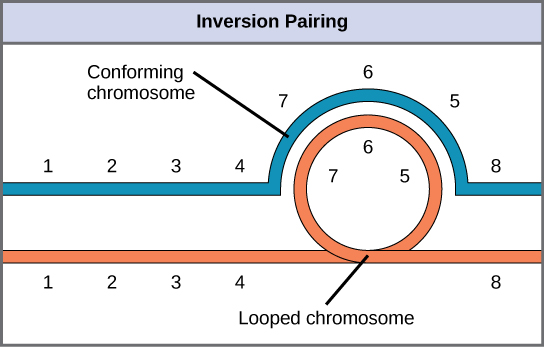
Chromosome inversions occur when a segment of DNA is cut out of the chromosome and then repair mechanisms reattach it. Sometimes, the repair mechanisms reattach it backwards, and this leads to inversion.
- Due to the inversion, this chromosome will no longer undergo normal crossing over at the inverted area during meiosis because the inverted portion will not match up with its homologous chromosome.
- This can result in the genes within the inverted region always being inherited as a group.
- However, there may also be an additional mechanism to allow for pairing: the chromosome with the inversion can create a loop in order to properly pair up with its homologous chromosome during recombination.
Practice: Duplication
When can duplication of a gene occur?