Wize University Biology Textbook > Lab Techniques for Biology
Whole Genome Sequencing
Popular Courses
MCAT
General Course
AP Biology Exam Prep Course
AP Exam Prep
Biology
General Course
General Biology
University Study Guides
BIOLOGY 1002B
Western University
BIOL 102
Queen's University
Grade 12 Biology
Canada High School
DAT
General Course
High School Biology
US High School
BIOL 200
McGill University
General Biology
University Study Guides
SC/BIOL 1000 3.00
York University
BIOL 311
University of Calgary
BIOL 112
McGill University
HMB265H1
University of Toronto
BIOL 1010
Dalhousie University
BIOL-1101
University of Windsor
BIO230H1
University of Toronto
BIOL 1201
Western University
BIOL 202
McGill University
0:00 / 0:00
DNA Sequencing
So you want to sequence a genome… where do you start?
- Purification – isolating DNA from an organism or cells.
- Fragmentation – breaking up the genome into smaller fragments to be sequenced.
- Amplification – make more copies of our fragments.
- Sequence fragments – assigning nucleotide bases to our fragments.
- Re-assembly of fragments – put all the sequence fragments back together to create a continuous sequence.
Types of Sequencing
- Sanger Sequencing
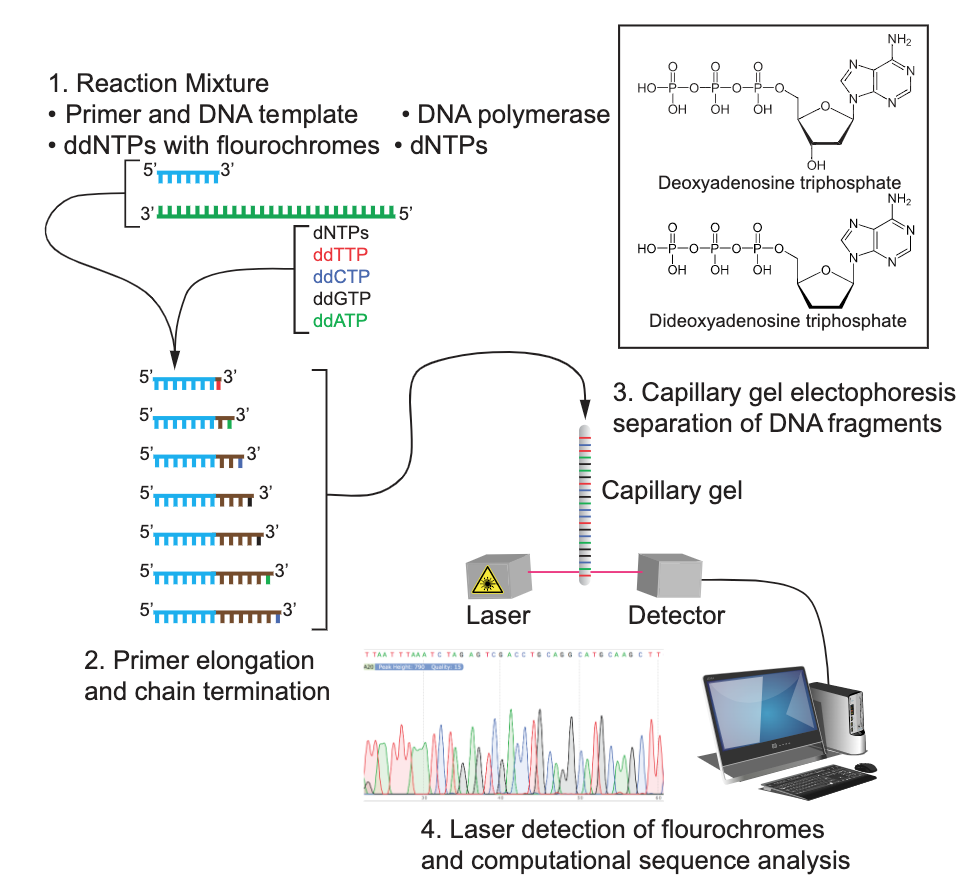
- Also known as the dideoxy method = dideoxynucleotides have an H on the 3’ carbon of the sugar-phosphate backbone instead of OH attached to a fluorescent tag.
- How it works:
- Amplified fragments are replicated again in the presence of the ddNTPs.
- Replication enzyme uses normal nucleotide bases and then randomly inserts a ddNTP that stops replication.
- Fluorescently labeled sequencing fragments are run through electrophoresis to separate them by size.
- The fluorescent tags are all different colors for their respective nucleotide base, need to subject gel to fluorescent filter.
- Order of sequence = shortest to longest (fragment that travelled most to fragment that travelled least).
- Most useful in sequencing single genes.
- Whole Genome Shotgun Sequencing
- Useful in sequencing the entire genome.
- How it works:
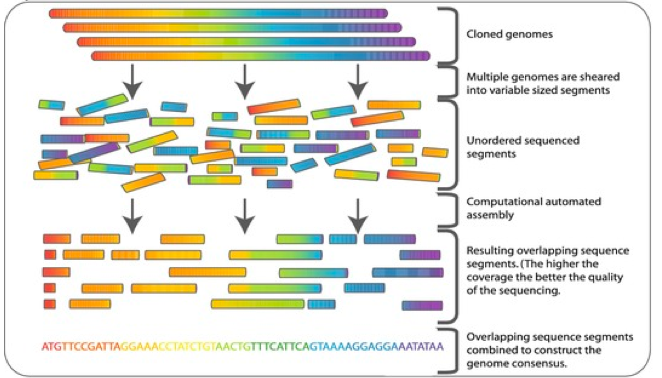
- Isolate genome DNA and break up into overlapping fragments.
- Do this by using 2 DNA samples that have been digested by 2 different restriction enzymes.
- Clone each fragment into a plasmid vector.
- Sequence the genomic DNA fragment in each clone.
- Use computer programs to re-align sequences based on areas of overlapping.
- Next Generation Sequencing
Allows one sequencing instrument to carry out billions of sequencing reactions at the same time.
- Useful for multiple gene sequencing of whole genome sequencing.
- How it works:
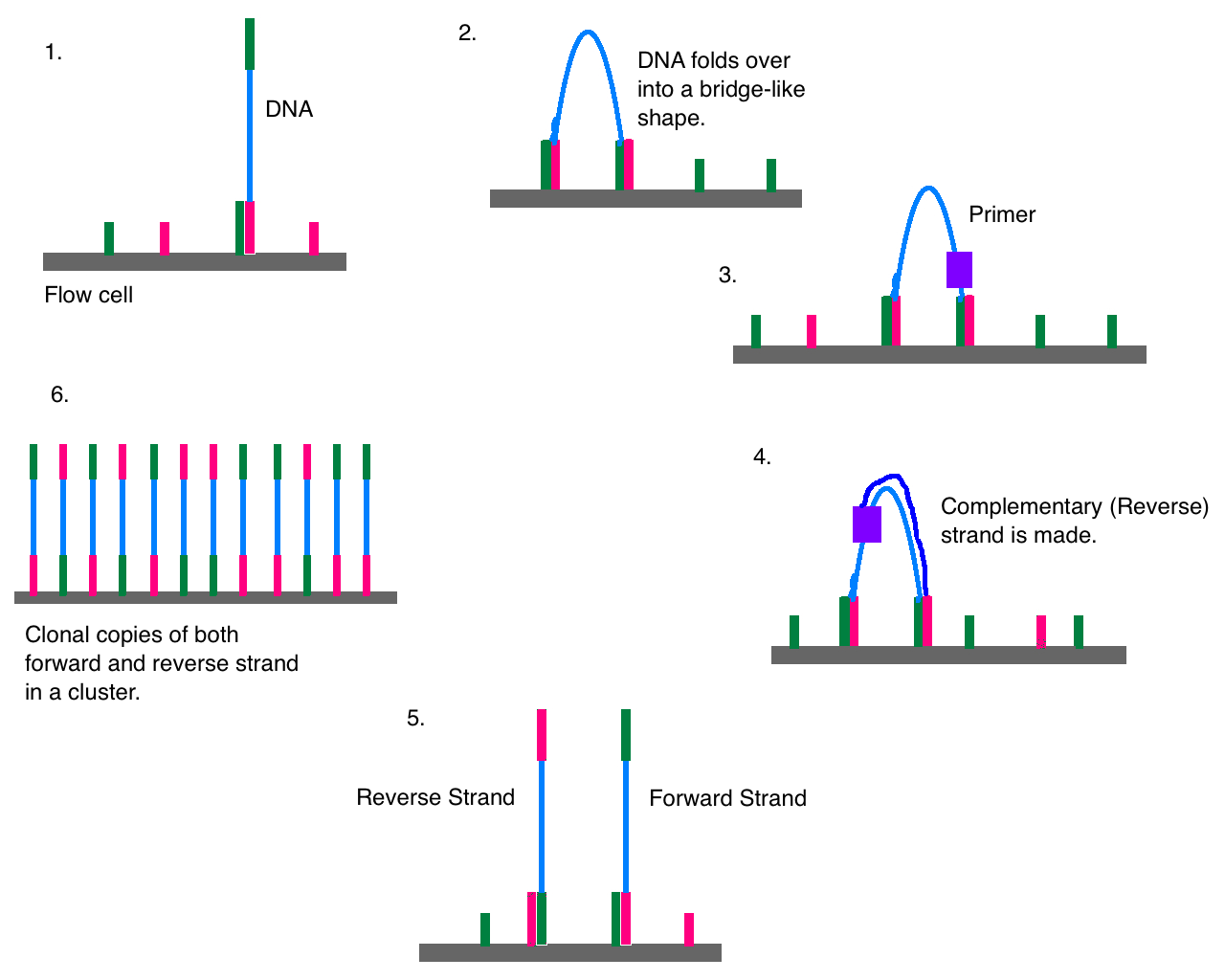
- DNA fragments prepared by adding double stranded linkers to both ends of the fragment.
- Fragments are amplified using PCR primers that are complementary to linkers.
- Primers are then used to covalently bond the DNA fragments to a solid surface in a tight cluster.
- The fragments are analyzed using a special microscope that detects which fluorescent labeled base is added to the DNA template by polymerase.