Wize University Biology Textbook > Lab Techniques for Biology
Protein Purification
Popular Courses
MCAT
General Course
Biology
General Course
General Biology
University Study Guides
DAT
General Course
Grade 12 Biology
Canada High School
High School Biology
US High School
BIOL 200
McGill University
General Biology
University Study Guides
BIOL 112
McGill University
BIO230H1
University of Toronto
BIOL 1201
Western University
BIOL 202
McGill University
BIOL 1P91
Brock University
BIOL 1020
University of Manitoba
BIOL 331
University of Calgary
BIOA01H3
University of Toronto
BISC 102
Simon Fraser University
BI110
Wilfrid Laurier University
BIO220H1
University of Toronto
BIOL 201
University of Alberta
0:00 / 0:00
Protein Purification Techniques
Wize Tip
Proteins can be separated from one another (purified) based on THREE main characteristics: size, electrical charge, and ligand affinity
Centrifugation: Size Separation
Proteins vary in MASS but not much in DENSITY.
- Differential Centrifugation - First step in most protein purification because it is used to separate soluble proteins from cell organelles. The organelles (heavy) form a pellet at the bottom, and the less dense soluble proteins can be collected from the supernatant.
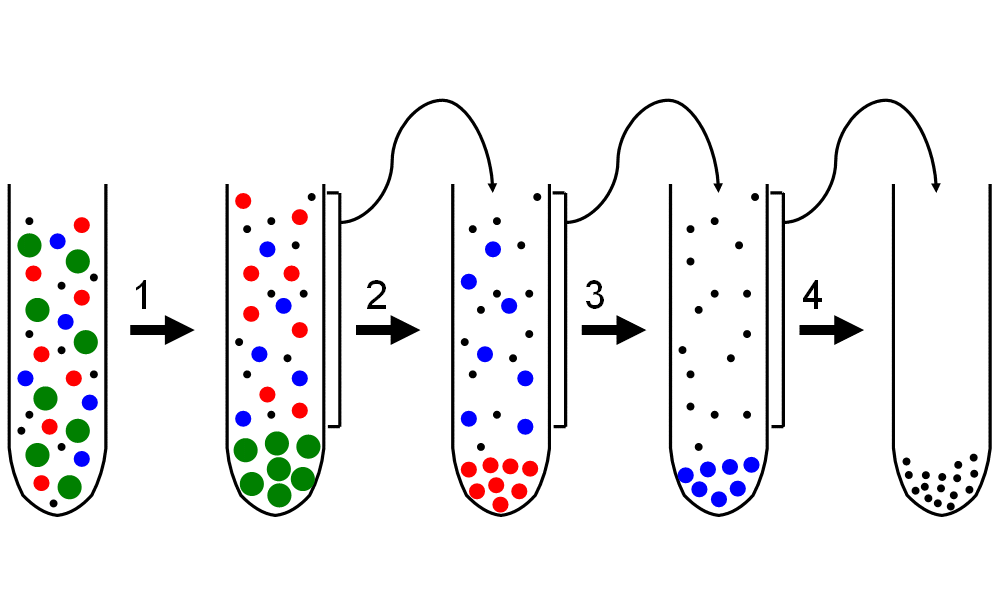
- Rate-Zonal Centrifugation - Proteins are separated through a density gradient (usually a sucrose gradient) and form discrete "zones/fractions" which can be isolated.
- Note: Rate-zonal centrifugation is good for separating proteins from one another but not reliable for determining the mass of these proteins.

0:00 / 0:00
Liquid Chromatography: Size, Electric Charge, and Affinity Separation
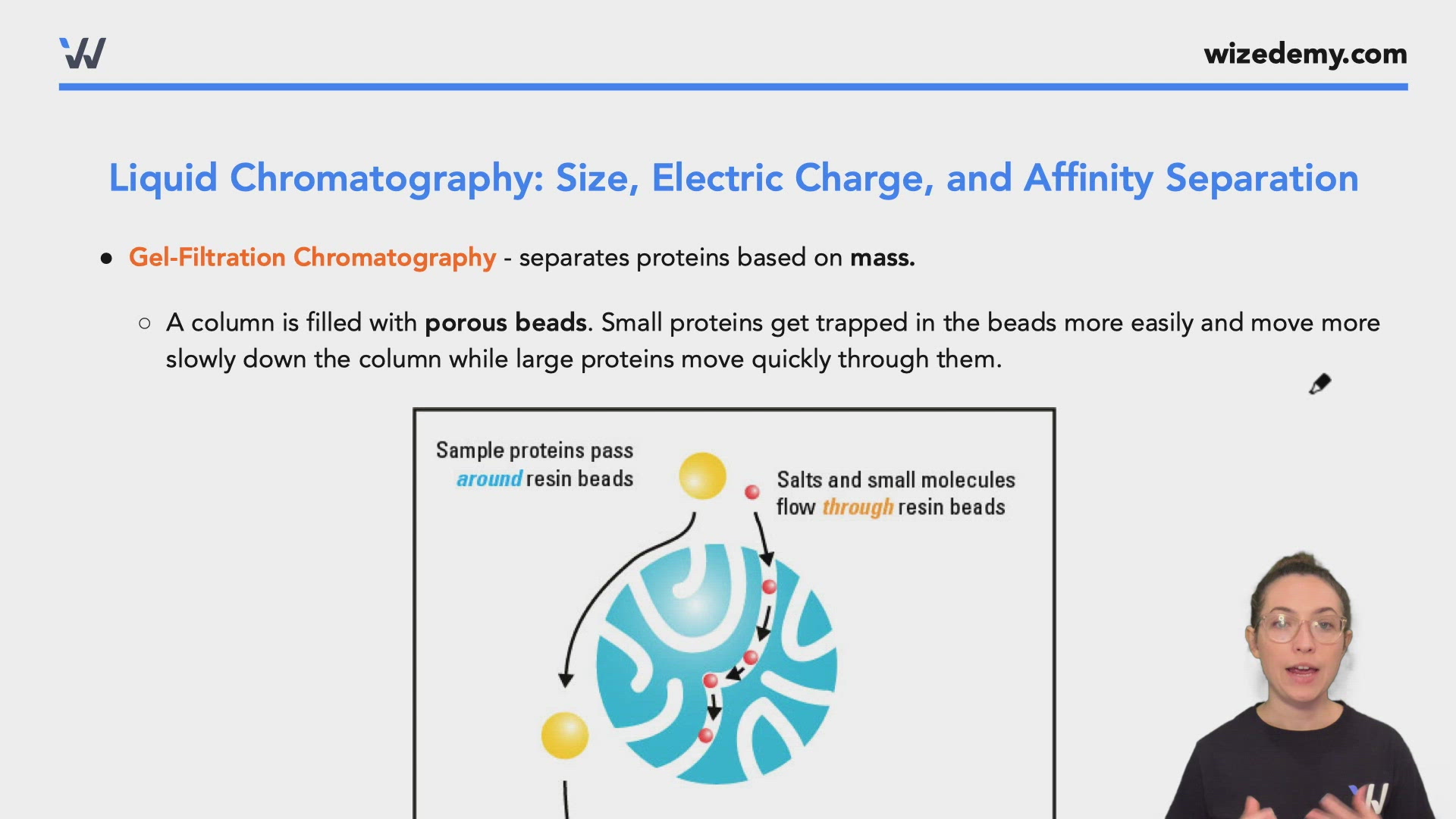
- Gel-Filtration Chromatography - separates proteins based on mass.
- A column is filled with porous beads. Small proteins get trapped in the beads more easily and move more slowly down the column while large proteins move quickly through them.

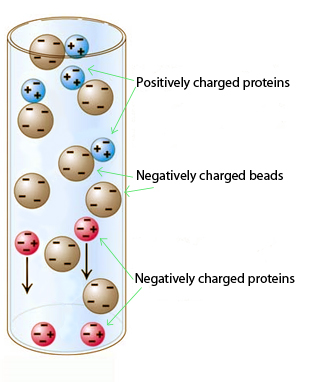
- Ion-Exchange Chromatography - separates proteins based on charge.
- A column is filled with charged beads (either negatively (anion) or positively charged (cation)).
- If the beads are positively charged, acidic (negatively charged) proteins will stick to them.
- If the beads are negatively charged, basic (positively charged) proteins will stick to them.
- A highly concentrated salt solution is then used to elute the proteins off of the beads (because the salt ions are more negatively charged than the proteins).
- Proteins with low/neutral charges are eluted first and more highly charged proteins are eluted last.
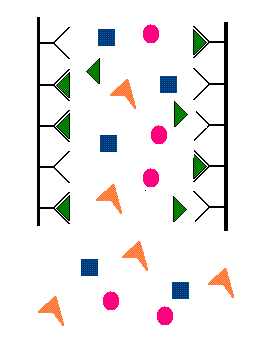
- Affinity Chromatography - separates proteins based on affinity for certain antibodies.
- A column is filled with beads attached to a specific ligand or antibody.
- Only proteins that bind to that specific ligand or antibody will get trapped on the column.
Practice: Protein Purification
You have a mixture of three proteins that have the same net charge but are all different sizes. Which of the following is the best method to separate the proteins for further analysis?