Wize University Biology Textbook > Lab Techniques for Biology
Proteomics and Protein/Protein Interactions
Popular Courses
MCAT
General Course
Biology
General Course
General Biology
University Study Guides
BIOLOGY 1002B
Western University
Grade 12 Biology
Canada High School
High School Biology
US High School
DAT
General Course
BIOL 200
McGill University
General Biology
University Study Guides
BIOLOGY 2581A/B
Western University
BIOL 112
McGill University
BIO230H1
University of Toronto
BIOL 1201
Western University
BIOL 202
McGill University
BIOL 1P91
Brock University
BIOL 331
University of Calgary
BIOL 1020
University of Manitoba
BIOA01H3
University of Toronto
BIOL 1105
Virginia Tech
BISC 102
Simon Fraser University
0:00 / 0:00
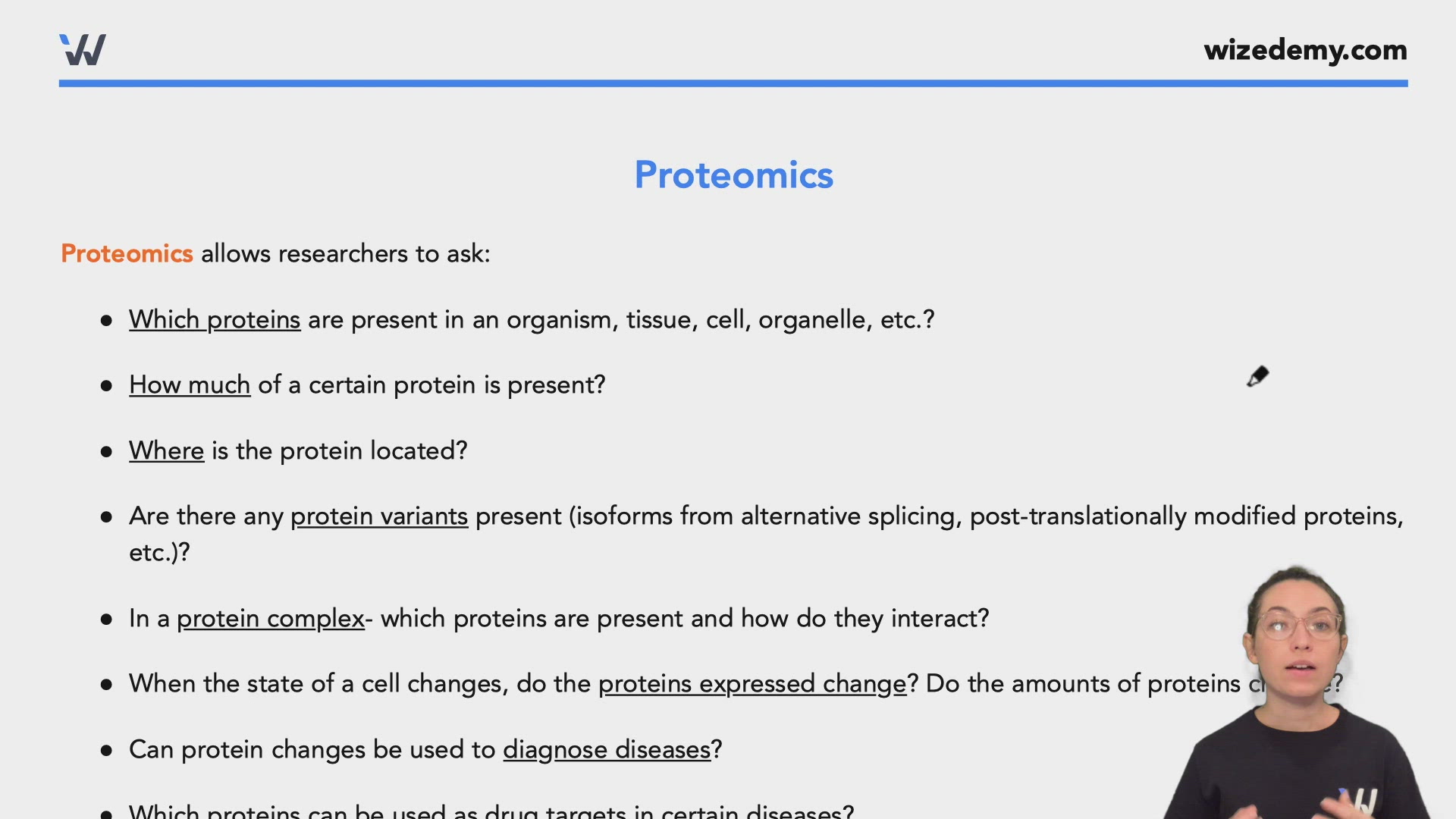
Proteomics
Proteomics allows researchers to ask:
- Which proteins are present in an organism, tissue, cell, organelle, etc.?
- How much of a certain protein is present?
- Where is the protein located?
- Are there any protein variants present (isoforms from alternative splicing, post-translationally modified proteins, etc.)?
- In a protein complex- which proteins are present and how do they interact?
- When the state of a cell changes, do the proteins expressed change? Do the amounts of proteins change?
- Can protein changes be used to diagnose diseases?
- Which proteins can be used as drug targets in certain diseases?
A Breakthrough Technology: High-throughput LC-MS/MS
- A complex mixture of proteins is digested by a protease.
- Liquid chromatography (LC) separates the proteins into less complex fractions.
- The fractions are injected by electrospray ionization into a tandem mass spectrometer.
- Multiple MS/MS cycles until all the proteins' peptide sequences have been determined.
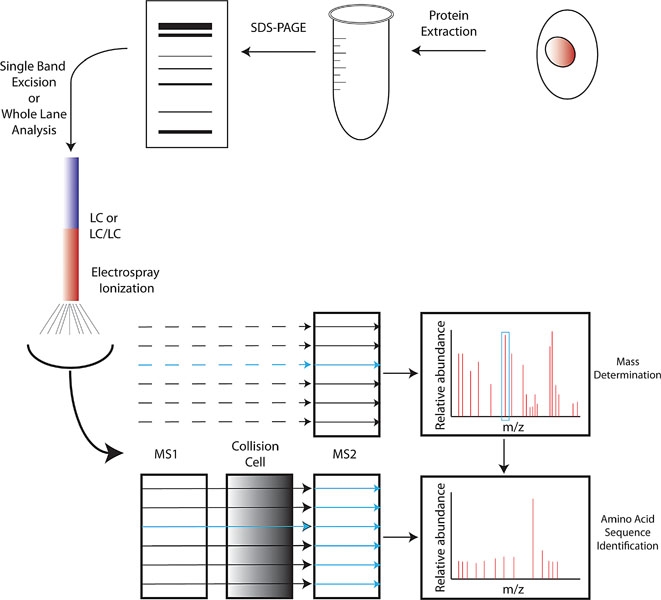
Pros: This method allowed researchers to take a mixture of organelles, break them open to release the proteins, identify the proteins, and figure out which organelle they came from- identified the locations of hundreds of proteins SIMULTANEOUSLY!
Cons: Sensitivity needs to be improved. You need a lot of cells (200,000-700,000 cells) to use LC-MS/MS
Phosphoproteomics
- The identification and quantification of phosphorylation sites on proteins.
- Protein phosphorylation by kinases and dephosphorylation by phosphatases can affect the function/ interactions of the proteins.
Pros: Phosphoproteomics provides insight into how phosphorylation can change protein interactions and function.
Cons: Need a lot more cells (50-100x) more than LC-MS/MS because only a small fraction of the proteins will be phosphorylated. Researchers usually have to use affinity chromatography to separate phosphorylated or dephosphorylated proteins before LC-MS/MS.
0:00 / 0:00
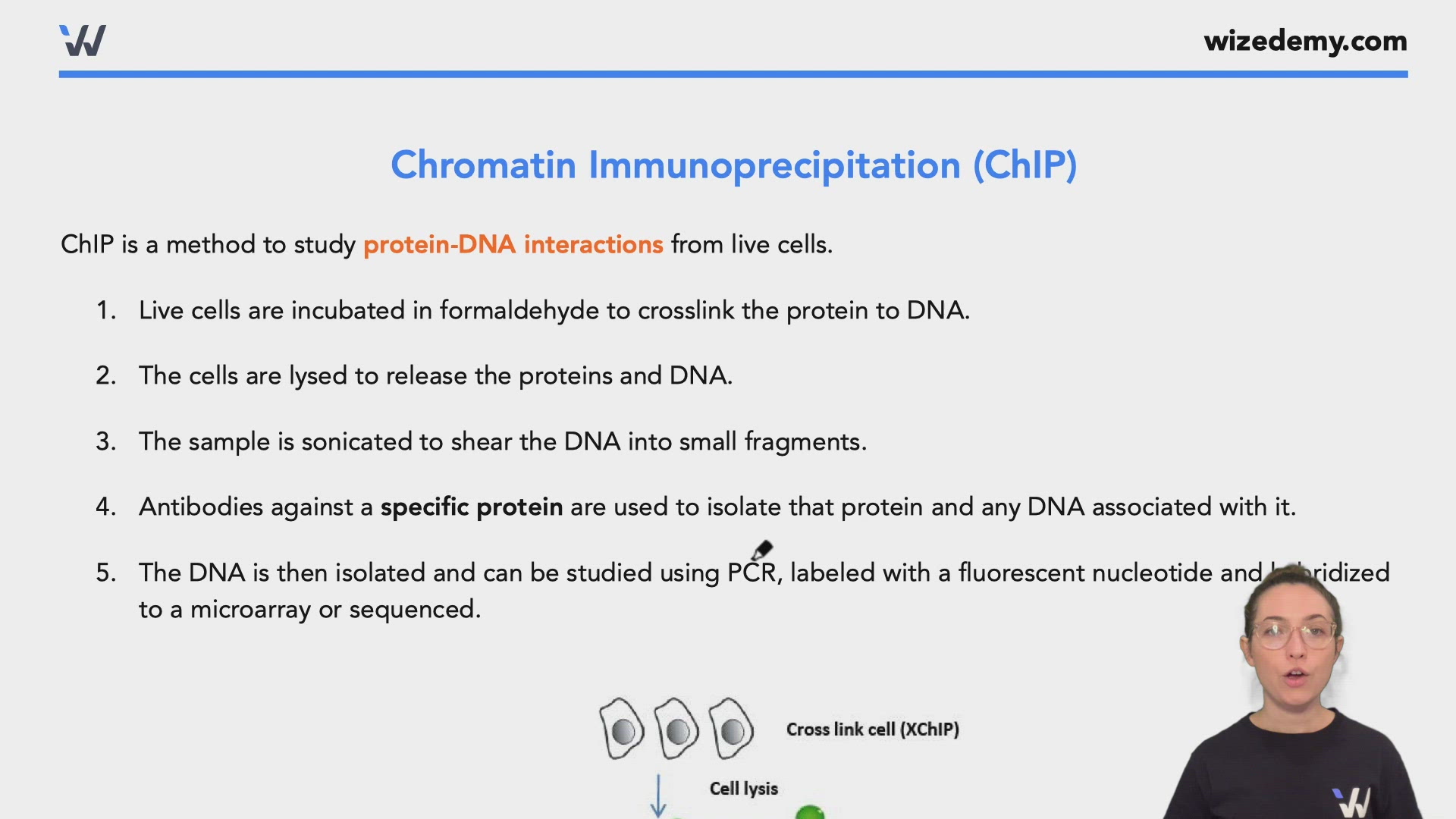
Chromatin Immunoprecipitation (ChIP)
ChIP is a method to study protein-DNA interactions from live cells.
- Live cells are incubated in formaldehyde to crosslink the protein to DNA.
- The cells are lysed to release the proteins and DNA.
- The sample is sonicated to shear the DNA into small fragments.
- Antibodies against a specific protein are used to isolate that protein and any DNA associated with it.
- The DNA is then isolated and can be studied using PCR, labeled with a fluorescent nucleotide and hybridized to a microarray or sequenced.

Practice: ChIP
How is chromatin immunoprecipitation (ChIP) different from regular immunoprecipitation (IP)?
Practice: Proteomics
You are studying a protein that is only found in a single neuron in the C. elegans nematode. When the protein is phosphorylated, it seems to associate with a bunch of other proteins to form a complex which represses the export of neurotransmitters from the cell. You want to know about the other proteins in the complex so you ask your friend to help you do a proteomics experiment using the LC-MS/MS protocol from his lab. He tells you that this experiment is going to be almost impossible to do. Why?
Practice: ChIP
Your colleague is studying the well characterized NuMa gene. She thinks that it might interact with an unknown protein and asks you whether she should use ChIP to identify it. What do you tell her?