ICE Tables
In equilibrium problems we will have to use something called an ICE table:
I= initial concentration of reactants and products before the reaction
C=change in concentration of reactants and products
E=concentration of reactants and products at equilibrium

0:00 / 0:00
Example: ICE Tables (Solve for Keq)
H2 and I2 are placed in a closed flask such that the concentrations of H2 and I2 are both 0.10 M respectively. The mixture is heated to 400oC and equilibrium is reached. Analysis of the equilibrium mixture finds HI to have a concentration of 0.050 M. Calculate the value of the equilibrium constant,
Kc. H2 (g) + I2 (g) ⇌ 2 HI (g)
Write out an ICE Table:
H2 (g) + I2 (g) ⇌ 2 HI (g)
I 0.10 0.10 0
C -x -x +2x
________________________________
E 0.10-x 0.10-x 2x = 0.050
From [HI] at equilibrium, solve for x:
2x = 0.050
x =
x= 0.025
Solve for [I2] and [H2] at equilibrium using x:
[H2] = 0.10 - x
= 0.10 - 0.025
[H2] = 0.075 M
[I2] = 0.10 - x
= 0.10 - 0.025
[I2] = 0.075 M
Plug equilibrium concentrations into K expression to solve for K:
Kc=0.444
0:00 / 0:00
Example: ICE Tables (Solve for Equilibrium Concentrations)
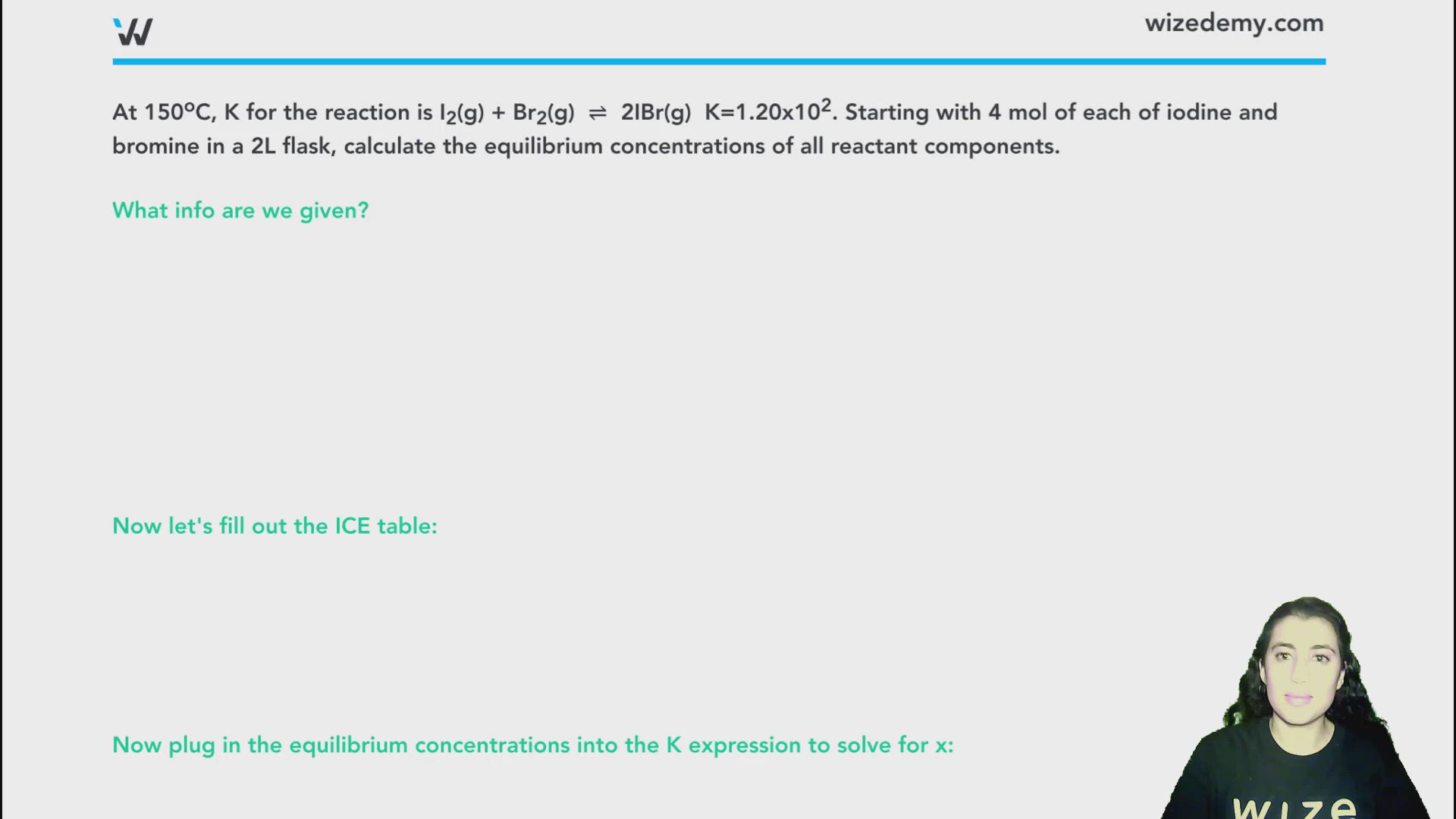
At 150oC, K for the reaction is I2(g) + Br2(g) ⇌ 2IBr(g) K=1.20x10². Starting with 4 mol of each of iodine and bromine in a 2L flask, calculate the equilibrium concentrations of all reactant components.
What info are we given?
We are given clues about the initial concentrations, but we need to solve for it.
We have 2L and 4mol, how do we solve for concentrations?
- Use the equation n=cv
c=n/v
c=4mol/2L
c=2M
Now let's fill out the ICE table:
I 2M 2M 0
C -x -x +2x
E 2-x 2-x 2x
Now plug in the equilibrium concentrations into the K expression to solve for x:
take the square root of both sides
10.954=2x/2-x
10.954(2-x)=2x
21.908 - 10.954x = 2x
21.508=12.954x
1.69=x
Now since we solved for x we can plug that into the equilibrium concentrations from our E part of the ICE table to solve for the equilibrium concentrations
- For I2 and Br2 [ ] at equilibrium are 2-x=2-1.69=0.309M
- For IBr, [ ] at eqm is 2x=2(1.69)=3.38M

0:00 / 0:00
Example: Calculating a Missing Equilibrium Concentration
Nitrogen oxides are air pollutants produced by the reaction of nitrogen and oxygen at high temperatures. At 2000 °C, the value of the equilibrium constant for the reaction is 4.1×10⁻⁴. Find the concentration of NO(g) in an equilibrium mixture with air at 1atm pressure at this temperature. In air, [N2] = 0.036 M and [O2] 0.0089 M.
First, set up the equilibrium constant:
Substitue known values:
Solve for [NO]:
0:00 / 0:00
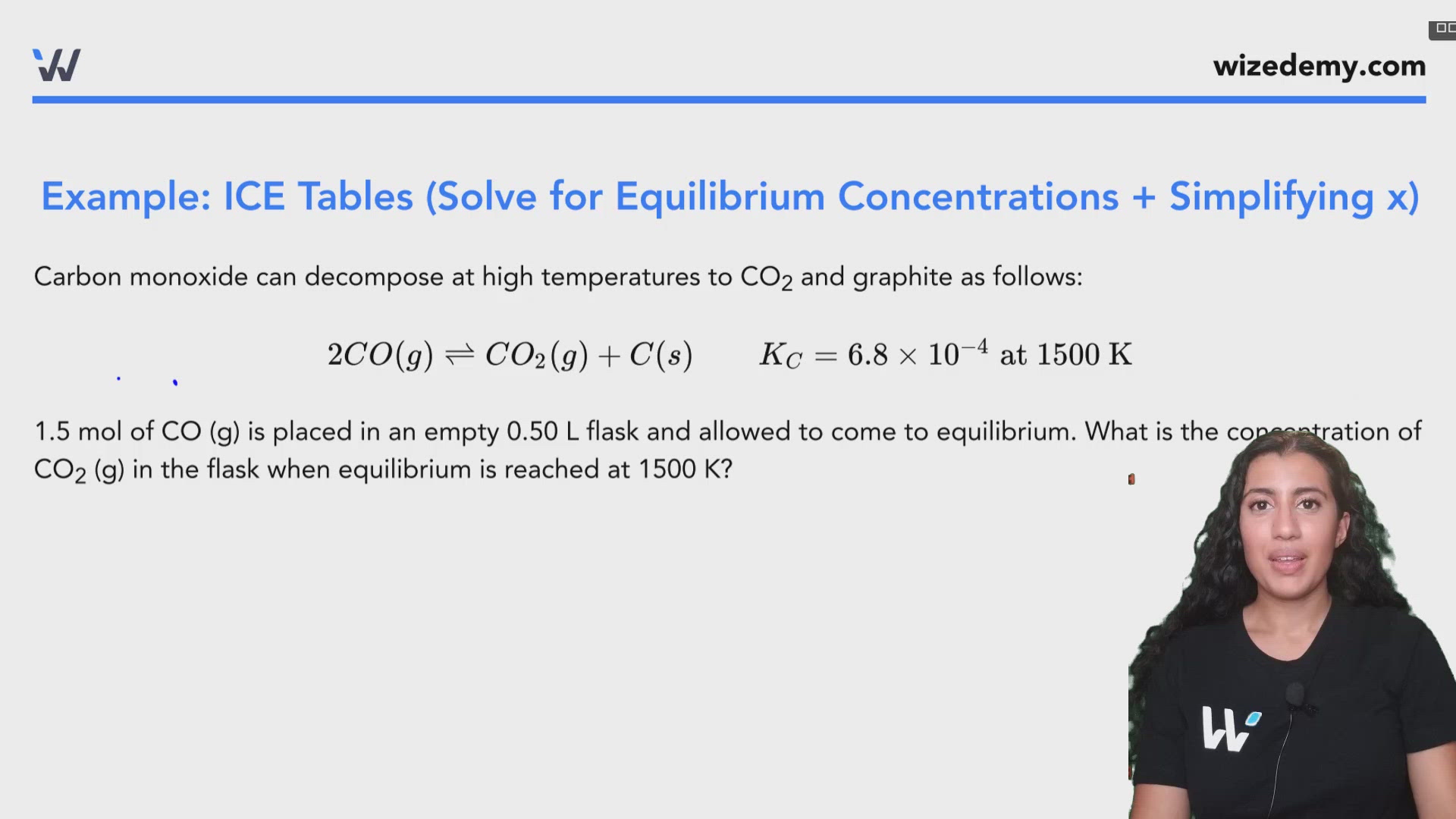
Example: ICE Tables (Solve for Equilibrium Concentrations + Simplifying x)
Carbon monoxide can decompose at high temperatures to CO2 and graphite as follows:
1.5 mol of CO (g) is placed in an empty 0.50 L flask and allowed to come to equilibrium. What is the concentration of CO2 (g) in the flask when equilibrium is reached at 1500 K?
We are given moles and a volume so we need to get concentration. Remember that solids do not appear in the equilibrium constant. Remember to take into account the stoichiometric coefficients. Let's set up the ICE table:
Now the equilibrium constant:
Wize Tip
There are a few different ways to check if we can simplify this:
"Small x" Approximation rule:
- If , then
- In other words, this means that the change in the initial concentration is small and it can be ignored. It won’t cause a significant change in the initial concentration.
Another rule we can use to simplify is:
- K=x2/(y-x)
- y/K > 400 then the assumption y -x ~ y can be made and we can ignore the "-x"
Justification:
- As long as the error is less than 5%, the approximate solution is considered valid. To see if the approximation is valid take:
Applying the small x approximation, means that 3.0-2x≈3.0, then:
0:00 / 0:00
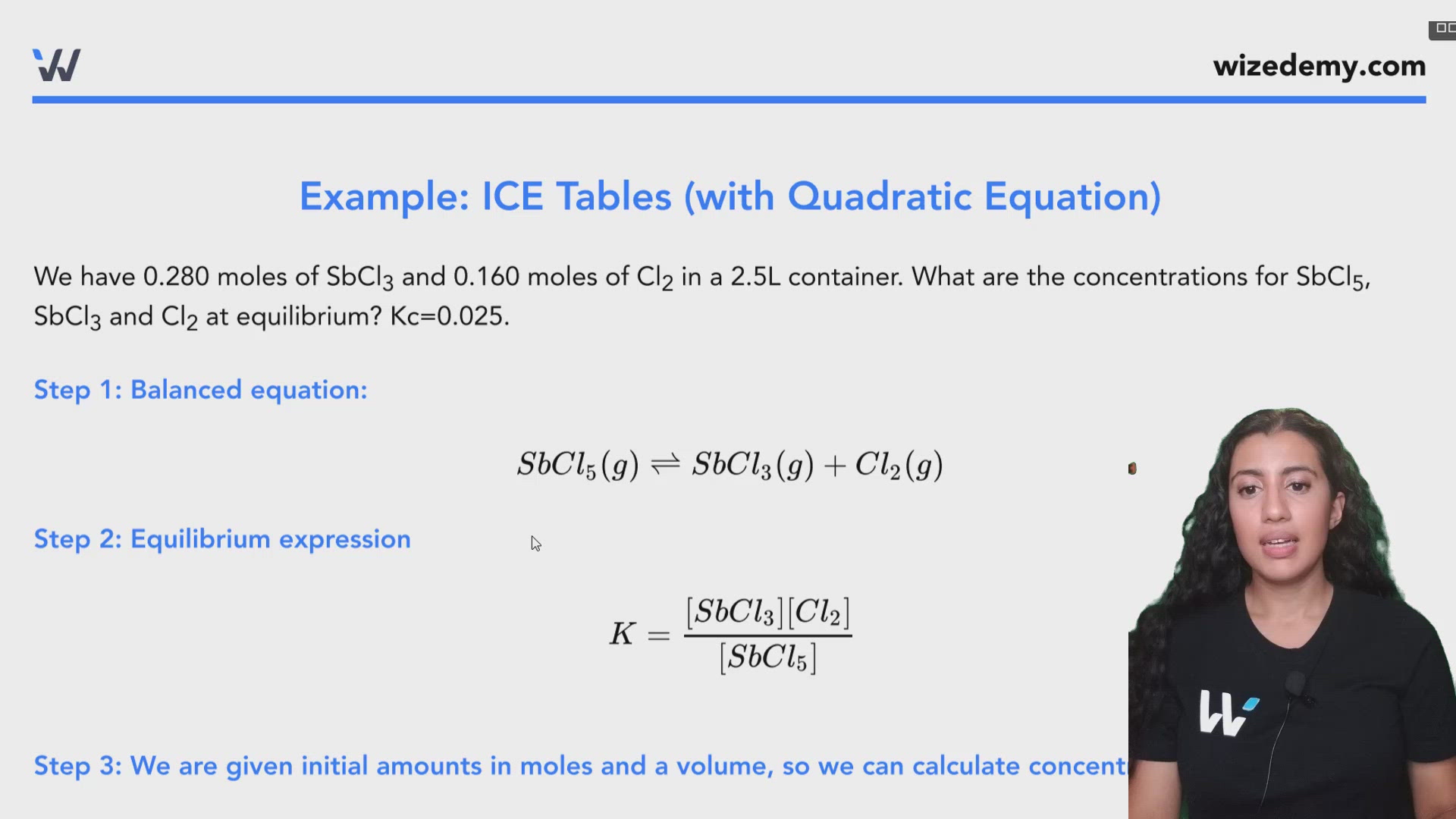
Example: ICE Tables (with Quadratic Equation)
We have 0.280 moles of SbCl3 and 0.160 moles of Cl2 in a 2.5L container. What are the concentrations for SbCl5, SbCl3 and Cl2 at equilibrium? Kc=0.025.
Step 1: Balanced equation
Step 2: Equilibrium expression
Step 3: We are given initial amounts in moles and a volume, so we can calculate concentration.
Recall: n = CV, so C = n/V (solve for initial concentrations and plug into table)

**Here we start with 0 reactants so the reaction will proceed to the left.
This is why there is a + sign for reactants and a – sign for products!
Step 4: The relative change is found from stoichiometry. Make sure the coefficients in the ’change’ line match the equation stoichiometry. Forgetting these coefficients is a common mistake on exams.
Step 5: Substitute the equilibrium line into the equilibrium expression and solve for x:
- Here you can check the assumption for: y1 = 0.11 and y2 = 0.064
- If we take y/K and we get >400 for both y1 and y2, then we don't have to use the quadratic equation and can ignore the " – x" parts!
- 0.11/0.025 = 4.4 < 400 so we must use the " – x" part
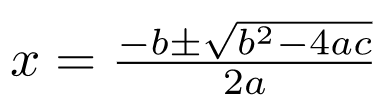
Here we will use the quadratic equation:
One of these x values does not make sense...why?
0.16 = x does not make sense.
If x = 0.16 M, then when solving for the equilibrium concentration of SbCl3, you would get:
[SbCl3] = 0.11 - x
= 0.11 - 0.16 = -0.05 M and a negative equilibrium concentration doesn't make any sense!
Therefore, we know the only possible value for x here is 0.046 M