0:00 / 0:00

Vector Spaces

A vector space VVconsists of:
  1. A non-empty set of objects called vectors
  2. Two operations that must satisfy 10 axioms (assumptions):
  3. vector addition (+)\left(+\right)
  4. scalar multiplication (  )(\ \cdot\ )
PAGE BREAK

Vector Space Axioms

The operations ++ and \cdot can be defined in any way as long as they satisfy the following:
  • Closure
  • u+v\vec u + \vec v must be in VV
  • kvk\cdot \vec v must be in VV
  • Associativity
  • (u+v)+w = u+(v+w)(\vec u + \vec v) + \vec w \ =\ \vec u + (\vec v + \vec w)
  • k(mv) = (km)vk\cdot(m\cdot\vec v) \ =\ (km)\cdot\vec v
  • Distributivity
  • k(u+v) = ku + kvk\cdot(\vec u + \vec v) \ =\ k\cdot\vec u \ +\ k\cdot \vec v
  • (k+m)v = kv + mv(k+m)\cdot\vec v \ =\ k\cdot \vec v \ +\ m\cdot\vec v
  • Commutativity
  • u+v= v+u\vec u + \vec v = \ \vec v + \vec u
And the space VV must contain:
  • Additive Identity
  • A zero vector 0\vec 0 such that: v+0 = 0+v = v\vec v + \vec 0 \ =\ \vec 0 + \vec v \ =\ \vec v
  • Additive Inverse
  • A negative vector v-\vec v such that: v+(v) = 0\vec v + (-\vec v)\ =\ \vec 0
  • Multiplicative Identity
  • 1v = v1\cdot\vec v \ =\ \vec v

PAGE BREAK

Real Vector Spaces

Vector spaces Rn\mathbb{R}^n use component-wise addition and scalar multiplication.

Example

R2:{x,y    x,yR}\mathbb{R}^2:\{\lang x,y \rang\;|\;x,y\in \mathbb{R}\} with:
  • u+v = u1,u2+v1,v2 = u1+v1,u2+v2\vec u + \vec v \ =\ \lang u_1,u_2\rang +\lang v_1,v_2\rang\ =\ \lang u_1+v_1,u_2+v_2\rang
  • kv = kv1,v2 = kv1,kv2k\cdot \vec v\ =\ k\cdot\lang v_1,v_2\rang\ =\ \lang kv_1,kv_2\rang
  • 0=0,0\vec{0} = \lang 0,0 \rang
  • v=v1,v2-\vec v=\lang -v_1,-v_2 \rang
Show that 0\vec 0 is the additive identity:
v+0=v1,v2+0,0=v1+0,v2+0=v1,v2=v\vec v + \vec 0 = \lang v_1,v_2\rang +\lang 0,0\rang = \lang v_1+0,v_2+0\rang =\lang v_1,v_2\rang =\vec v
Show that v- \vec v is the additive inverse:
v+(v)=v1,v2+v1,v2=v1+(v1), v2+(v2)=0,0=0\vec v + (-\vec v) = \lang v_1,v_2\rang +\lang -v_1,-v_2\rang =\lang v_1+( -v_1) ,\ v_2+(-v_2) \rang =\lang 0,0\rang =\vec 0

PAGE BREAK

Abstract Vector Spaces

Abstract vector spaces are vector spaces that satisfy the 10 axioms, but they do not behave like real vector spaces.
Example

V={x,y    x,yR+}V=\{\lang x,y \rang \;|\;x,y \in \mathbb{R}^+\} with operations:
  • u+v=u1,u2+v1,v2=u1v1,u2v2\vec u + \vec v = \lang u_1,u_2\rang + \lang v_1,v_2\rang=\lang u_1v_1,u_2v_2\rang
  • kv=kv1,v2=v1k,v2kk\cdot \vec v = k\cdot \lang v_1,v_2 \rang = \lang v_1^k,v_2^k \rang
  • 0=1,1\vec{0}= \lang 1,1 \rang
  • v=v1,v2=1v1,1v2-\vec v =-\lang v_1, v_2 \rang=\left \lang \dfrac{1}{v_1},\dfrac{1}{v_2}\right \rang
Show that 0\vec 0 is the additive identity:
v+0=v1,v2+1,1=v11, v21=v1,v2=v\vec v + \vec 0 = \lang v_1,v_2\rang +\lang 1,1\rang = \lang v_1\cdot1,\ v_2 \cdot 1\rang =\lang v_1,v_2\rang =\vec v
Show that v- \vec v is the additive inverse:
v+v=v1,v2+1v1,1v2=v11v1, v21v2=1,1=0\vec v + \lang -\vec v\rang =\lang v_1,v_2\rang + \left\lang \dfrac{1}{v_1},\dfrac{1}{v_2} \right\rang = \left\lang v_1\cdot\dfrac{1}{v_1},\ v_2\cdot\dfrac{1}{v_2}\right\rang =\lang 1,1\rang =\vec 0

Show that 11 is the multiplicative identity:
1v=1v1,v2=v11,v21=v1,v2=v1\cdot \vec v = 1\cdot \lang v_1, v_2 \rang= \lang {v_1}^1, {v_2}^1 \rang = \lang v_1, v_2 \rang = \vec v
0:00 / 0:00

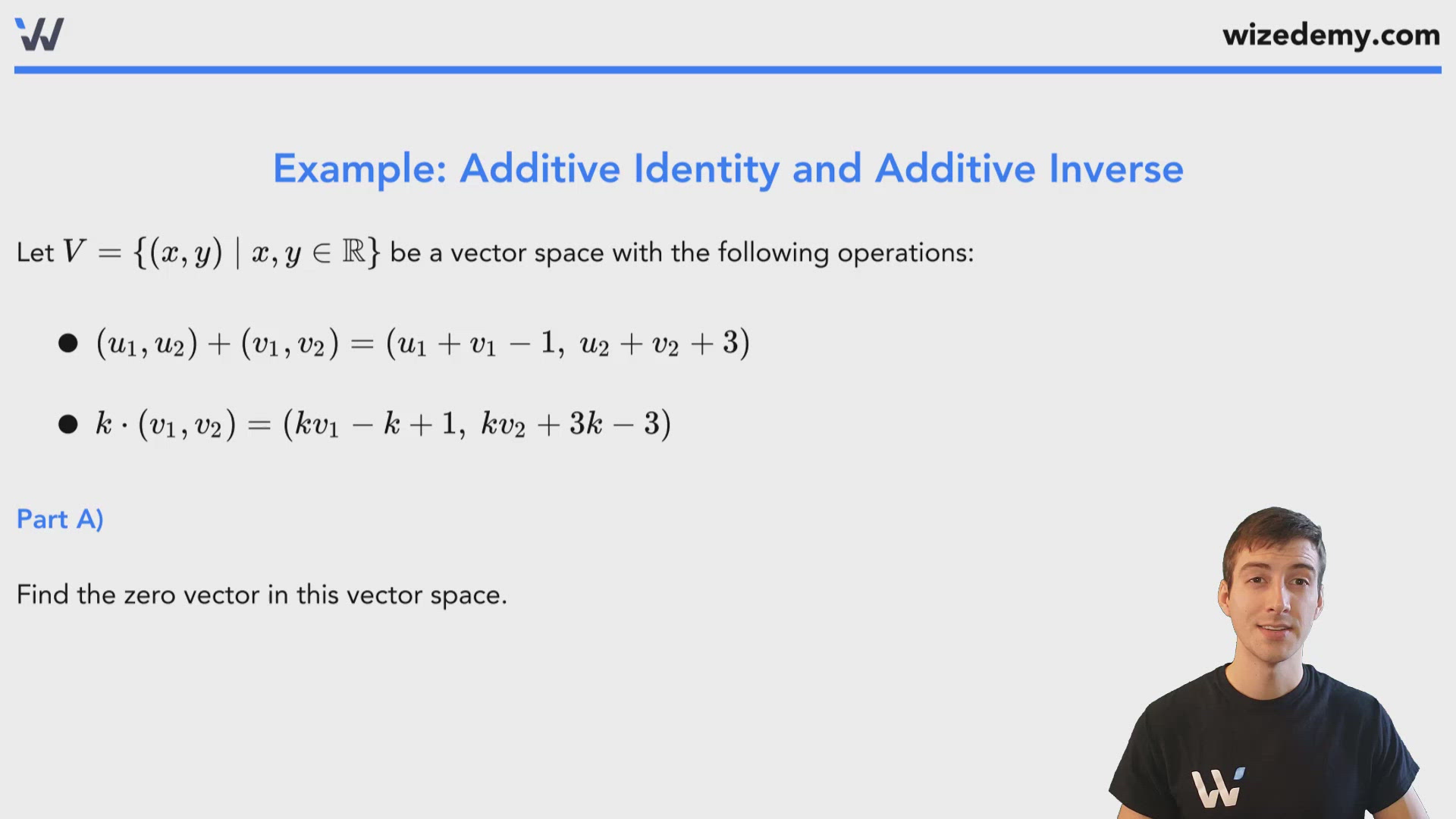
Example: Additive Identity and Additive Inverse

Let V={(x,y)    x,yR}V=\{(x,y)\;|\;x,y\in\mathbb{R}\} be a vector space with the following operations:
  • (u1,u2)+(v1,v2)=(u1+v11, u2+v2+3)(u_1,u_2)+(v_1,v_2)=(u_1+v_1-1,\ u_2+v_2+3)
  • k(v1,v2)=(kv1k+1, kv2+3k3)k\cdot(v_1,v_2)=(kv_1-k+1,\ kv_2+3k-3)

Part A)

Find the zero vector in this vector space.
We are looking for a vector (a1,a2)(a_1,a_2) that satisfies the following equation:
(v1,v2)+(a1,a2)=(v1,v2)(v_1,v_2)+(a_1,a_2)=(v_1,v_2)
Using the defined operation of vector addition we write this as:
(v1+a11,v2+a2+3)=(v1,v2)(v_1+a_1-1,v_2+a_2+3)=(v_1,v_2)
These vectors are equal if and only if:
v1+a11=v1    a1=1v_1+a_1-1=v_1 \implies a_1 = 1
v2+a2+3=v2    a2=3v_2+a_2+3=v_2 \implies a_2=-3
So in this vector space the zero vector is 0=(1,3)\boxed{\vec 0 = (1,-3)}.
PAGE BREAK

Part B)

Find the additive inverse, v-\vec v, of v=(v1,v2)\vec v=(v_1,v_2).
We are looking for a vector (a1,a2)(a_1,a_2) that satisfies the following equation (using the zero vector found in Part A):
v+(v)=0    (v1,v2)+(a1,a2)=(1,3)\vec v + (-\vec v) = \vec 0\implies (v_1,v_2)+(a_1,a_2)=(1,-3)
Using the defined operation of vector addition, we write this as:
(v1+a11, v2+a2+3)=(1,3)(v_1+a_1-1,\ v_2+a_2+3)=(1,-3)
These vectors are equal if and only if:
v1+a11=1    a1=2v1v_1+a_1-1=1 \implies a_1 = 2-v_1
v2+a2+3=3    a2=6v2v_2+a_2+3=-3 \implies a_2=-6-v_2
So in this vector space the additive inverse of v\vec v is:
(v1,v2)=(2v1,6v2)\boxed{-(v_1,v_2)=(2-v_1,-6-v_2)}
0:00 / 0:00

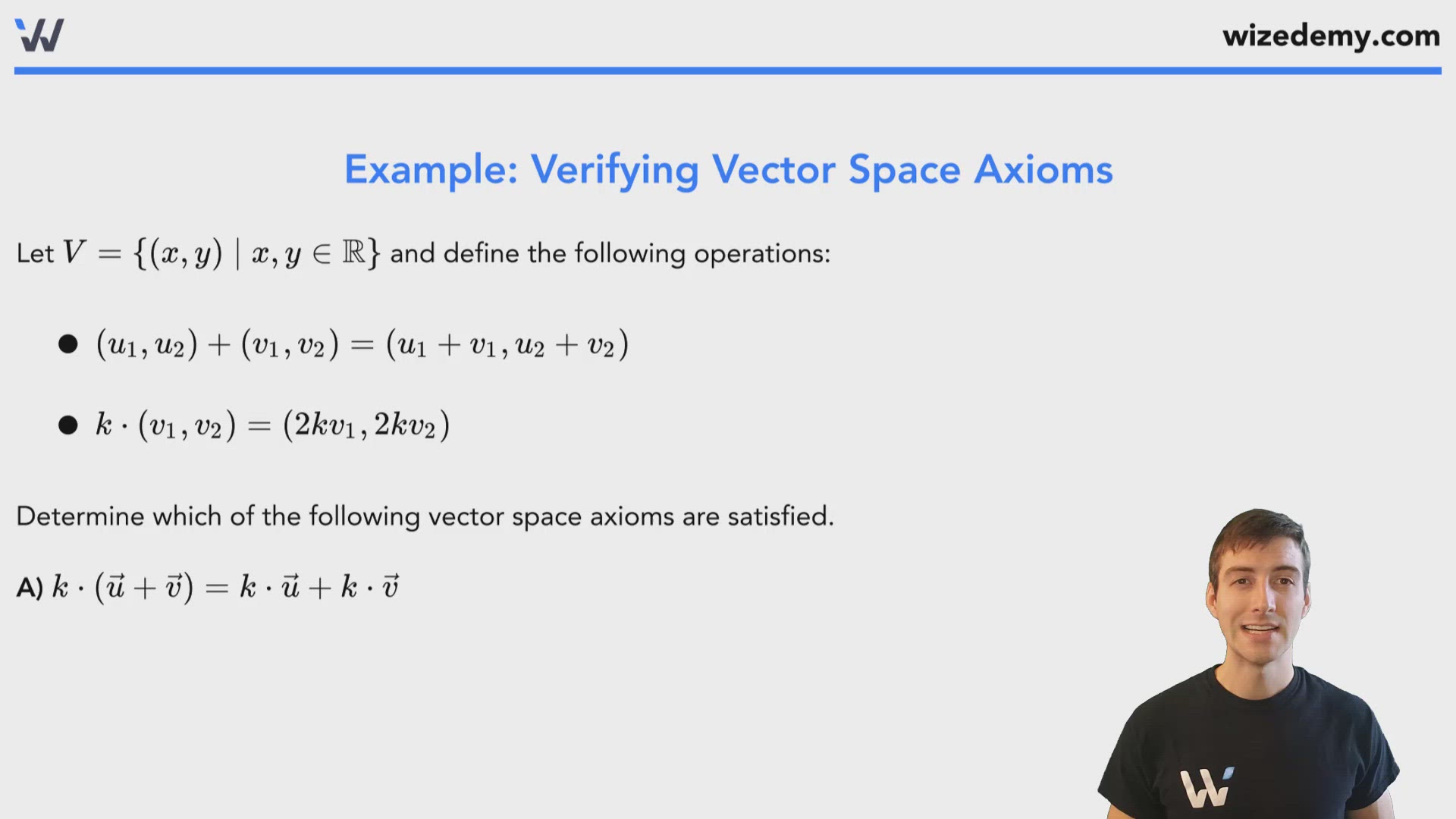
Example: Verifying Vector Space Axioms

Let V={(x,y)    x,yR}V=\{(x,y)\;|\;x,y\in\mathbb{R}\} and define the following operations:
  • (u1,u2)+(v1,v2)=(u1+v1,u2+v2)(u_1,u_2)+(v_1,v_2)=(u_1+v_1,u_2+v_2)
  • k(v1,v2)=(2kv1,2kv2)k\cdot(v_1,v_2)=(2kv_1,2kv_2)
Determine which of the following vector space axioms are satisfied.
A) k(u+v)=ku+kvk\cdot(\vec u + \vec v) = k\cdot\vec u + k\cdot\vec v
Let u=(u1,u2)\vec u = (u_1,u_2) and v=(v1,v2)\vec v = (v_1,v_2), then:
k(u+v)=k((u1,u2)+(v1,v2))=k(u1+v2,u2+v2)=(2k(u1+v1),2k(u2+v2))k\cdot(\vec u + \vec v) = k\cdot((u_1,u_2)+(v_1,v_2)) = k\cdot(u_1+v_2,u_2+v_2) = \colorOne{(2k(u_1+v_1),2k(u_2+v_2))}
Meanwhile:
ku+kv=k(u1,u2)+k(v1,v2)=(2ku1,2ku2)+(2kv1,2kv2)=(2ku1+2kv1,2ku2+2kv2)k\cdot\vec u + k\cdot \vec v = k\cdot(u_1,u_2)+k\cdot(v_1,v_2)=(2ku_1,2ku_2)+(2kv_1,2kv_2)=\colorThree{(2ku_1+2kv_1,2ku_2+2kv_2)}
Since (2k(u1+v1),2k(u2+v2))=(2ku1+2kv1,2ku2+2kv2)\colorOne{(2k(u_1+v_1),2k(u_2+v_2))} = \colorThree{(2ku_1+2kv_1,2ku_2+2kv_2)}, this axiom is satisfied.
B) (k+m)v=kv+mv(k+m)\cdot\vec v = k\cdot\vec v + m\cdot\vec v
(k+m)v=(k+m)(v1,v2)=(2(k+m)v1,2(k+m)v2)(k+m)\cdot\vec v = (k+m)\cdot(v_1,v_2) = \colorOne{(2(k+m)v_1,2(k+m)v_2)}
Meanwhile:
kv+mv=(2kv1,2kv2)+(2mv1,2mv2)=(2kv1+2mv1,2kv2+2mv2)k\cdot\vec v + m\cdot\vec v = (2kv_1,2kv_2)+(2mv_1,2mv_2)=\colorThree{(2kv_1+2mv_1,2kv_2+2mv_2)}
Since (2(k+m)v1,2(k+m)v2)=(2kv1+2mv1,2kv2+2mv2)\colorOne{(2(k+m)v_1,2(k+m)v_2)}=\colorThree{(2kv_1+2mv_1,2kv_2+2mv_2)}, this axiom is satisfied.
C) k(mv)=(km)vk\cdot(m\cdot\vec v) = (km)\cdot\vec v
k(mv)=k(m(v1,v2))=k(2mv1,2mv2)=(2k(2mv1),2k(2mv2))=(4kmv1,4kmv2)k\cdot(m\cdot\vec v) = k\cdot(m\cdot(v_1,v_2)) =k\cdot(2mv_1,2mv_2) = (2k(2mv_1),2k(2mv_2)) = \colorOne{(4kmv_1,4kmv_2)}
Meanwhile:
(km)v=(km)(v1,v2)=(2kmv1,2kmv2)(km)\cdot\vec v = (km)\cdot(v_1,v_2)=\colorThree{(2kmv_1,2kmv_2)}
Since(4kmv1,4kmv2)(2kmv1,2kmv2)\colorOne{(4kmv_1,4kmv_2)} \textcolor{red}{\neq}\colorThree{(2kmv_1,2kmv_2)}, this axiom is not satisfied.

Practice: Verifying Vector Space Axioms

Let V={(x,y)    x,yR}V=\{(x,y)\;|\;x,y\in\mathbb{R}\} and define the following operations:
  • (u1,u2)+(v1,v2)=(u1+v1+1, u2+v2+1)(u_1,u_2)+(v_1,v_2)=(u_1+v_1+1,\ u_2+v_2+1)
  • k(v1,v2)=(kv1,kv2)k\cdot(v_1,v_2)=(kv_1,kv_2)
Determine which of the following vector space axioms, if any, are satisfied. [Select all that apply]

Practice: Finding the Additive Identity and Additive Inverse

Let W={x,y,z    x,y>0,zR}W=\{\lang x,y,z \rang\;|\;x,y>0,z\in\mathbb{R}\} with the following operations:
  • u1,u2,u3+v1,v2,v3=u1v1, u2v2, u3+v3\lang u_1,u_2,u_3 \rang+\lang v_1,v_2,v_3 \rang=\lang u_1v_1,\ u_2v_2,\ u_3+v_3\rang
  • kv1,v2,v3=v1k,v2k,kv3k\cdot\lang v_1,v_2,v_3\rang=\lang v_1^k,v_2^k,kv_3 \rang
Find the zero vector, 0W\vec 0 \in W.
Extra Practice